Who will win the FA Cup? Favorites, form, and what to watch
Will Man City retain the FA Cup? Or will this be another year of the underdog? Here's our take.
Soccer
By OG.com Staff

The FA Cup, or Football Association Challenge Cup to give it its proper name, is the oldest and arguably most famous domestic soccer tournament in the world.
In this article, we’re exploring how it works, which teams dominate and who will win the FA Cup this season.
This article is for informational purposes only and should not be construed as financial or investment advice. Past performance does not guarantee future results.
How the FA Cup works
The FA Cup is a knockout competition, with preliminary rounds where lower ranked teams compete against each other. At the third round ‘proper’, higher ranked teams enter and may be drawn to play teams that made it through the preliminary rounds.
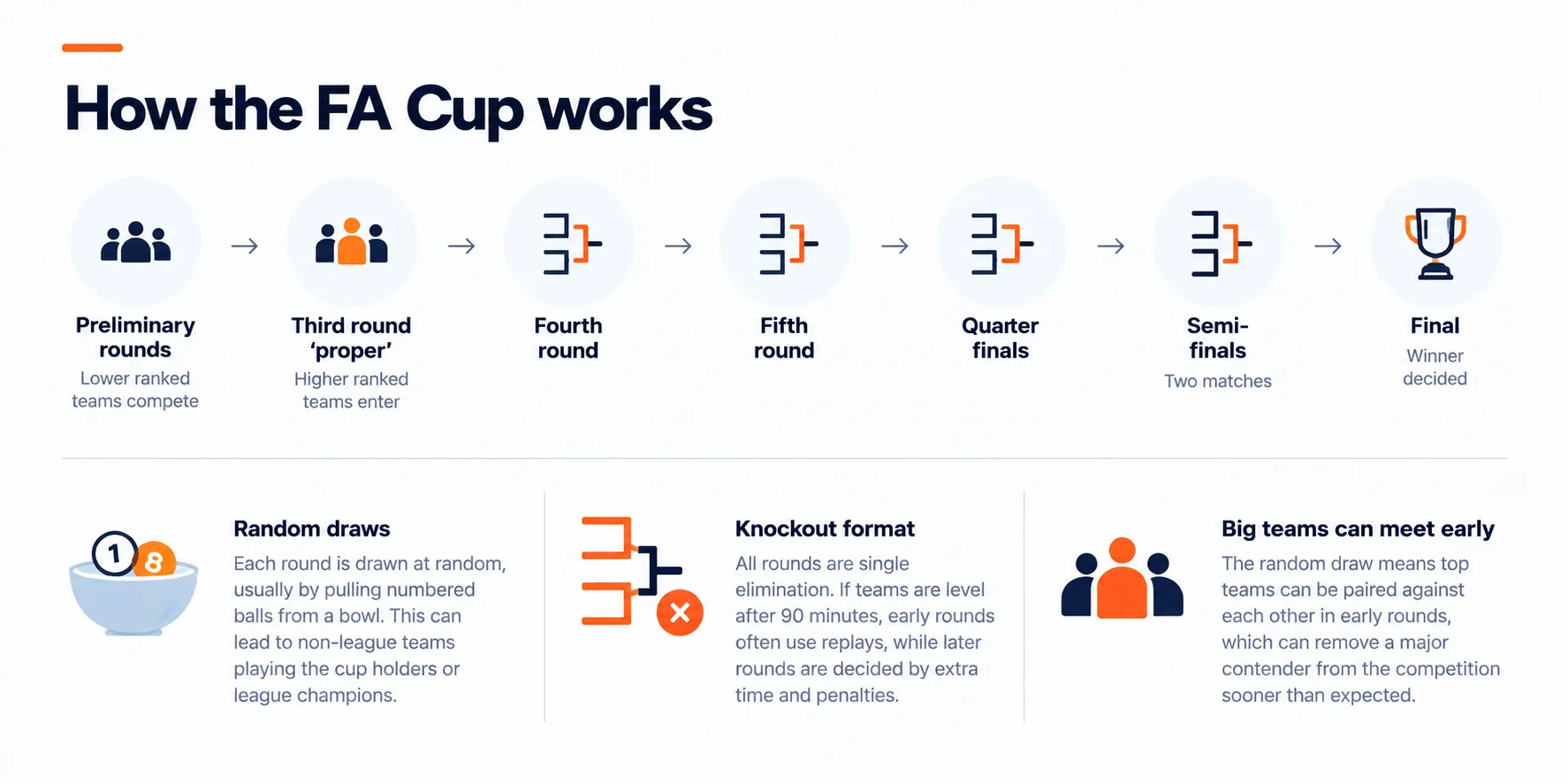
There is a fourth round, fifth round, quarter final round, two semi-finals and then the final, where the winner is decided.
The draw for each round is random, often made by pulling numbered balls from a bowl, meaning non-league teams can play against the cup holders or league champions. This also means that top teams can be drawn against one another early on in the tournament, effectively removing one strong contender from the competition early.
All rounds are knock-out, with ties decided by replays in the early rounds, then extra time and penalties in the later rounds.
Who are the favorites this season?
The favorites are usually concentrated among the Premier League’s top teams, including Arsenal, Chelsea, Manchester City, Manchester United and Liverpool.
This doesn’t mean the top Premier League teams always win, but given that the FA Cup provides a path to European competitions, the top teams in England are always fancied to win the FA Cup.
Manchester City are the current FA Cup holders and have made it to the final for the past four years. Although with a new manager after the departure of the iconic Pep Guardiola, it’s tough to say if they’ll continue their impressive form.
The FA Cup favorites will change as the league season and FA Cup progress. It can often be influenced by how well a team is doing in other competitions. For example, if a top team is struggling in the league, they may decide to put all their efforts into winning the FA Cup in order to secure some silverware.
Look for teams who traditionally finish in the top six of the Premier League that are in a lower than expected position in the league. Oftentimes these teams will prioritize winning the FA Cup.
However, one of the big reasons soccer fans around the world love the FA Cup is that it’s a great opportunity for smaller clubs to pick up silverware.
A particularly popular feature of the FA Cup is that big, successful teams regularly win the FA Cup after being eliminated in the early rounds, either due to losing unexpectedly to a lower ranked team, or from having lost to an equally ranked side.
Team form and recent results that matter
Because FA Cup ties are spaced out across the season, league form is less influential on cup performance. However, sometimes a cup win can be a catalyst for an improvement in league form. And in some instances, an FA Cup win can be the start of a strong run of form that continues to the next round.
Teams that are playing in multiple competitions simultaneously, for example teams that have progressed in the League Cup (currently called the Carabao Cup for sponsorship reasons), European competitions such as the Europa League or Champions League, plus the domestic league competition, may struggle to fire on all cylinders.
Fixture congestion can have an impact too, with ties having to be rescheduled or played close to other important games.
Explore Premier League 26/27 predictions
- Liverpool 26/27 prediction
- Manchester City 26/27 prediction
- Arsenal 26/27 prediction
- Manchester United 26/27 prediction
- Chelsea 26/27 prediction
- Aston Villa 26/27 prediction
Key players and managers who could decide it
An FA Cup win can be a great way for a head coach new to a club to make a splash. And this season, there are a record nine clubs with new head coaches, including Manchester City, Liverpool and Chelsea.
Some coaches starting out with new clubs have Premier League and FA Cup pedigree, notably Nottingham Forest’s Oliver Glasner, who won the FA Cup with Crystal Palace in the 2024-2025 season.
Enzo Maresca at Manchester City may not fancy his chances of beating Arsenal to the Premier League title this season, but the FA Cup would be a great way for him to add some silverware of his own to the Manchester City trophy cabinet.
Of the players eligible to play in the FA Cup this season, Erling Haaland of Manchester CIty, Bruno Fernandes of Manchester United, Phil Foden of Manchester City and Joao Pedro of Chelsea, formerly of Brighton and Hove Albion are the highest scorers from the Premier League.
Players from lower leagues, including Wrexham’s Paul Mullin, Stockport County’s Kyle Wootton, Derby County’s Sammie Szmodics and Luke Leahy of Wycombe Wanderers also rank highly in the scoring table, but this is a function of them having played in more of the earlier rounds, arguably against significantly weaker opposition.
Given the prevalence of penalty shootouts in the FA Cup and the drama that comes with them, goalkeepers are often strongly associated with FA Cup success. Lucas Perri of Leeds United was the shootout hero in the FA Cup quarter final of 2025-2026, saving two West Ham United penalties in the shootout.
Crystal Palace’s Dean Henderson, while not through a penalty shootout, put in an astounding performance when Palace lifted the trophy, making a number of crucial saves to keep the score at 1-0 as Manchester City pushed for an equalizer.
Historical FA Cup pedigree
Arsenal have won the most FA Cups of all time, with 14. Manchester United are second with 13. Of recent Manchester times, Manchester City have lifted the trophy in three of the last 10 years, most recently in 2025-2026.
Historically, Chelsea, Tottenham Hotspur, Liverpool, Aston Villa, Blackburn Rovers, Newcastle United and Everton have performed well, each winning the competition at least five times.
Can an underdog win the FA Cup?
Yes, but it’s rare for a true underdog to win it. The last time a team from outside the top flight of English soccer won the FA Cup was 1980, when West Ham United beat Arsenal 1-0.
When Wigan Athletic won the FA Cup in 2013, they were in the Premier League, but finished the season 18th and were relegated. Other unexpected wins include Crystal Palace’s first and to date only FA Cup win in 2025, a season in which they finished 12th.
Portsmouth won the FA Cup in 2008 and were considered an underdog due to their size and resources, but at the time they were a Premier League team, finishing eighth that season. Another caveat to that story is that they beat Cardiff City in the final, who were in the league below and even more of an underdog.
The last non Premier League team to reach the FA Cup final before Cardiff City was Millwall, who lost 3-0 to Manchester United in 2004.
Technically speaking Arsenal and Manchester United, despite their pedigree in both league and cup, won while finishing eighth in 2020 and 2024 respectively, but that was more of a league blip.
What winning means for Champions League qualification
Winning the FA Cup does not qualify a team for the Champions League, but that doesn’t necessarily mean the FA Cup winners won’t qualify for the Champions League. Winning the FA Cup automatically qualifies a team for the Europa League tournament.
However, if the FA Cup winner finishes in the Premier League’s top four, they qualify for the Champions League instead. Their Europa League place then passes to a lower-ranked team, typically sixth or seventh, depending on other European qualification routes.
How much prize money does the winner get?
According to the Football Association, the FA Cup winner receives $2.8 million in prize money. While this is a lot of money to most teams, considering most FA Cup winners are Premier League teams, it pales into insignificance compared to what teams win for their league finish.
In the 2024-2025 season, Southampton, the team finishing bottom of the Premier League that season, won $143 million. FA Cup winner prize money is worth approximately 2% of finishing last in the Premier League. This is mainly due to the original prize fund, which is based on television rights.
Bracket, fixtures, and path to the final
The FA Cup is a knock-out tournament with 14 rounds and it takes place concurrently with the domestic soccer season in England and Wales. Any club playing in or above Level 9 of English soccer, provided they meet stadium eligibility requirements, can apply to enter. All professional clubs in the top four leagues of English soccer are automatically eligible.
The tournament technically starts in August, often before the start of the traditional soccer season, with extra-preliminary rounds for the lowest ranked clubs. Then follows a preliminary round, first through fourth rounds, with teams of higher ranking joining at various stages.
This stage allows the lowest ranked teams to compete against each other for advancement. Once these preliminary rounds are complete, the competition moves onto what’s called the ‘competition proper’, starting back at the first round.
Round 3 of the ‘competition proper’ is where teams in the top two leagues of English soccer join. The FA Cup third round is a well-loved feature of English soccer because fixtures are drawn at random, meaning very small, often non-professional teams can be drawn to play against the biggest teams in the country.
FAQs about who will win the FA Cup
Does the FA Cup have replays?
No. Replays were removed from the first round onwards in the 2024–25 season to reduce fixture congestion. Drawn matches now go to extra time and, if needed, penalties.
What are some FA Cup clichés?
Common FA Cup phrases include “in the hat” for reaching the next round, “plucky minnows” for lower-ranked teams performing well and “giant-killing” when an underdog beats a much stronger side. A “potential banana skin” is a match in which the favourite risks an upset, while the “magic of the FA Cup” describes the competition’s unusual settings, unlikely heroes and surprise results. Learn more about soccer slang.
Important information: Prediction is an event contract that is a derivatives product offered by North American Derivatives Exchange, Inc. (NADEX), a CFTC-regulated exchange, which does business under the brand OG.com Prediction Markets (OG). Crypto.com | Derivatives North America uses a CFTC-regulated exchange that uses OG.com technology.
Trading on OG.com involves risk and may not be appropriate for all. By trading you risk losing your cost to enter any transaction, including fees. You should carefully consider whether trading on OG.com is appropriate for you in light of your investment experience and financial resources. Any trading decisions you make are solely your responsibility and at your own risk.