Chelsea predictions: Where will Chelsea finish in the 26/27 Premier League?
Chelsea have the attacking talent to become serious Premier League contenders under Xabi Alonso, but turning an exciting young side into one capable of controlling games may decide how high the Blues can climb.
Soccer
By Chris Old
Chelsea are not struggling to score.
Cole Palmer, Morgan Rogers and João Pedro give Xabi Alonso three attackers who can create, carry the ball and finish themselves.
Pedro Neto adds direct running from wider areas, while Chelsea's considerable summer investment has strengthened a squad that finished only 10th last season.
The early evidence has shown how dangerous that combination can be. Chelsea scored three at Fulham and four against Brighton, with Alonso's side particularly impressive when they can break quickly into space.
Palmer looks refreshed after an injury-hit campaign, Rogers has made an immediate impact and João Pedro continues to score.
At the other end, the picture is much less comfortable.
Chelsea conceded twice against Fulham and another three against Brighton. They led Brighton 3–0 after 32 minutes but allowed the game to become open enough that their opponents repeatedly found space and eventually pulled back to 3–2 before Chelsea restored their two-goal cushion.
That contrast may define their season.
Chelsea have enough attacking talent to hurt almost anybody. Alonso's bigger task is making sure everybody understands their responsibilities when the ball is lost, when the shape changes and when a game needs controlling rather than accelerating again.
This article is for informational purposes only and should not be construed as financial or investment advice. Past performance does not guarantee future results.
Chelsea 26/27 season overview
Chelsea entered 2026/27 needing a substantial rebound.
The Blues finished 10th last season with 52 points, winning 14, drawing 10 and losing 14. They scored 58 Premier League goals and conceded 52, finishing 33 points behind champion Arsenal.
Alonso was appointed to change that trajectory.
His arrival was followed by another major recruitment drive. Morgan Rogers joined from Aston Villa after establishing himself as one of the Premier League's most productive young attackers, while Maxence Lacroix strengthened the center-back options.
Chelsea have subsequently addressed another longstanding concern by signing Emiliano Martínez from Aston Villa. The Argentina goalkeeper went straight into Alonso's starting XI against Brighton and produced several important saves even as Chelsea conceded three.
The attacking picture is already much clearer.
Palmer and Rogers can operate either side of João Pedro in Alonso's 3-4-2-1, but none of the three is restricted to one position. João Pedro can drop away from the center backs, Rogers can carry possession through midfield and Palmer can drift into whichever pocket offers the best route toward goal.
That flexibility has made Chelsea difficult to contain. It has not yet made them difficult enough to score against.
Where will Chelsea finish in the 26/27 Premier League?
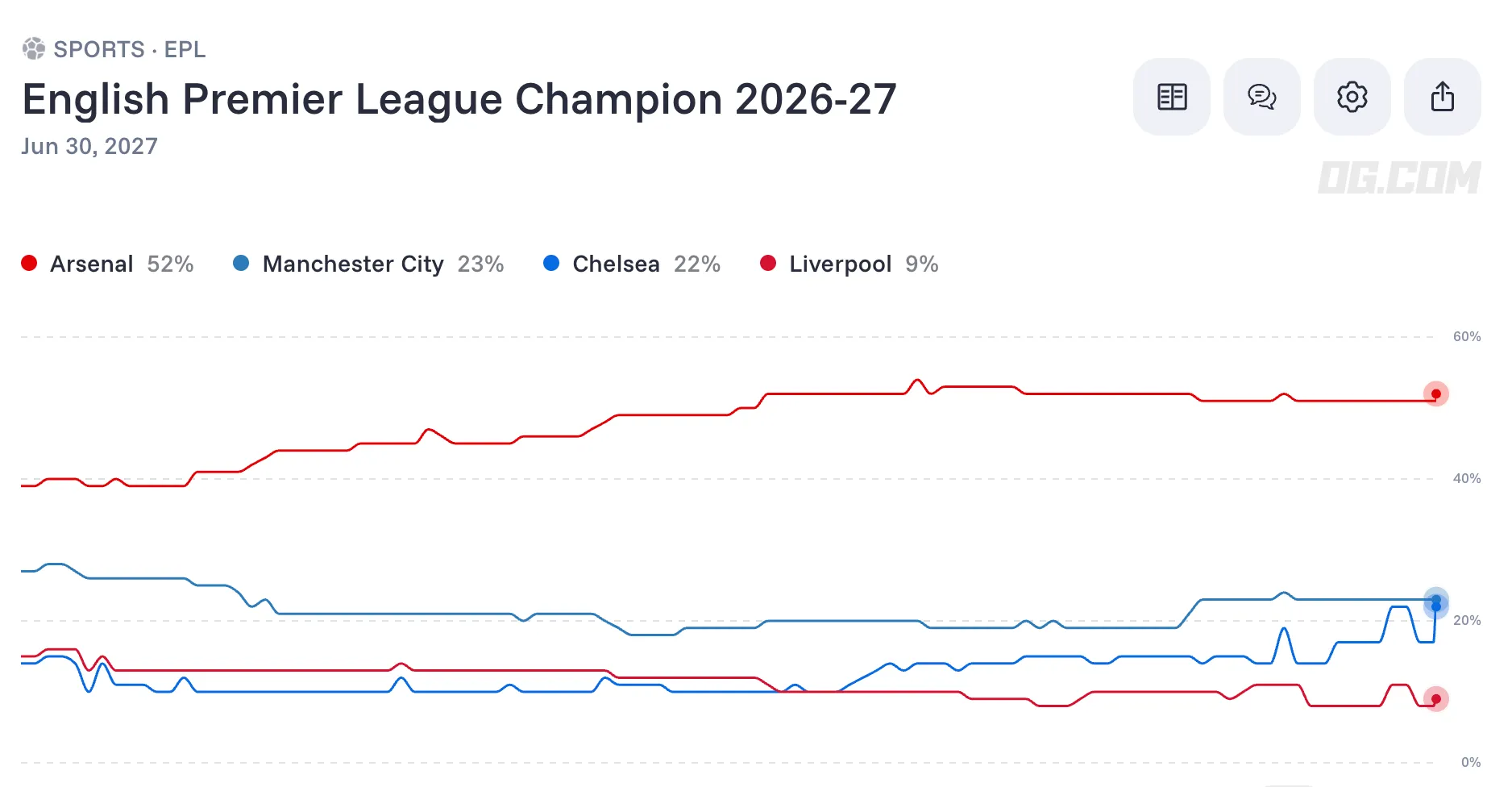
Prediction markets for English Premier League champion currently make Chelsea one of the leading challengers behind Arsenal .
Chelsea’s 22% market-implied probability puts them almost level with Manchester City, and suggests finishingthird is the most likely outcome for Chelsea this season.
Market data as of August 31. For the latest market-implied probability, check the OG app.
That is a significant position for a team that finished 10th last season, but the squad gives prediction markets plenty to work with. Palmer, Rogers and João Pedro provide multiple sources of goals and creativity, Alonso has strengthened the defense and Chelsea have no European campaign competing for preparation and recovery time.
The uncertainty lies at the other end.
Chelsea have already shown how quickly their attacking freedom can leave them exposed when possession changes hands. Alonso has talented individual defenders, but the collective responsibilities around them are not yet automatic: who steps out, who covers the wingback, who protects the center and when Chelsea should press rather than recover into shape.
At 22%, Chelsea should be discussed as genuine title contenders. Whether they can turn that attacking quality into the defensive control required over 38 games is the bigger question.
Alonso has made Chelsea more dangerous in transition
Chelsea do not necessarily need to dominate possession to dominate attacking moments.
That already distinguishes Alonso's approach from some of Chelsea's recent teams.
Against Brighton, Chelsea were happy at times to attack quickly rather than endlessly recycle possession. Rogers can carry the ball through pressure, Neto provides speed outside him and Palmer is particularly dangerous when receiving before a defense has completely reset.
Alonso has been clear that possession percentage itself is not the objective. He wants Chelsea to recognize what the game requires and adapt accordingly.
That suits the squad. The challenge comes when those attacks break down.
Committing wingbacks and attacking midfielders forward creates space behind them. Chelsea need the players remaining deeper to know precisely who protects that space and when.
Palmer, Rogers and João Pedro give Chelsea a serious front three
This is the most compelling reason for optimism.
Palmer remains the player capable of deciding games with one action, but Chelsea are no longer asking him to provide almost everything creative.
Rogers changes that.
His ability to run with the ball gives opponents another player to stop between midfield and defense, while João Pedro can either occupy the center backs or move away from them and create space for Palmer and Rogers to attack.
All three scored against Fulham. Against Brighton, João Pedro and Palmer scored again while Rogers created Neto's goal.
That variety is important. Opponents can double up on Palmer. It becomes much harder when doing so gives Rogers room to carry the ball or João Pedro space closer to goal.
Emiliano Martínez addresses one problem, not the whole defense
Martínez immediately improves Chelsea's experience in goal.
He has played in major international and club games, commands his penalty area and showed on debut that he can make saves when Chelsea's defensive structure is breached.
But changing goalkeeper cannot solve everything.
Brighton repeatedly found space during the second half despite Martínez making several saves. Chelsea's problems were structural as much as individual: the game became stretched and the distances between the attacking players, midfield and back three became increasingly difficult to manage.
That places responsibility on the entire team rather than simply the defenders.
Martínez can stop shots. Alonso needs Chelsea to concede fewer good ones.
Maxence Lacroix gives Alonso the right defensive profile
Lacroix is an important addition.
His recovery pace is valuable for a team intending to defend high up the field, particularly when the wingbacks have moved forward and Chelsea need their center backs to defend larger spaces.
But the defensive improvement cannot depend on Lacroix continually rescuing those situations.
If one center back steps forward, somebody has to cover behind him. If a wingback presses, the nearest midfielder has to recognize the space being vacated. When Chelsea lose possession centrally, the players closest to the ball have to know whether to counterpress or recover into shape.
Those responsibilities need to become automatic.
That is the difference between having good defenders and having a good defense.
Can Alonso turn attacking freedom into defensive clarity?
This is the biggest one.
Chelsea's attacking movement works partly because players are given freedom.
Palmer drifts. Rogers carries the ball from different starting positions. João Pedro drops off the front. The wingbacks advance.
That unpredictability creates problems for opponents. It can create problems for Chelsea too.
When possession changes hands, somebody has to know who is protecting the center, who is covering the wide channel and who engages the player with the ball.
Against Brighton, Chelsea showed both extremes. They were outstanding while building a 3–0 lead, then allowed the game to become far too open and needed Martínez to make saves before Palmer gave them breathing room again.
Alonso does not need to make Chelsea less adventurous. He needs to make the defensive responsibilities surrounding that adventure much clearer.
Can Chelsea learn to control games they are already winning?
This was a weakness before Alonso arrived.
Chelsea dropped 17 points from winning positions at home last season, more than any other Premier League team.
The Brighton game showed why that remains relevant.
Going 3–0 ahead should allow a strong team to dictate what happens next. Chelsea instead became increasingly reactive as Brighton found routes back into the contest.
Alonso admitted afterwards that his side began playing too much according to the score rather than continuing to impose themselves.
Game management does not mean sitting everybody behind the ball.
Sometimes it means keeping possession for two minutes. Sometimes it means killing a counterattack early. Sometimes it means recognizing that both wingbacks do not need to attack simultaneously.
Chelsea need to become better at making those decisions collectively.
How important is Moisés Caicedo to the balance?
Chelsea's attacking depth is obvious.
The defensive midfield balance may depend much more heavily on Caicedo.
He missed the opening league game and only returned from injury as a substitute against Brighton. In his absence, Alonso has had to experiment with different midfield combinations and even use Malo Gusto centrally.
A fully fit Caicedo gives Chelsea a midfielder capable of covering ground, recovering possession and protecting the defense when other players move forward.
For a team with this many attacking instincts, that could be particularly important.
Does no European soccer give Chelsea an advantage?
Potentially a significant one.
Alonso is teaching new movements to a squad that has undergone another summer of change.
He now gets far more uninterrupted training time than managers balancing Premier League games with European competition.
That allows Chelsea to work repeatedly on exactly the areas still causing problems: distances between the lines, defensive transitions, the positioning of the wingbacks and how the back three responds when one defender steps forward.
For an established team, those extra sessions may be useful.
For a developing one, they could be transformative.
What could move Chelsea's odds during the season?
Chelsea's defense may tell us more than their attack.
We already know Palmer, Rogers and João Pedro can create chances. The bigger evidence will come from whether Chelsea start giving opponents fewer routes back into games.
Caicedo's fitness should help, as should Martínez settling behind a more established back three. Lacroix's pace gives Alonso greater freedom to defend higher, but the organization around him has to improve at the same time.
The absence of European competition could become increasingly important as Alonso gets more time on the training field.
And then there is the simplest measure of all: points.
Chelsea finished 10th last season.
They do not need perfection to improve dramatically.
But going from an entertaining team with considerable attacking talent to a genuine title contender requires another step.
Alonso's Chelsea already look capable of scoring enough goals.
Now they have to learn how to stop games becoming quite so wild.
Important information
Prediction is an event contract that is a derivatives product offered by North American Derivatives Exchange, Inc. (NADEX), a CFTC-regulated exchange, which does business under the brand OG.com Prediction Markets (OG). Crypto.com | Derivatives North America uses a CFTC-regulated exchange that uses OG.com technology.
Trading on OG.com involves risk and may not be appropriate for all. By trading you risk losing your cost to enter any transaction, including fees. You should carefully consider whether trading on OG.com is appropriate for you in light of your investment experience and financial resources. Any trading decisions you make are solely your responsibility and at your own risk.