Manchester City predictions: Where will Man City finish in the 26/27 Premier League?
Manchester City remain Arsenal's closest challenger in prediction markets, with Erling Haaland leading a new-look side adapting to Enzo Maresca after one of the biggest midfield rebuilds of the club's modern era.
Soccer
By Chris Old
Manchester City spent a decade knowing exactly what they were.
Pep Guardiola was the manager. Rodri dictated the midfield. Bernardo Silva found space where other players could barely see it. Around them sat a squad built and rebuilt to play a very particular kind of soccer.
All three are gone.
Enzo Maresca has inherited the job of preserving City's place among the Premier League elite without simply trying to recreate Guardiola's team. Elliot Anderson has arrived for a British-record fee, 18-year-old Ayyoub Bouaddi has joined after emerging as one of Europe's most highly rated young midfielders, and Brazilian winger Allan Elias adds another new option in attack.
There are still some extremely familiar reasons to expect City near the top.
Erling Haaland remains the focal point. Phil Foden and Rayan Cherki provide creativity behind him. Joško Gvardiol and Marc Guéhi form part of a strong defensive group, while Antoine Semenyo gives Maresca another direct attacking threat.
The early signs have shown both sides of the transition. City needed two late goals to beat Bournemouth in Maresca's first Premier League game before producing a much more convincing attacking performance in a 4–1 win at Crystal Palace. Cherki and Haaland scored twice each at Palace, with the Frenchman increasingly looking capable of becoming one of the defining players of the new era.
Manchester City still have one of the strongest squads in England.
The question is whether they can become a great team again quickly enough to catch Arsenal.
This article is for informational purposes only and should not be construed as financial or investment advice. Past performance does not guarantee future results.
Manchester City 26/27 season overview
City finished second in the 2025/26 Premier League with 78 points, seven behind Arsenal.
They still scored a league-high 77 goals and completed a domestic cup double, beating Arsenal in the Carabao Cup final before overcoming Chelsea in the FA Cup final.
Haaland remained the most reliable part of the operation. He scored 27 Premier League goals to claim his third Golden Boot in four seasons and finished with 38 goals across all competitions.
Then the Guardiola era ended.
Maresca returned to Manchester on a three-year deal after previously coaching City's Elite Development Squad and working on Guardiola's senior staff during the Treble-winning 2022/23 season.
Familiarity helps; it does not make this a continuation of the same project.
Bernardo Silva left after nine seasons. John Stones also departed. Most significantly, Rodri completed a move to Barcelona in August, ending a seven-year City career in which he became one of the defining midfielders of Guardiola's team.
City's response has been to rebuild rather than search for one direct replacement.
Anderson brings ball-carrying, ball-winning and physical range. Bouaddi is a natural holding midfielder with unusual composure for an 18-year-old. Allan adds another wide attacker, while Jeremy Monga represents a longer-term investment in attacking potential.
There has been movement in the other direction too. Sávio joined Tottenham permanently and Omar Marmoush followed him to north London on loan, while Nico González moved to Newcastle.
This is therefore not Guardiola's City with a new coach standing on the sideline.
It is the beginning of something different.
Where will Manchester City finish in the 26/27 Premier League?
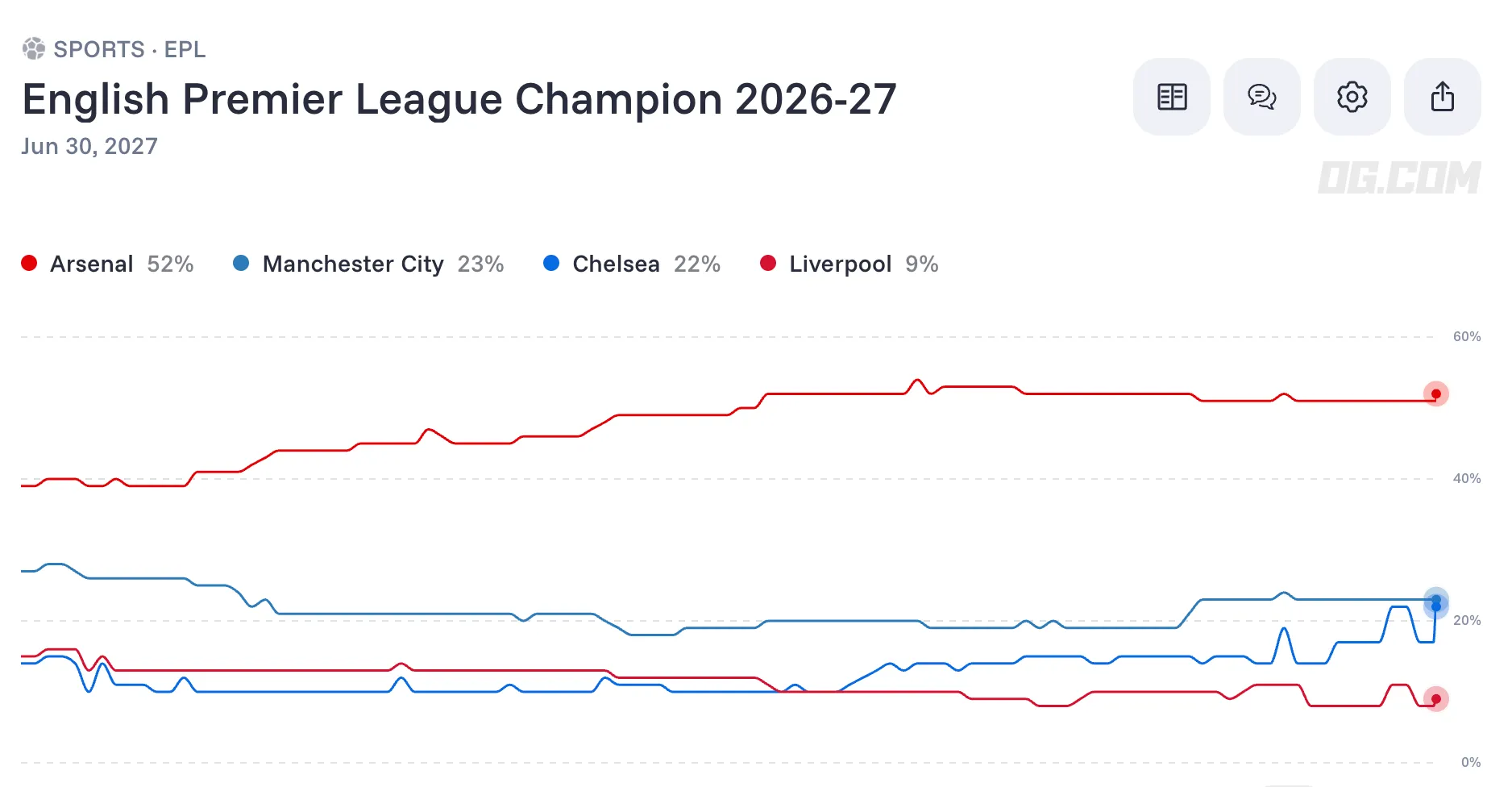
Prediction markets for English Premier League champion currently give Manchester City a 23% market-implied probability of winning the 2026/27 Premier League title.
This makes finishing second the market’s single most likely finishing position for the Citizens, but Chelsea have been closing the gap.
Market data as of August 31. For the latest market-implied probability, check the OG app.
City remain Arsenal's closest individual challenger, but the gap is significant.
A 23% title probability does not suggest anything is settled. It means prediction markets currently see a little under a one-in-four chance of City finishing as champions, with Arsenal considerably more strongly favored.
There is enough quality in City's squad to understand why they remain second.
Haaland gives Maresca arguably the most destructive center forward in the league. Foden is entering what should be the prime of his career. Cherki offers the kind of individual invention that can unlock opponents who spend most of the game protecting their own penalty area.
Anderson, meanwhile, changes the physical profile of midfield, while Bouaddi gives City a specialist option at the base of it.
The reason for caution is not difficult to find either.
Guardiola, Rodri and Bernardo were central to the mechanisms City used to control games. Losing all three in one summer asks Maresca to reconstruct some of the most important relationships in the team while simultaneously competing against an Arsenal side that begins from a much more settled base.
City's opening Premier League performances have provided glimpses of the possibilities.
The Bournemouth win was messy but persistent. City trailed until the 84th minute before goals from Guéhi and Gvardiol turned the game around. Against Crystal Palace, the attacking football was much more fluent, with Cherki given the freedom to drift, combine and carry the ball rather than being fixed rigidly to one area.
That is encouraging without answering the season's bigger question.
City have enough talent to challenge for the title. Whether they can sustain the control and consistency required to win it is much less certain.
Replacing Guardiola would be difficult for any coach.
Trying to imitate him would probably make it harder.
Maresca shares some obvious principles with his former boss. He wants City to dominate possession, build patiently from deep and regain the ball quickly when attacks break down.
There are differences in how he gets there.
City's positioning has already shown greater flexibility around the attacking midfielders, particularly Cherki. Against Crystal Palace, Maresca allowed him enough freedom to move across the pitch rather than reducing one of his most inventive players to a fixed positional role.
The press is another area Maresca has emphasized. After the Bournemouth game, he highlighted City's ability to recover possession when pressing and suggested the squad were already getting close to understanding what he wanted from them.
There will inevitably be rougher moments.
Ten years of Guardiola created habits almost unique in club soccer. Maresca is asking many of the same players to recognize different cues and relationships while simultaneously integrating a large group of new arrivals.
The objective is not to become Guardiola's City again; it is to find a version that works without him.
Rodri's departure changes the entire midfield question
Rodri left the club for Barcelona after seven years.
His value went far beyond being a holding midfielder. He controlled the tempo of possession, protected attacks against counterattacks and repeatedly positioned himself where City needed an extra passing option.
There is no obvious like-for-like replacement.
Instead City have spent heavily on different qualities.
Anderson is a high-volume ball winner with the running power to cover enormous areas. His final season at Nottingham Forest established him as one of the Premier League's strongest two-way midfielders before City signed him on a five-year deal.
Bouaddi is a different profile.
The Morocco international already made 96 appearances for Lille before turning 19 and is more naturally suited to operating at the base of midfield. His positional intelligence and security in possession provide Maresca with qualities closer to those traditionally demanded from City's deepest midfielder.
Neither needs to become Rodri. City need the midfield as a whole to replace what he allowed the team to do.
Elliot Anderson gives City something different
Anderson may become particularly important when games stop looking like controlled City possession exercises.
He can tackle, carry the ball through midfield and play forward under pressure. He also brings the physical capacity to recover ground when possession changes hands.
That last part matters.
Maresca wants City to commit players into advanced positions. When attacks break down, somebody has to protect the space those movements leave behind.
Anderson can do that without being limited to a purely destructive role.
There is an adaptation involved.
Playing for Nottingham Forest often gave him room to attack in transition. City will regularly face teams sitting much deeper, leaving less space for long carries and demanding quicker combinations around compact defenses.
His best version at City may therefore look different from the player who earned the move.
Ayyoub Bouaddi could be the long-term answer at No. 6
An £85m teenager is not a normal development project.
Bouaddi arrives with extraordinary experience for his age.
He became Lille's youngest-ever player in European competition at 16, established himself in Ligue 1 and then enhanced his reputation with Morocco during the 2026 World Cup. City have given him a five-year contract.
His importance is amplified by Rodri's departure.
Bouaddi is comfortable receiving the ball from the center backs, turning away from pressure and moving possession through midfield. Those are not spectacular actions, but they are fundamental to the way City want to control territory.
He also gives Maresca options. Anderson can play alongside him rather than being asked to anchor midfield alone, while Foden and Cherki can operate further forward without all of the defensive responsibility falling onto one player.
At 18, inconsistency should be expected.
City have nevertheless spent like a club that believes Bouaddi can eventually become much more than squad depth.
Rayan Cherki could become central to the new attack
The most intriguing attacking question may not involve Haaland.
We already know what Haaland does.
Cherki is still defining what he can become in this team.
His performance against Crystal Palace offered a compelling answer. He scored twice, including a brilliant individual opener, and was City's most inventive attacking player as Maresca gave him freedom to find space rather than restricting his movement.
That relationship could become important. Guardiola's City often achieved control through positional discipline. Maresca appears willing to give Cherki more license when his movement can create something the structure cannot.
With Bernardo gone, City need another player comfortable receiving possession in congested central areas and creating when the obvious passing route is closed.
Foden can do it. Cherki can too.
Having both around Haaland gives City an attacking configuration capable of being considerably less predictable.
Erling Haaland remains the constant
Among all the change, Haaland makes the title argument much simpler.
City still have a striker who can score 25 or 30 league goals without requiring the team to be flawless around him.
He won another Golden Boot last season with 27.
His role under Maresca should not require major reinvention. City need to get Haaland into the penalty area with enough service and prevent possession from becoming so slow that opponents can surround him with center backs.
Cherki's emergence could help.
So could greater midfield running from Anderson, particularly if it gives City another player arriving through rather than simply circulating around defensive blocks.
The challenge is creating chances consistently.
Haaland can outperform the quantity of opportunities most strikers receive. He cannot score chances City never create.
City are rebuilding their width
The attacking turnover has been substantial.
Sávio has left for Tottenham. Marmoush has followed on loan. City have also been looking for further wide reinforcement before the transfer window closes.
Allan Elias is one confirmed answer.
The 22-year-old arrives from Palmeiras after 96 senior appearances and can play on the right wing, in midfield or as a second striker. His direct dribbling gives Maresca another player capable of attacking defenders rather than simply maintaining width.
That matters because City cannot rely entirely on central combinations.
Against deep defenses, a winger beating the first opponent can immediately distort a defensive shape that has otherwise remained comfortable.
Jérémy Doku already provides that threat from the left.
Allan gives Maresca another possibility from the opposite side.
Biggest factors that could shape Manchester City's season
Can City control games without Rodri and Bernardo?
This may still be the defining football question.
Manchester City have not lacked talented players during their dominant era.
Their real advantage was often the ability to decide what kind of game everybody else had to play.
Rodri and Bernardo were enormous parts of that.
They allowed City to keep the ball under pressure, recover it quickly and turn periods of opposition momentum back into long spells of possession.
Maresca has different tools. Anderson provides energy. Bouaddi provides composure deeper in midfield. Foden and Cherki offer more attacking invention.
The challenge is combining those qualities without making City easier to counterattack.
A midfield can become more dynamic while becoming less controlling. Over a 38-game title race, City need both.
How much freedom should Rayan Cherki have?
Cherki gives Maresca a pleasant problem.
Structure makes possession reliable. Freedom can make an attack dangerous.
The Frenchman is at his best when allowed to drift toward the ball, combine with teammates and attack defenders from unexpected positions. His performance at Palace showed why too much positional restraint would waste some of his best qualities.
The balance lies behind him. If Bouaddi and Anderson can provide enough security, Maresca can afford to release Cherki into areas where opponents cannot easily assign one defender to him.
That could make City considerably harder to read than a team relying exclusively on repeated buildup patterns.
Can Bouaddi handle Premier League responsibility immediately?
Talent is not really the debate. Timing is.
Bouaddi has played senior soccer since 16 and already handled Champions League football and a World Cup.
The Premier League still presents a different physical and tactical test every week.
Opponents will press him. Others will deliberately leave him on the ball while blocking the more dangerous passing lanes ahead. Some will bypass midfield entirely and ask him to defend second balls rather than dictate possession.
City do not necessarily need an 18-year-old to control their season.
Rodri leaving means they may need him to matter sooner than originally planned.
Is City's defense strong enough to support a more adventurous midfield?
The attacking and midfield changes naturally attract attention.
City's defensive quality may determine how much freedom Maresca can afford elsewhere.
Gvardiol remains one of the league's strongest defenders both in and out of possession, while Guéhi adds another center back comfortable defending higher up the field.
That becomes important if City press aggressively.
The higher the defensive line moves, the more often center backs are exposed to forwards attacking space behind them.
Maresca therefore needs defenders capable of winning those situations without constantly requiring another midfielder to drop alongside them.
If they can, City can play more aggressively.
If they cannot, the loss of Rodri's protection becomes more visible.
Can Haaland give City another 25-goal season?
There is a temptation to treat this as automatic.
It isn't. Haaland's scoring record is extraordinary precisely because most strikers cannot maintain it.
Another season around his recent Premier League level would remove a huge amount of pressure from City's adjustment elsewhere.
It also gives Maresca a luxury few new managers inherit.
A team still learning how it wants to play can occasionally produce one great chance rather than 10 good ones.
Haaland means that may still be enough to win.
Can Maresca keep pace with a settled Arsenal?
This is ultimately what the market is asking. City do not need to prove they are a good team.
They need to prove they can be better across 38 games than the defending champions.
Arsenal currently sit at 51% in the title market compared with City's 23%.
That gap reflects more than individual talent.
Mikel Arteta has spent years building the relationships within his team. Maresca is weeks into doing the same while replacing several of the players who defined City's previous era.
City's advantage is upside.
If Anderson settles, Bouaddi develops quickly and Cherki turns his individual talent into consistent Premier League production, the team in the spring could be considerably stronger than the one Maresca inherited in the summer.
Arsenal start ahead. City still have enough quality to make them prove they can stay there.
What could move Manchester City's odds during the season?
The title race will eventually answer questions that August cannot.
Results matter first, but the manner of them can tell us something about whether City are becoming the team Maresca wants.
Their ability to control stronger opponents will be particularly revealing. Beating teams through Haaland's finishing or Cherki's individual brilliance is useful. Sustaining title form requires a repeatable way of dominating games even when neither produces something exceptional.
Midfield development should therefore be watched closely.
Bouaddi's role could expand as he adapts to English soccer. Anderson's responsibilities may evolve alongside him, while Maresca still has to determine the best balance between his deeper midfielders and the creative players operating around Haaland.
Squad health will matter too. Haaland remains difficult to replace. Foden and Cherki give City different forms of creativity, but losing either for a sustained spell changes the combinations available against deep defenses.
Then there is Arsenal.
City's market-implied probability does not exist in isolation. A long winning run can strengthen their title case, but its effect will be limited if Arsenal are collecting points at the same rate.
That comparison will run throughout the season. Manchester City have moved beyond simply replacing Guardiola. They are building the first team after him.
Whether that process is fast enough to produce another Premier League title is what makes their 26/27 season so interesting.
Important information
Prediction is an event contract that is a derivatives product offered by North American Derivatives Exchange, Inc. (NADEX), a CFTC-regulated exchange, which does business under the brand OG.com Prediction Markets (OG). Crypto.com | Derivatives North America uses a CFTC-regulated exchange that uses OG.com technology.
Trading on OG.com involves risk and may not be appropriate for all. By trading you risk losing your cost to enter any transaction, including fees. You should carefully consider whether trading on OG.com is appropriate for you in light of your investment experience and financial resources. Any trading decisions you make are solely your responsibility and at your own risk.
.webp)