Aston Villa predictions: Where will Villa finish in the 26/27 Premier League?
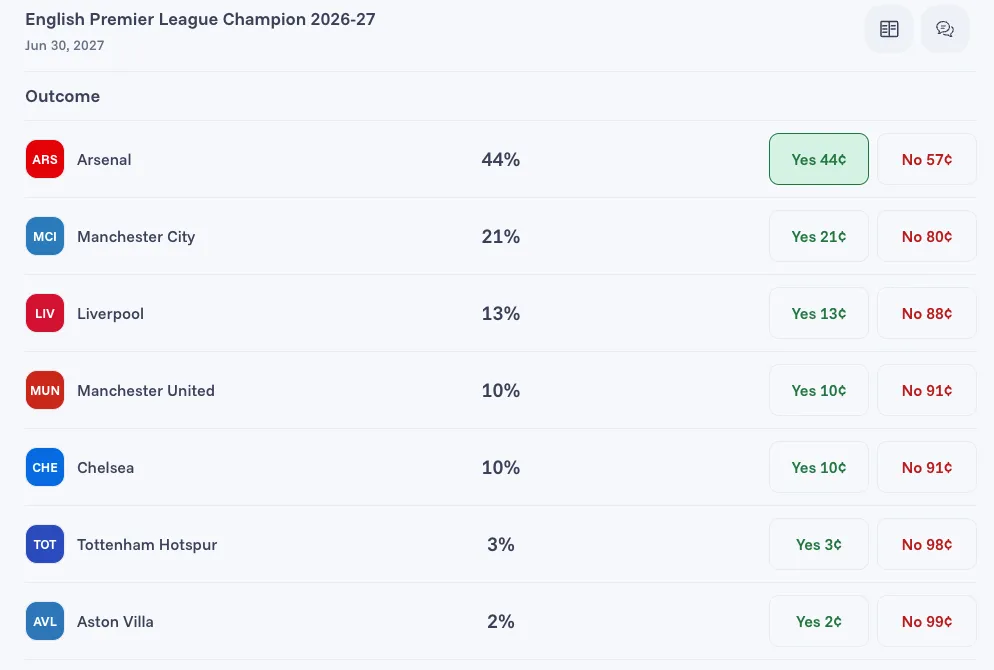
Aston Villa enters 2026/27 as the seventh-most likely Premier League champion, with a 2% market-implied title probability after another top-four finish but a summer of significant squad turnover.
Soccer
By Chris Old
Villa begins the new season after arguably the strongest campaign of the Unai Emery era, finishing fourth and winning the Europa League. But Morgan Rogers, Youri Tielemans and Lucas Digne have all left, while Ollie Watkins is now attracting transfer interest.
Johan Manzambi, João Gomes and Alejandro Garnacho give Emery new options, but Villa’s ability to absorb so much change while returning to the Champions League could define its season.
This article is for informational purposes only and should not be construed as financial or investment advice. Past performance does not guarantee future results.
Aston Villa 26/27 season overview
Aston Villa begins 2026/27 trying to prove that its place among the Premier League’s leading teams is sustainable.
Emery’s side finished fourth in 2025/26 with 65 points, winning 19 of 38 games. Villa scored 56 league goals and conceded 49, finishing five points ahead of Liverpool and securing Champions League qualification.
The league campaign was only part of an outstanding season. Villa also won the Europa League, beating Freiburg 3–0 in the final to claim its first major trophy in more than 30 years. Morgan Rogers was subsequently named the competition’s Player of the Season, while Emi Buendía was Player of the Match in the final.
Ollie Watkins remained Villa’s most reliable scorer. His two goals against Manchester City on the final day took him to 21 goals in all competitions, including 16 in the Premier League. He also produced eight goals and two assists across his final 10 league appearances.
But the team Emery takes into 2026/27 looks noticeably different. Rogers, Tielemans and Digne have all departed during a summer of significant turnover. Villa has reinvested in younger players, with Johan Manzambi joining from Freiburg, João Gomes from Wolves and Alejandro Garnacho arriving on loan from Chelsea.
Manzambi arrives with considerable upside. The 20-year-old was named the Europa League Young Player of the Season and then contributed three goals and two assists for Switzerland at the World Cup. Gomes brings 130 appearances of Premier League experience with Wolves, while Garnacho scored eight goals in 43 appearances for Chelsea last season.
There is another potential change still hanging over the squad. Watkins remains a Villa player and is currently expected to return to the starting lineup after his post-World Cup break, but Al-Hilal has been linked with a move for the 30-year-old. Reports suggest any formal pursuit remains dependent on the Saudi club resolving Karim Benzema’s situation first.
Villa has already lost several important players from last season’s team. Losing its leading scorer as well would turn a significant rebuild into a much deeper one unless another proven striker arrives forthwith.
Where will Aston Villa finish in the 26/27 Premier League?
Prediction markets for English Premier League champion currently give Aston Villa a 2% market-implied probability of winning the 2026/27 Premier League title.
That suggests a seventh-place finish, which is lower than at any time in the previous past three seasons.
Market data as of August 18. For the latest market-implied probability, check the OG app.
Prediction markets currently show a clear top 5, comprising of Arsenal, Manchester City, Liverpool, Manchester United and Chelsea. Villa are favored to be in and around a rejuvenated Tottenham.
Yet in a season of much change in the Premier League, Villa have a constant in manager Unai Emery, and markets can move quickly.
Its place in the market is also still notable. Villa sits immediately behind the 'Big Six', whose revenues dwarf competitors - significant in the age of punitive financial restrictions - and ahead of the rest of the Premier League. That reflects how much Emery has changed expectations around the club.
Last season’s fourth-place finish was not based on one isolated run of form. Villa won 19 league games, secured another Champions League campaign and demonstrated its ability to sustain a successful European run at the same time.
The market's caution reflects their status as 'over-achievers' last season - outpacing their XG and XGa - plus what has happened since. Rogers was one of Villa’s most influential attacking players, finishing the Europa League campaign as Player of the Season. Tielemans offered control and passing quality through midfield, while Digne was an established part of Emery’s defensive structure.
Villa has replaced some of that quality with younger players rather than established stars at their peak. Manzambi is only 20. Garnacho remains talented but inconsistent. Gomes offers substantial Premier League experience, although his profile is more combative than Tielemans’ and therefore changes the balance of midfield.
Watkins could become the decisive variable. If he stays, Villa retains a striker who scored 16 league goals last season and has reached double figures in every Premier League campaign of his Villa career. His movement, pressing and familiarity with Emery’s system would give the new-look attack an established focal point while the summer signings settle.
If he leaves without an equivalent replacement, the outlook changes considerably.
Villa would then be attempting to replace Rogers’ creativity, Tielemans’ midfield influence and Watkins’ goals in the same summer while simultaneously stepping back into Champions League competition.
The question is whether Villa can again mount a bid for Champions League qualification. The market still favors the traditional Big Six, and their greater spending power, but their dominance is far from guaranteed: a rough extrapolation from current title pricing puts the likelihood of all six finishing above Villa at only around 53%.
He finished last season with 13 goals and 11 assists before the Europa League final, then scored Villa’s third goal in Istanbul and ended the campaign as UEFA’s Europa League Player of the Season.
His influence went beyond goals and assists. Rogers gave Villa a way to carry possession through pressure and quickly turn defensive situations into attacks. His combination of size, acceleration and technical ability allowed him to advance the ball without relying exclusively on structured passing combinations.
That made him particularly valuable in Emery’s more direct moments.
Replacing that profile is difficult because no single summer signing offers exactly the same qualities. Garnacho can provide direct running. Manzambi can create centrally. Buendía can operate between the lines.
Villa may therefore need several players to collectively replace what Rogers provided.
Johan Manzambi brings considerable upside
Manzambi may be the most exciting part of Villa’s rebuild.
The Swiss midfielder arrives after helping Freiburg reach the Europa League final and being named Young Player of the Season in the competition. He then enhanced his reputation at the World Cup, scoring three goals and providing two assists for Switzerland.
His versatility should appeal to Emery.Manzambi has experience playing deeper in midfield but demonstrated at the World Cup that he can influence games much closer to goal.
That makes him potentially useful in replacing both some of Tielemans’ midfield responsibility and some of Rogers’ attacking influence.
The uncertainty is age and adaptation. At 20, he is entering his first Premier League season while joining a team expected to compete in the Champions League.
If he settles quickly, Villa may have recruited one of the league’s most interesting young midfielders. If he needs time, Emery will have to find production elsewhere during the opening months.
João Gomes changes the midfield profile
João Gomes gives Villa something different.The Brazil international made 130 appearances for Wolves and established himself as an aggressive, dynamic midfielder capable of covering large areas and competing for possession.
That profile fits many of Emery’s defensive demands.
Villa can press high but is equally comfortable dropping into a compact structure before attacking quickly once possession is regained. Gomes gives Emery another midfielder able to disrupt those transitions before opponents develop them.
But he is not a direct replacement for Tielemans, who gave Villa more passing range and control from central positions. Gomes brings greater defensive intensity.
That means Villa may become stronger without the ball while simultaneously asking McGinn, Buendía, Manzambi and others to take greater responsibility in possession.
Alejandro Garnacho gives Villa more speed and directness
Garnacho joins on a season-long loan after scoring eight goals in 43 appearances for Chelsea last season.
His profile is straightforward. He wants to carry the ball forward, attack defenders and exploit space behind the defensive line.
That gives Emery a potentially useful weapon in transition, particularly after losing Rogers.
Garnacho can play from either side and through more central positions, which should allow Villa to vary the attacking structure around Watkins, Tammy Abraham or another center forward.
The issue is consistency. Villa does not need occasional flashes from Garnacho; it needs sustained production across a season in which the squad is already replacing several established contributors.
Emery has a strong reputation for improving players tactically. If he can make Garnacho more efficient in the final third, the loan could become one of Villa’s most important pieces of business.
Ollie Watkins' future has become a major variable
A month ago, Watkins looked like one of the obvious constants in Villa’s rebuild. That is less certain now.
Al-Hilal is reportedly considering Watkins as a possible replacement for Benzema, although no club-to-club agreement has been reached and the Saudi side’s ability to proceed appears linked to resolving Benzema’s contract situation.
For now, Watkins remains central to Villa’s plans. He scored 21 goals last season, including 16 in the Premier League, and ended the campaign in some of the best form of his career.
Villa does have alternatives. Tammy Abraham is already in the squad, while 17-year-old Brian Madjo has emerged rapidly during preseason and scored against Paris Saint-Germain in the Super Cup. Emery regards Madjo as a first-team option, but the youngster remains at the beginning of his senior career.
That makes the distinction important. Madjo’s emergence improves Villa’s depth. It does not yet provide evidence that he can replace a proven 15–20-goal Premier League striker over an entire season.
If Watkins stays, this becomes a depth story. If Watkins leaves, Villa’s response in the transfer market could materially change its season outlook.
Biggest factors that could shape Aston Villa's season
Can Emery outperform expectations again?
Villa’s strongest reason for optimism remains its manager.
Emery has transformed the club from a lower-half side into a regular European contender and has now delivered both Champions League qualification and a major trophy. Last season Villa finished fourth while simultaneously winning the Europa League.
His tactical flexibility has been central to that progression. Villa is not dependent on one method of winning games. Emery can ask his team to press aggressively, control possession or sit deeper and attack space depending on the opponent.
Watkins described the final-day victory over Manchester City as a game in which Villa deliberately managed the first half from a lower block before becoming more aggressive after halftime.
That adaptability is particularly valuable now. The squad has changed enough that recreating last season’s system player for player may not be possible.
Emery instead needs to build another version around Gomes, Manzambi, Garnacho and whichever striker ultimately leads the attack.
The question is whether even Emery can continually absorb major departures without eventually losing ground to richer rivals.
Can Villa replace Rogers and Tielemans creatively?
This may be the biggest football question even if Watkins stays.
Rogers and Tielemans performed different roles but together gave Villa much of its progression and creativity through central areas.
Manzambi is one possible solution. Buendía is another.
Buendía ended last season’s Europa League campaign with four goals and six assists in 12 starts, finishing as the competition’s leading goal contributor. He also scored and assisted in the final.
His role could therefore grow significantly. John McGinn also remains an important creator. He generated 41 Premier League chances last season and supplied 46 successful passes into the penalty area.
Villa may not replace Rogers and Tielemans directly. Instead, Emery could distribute more responsibility among Buendía, McGinn, Manzambi and Garnacho.
Whether that collective solution produces enough chances will be one of the earliest indications of how successful the rebuild has been.
Does Watkins stay — and what happens if he leaves?
This is now the most important live variable. Watkins scored 16 of Villa’s 56 Premier League goals last season, meaning he accounted for almost 29% of the team’s league scoring himself.
His contribution is also difficult to measure purely through goals. He stretches defensive lines, presses from the front and already understands the movements Emery expects from the rest of Villa’s attack.
If he stays, Villa has a proven scorer around whom the new players can settle. If he leaves, three questions immediately follow:
Who replaces his goals? Who becomes the first-choice center forward? And does Villa reinvest the transfer fee in another established striker?
Abraham provides experience, while Madjo’s emergence is exciting. But losing Watkins after already selling Rogers would remove two of the players most responsible for Villa’s attacking production last season.
Can Manzambi develop quickly enough?
Manzambi’s ceiling is obvious. What matters for 2026/27 is how quickly Villa can access it.
His World Cup production — three goals and two assists — demonstrated an attacking dimension beyond the deeper role he sometimes occupied at Freiburg.
The Premier League presents a different challenge. Villa needs Manzambi to handle greater physical pressure while making decisions more quickly and maintaining Emery’s demanding positional structure.
There may also be greater responsibility available immediately because of Rogers and Tielemans leaving. That creates opportunity and pressure at the same time.
If Manzambi adapts quickly, Villa’s summer could eventually look more like intelligent regeneration than decline.
Can Villa improve defensively?
Villa conceded 49 Premier League goals last season.That was enough for fourth place, but Arsenal conceded only 27 and Manchester City 35.
Villa therefore has scope to compensate for any reduction in attacking production by becoming more efficient defensively. Ezri Konsa remains central to that.
He recorded Villa’s most Premier League clean sheets last season with nine and led the squad with 122 clearances and 29 blocks. Digne’s departure changes the left side, while Emery has several defensive combinations available elsewhere.
Villa’s Europa League campaign demonstrated the defensive ceiling of the team: it conceded only eight goals across 15 matches in the competition. Translating more of that control into the Premier League would make another top-four challenge considerably easier.
Can Villa handle Champions League workload?
This is a materially harder schedule than last season.
Villa successfully balanced the Premier League and Europa League, but Champions League opponents increase the intensity of the European calendar while the squad itself is undergoing substantial change.
That places more pressure on depth. Manzambi, Garnacho and several younger players may need to contribute immediately rather than gradually.
The World Cup has also shortened the summer for some senior players. Watkins, Martínez and Konsa were given extended breaks after international duty, while Villa’s Super Cup team contained only five starters from the Europa League final.
The effect may not be visible immediately. The bigger question is whether the squad still looks deep enough when Premier League and Champions League fixtures accumulate through autumn and winter.
Could Brian Madjo become a genuine first-team option?
Madjo has provided one of Villa’s most unexpected positives. The teenager scored against Paris Saint-Germain in the Super Cup after an impressive preseason and became the competition’s youngest goalscorer.
His physical profile immediately stands out. At around 6-foot-4, Madjo has shown an ability to hold defenders off, link play and attack the penalty area rather than looking like a player physically overwhelmed by senior football.
Emery is reportedly treating him as a genuine first-team option. That could reduce pressure on Villa to overuse Watkins or Abraham.
But expectations need to remain realistic. One outstanding summer does not make a 17-year-old a proven Premier League scorer.
For Villa, anything significant Madjo contributes this season should initially be viewed as upside rather than something the squad must depend upon.
What could move Aston Villa's odds during the season?
Villa’s prediction-market price can change continuously as traders reassess.
Results will naturally matter most. A strong opening run would reinforce the idea that Emery has successfully absorbed the summer departures, while an early decline could strengthen concerns that the squad has lost too much experience.
Watkins’ future may be the most immediate market variable. If he stays, Villa retains its leading scorer. If he leaves, the quality of any replacement could materially alter expectations around the attack.
The new midfield’s performance will also matter. Manzambi and Gomes are replacing players with significant influence, and the speed with which they adapt could determine whether Villa’s level drops, holds steady or improves.
Buendía’s role offers upside. If last season’s Europa League production carries into domestic football, Villa will have replaced part of the creativity lost through Rogers without needing another major signing.
Champions League performance could affect the market in two directions. A strong run would reinforce the quality of the team but increase fixture congestion; an earlier exit would reduce the workload and allow greater focus on the league.
Further transfers remain important while the window is open. Emery has already indicated that Villa’s rebuild is not necessarily finished.
And Villa’s probability is relative to what the teams above it do.
Important information
Prediction is an event contract that is a derivatives product offered by North American Derivatives Exchange, Inc. (NADEX), a CFTC-regulated exchange, which does business under the brand OG.com Prediction Markets (OG). Crypto.com | Derivatives North America uses a CFTC-regulated exchange that uses OG.com technology.
Trading on OG.com involves risk and may not be appropriate for all. By trading you risk losing your cost to enter any transaction, including fees. You should carefully consider whether trading on OG.com is appropriate for you in light of your investment experience and financial resources. Any trading decisions you make are solely your responsibility and at your own risk.