AFC West predictions and odds: Who will win the AFC West in 2026?
Denver begins as the narrow AFC West favorite, but the Los Angeles Chargers and Kansas City Chiefs sit almost alongside the Broncos in what could be the conference's tightest division race.
Football
By Chris Old
For most of the Patrick Mahomes era, the AFC West started with Kansas City and everybody else trying to catch up.
Not anymore.
Denver went 14-3 last season, won the division and reached the AFC Championship Game. The Los Angeles Chargers finished 11-6 and made the playoffs. Kansas City fell to 6-11 after Mahomes suffered a serious knee injury late in the season, while the Las Vegas Raiders finished 3-14.
That reversal has carried into the 2026 market.
The Broncos now lead, but there is remarkably little between the top three.
Denver has added Jaylen Waddle to an offense already led by Bo Nix, Courtland Sutton and a strong offensive line. The defense remains one of the league's best, with Pat Surtain II and Nik Bonitto among the established stars.
The Los Angeles Chargers have a different route upward.
Justin Herbert got them to 11 wins last season despite poor protection and playing through a fractured left hand. Rashawn Slater and Joe Alt return at tackle, while Mike McDaniel takes over the offense with the job of extracting more from Herbert without asking him to rescue broken plays every week.
Kansas City remains the obvious complication.
Mahomes has returned to 11-on-11 work after tearing his ACL, while Andy Reid, Travis Kelce, Rashee Rice, Xavier Worthy and Chris Jones remain. A six-win season does not erase what this core has already proved capable of doing.
Las Vegas is much further back, but the Raiders have rebuilt aggressively around veteran quarterback Kirk Cousins, No. 1 overall pick Fernando Mendoza, Ashton Jeanty and Brock Bowers.
So this is no longer Kansas City's division by default.
It is a three-team race with a fourth trying to accelerate its rebuild.
This article is for informational purposes only and should not be construed as financial or investment advice. Past performance does not guarantee future results.
AFC West prediction and odds 2026
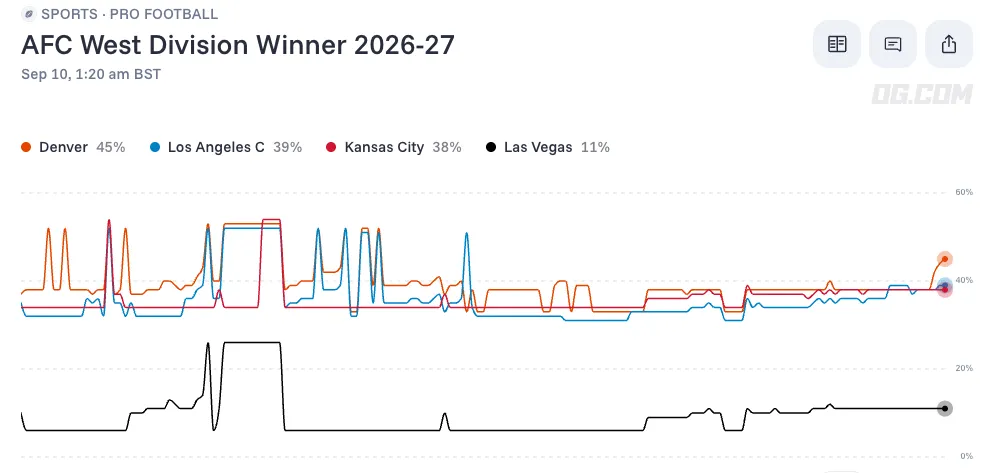
Prediction markets currently make the Denver Broncos the AFC West favorite at 45%, with the Los Angeles Chargers at 39% and Kansas City Chiefs at 38% almost level behind them.
Denver Broncos — 45%
Los Angeles Chargers — 39%
Kansas City Chiefs — 38%
Las Vegas Raiders — 11%
Market data as of September 9, 2026. For the latest market-implied probabilities, check the OG app.
The top three numbers tell us almost everything we need to know.
Denver deserves to lead after winning 14 games and taking the division last season, but the market is not treating that performance as proof of another comfortable title.
The Los Angeles Chargers sit only six percentage points behind.
Kansas City is only seven back.
That means the market effectively sees three credible winners rather than one favorite and two conventional challengers.
Denver has the best recent evidence.
The Chargers may have the clearest route to improvement.
Kansas City still has the division's most accomplished quarterback-coach combination.
Las Vegas at 11% sits in a different category. The Raiders need substantially more to go right, but their offseason has added enough veteran quality and young talent to make them more than an automatic afterthought.
Denver Broncos — 45%
Denver's case begins with the fact that it already worked.
The Broncos did not merely sneak into the playoffs last season.
They went 14-3, finished with a +90 point differential, went 5-1 inside the AFC West and earned the conference's No. 1 seed.
Bo Nix then led them through the Divisional Round before an ankle injury ended his season and prevented him from playing in the AFC Championship Game.
That injury is no longer expected to be a problem.
Sean Payton said during the offseason that Nix would be back to full speed for training camp, and Nix subsequently returned to practice with doctors describing the ankle as effectively back to normal.
The offense around him has improved too.
Denver traded for Jaylen Waddle, giving Nix an explosive receiver alongside Courtland Sutton, Troy Franklin and Marvin Mims Jr. Waddle has three 1,000-yard seasons in his first five NFL campaigns and adds the kind of speed that can change how defenses allocate coverage.
The offensive line remains largely intact, with Garett Bolles, Ben Powers, Luke Wattenberg, Quinn Meinerz and Mike McGlinchey all on the initial roster.
That continuity matters.
Our guide to NFL positions explained breaks down why offensive-line play affects almost everything a quarterback can do, from the depth of passing concepts to how long routes have to develop.
The biggest offensive change is actually on the sideline.
Davis Webb has been promoted to offensive coordinator and will call plays for the first time, with Payton remaining heavily involved in the offense. Webb has worked closely with Nix throughout his first two NFL seasons, which should reduce the disruption that can accompany a play-calling change.
Then there is the defense.
Denver ranked second in total defense and third in scoring defense last season, while leading the NFL in yards allowed per play. The Broncos also led the league in sacks for the second consecutive year.
Surtain remains one of football's best cornerbacks.
Bonitto is coming off a 14-sack season.
Zach Allen, Talanoa Hufanga and a deep defensive front remain around them.
There is therefore no obvious reason Denver should suddenly fall away.
The question is whether last season's 14 wins represent the Broncos' new baseline or the high point of a season where almost everything aligned.
At 45%, the market gives Denver the edge without assuming the answer.
Los Angeles Chargers — 39%
The Los Angeles Chargers may have the most obvious improvement case in the division.
Herbert was already good enough last season.
The circumstances around him were not.
The Chargers still went 11-6 despite Herbert playing through a fractured left hand and an offensive line repeatedly compromised by injuries.
Rashawn Slater missed the entire season after tearing his patellar tendon in training camp.
Joe Alt played only six games before an ankle injury ended his year.
Both return.
That should immediately change how the offense can function.
The Chargers wanted to rebuild the interior around Tyler Biadasz as well, although his training-camp injury has forced Jake Slaughter into the center role. That means the line is not suddenly free of questions, but getting Slater and Alt back still represents a major improvement on last year's protection environment.
Then comes McDaniel.
The former Miami head coach is now Jim Harbaugh's offensive coordinator, and his work with Herbert has already focused on details such as footwork, timing and creating easier answers rather than changing what makes the quarterback effective.
That pairing is intriguing because Herbert spent too much of last season being asked to improvise after protection broke down.
McDaniel's offenses have traditionally relied on motion, timing and creating space before the quarterback has to make difficult decisions.
If that structure works, Herbert may not need to become a better quarterback for the Chargers to become a better offense.
Ladd McConkey and Quentin Johnston return at receiver, while Omarion Hampton remains in the backfield.
The defense also gives Los Angeles a relatively high floor under Harbaugh.
The real question is postseason translation.
The Chargers have reached the playoffs in both of Harbaugh's first two seasons.
Now they need to turn regular-season competence into a team capable of winning this division and then winning in January.
At 39%, prediction markets clearly believe that step is realistic.
Kansas City Chiefs — 38%
Kansas City is in an unfamiliar position.
The Chiefs begin behind two AFC West rivals.
That would have sounded absurd through most of the Mahomes era.
Then 2025 happened.
Kansas City finished 6-11, went 1-5 inside the division and ended the year on a six-game losing streak.
The season also ended with the biggest possible uncertainty.
Mahomes tore his ACL in December.
His recovery has progressed quickly.
He returned to 11-on-11 work at the beginning of training camp, with Reid saying Mahomes looked strong and that his feet were moving well. The following day, Mahomes was already moving within the pocket and making throws that required some of the mobility central to his game.
That is hugely encouraging.
It is not the same as proving the knee will be irrelevant across a 17-game season.
Mahomes' ability to extend plays is part of what makes defending Kansas City different from defending a normal pocket passer. The Chiefs do not merely need him medically cleared.
They need him able to move, reset and create after the first structure breaks down.
The offensive pieces remain recognizable.
Rice and Worthy lead the receiving corps. Kelce remains at tight end. Kenneth Walker joins the backfield, while Creed Humphrey and Trey Smith remain central to the offensive line.
The defense still contains Jones, George Karlaftis and Nick Bolton.
But there has been turnover.
The secondary looks different after departures that included Trent McDuffie and Jaylen Watson, although L'Jarius Sneed has returned and Kansas City has added other new defensive backs around him.
None of that changes the fundamental reason Kansas City sits at 38%.
Mahomes and Reid remain.
A single poor season — particularly one heavily affected by injury — is not enough to dismiss one of the defining quarterback-coach partnerships of the modern NFL.
The difference is that Kansas City now has to prove it can catch the division rather than asking everybody else to prove they can catch Kansas City.
Las Vegas Raiders — 11%
Las Vegas has rebuilt aggressively enough to make the 11% interesting.
The Raiders went 3-14 last season and finished with a -191 point differential, the worst figure in the AFC West by an enormous margin.
That explains why the gap remains so large.
The offseason explains why the market has not reduced Las Vegas to virtually zero.
Klint Kubiak is the new head coach.
Kirk Cousins arrives as the veteran starting quarterback after 14 NFL seasons, and the relationship should already contain some familiarity because Cousins previously worked with Kubiak in Minnesota.
Behind him sits Fernando Mendoza.
The Raiders selected the reigning Heisman Trophy winner No. 1 overall after he led Indiana to an undefeated national championship season with 41 touchdown passes against six interceptions.
That gives Las Vegas both a short-term quarterback plan and a long-term one.
Cousins can start without asking Mendoza to solve the NFL immediately.
If the veteran struggles or the season changes direction, the rookie is waiting.
The offense also contains genuine young talent.
Ashton Jeanty remains the lead running back.
Brock Bowers is already one of the league's most dangerous tight ends.
Jack Bech, Tre Tucker and Dont'e Thornton Jr. are among the receivers.
The defense has been strengthened too.
Maxx Crosby remains the centerpiece, while Quay Walker, Nakobe Dean, Kwity Paye and Taron Johnson are among the additions around him.
That is a significant amount of change.
It is also the problem.
The Raiders are asking a new head coach, new quarterback, heavily altered defense and multiple young offensive players to become cohesive quickly enough to compete with three teams already operating at playoff level.
Going from three wins to respectable is one challenge.
Going from three wins to AFC West champion requires an enormous jump.
At 11%, the market leaves room for Kubiak and Cousins to accelerate the rebuild.
It does not confuse potential improvement with proven contention.
Can Denver turn last season's breakthrough into a new baseline?
Denver's biggest challenge may simply be repeating what it has already done.
Fourteen wins creates a very different expectation from entering a season as an emerging playoff team.
Opponents now have substantially more film on Nix.
The Broncos will be prepared for as defending division champions rather than as the team trying to climb toward Kansas City.
And the offense has changed its play-caller.
That last point is particularly important.
Webb knows Nix extremely well and has worked alongside Payton throughout the quarterback's first two seasons. He is not arriving from another organization with a completely different offense.
But calling plays is different from helping design them.
Decisions have to happen in seconds. Sequencing matters. Understanding what an opposing defense has changed between drives matters.
If Webb handles that transition smoothly, Denver may actually become more difficult to defend because Waddle adds a type of speed the offense lacked.
The defense gives the Broncos room for the offense to find itself.
A unit that finished among the league's best in almost every meaningful category should keep Denver competitive even when the offense is not operating perfectly.
That combination is why 45% makes sense.
The Broncos do not need to reproduce 14 wins to retain the AFC West.
They just need last season to have been more foundation than anomaly.
Does better protection unlock another level from Justin Herbert?
The offensive line may decide the Chargers' season.
That sounds less glamorous than Herbert or McDaniel.
It may matter more.
Last year demonstrated what happens when protection deteriorates.
Herbert can still create enough plays to keep the offense moving, but asking him to repeatedly solve immediate pressure makes everything harder.
Getting Slater and Alt back changes the edges of the pocket.
That allows deeper concepts time to develop.
It gives Herbert cleaner opportunities to work through progressions rather than immediately escaping pressure.
It should also help the running game.
There are still questions inside after Biadasz's injury, so this is not suddenly a perfect unit.
But tackle play is fundamental to protecting the quarterback against edge rushers — something our guide to football positions explains in more detail.
Then McDaniel gets to design around a quarterback with one of the strongest arms in football.
If the line holds up, Los Angeles may discover that the biggest improvement available was simply allowing Herbert to play from stable circumstances.
That makes the Chargers' 39% one of the most compelling numbers in the division.
How close to full strength is Patrick Mahomes?
Kansas City's season may depend on one question more than any other.
Mahomes is back.
Is the old Mahomes back?
Training camp has provided encouraging evidence.
He has taken 11-on-11 snaps.
He has moved within the pocket.
Reid has publicly praised the strength in his legs.
But a regular-season pass rush is different.
Mahomes has built much of his career on turning plays that appear dead into completions outside the original structure.
That requires confidence in the knee as much as medical clearance.
If he can move naturally and protect himself when pressure arrives, the Chiefs immediately become much harder to leave behind Denver and the Chargers.
If he is even slightly restricted, opposing defenses can attack Kansas City differently.
That is why 38% feels about right.
The Chiefs have the highest proven ceiling in the division.
They also enter with the largest individual health question among the three favorites.
Is the AFC West strong enough to damage its own contenders?
This may be the central structural problem for all three favorites.
Denver went 5-1 inside the division last season.
So did the Chargers.
Kansas City went 1-5.
Those records were a major part of why the standings looked so different from previous years.
Now imagine the top three are genuinely closer.
Denver, the Los Angeles Chargers and Kansas City have to play each other six times collectively.
Every one of those games creates a direct swing.
A Denver win over Kansas City is not merely another Broncos victory. It simultaneously hands the Chiefs a loss.
The same applies to Chargers-Broncos and Chargers-Chiefs.
That matters for more than winning the West.
The AFC's No. 1 seed receives the only first-round bye. A team can be one of the best in the conference and still spend January traveling because its own division was unusually strong.
There is also a wider playoff implication.
AFC wild-card places are finite.
If the division produces three strong teams, the West may crowd out contenders elsewhere.
If those teams instead spend the season taking games from one another, the division winner could emerge with a relatively ordinary record despite being extremely strong.
Can Las Vegas close the gap quickly enough to matter?
The Raiders do not need to win the AFC West to influence it.
They play Denver, the Los Angeles Chargers and Kansas City twice each.
That gives Las Vegas six opportunities to remove a win from one of the favorites.
The rebuild therefore matters to the division race even if 11% proves too ambitious.
Cousins should give Kubiak more stability than the Raiders had at quarterback last season.
Jeanty and Bowers give the offense legitimate foundational pieces.
Crosby remains capable of wrecking individual drives defensively.
The question is whether enough of the new roster works immediately.
Three-win teams usually need time.
Las Vegas has tried to shorten that process by pairing veterans with young players rather than handing everything to Mendoza from Week 1.
If Cousins is efficient and the new defense becomes respectable, the Raiders can become precisely the kind of team nobody wants to face in a tight divisional race.
That would matter enormously when only seven percentage points currently separate first from third in the market.
AFC West prediction overview
Denver deserves to be the favorite.
The Broncos have the strongest recent evidence, the defending division title and a roster that arguably improved after a 14-win season.
Nix is healthy again, Waddle gives the offense another explosive weapon and the defense remains elite.
That is the best overall combination entering Week 1.
But there is little comfortable about the position.
The Los Angeles Chargers may have the cleanest improvement case in the division.
They already won 11 games despite Herbert playing through injury and protection problems. Better tackle health plus McDaniel's arrival gives the offense an obvious route to another level without requiring Herbert himself to transform.
Kansas City is the wildcard hiding in plain sight.
A healthy Mahomes can make 38% look absurdly low very quickly.
The Chiefs' 2025 season was poor, but it would be a mistake to treat one down year as evidence that Reid and Mahomes have permanently surrendered control of the AFC West.
Las Vegas belongs fourth.
The Raiders have improved enough to be dangerous and have built a more credible short-term structure around Cousins while Mendoza develops.
But the distance from 3-14 to finishing ahead of all three contenders remains enormous.
What could move AFC West odds during the season?
Kansas City's first few games may create the biggest swing.
If Mahomes looks completely unrestricted, the Chiefs' current position behind Denver and the Los Angeles Chargers could disappear quickly.
If his movement is visibly compromised, the market has a reason to widen the gap.
The Chargers' offensive line should be almost as important.
Slater and Alt returning is significant, but the interior remains less settled after Biadasz's injury.
Clean protection for Herbert would give McDaniel far more freedom to use the full offense.
Repeated pressure would make 2026 look frustratingly familiar.
Denver's early question is different.
The Broncos already know the roster works.
They need to show that Webb can take over play-calling without losing the efficiency Payton helped build, while Nix needs to prove that defenses having another year of film on him does not change the trajectory of his development.
Then come the six division games.
Those could move probabilities more than almost anything else.
Denver opens its AFC West schedule against Kansas City, immediately giving the market a direct comparison between the defending champion and the team that controlled this division for most of the previous decade.
Las Vegas gets opportunities of its own.
One upset can matter in a race this tight.
By December, the conversation should increasingly turn to divisional record and tiebreakers rather than roster projections.
The AFC West does not currently have one team everybody else is chasing.
It has three teams that can reasonably believe the division belongs to them.
Important Information
Prediction is an event contract that is a derivatives product offered by North American Derivatives Exchange, Inc. (NADEX), a CFTC-regulated exchange, which does business under the brand OG.com Prediction Markets (OG). Crypto.com | Derivatives North America uses a CFTC-regulated exchange that uses OG.com technology.
Trading on OG.com involves risk and may not be appropriate for all. By trading you risk losing your cost to enter any transaction, including fees. You should carefully consider whether trading on OG.com is appropriate for you in light of your investment experience and financial resources. Any trading decisions you make are solely your responsibility and at your own risk.