AFC Championship prediction and odds: Who will win the AFC in 2026?
The Buffalo Bills enter the season as narrow AFC favorites, but Baltimore, Kansas City and a deep group of challengers make this one of the hardest conference races to separate.
Football
By Chris Old
There is no obvious heavyweight towering over the AFC.
Buffalo has Josh Allen and a roster built to contend immediately, but the Bills are beginning a new era under head coach Joe Brady.
Baltimore has Lamar Jackson and one of the conference's deepest rosters, but Jesse Minter is replacing John Harbaugh after 18 seasons.
Patrick Mahomes is back practicing fully after the serious knee injury that ended Kansas City's 2025 season, while Denver, the Los Angeles Chargers, New England, Houston and Cincinnati all have legitimate routes into the postseason.
That depth is reflected in the market.
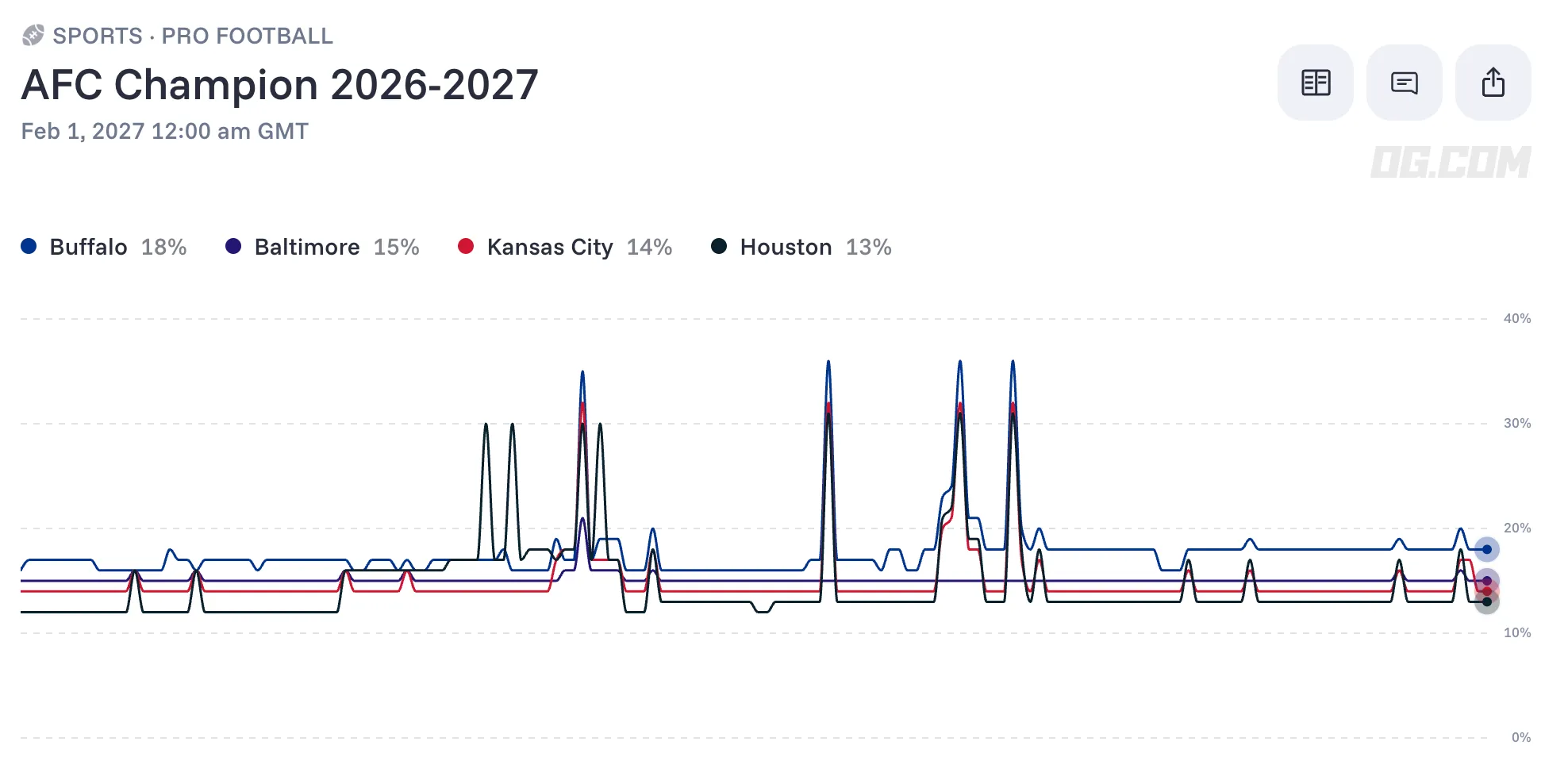
Buffalo leads the current AFC Championship market at only 18%, with Baltimore just behind at 15%. There is no equivalent of a 30% or 40% favorite here.
This article is for informational purposes only and should not be construed as financial or investment advice. Past performance does not guarantee future results.
AFC Championship prediction and odds
Prediction markets currently make the Buffalo Bills the AFC favorites at 18%, narrowly ahead of the Baltimore Ravens at 15%.
Buffalo Bills — 18%
Baltimore Ravens — 15%
Kansas City Chiefs — 14%
Houston Texans — 13%
Los Angeles Chargers — 13%
New England Patriots — 12%
Denver Broncos — 12%
Cincinatti Bengals — 11%
Market data as of September 7, 2026. For the latest market-implied probabilities, check the OG app.
The percentages tell the story better than any preseason ranking could.
Buffalo leads, but 18% still means prediction markets see far more ways for the Bills not to win the conference than to win it.
Baltimore is almost alongside them, while Kansas City and the Los Angeles Chargers entered the final preseason stretch immediately behind the leading pair in the broader AFC hierarchy.
The conference is also unusually deep.
Denver won 14 games and earned the AFC's No. 1 seed last season. New England went 14-3 and represented the conference in Super Bowl LX. Houston won 12 games. Cincinnati still has Joe Burrow. Kansas City still has Mahomes and Andy Reid.
That leaves relatively little margin between being an AFC Championship contender and fighting merely to secure a playoff place.
Buffalo Bills — can Josh Allen finally take Buffalo through the AFC?
Buffalo deserves to begin at the top.
Any championship case built around Josh Allen already has the hardest position solved. The question is whether the supporting structure is now strong enough to survive the AFC postseason.
The Bills have changed significantly around their quarterback.
Joe Brady has moved from offensive coordinator to head coach, while Pete Carmichael now runs the offense and Jim Leonhard oversees the defense. Buffalo has also added DJ Moore to a receiving group containing Khalil Shakir and Keon Coleman, giving Allen another established downfield and yards-after-catch threat. The final 53-man roster also retained James Cook, Dalton Kincaid, Dawson Knox and much of the offensive line around him.
The defense may be the more important variable.
Bradley Chubb joins Greg Rousseau in the pass rush, while C.J. Gardner-Johnson adds experience to a secondary that also includes Christian Benford and Cole Bishop.
Buffalo does not need Allen to become better than he already is.
It needs the roster around him to give him fewer postseason games in which he has to solve every problem himself.
That is the strongest argument for the Bills at 18%.
Baltimore Ravens — does the coaching reset raise their ceiling?
Baltimore has almost everything required to win the AFC.
Lamar Jackson remains one of football's hardest quarterbacks to defend. Derrick Henry still gives the offense a completely different physical dimension. Zay Flowers remains a major receiving threat.
The Ravens have also attacked one of the areas that needed improvement by adding Trey Hendrickson to the pass rush. Baltimore's own reporting has identified Hendrickson's impact, Jackson's health and the return of defensive tackle Nnamdi Madubuike among the major variables entering the season.
What is new is the coaching structure.
Jesse Minter replaces John Harbaugh, while Declan Doyle takes over the offense. Jackson said in late August that he felt comfortable and ready within the new system despite not playing during the preseason.
That creates two possible interpretations.
Baltimore could spend September adjusting to significant change after nearly two decades of continuity.
Or the new staff could unlock a roster that already contains Jackson, Henry, Flowers, Roquan Smith, Kyle Hamilton and a stronger pass rush.
At 15%, the market is clearly leaning toward the second possibility being credible.
Kansas City Chiefs — how much of the old Mahomes advantage remains?
Kansas City is the hardest AFC contender to place.
A year ago, the answer would have been easy. Mahomes and Reid automatically put the Chiefs near the top of any postseason hierarchy.
The 2026 version requires more thought.
Mahomes tore his ACL late last season, but his recovery has progressed remarkably quickly. He was cleared to participate in training camp, returned to 11-on-11 work in July and was still making high-level throws and moving effectively through August.
Kansas City also enters with more offensive speed around him. Xavier Worthy and Rashee Rice remain at receiver, while Kenneth Walker joins the backfield. Travis Kelce is still there too.
The concern is whether Mahomes returns as merely healthy enough to play or as the quarterback capable of repeatedly turning January games in Kansas City's favor.
There have also been important personnel changes elsewhere, particularly in the secondary.
That makes the Chiefs more volatile than usual.
But as long as Mahomes is moving well and Reid is calling the offense, writing them out of the AFC picture would be premature.
Houston Texans — is the offense good enough for the defense?
Houston's case begins with a defense already capable of carrying a postseason team.
The harder question is whether the offense can stop making life so difficult for itself.
C.J. Stroud remains the obvious centerpiece, but protection has been a recurring concern. That issue has not disappeared completely entering 2026: veteran tackle Braden Smith was placed on injured reserve as the roster was finalized.
There were more encouraging signs late in camp. Houston's own reporting highlighted the offense producing some of its best work during August joint practices.
That is the route to improvement.
The Texans do not necessarily need to develop into the AFC's best offense. If Stroud gets cleaner pockets, early-down efficiency improves and Houston stops asking the defense to protect narrow margins every week, the whole team becomes much harder to eliminate.
A Week 1 meeting with Buffalo will provide an immediate test of where Houston actually stands.
Los Angeles Chargers — can better protection unlock Justin Herbert?
The Chargers may have one of the simplest improvement cases in the conference.
Justin Herbert does not need reinventing.
He needs better circumstances.
Herbert dragged Los Angeles back into the playoffs last season despite poor offensive-line performance and playing through a fractured left hand. The Chargers have since rebuilt the protection around him, with Rashawn Slater and Joe Alt returning and Tyler Biadasz added at center.
That gives new offensive coordinator Mike McDaniel an attractive foundation.
A healthier line changes more than sack totals. It creates cleaner early-down passing situations, allows deeper concepts to develop and reduces the number of drives Herbert has to rescue after immediate pressure.
Los Angeles has reached the playoffs in each of Jim Harbaugh's first two seasons.
The next step is winning when it gets there.
If the offensive line delivers the expected improvement, the Chargers may have one of the clearest routes from playoff team to genuine conference threat.
New England Patriots — can the defending AFC champions do it again?
The Patriots have already answered one question.
They can win the AFC.
New England went 14-3 last season and reached Super Bowl LX behind Drake Maye's emergence at quarterback. Seven months later, Maye said the experience had given the team something tangible to learn from rather than treating the postseason run as an abstraction.
The roster around him has improved too.
A.J. Brown gives Maye a proven No. 1 receiver and changes how defenses can treat the rest of the passing game.
That matters because repeating a conference-title run is a different challenge from making the first one.
Opponents now have a full season of tape on Maye. New England will not be treated as a developing team. And the Patriots still have to navigate an AFC East containing Allen and Buffalo.
None of that makes last season disappear.
If Maye continues progressing rather than merely repeating his 2025 level, New England has a legitimate route back to January's biggest AFC game.
Denver Broncos — was 14-3 the beginning rather than the peak?
Denver should not be treated as a surprise contender.
The Broncos went 14-3, won the AFC West and secured the conference's No. 1 seed last season before falling one victory short of the Super Bowl.
That performance changes the standard for 2026.
Bo Nix enters with evidence that he can quarterback a high-level regular-season team rather than merely projections about what he might become. Denver has also added Jaylen Waddle to a receiving group already featuring Courtland Sutton.
The concern is whether last season represented a ceiling created by everything breaking correctly at once.
Denver will now play with substantially different expectations. Opponents have more film on Nix, the schedule brings repeated games against Kansas City and the Chargers, and the Broncos themselves no longer get to approach the season as the emerging team nobody quite trusts.
Nix described the group as "battle-tested" during August. That description is fair.
Now Denver has to prove it can sustain that level.
Cincinnati Bengals — how much can Joe Burrow change the equation?
Any team with a healthy Joe Burrow remains dangerous.
That qualifier has become impossible to ignore.
Burrow missed nine games last season after suffering a toe injury in Week 2. When he returned, Cincinnati immediately regained the passing threat that makes the Bengals difficult to play against, including a 261-yard, two-touchdown performance against Baltimore in his first game back.
The receiving structure remains formidable.
Ja'Marr Chase and Tee Higgins give Cincinnati one of the AFC's strongest starting receiver combinations, while Burrow enters 2026 backed up by veteran Joe Flacco.
The bigger question is everything surrounding them.
Cincinnati needs the offensive line to hold up and the defense to become stable enough that Burrow does not have to turn every game into a scoring race.
If those areas improve, the Bengals have the quarterback and receivers to beat anybody in one postseason game.
If not, they may again spend too much of the season asking Burrow to compensate.
Can Buffalo's new structure improve the team without disrupting what already works?
Changing head coach around an established contender creates unusual pressure.
Joe Brady already knows Allen and the offense intimately, which should reduce the normal disruption associated with a coaching transition. The bigger unknown is how Buffalo changes elsewhere — game management, defensive identity and the decisions that become magnified in January.
The Bills do not need wholesale reinvention.
They need marginal improvement in exactly the areas that have repeatedly separated very good Buffalo teams from a Super Bowl appearance.
DJ Moore gives Allen another weapon. Chubb gives the defense another pass-rush option. Leonhard gives that unit a new structure.
If those additions help without taking away Buffalo's existing strengths, 18% may prove a fair starting point.
Does Baltimore's roster depth outweigh the coaching transition?
Baltimore might have the conference's most complete collection of established stars.
Jackson and Henry can control games in very different ways. The defense contains elite talent at all three levels. Hendrickson adds a proven edge threat to a unit that needed more consistent pressure.
There are fewer obvious personnel holes here than on most challengers.
What Baltimore does have is change.
A new head coach and offensive coordinator bring new language, responsibilities and situational decision-making. Those issues can disappear quickly when things go well, but the AFC North rarely gives teams much time to learn on the job.
If Minter's Ravens reach October with the offense comfortable and the defense healthier than last season, the case for Baltimore could become considerably stronger.
How close to his best is Patrick Mahomes?
This may be the single most important individual question in the AFC.
Mahomes does not need to prove that he can win postseason games. He has already built a career around doing exactly that.
The uncertainty is physical.
A quarterback returning from a torn ACL can be medically cleared long before every part of his game looks completely normal. For Mahomes, pocket movement, improvisation and the ability to create throws after structure breaks down are particularly important.
His training-camp progression has been extremely encouraging.
If September shows the old movement and arm talent are fully available, Kansas City's conference probability becomes easier to defend.
If the injury still limits the improvisational part of his game, the Chiefs suddenly look much more mortal.
Is the AFC West strong enough to damage its own contenders?
Kansas City, Denver and the Chargers can all make serious AFC cases.
The problem is that they have to play one another twice.
Denver enters after a 14-win season. Los Angeles has made the playoffs in consecutive years. Kansas City still has Mahomes.
Those six divisional games can affect far more than the AFC West standings.
They can influence playoff qualification, conference seeding and the likelihood of securing home-field advantage or the first-round bye.
A strong team finishing second in this division could spend January traveling while a weaker division champion hosts.
The AFC West may therefore produce several contenders while simultaneously making each one's route more difficult.
Which young quarterback can make the next jump?
The established AFC hierarchy still revolves around Allen, Jackson, Mahomes and Burrow.
But Maye, Nix, Herbert and Stroud give the conference another layer.
Maye has already reached a Super Bowl. Nix has already quarterbacked a No. 1 seed. Herbert has repeatedly demonstrated high-end individual ability without yet producing the corresponding postseason run. Stroud has shown enough to make Houston dangerous if the protection improves.
One leap can reshape an entire conference.
If one of those quarterbacks moves from "good enough to contend" to controlling games against the AFC's elite, the championship hierarchy becomes even harder to predict.
The Bills have the best combination of an established elite quarterback, a roster still capable of winning now and offseason additions that address genuine needs.
But the margin is tiny.
Baltimore arguably has the deeper all-round roster. Kansas City remains uniquely dangerous if Mahomes' knee allows him to return completely to form.
Denver has already shown it can earn the AFC's top seed, New England is literally the defending conference champion, and the Chargers have a plausible path to improvement without needing Herbert himself to become substantially better.
An 18% favorite feels appropriate for that kind of conference. No one owns the AFC entering 2026.
What could move AFC Championship odds during the season?
Quarterback health will matter more than almost anything else.
Buffalo's outlook changes dramatically if Allen misses time. Baltimore's does the same with Jackson. Kansas City's entire ceiling depends partly on how Mahomes' knee responds once the regular-season contact and workload arrive.
The early performance of the new coaching staffs in Buffalo and Baltimore will provide another signal. Neither team is rebuilding, so the relevant question is whether change improves an existing contender or introduces short-term instability.
The AFC West should also move the market quickly. Denver, Kansas City and the Chargers play enough games against one another that each result can change both the division hierarchy and the eventual playoff-seeding picture.
For New England, the question is repeatability. Another strong start would reinforce the idea that last season's Super Bowl run reflected sustainable progress from Maye rather than a single breakout year.
Houston and Cincinnati may be more dependent on supporting units. If Houston protects Stroud consistently or Cincinnati's defense gives Burrow reasonable margins, both could move closer to the leading group.
By December, the market will become less about preseason roster evaluation and more about playoff routes.
Seeding matters. The No. 1 seed gets the conference's only first-round bye. Home games matter. And in a conference this tightly packed, one head-to-head result in September or October could eventually determine where a January rematch is played.
Important Information
Prediction is an event contract that is a derivatives product offered by North American Derivatives Exchange, Inc. (NADEX), a CFTC-regulated exchange, which does business under the brand OG.com Prediction Markets (OG). Crypto.com | Derivatives North America uses a CFTC-regulated exchange that uses OG.com technology.
Trading on OG.com involves risk and may not be appropriate for all. By trading you risk losing your cost to enter any transaction, including fees. You should carefully consider whether trading on OG.com is appropriate for you in light of your investment experience and financial resources. Any trading decisions you make are solely your responsibility and at your own risk.