NFC Championship prediction and odds: Who will win the NFC in 2026?
The Los Angeles Rams enter the season as clear NFC favorites, but defending champion Seattle and a deep chasing group leave plenty of ways for the conference race to change before January.
Football
By Chris Old
The defending Super Bowl champions are not the favorites to win their own conference.
Seattle completed a 14-3 regular season before beating San Francisco, Los Angeles Rams and New England on the way to Super Bowl LX.
Sam Darnold returns, Jaxon Smith-Njigba remains the centerpiece of the passing game and Mike Macdonald's defense still gives the Seahawks a championship-caliber foundation.
Yet prediction markets currently put the Los Angeles Rams well ahead of Seattle.
The logic is not difficult to find. The Rams already had the NFL's No. 1 offense and reigning MVP Matthew Stafford. The Rams have since added Myles Garrett, brought Aaron Donald back into the defensive front and completely rebuilt the top of the secondary with Trent McDuffie and Jaylen Watson.
Behind the NFC West pair comes another credible group.
Philadelphia still has Jalen Hurts, Saquon Barkley and one of the conference's strongest defensive cores.
Detroit retains Jared Goff, Jahmyr Gibbs and Amon-Ra St. Brown.
Dallas has rebuilt a defense that desperately needed it.
San Francisco still has Brock Purdy, Christian McCaffrey, George Kittle and a roster accustomed to playing meaningful January football.
Then come Green Bay and Chicago from what may be the deepest division in the conference.
This article is for informational purposes only and should not be construed as financial or investment advice. Past performance does not guarantee future results.
NFC Championship prediction and odds 2026
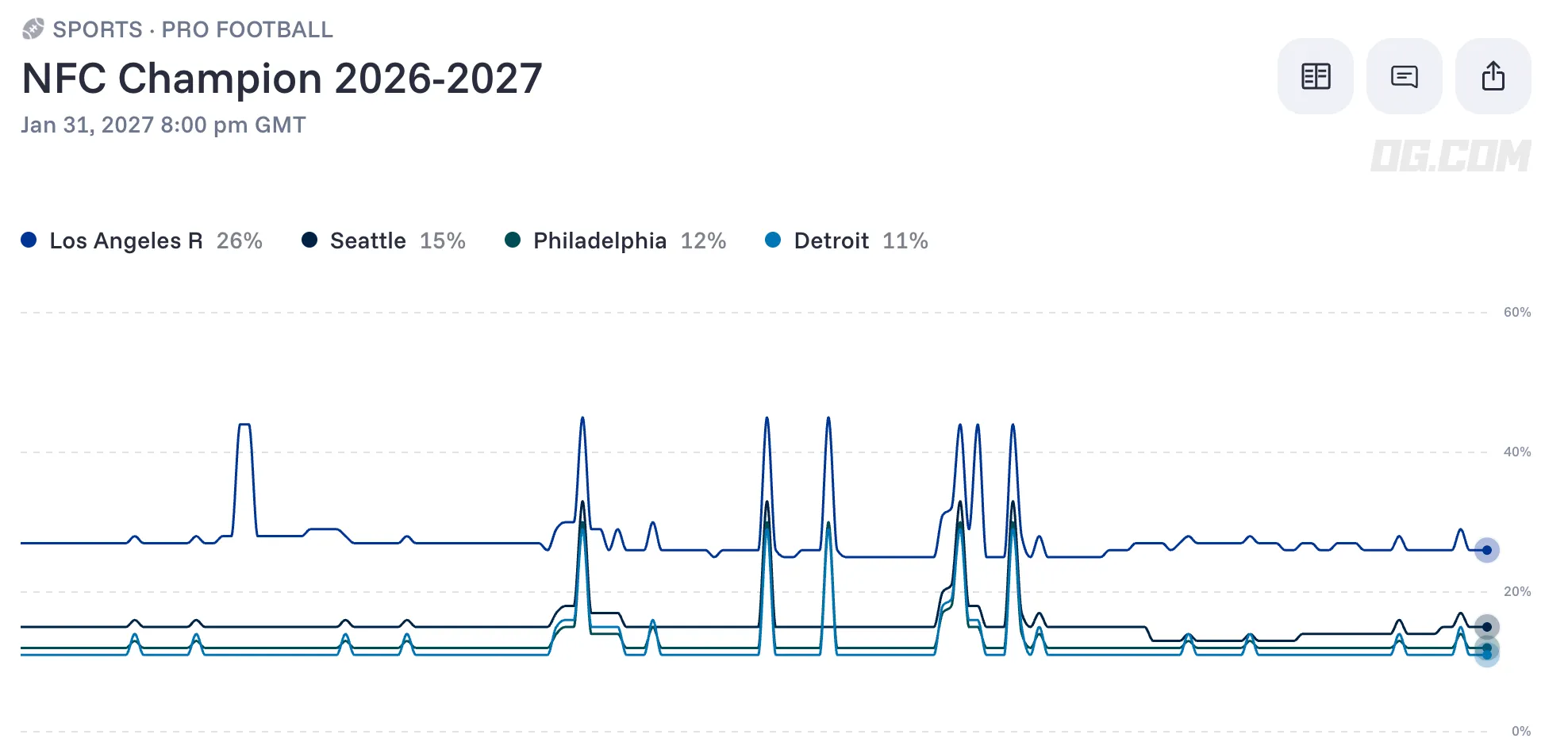
Prediction markets currently make the Los Angeles Rams the NFC favorites at 27%, with the Seattle Seahawks second at 14%.
Los Angeles Rams — 26%
Seattle Seahawks — 5%
Philadelphia Eagles — 12%
Detroit Lions — 11%
Dallas Cowboys — 11%
San Francisco 49ers — 11%
Green Bay Packers — 10%
Chicago Bears — 10%
Market data as of September 7, 2026. For the latest market-implied probabilities, check the OG app.
The gap between first and second is notable.
Los Angeles is not merely one contender among many. The market currently gives the Rams roughly twice Seattle's probability despite the Seahawks entering as defending champions.
That reflects both what Los Angeles was last season and what it has added since.
The Rams went 12-5, reached the NFC Championship Game and finished first in the NFL in total offense, yards per play, passing yards per game and offensive points per game. Stafford led the league with 4,707 passing yards and 46 touchdown passes, while Puka Nacua produced 129 receptions and 1,715 receiving yards.
Seattle presents the obvious counterargument.
The Seahawks have already shown that their formula works in January. Their defense dominated Super Bowl LX, holding New England scoreless through three quarters while producing six sacks and three takeaways.
The question is whether anybody behind those two can turn a deep NFC into a different hierarchy by the postseason.
Los Angeles Rams — have they built the NFC's most complete roster?
The Rams have the strongest case in the conference.
That starts with an offense that already needed very little fixing.
Stafford won the 2025 NFL MVP after leading the league in passing yards and touchdowns. Nacua was a unanimous First-Team All-Pro, Kyren Williams rushed for 1,252 yards and Davante Adams scored 14 receiving touchdowns. Los Angeles Rams finished first in both total offense and scoring offense.
Then the defense changed.
Myles Garrett joins a front containing Aaron Donald, Kobie Turner and Braden Fiske. Trent McDuffie and Jaylen Watson arrive in a cornerback room that underwent a major offseason overhaul.
That combination is why the 27% is significant.
Los Angeles Rams do not require a speculative breakout from its quarterback. It does not need a young offense suddenly to become elite. It does not need a weak unit merely to become respectable.
The Rams are trying to take a team that was already one win from the Super Bowl and remove the areas that prevented it getting there.
There are still vulnerabilities.
Stafford is entering his 18th NFL season, and quarterback health changes the entire calculation. Los Angeles Rams also play in a division containing the defending champions and a San Francisco team with enough high-end talent to make every divisional game meaningful.
But judged purely on the current roster, the Rams deserve to lead the conference.
Seattle Seahawks — can the champions build a second version of the same formula?
Seattle has already done the hardest thing. It has won the NFC.
The Seahawks went 14-3 last season, secured the conference's No. 1 seed and then won the Super Bowl behind a defense capable of taking games away from opponents. Darnold finished with 4,048 passing yards and a 99.1 passer rating while making his second consecutive Pro Bowl.
Much of that foundation remains.
Macdonald is still in charge. Devon Witherspoon, Leonard Williams, Ernest Jones IV and much of the defensive structure return. Smith-Njigba again leads the receiving group, with Cooper Kupp and Rashid Shaheed providing further options.
The bigger questions are offensive.
Brian Fleury has replaced Klint Kubiak as coordinator after Kubiak left for Las Vegas. The transition should be less disruptive than the title change suggests because Fleury comes from a similar Shanahan-style offensive background and Seattle deliberately prioritized continuity.
Running back is more uncertain.
Kenneth Walker III is gone. Zach Charbonnet begins the year on the physically unable to perform list after his ACL injury, leaving first-round rookie Jadarian Price among the players expected to carry the early workload.
That does not invalidate Seattle's championship case.
It does mean the 2026 Seahawks cannot simply rerun last season.
If the defense remains elite and Darnold handles another coordinator change comfortably, Seattle has already proved it can beat the teams it may meet again in January.
Philadelphia Eagles — can the offense become dangerous again?
Philadelphia's roster still looks like one capable of reaching the NFC Championship Game.
Jalen Hurts remains at quarterback. Saquon Barkley is still the foundation of the running game. DeVonta Smith becomes the leading receiver, while the offensive line retains established players such as Lane Johnson, Jordan Mailata, Landon Dickerson and Cam Jurgens.
What has changed is the passing offense around them.
A.J. Brown was traded to New England, leaving Philadelphia to rebuild part of the receiver structure with Hollywood Brown, rookie Makai Lemon, Elijah Moore and others around Smith.
Sean Mannion also takes over as offensive coordinator.
Mannion is a first-time NFL play-caller and has described the new offense as a blend of his own background with concepts that have already worked for Philadelphia.
That may be exactly what the Eagles need.
The 2025 offense too often became easier to defend than its talent suggested. Barkley and Hurts can still punish teams on the ground, but Philadelphia needs a passing structure capable of consistently exploiting defenses that commit additional bodies to stopping that run game.
The defense should keep the floor high.
Jalen Carter, Jordan Davis, Zack Baun and Nolan Smith remain central pieces, while Jonathan Greenard and A.J. Epenesa add more edge options.
Philadelphia does not need a complete rebuild.
It needs the new offense to turn established talent back into a unit opponents cannot comfortably anticipate.
Detroit Lions — is there enough continuity around the offensive stars?
Detroit still has one of the most attractive offensive cores in football.
Goff threw for 4,564 yards and 34 touchdowns last season. Gibbs produced more than 1,800 yards from scrimmage and 18 total touchdowns. Amon-Ra St. Brown and Jameson Williams give the Lions different ways to attack through the passing game.
The skill-position talent is not the concern.
The structure around it has changed.
David Montgomery is gone, with Isiah Pacheco added behind Gibbs. Taylor Decker has departed from the offensive line, and Detroit has been working through changes across a unit that has been fundamental to the offense's identity.
There is also another coordinator transition.
Drew Petzing is now running the offense, joining Detroit after three years as Arizona's offensive coordinator. Dan Campbell has praised Petzing's ability to create favorable matchups and work across different personnel groups.
Defensively, the upside remains considerable.
Aidan Hutchinson recorded 14.5 sacks last season, while Alim McNeill returns in the interior. But Detroit begins the year with Brian Branch and Kerby Joseph on the physically unable to perform list, which immediately reduces some of the secondary's strength.
The Lions can absolutely win the NFC.
The question is whether a team undergoing changes on the offensive line, in the backfield and at coordinator can maintain the efficiency that made its offense so difficult to stop.
Dallas Cowboys — what happens if the defense finally catches up?
Dallas is one of the easier NFC teams to imagine improving substantially.
The offense already has a credible foundation.
Dak Prescott returns alongside CeeDee Lamb and George Pickens, with Jake Ferguson at tight end and an offensive line containing Tyler Smith, Cooper Beebe, Tyler Booker and Terence Steele.
The offseason emphasis has been the defense.
Dallas added Rashan Gary to the pass rush, Jalen Thompson and P.J. Locke at safety and Cobie Durant at cornerback, while Quinnen Williams remains at the center of the defensive line. The initial 53-man roster also includes Von Miller and rookie safety Caleb Downs.
That is a significant amount of change.
The Cowboys do not necessarily need this group to become the best defense in football.
They need it to stop undermining an offense capable of scoring enough points to compete with the NFC's stronger teams.
If Christian Parker can turn the defensive overhaul into even a good unit, Dallas' ceiling changes considerably.
The difficulty is the division.
Philadelphia remains strong, Washington gets Jayden Daniels back, and the New York Giants are trying to accelerate under John Harbaugh.
Dallas has a plausible conference-winning roster.
It first has to prove the new defense is more than an impressive collection of offseason additions.
San Francisco 49ers — is there another run left in this core?
San Francisco is difficult to dismiss because the central pieces still look familiar.
Purdy remains the franchise quarterback. McCaffrey enters the season as the reigning Comeback Player of the Year. George Kittle is still at tight end. Deebo Samuel Sr. is back, while Mike Evans has joined the receiving group.
The 49ers also still have stars on defense, led by Fred Warner and Nick Bosa, with Raheem Morris overseeing some new fronts and defensive looks.
That gives San Francisco a very high ceiling when healthy.
The word "healthy" is doing a lot of work.
McCaffrey's availability has repeatedly changed the offense's level. Trent Williams remains vital at left tackle. Kittle's health influences both the passing and running games. The roster still has enough veteran star power that losing one or two of those pieces can quickly change how the team functions.
San Francisco also has to survive the same NFC West that contains the current conference favorite and defending Super Bowl champion.
That may make the 49ers' regular-season path harder than their roster quality alone suggests.
But a healthy Purdy-McCaffrey-Kittle offense paired with Bosa and Warner is not a team anybody will want to face in January.
Green Bay Packers — can Jordan Love push them into the top tier?
Green Bay sits just outside the most obvious NFC favorites, but the path upward is straightforward.
Jordan Love needs to elevate the offense from good to genuinely difficult to defend every week.
Christian Watson, Jayden Reed and Matthew Golden give him multiple receiving options. Tucker Kraft remains at tight end, while Green Bay added Jonnu Smith late in the roster-building process.
The uncertainty is partly around availability.
Luke Musgrave begins the season on PUP. Josh Jacobs appears on the commissioner's exempt list in Green Bay's initial roster documentation, and the offensive line has significant turnover and competition around it.
The Packers have also lost Rashan Gary to Dallas, changing the shape of the pass rush.
That leaves Green Bay needing internal development rather than relying purely on veteran additions.
The attraction remains Love.
If he reaches another level and the young roster grows around him, the Packers have enough talent to emerge from a congested NFC North.
If not, they may be good enough to threaten the playoffs without being complete enough to win three postseason games.
Chicago Bears — how high can Caleb Williams take them?
Chicago already took a meaningful step under Ben Johnson.
The Bears won 11 games last season, and Williams produced enough spectacular football to show why the offense can have a much higher ceiling.
Now the challenge is consistency.
Williams does not need more highlight-reel throws. He needs fewer stalled possessions between them.
The surrounding talent gives him a chance.
Rome Odunze and Luther Burden III lead a receiver group with different skill sets, while Colston Loveland provides another potential mismatch at tight end. D'Andre Swift remains in the backfield.
Johnson's second season should also allow the offense to move beyond installation and toward refinement.
The bigger questions sit on defense.
NFL.com's NFC North camp assessment highlighted uncertainty across the unit, including the pass rush. That matters when Chicago has to play Detroit, Green Bay and Minnesota twice before it can even think about the wider NFC.
Williams gives Chicago the biggest potential leap of any NFC contender outside the established elite.
If his week-to-week floor rises, the Bears become much harder to treat as outsiders.
Is the Rams' defense now good enough to match the offense?
Los Angeles Rams already knew they could score.
The 2025 Rams finished first in the NFL in total offense and scoring offense, with Stafford producing an MVP season and Nacua establishing himself among the league's elite receivers.
That is why the offseason matters so much.
Adding Garrett would transform most pass rushes by itself. The Rams have paired him with Donald, Turner and Fiske while also rebuilding cornerback with McDuffie and Watson.
The potential consequence is enormous.
A championship-caliber offense does not need the defense to become historically dominant. It needs enough pressure and coverage to avoid putting Stafford into weekly shootouts.
If the new front consistently creates pressure without heavy blitzing, the secondary can play with more flexibility. If McDuffie gives them a genuine matchup defender against elite receivers, the Rams suddenly have answers on both sides of the ball.
The market has already moved strongly toward that interpretation.
Now the Rams have to prove that an aggressive offseason translates into a coherent defense rather than simply a collection of famous names.
Can Seattle preserve the championship defense while rebuilding parts of the offense?
Seattle's title was not built on one side of the ball alone, but the defense gave it the largest margin for error.
The Seahawks produced six sacks and three takeaways in the Super Bowl and did not allow New England to score until the fourth quarter. That is the kind of defensive performance that can survive an imperfect offensive day in January.
Most of that identity remains.
The bigger uncertainty is whether the offense can evolve without becoming less efficient.
Fleury's scheme should retain much of the existing language and structure, and Darnold is no stranger to changing coordinators. The receiver group remains strong.
Running back is the obvious early concern.
Seattle is replacing Walker while Charbonnet continues his recovery. Price has talent, but asking a rookie to become a significant part of a defending champion's offense immediately is different from bringing him into a low-pressure situation.
If Seattle maintains its defensive standard and finds a stable rushing attack, the 14% probability could begin to look surprisingly conservative for a team that has already proved it can win the conference.
Does the NFC West help produce the champion — or make the road harder?
The conference's two leading teams are in the same division.
So is San Francisco.
That creates an unusual dynamic.
The Rams, Seahawks and 49ers can all plausibly reach the playoffs, but they also have six division games in which direct contenders take wins from one another.
Those results affect much more than an NFC West banner.
They influence playoff seeding, the likelihood of earning the conference's only first-round bye and which teams have to travel during the postseason.
The Rams may have the NFC's best roster and still find itself fighting Seattle into December simply to secure a home playoff route.
The same applies to the Seahawks.
This is one reason conference probabilities should not be read like neutral roster rankings. The route matters.
The NFC West may contain the best teams while simultaneously making their regular seasons more difficult.
Can Philadelphia reinvent the passing game without A.J. Brown?
The Eagles still have the framework of a contender.
Hurts, Barkley, Smith and an established offensive line are enough to build around, and the defense should prevent Philadelphia from needing 35 points every week.
But Brown's departure removes one of the league's most physically difficult receivers to cover.
That changes how opponents can allocate coverage.
Smith now has to operate as the unquestioned No. 1 target. Makai Lemon, Hollywood Brown and the rest of the group have to provide enough threat that defenses cannot compress everything around Barkley and Hurts.
Mannion's new offense therefore matters beyond play-calling aesthetics.
Philadelphia needs more answers when opponents take away its first option.
If those answers emerge, the Eagles have enough defensive talent and postseason experience to move much closer to the Rams and Seahawks.
If the passing game remains inconsistent, the margin against elite opponents becomes much smaller.
Which NFC North team can separate itself?
Detroit, Green Bay and Chicago can all construct convincing playoff cases.
Minnesota prevents the division from becoming comfortable for any of them.
The question is which team can become more than simply the best of a crowded group.
Detroit has the most established offensive production, but its offensive line is changing and two important defensive backs begin the year unavailable.
Green Bay has Love and a deep collection of young offensive talent, but enough uncertainty around the line, backfield and pass rush to make its ceiling difficult to pin down.
Chicago has perhaps the largest single variable in Williams.
If he becomes a more consistent down-to-down quarterback while preserving the improvisational plays that make him special, the Bears can jump levels very quickly.
Six games inside this division make the margins even smaller.
The eventual NFC North champion may emerge battle-tested.
It may also arrive in January with a worse seed because the division spent four months taking games from itself.
Can Dallas turn an offseason defensive overhaul into a functioning unit quickly enough?
There is a huge difference between adding talent and creating a defense.
Dallas has unquestionably added talent.
Gary gives it another proven edge rusher. Williams gives it high-end interior disruption. Thompson, Locke and Downs change the safety room. Durant adds another option at cornerback.
The difficulty is getting all of those pieces operating as one unit.
Communication in the secondary matters. Rush lanes matter. Coverage and pressure have to complement one another rather than exist independently.
That process can take time.
Dallas cannot afford too much of it.
Philadelphia is already established inside the division, while Washington gets Daniels back. Dropping early conference and division games while the defense finds itself can affect January seeding months later.
If Parker gets the unit functioning quickly, the Cowboys may have one of the conference's larger year-on-year improvements without the offense needing to change dramatically.
NFC Championship prediction overview
Los Angeles Rams deserve to be the favorite.
The Rams had the NFC's best offense last season, have the reigning MVP at quarterback and responded to falling short of the Super Bowl by adding elite defensive talent at every level.
There are fewer obvious weaknesses than on any other NFC contender.
Seattle remains the strongest counterargument.
The Seahawks have already beaten the postseason path the Rams are trying to navigate, and Macdonald's defense gives them a reliable foundation regardless of how quickly the reworked backfield develops.
Philadelphia belongs immediately behind that pair. Detroit still has enough offensive firepower to beat anyone, while Dallas may have improved more defensively than any other leading NFC team.
San Francisco remains dangerous because its high-end talent is still capable of producing a January run when healthy.
Then Green Bay and Chicago provide the conference with two genuine upward-mobility candidates.
So the hierarchy is clearer than in the AFC:
The Rams have the strongest case. Seattle has the strongest proof. Philadelphia, Detroit and the next group have enough talent to make neither position secure.
At 27%, Los Angeles Rams are a meaningful favorite.
It is nowhere close to an inevitable NFC champion.
What could move NFC Championship odds during the season?
The first major signal will come from the NFC West.
The Rams, Seahawks and 49ers are all capable of reaching January, so their head-to-head games could move both the division and conference markets quickly.
Stafford's health is particularly important for the Rams. The rest of the roster may be deep, but replacing an MVP quarterback is not a realistic exercise for any contender.
Seattle's offense will provide another early test. If Fleury preserves last season's efficiency and the new running-back rotation works, the defending champions may quickly move closer to Los Angeles Rams. If the offense becomes less balanced, the defense will be asked to carry a larger burden.
Philadelphia's new passing structure should also become clearer within the opening weeks. The Eagles have too much talent for the offense to remain ordinary indefinitely, but losing Brown and changing coordinators creates real uncertainty.
In the NFC North, early results may produce larger swings because the teams begin relatively close together. A Detroit offensive-line problem, a significant Love jump or a more consistent Williams could change the conference hierarchy beyond the division itself.
Dallas may be judged almost entirely on defense.
If the new group creates pressure, limits explosive plays and prevents Prescott from constantly chasing games, the Cowboys can move quickly from interesting contender to legitimate NFC threat.
Injuries will eventually become just as important as roster quality.
The NFC contains several contenders heavily dependent on veteran or high-usage stars: Stafford in Los Angeles, McCaffrey in San Francisco, Barkley in Philadelphia, Hutchinson in Detroit and others.
By December, the market should increasingly reflect playoff route as much as raw strength.
The No. 1 seed gets the only first-round bye. Division winners host playoff games. Wild-card teams may need three road victories just to reach the Super Bowl.
In a conference this deep, where January games are played may become almost as important as who is playing them.
Important Information
Prediction is an event contract that is a derivatives product offered by North American Derivatives Exchange, Inc. (NADEX), a CFTC-regulated exchange, which does business under the brand OG.com Prediction Markets (OG). Crypto.com | Derivatives North America uses a CFTC-regulated exchange that uses OG.com technology.
Trading on OG.com involves risk and may not be appropriate for all. By trading you risk losing your cost to enter any transaction, including fees. You should carefully consider whether trading on OG.com is appropriate for you in light of your investment experience and financial resources. Any trading decisions you make are solely your responsibility and at your own risk.