NFC North predictions and odds: Who will win the NFC North in 2026?
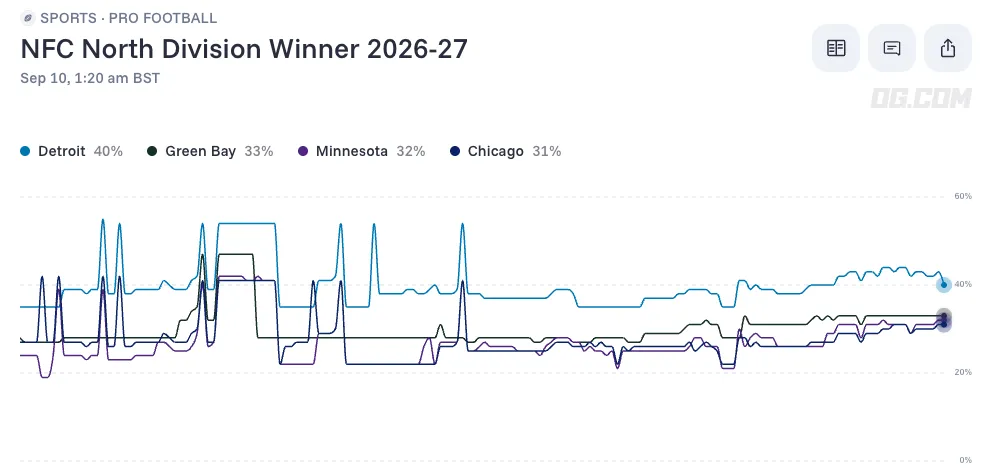
Detroit begins as the NFC North favorite, but Green Bay, Minnesota and defending champion Chicago are all within nine percentage points in the tightest four-team division market we have covered.
Football
By Chris Old
The NFC North does not have an obvious weak link.
Chicago won the division last season at 11-6 and then beat Green Bay in the playoffs. The Packers finished 9-7-1, while both Detroit and Minnesota went 9-8. Even the fourth-place Lions finished with a +68 point differential, comfortably the best in the division, which tells you how misleading the final order can be when four competitive teams spend a season taking games from one another.
Prediction markets now put Detroit back on top.
There is a strong offensive case for that. Jared Goff still has Amon-Ra St. Brown and Jameson Williams, Jahmyr Gibbs moves into an even larger role following David Montgomery's departure, and Sam LaPorta remains one of the league's better receiving tight ends.
Detroit has also changed offensive coordinators again, with Drew Petzing taking over a group that remained among the NFL's highest-scoring offenses despite significant offensive-line problems last season.
Green Bay is only seven percentage points behind and still has Jordan Love entering his prime. Minnesota has gone in a different direction by naming Kyler Murray its starter over J.J. McCarthy, adding another experienced playmaker in Jauan Jennings alongside Justin Jefferson and Jordan Addison.
Chicago, meanwhile, is somehow the fourth choice despite being the defending division champion and returning Caleb Williams for Year 2 under Ben Johnson.
That makes this less a case of identifying a favorite and more an exercise in working out which roster has the fewest unresolved issues.
This article is for informational purposes only and should not be construed as financial or investment advice. Past performance does not guarantee future results.
NFC North prediction and odds 2026
Prediction markets currently make the Detroit Lions the NFC North favorite at 40%, followed by the Green Bay Packers at 33%, Minnesota Vikings at 32% and Chicago Bears at 31%.
Detroit Lions — 40%
Green Bay Packers — 33%
Minnesota Vikings — 32%
Chicago Bears — 31%
Market data as of September 9, 2026. For the latest market-implied probabilities, check the OG app.
Nine percentage points separate first from fourth.
Detroit's favoritism seems to be based more on underlying strength than last season's finishing position. The Lions scored 481 points, most in the division, and their +68 point differential was more than double Green Bay's +31 and well above Chicago's +26 or Minnesota's +11.
Yet Detroit finished only 2-4 inside the NFC North, which helped turn a statistically strong season into fourth place.
Chicago represents the opposite tension. The Bears won the division and produced one of the league's great late-game seasons, with Williams helping them win seven games they had trailed in the final two minutes. That resilience was real, but so is the possibility that repeatedly winning tight games becomes difficult to reproduce.
Green Bay and Minnesota sit between those two stories. Both finished 9-8 or better, both went 4-2 inside the division, and both have enough high-end talent to believe relatively small improvements could put them first.
This is about as open as a four-team division race gets.
Detroit Lions — 40%
Detroit's market position starts with the offense.
Goff still operates behind one of the league's best individual linemen in Penei Sewell and has an exceptional group of skill players around him. Gibbs rushed for more than 1,200 yards last season, added another 616 receiving yards and scored 18 total touchdowns, while St. Brown and Williams give Detroit two very different threats through the air.
The offense is changing around them, however, and the line may be the most important part.
Taylor Decker has been released, Sewell has moved from right tackle to left tackle and Detroit is replacing the opposite tackle spot with either rookie first-round pick Blake Miller or a veteran option.
The Lions ranked 31st in pass-block win rate last season despite still producing a top-five offense, so even moderate improvement up front could make the unit more efficient.
Equally, another year of shaky protection would place more pressure on Goff, particularly against a division containing several capable pass rushes.
Petzing is another variable. He replaces John Morton as offensive coordinator and arrives with a reputation for designing around matchups and personnel rather than forcing the same structure every week.
Detroit already has Gibbs, St. Brown, Williams and LaPorta, so Petzing's task is less about inventing offense than arranging an unusually good collection of pieces effectively.
The defense may decide whether 40% proves justified.
Aidan Hutchinson remains the cornerstone of the pass rush and Detroit has invested heavily in retaining the core around him, but the secondary begins the season without Brian Branch and Kerby Joseph.
Both are on the reserve/PUP list and must miss at least the opening four games, with Branch recovering from a torn Achilles and Joseph from the knee injury that cost him 11 games last season.
Detroit has added veteran depth to cope with that absence, but Branch and Joseph at their best form one of the strongest safety pairings in football. Starting without both increases the pressure on the rest of the defense at precisely the point where divisional rivals are arriving with dangerous passing games.
The Lions are favored because their ceiling may still be the highest of the four.
Their route to actually winning the North depends on the offensive-line transition holding up and the defense surviving long enough to get healthy.
Green Bay Packers — 33%
Green Bay's argument starts with stability at quarterback and uncertainty almost everywhere immediately around it.
Love remains the clear franchise quarterback, now backed up by veteran Tyrod Taylor, and his receiving group still includes Christian Watson, Jayden Reed and Matthew Golden. Tucker Kraft remains the leading tight end, with Jonnu Smith another option after being added to the roster.
The offensive line has changed significantly.
Jordan Morgan takes over at left tackle after spending his first two seasons moving between guard and tackle, while Aaron Banks is at left guard and several younger players occupy the rest of the current starting group.
Green Bay has deliberately kept considerable offensive-line depth on the roster, but this is still a different unit protecting Love from the one the Packers entered last season with.
Running back introduces another uncertainty. Josh Jacobs appears on the commissioner's exempt list in Green Bay's initial roster, leaving the current depth chart headed by MarShawn Lloyd.
Defensively, the biggest early absence is Micah Parsons.
Parsons is expected to begin the regular season on PUP, meaning Green Bay will be without its premier edge rusher for at least four games. Rashan Gary has also been traded to Dallas, leaving Lukas Van Ness and a younger group responsible for generating pressure until Parsons returns.
The interior looks better equipped, with Javon Hargrave joining Devonte Wyatt and Karl Brooks, while Xavier McKinney remains the anchor at safety and Zaire Franklin has joined the linebacker group.
Green Bay went 4-2 inside the North last season, and that divisional performance gives the Packers a legitimate base.
Their 33% probability feels less like a bet on major improvement than confidence that Love, Matt LaFleur and a relatively young roster can remain around nine or 10 wins while getting healthier through the early part of the year.
If the new offensive line settles quickly and Parsons returns at full strength, Green Bay can win this division.
Minnesota Vikings — 32%
Minnesota has made the biggest quarterback decision in the division.
Kyler Murray won the starting job.
The Vikings signed Murray to a one-year contract in March, allowed him to compete with J.J. McCarthy through the offseason and training camp, then Kevin O'Connell named the veteran starter after 10 practices.
Murray brings 87 NFL starts and a very different skill set from McCarthy, particularly through his ability to create outside structure with his legs.
The supporting cast gives him plenty to work with.
Justin Jefferson remains the obvious centerpiece. Jordan Addison is back, and Jauan Jennings has joined after scoring a career-high nine touchdowns for San Francisco last season. T.J. Hockenson remains at tight end, while Aaron Jones and Jordan Mason share the top of the running-back depth chart.
That receiving group should allow O'Connell to attack defenses in different ways. Jefferson can win anywhere, Addison adds speed and route-running, while Jennings gives the offense a larger, more physical option who has been effective in contested and high-leverage situations.
The line is fairly established too, with Christian Darrisaw, Donovan Jackson, Blake Brandel, Will Fries and Brian O'Neill forming the current first unit.
The more interesting changes have come defensively.
Minnesota released Harrison Smith, Jonathan Allen and Javon Hargrave during the offseason, creating significant turnover in areas that had contained some of the roster's most experienced players.
Brian Flores still has Andrew Van Ginkel, Dallas Turner, Blake Cashman and Byron Murphy Jr., while the Vikings used their first-round pick on defensive lineman Caleb Banks.
Turner is expected to take on the rush role previously occupied by Jonathan Greenard and has generated strong camp reports, while Van Ginkel enters the season healthy.
Minnesota's 32% therefore depends partly on whether Murray can provide the offense with more stability immediately, rather than forcing the Vikings to wait another season for McCarthy's development.
If O'Connell gets a good version of Murray and Flores successfully refreshes the defense, the Vikings can absolutely improve on last year's 9-8 record.
The downside is that quarterback change can cut both ways. Murray played only five games for Arizona last season, and Minnesota is asking him to adapt quickly to a new offense while the defense works through its own personnel turnover.
Chicago Bears — 31%
Chicago is fourth in the market and first on the thing that ultimately mattered last season: the standings.
The Bears went 11-6, won the NFC North and then beat Green Bay in the playoffs. Williams set a franchise single-season record with 3,942 passing yards and repeatedly delivered late, helping Chicago win seven games it had trailed in the final two minutes.
He now gets a second full season with Ben Johnson.
That continuity could be particularly important. Year 1 was about installing Johnson's offense and rebuilding confidence after Williams' difficult rookie season. Year 2 allows the Bears to refine a system that already produced a division title rather than starting over again.
The receiving hierarchy has changed.
DJ Moore has been traded to Buffalo, leaving Rome Odunze and Luther Burden III as the leading wide receivers. Colston Loveland and Cole Kmet remain at tight end, while D'Andre Swift heads the backfield.
There is enough talent there, although Moore's departure removes an established high-volume target and places more responsibility on Odunze and Burden. Odunze dealt with a foot injury during 2025, while Burden now has a chance to become a much larger part of the offense.
The offensive line should remain one of Chicago's strengths.
Joe Thuney, Jonah Jackson and Darnell Wright return from the unit that helped drive last year's improvement, while Garrett Bradbury replaces the retired Drew Dalman at center. Thuney was named the NFL's inaugural Protector of the Year after another First-Team All-Pro season.
Defensively, the Bears have kept the core of their pass rush together. Montez Sweat is coming off a 10-sack season, with Austin Booker and Gervon Dexter Sr. also returning after finishing among Chicago's sack leaders. Devin Bush joins the linebacker group after a career year in Cleveland, while first-round pick Dillon Thieneman and veteran Coby Bryant strengthen the safety room.
Chicago at 31% is therefore an unusual fourth favorite.
The Bears are not being priced like a weak team. They are being priced like the defending champion of a division where all four teams have credible 10-win cases.
A further Williams jump would make fourth place in the market look very strange very quickly.
Can Detroit turn underlying strength into divisional wins?
Detroit's 2025 season is a useful reminder that point differential does not award playoff places.
The Lions outscored opponents by 68 points, more than twice Green Bay's margin and comfortably ahead of Chicago or Minnesota. They also scored a division-high 481 points. Yet a 2-4 NFC North record left them at the bottom of a four-team race separated by only two wins.
That puts unusual weight on the six divisional games this year.
Detroit's offense can overwhelm weaker opponents with Gibbs, Goff, St. Brown and Williams, but Chicago, Green Bay and Minnesota all know the Lions well and possess enough offensive quality of their own to punish mistakes.
The line reshuffle also arrives at an awkward time. Sewell should handle the move to left tackle, but replacing Decker and settling a new right tackle introduces more uncertainty than Detroit has been accustomed to at one of football's most important position groups.
If the Lions protect Goff better than they did last season and move closer to .500 or better inside the North, the raw strength that produced that +68 differential has a much better chance of translating into first place.
How much do Green Bay's early absences cost?
The Packers may look very different in October from how they look in September.
Parsons is expected to miss at least the first four games on PUP, while Jacobs' current availability creates another issue on offense. Green Bay is also integrating a substantially changed offensive line.
A slow start therefore would not necessarily mean the Packers are a bad team; it could simply leave them with too much ground to make up in a division where none of the other three contenders looks likely to collapse.
That is the harsh part of the NFC North.
A team can improve considerably over the course of the season and still find the mathematics unforgiving because every rival is capable of winning nine, 10 or 11 games.
Love gives Green Bay stability through that early uncertainty. If he keeps the offense functioning until Parsons and other pieces return, the Packers should remain in the race. If protection problems and a diminished pass rush produce several early losses, 33% can shrink before the roster ever reaches its intended form.
What version of Kyler Murray does Minnesota get?
Minnesota has enough talent around the quarterback that Murray does not need to produce a career year.
He does need to be good.
O'Connell's offense gives him Jefferson, Addison, Jennings and Hockenson, plus a stable line and two experienced running backs. There are few excuses around supporting personnel.
The uncertainty comes from Murray's recent history.
He played only five games last season, and his Arizona career contained both high-level stretches and periods where injuries or offensive instability interrupted momentum. Minnesota is betting that putting him into O'Connell's system can recover more of the former.
His mobility could be particularly useful. It adds another dimension to an offense that already stretches defenses horizontally and vertically through Jefferson and the receiving group, while also giving Minnesota an answer when protection breaks down.
If Murray stays healthy and plays efficient football, 32% may prove conservative. If the adjustment takes longer or availability becomes an issue again, McCarthy waiting behind him quickly becomes part of the conversation.
Can Caleb Williams turn late-game brilliance into broader dominance?
Chicago's seven late comeback wins were one of the defining stories of the 2025 season.
They were also an inherently difficult thing to repeat.
Williams deserves enormous credit for producing in those situations, but the Bears would rather not need the final two minutes to decide so many games. The next stage of his development is turning more of those dramatic victories into afternoons where Chicago controls the game earlier.
The foundation is there.
The offensive line is far stronger than it was when Williams entered the league. Johnson's system is now familiar. Odunze, Burden, Loveland and Kmet give him a young receiving group that can grow with him.
Losing Moore reduces proven production, but it also clarifies the next generation of the offense.
If Williams improves his early-down efficiency and Chicago remains dangerous in high-leverage situations, the Bears may actually be better while producing fewer spectacular comebacks.
That is the version of Chicago capable of defending the division title.
Will the NFC North cannibalize itself again?
Last year's records tell the story.
Chicago: 11-6.
Green Bay: 9-7-1.
Minnesota: 9-8.
Detroit: 9-8.
There was no comfortable rebuilding team handing everybody two expected wins.
Green Bay and Minnesota each went 4-2 inside the division. Chicago and Detroit both went 2-4. Those six games had an enormous influence on an otherwise tightly packed table.
Nothing about 2026 suggests the division has become easier.
Detroit is the market favorite.
Chicago is the defending champion.
Green Bay still has Love and a roster expecting to make the playoffs.
Minnesota has deliberately chosen an experienced quarterback because it believes the rest of the roster can win now.
A team going 5-1 inside the North could create separation without needing a dominant overall season. Go 2-4, as Detroit and Chicago did last year, and even strong performances elsewhere may leave very little margin.
This division may ultimately be decided less by who has the best roster on paper than by who consistently wins the games where both teams already know exactly what the other wants to do.
NFC North prediction
Detroit has the strongest case, but not by enough to make this comfortable.
The Lions produced the division's best point differential and highest-scoring offense last season despite finishing fourth. Goff, Gibbs, St. Brown and Williams remain, while Hutchinson gives the defense a genuine game-changing pass rusher.
There are real concerns around them. The offensive line is changing and the defense starts without Branch and Joseph, so Detroit's 40% is much easier to understand as a slight preference than a declaration that the Lions are clearly better than everybody else.
Green Bay may have the most conventional challenger profile. Love is established, the Packers went 4-2 in the division last season and Parsons can transform the defense when he returns. Their early health and offensive-line questions make the first month particularly important.
Minnesota has a higher variance. Murray entering O'Connell's offense with Jefferson, Addison and Jennings can work extremely well, while Flores still has enough defensive talent to make life difficult for opponents. There is simply more uncertainty attached to a new starting quarterback and significant defensive personnel turnover.
Chicago being fourth at 31% demonstrates how strong the division is. The Bears won it last season and Williams is entering Year 2 in Johnson's system rather than starting over. If his development continues, there is no reason Chicago cannot defend its title.
What could move NFC North odds during the season?
Detroit's early defense will be worth watching closely.
Branch and Joseph are guaranteed to miss the first four games, so the Lions need their replacement secondary to survive until two major starters can return. If Detroit banks wins anyway, its current market lead may grow before the roster even reaches full strength.
Green Bay's first month revolves around similar logic. Parsons' absence reduces the pass rush, while the offensive line and backfield are both working through change. A stable 3-1 opening stretch would be far more encouraging than simply judging the Packers on whether they look polished immediately.
Minnesota's market should respond quickly to Murray. If he looks comfortable in O'Connell's offense and consistently finds Jefferson, Addison and Jennings without relying on broken plays, the Vikings suddenly have one of the strongest passing-game arguments in the division.
Chicago's signal is likely to be less dramatic. Williams simply needs to continue the progression we saw last year while the rebuilt receiving hierarchy settles around him. If the Bears win games without repeatedly needing miracle finishes, the defending champion will start looking more sustainable.
The divisional schedule may eventually override all of those individual narratives.
With four teams this closely matched, head-to-head results create immediate two-way swings: one team gains a win while another contender takes the loss. By December, 40%, 33%, 32% and 31% may feel less important than who managed to go 4-2 or 5-1 against the other three.
Important Information
Prediction is an event contract that is a derivatives product offered by North American Derivatives Exchange, Inc. (NADEX), a CFTC-regulated exchange, which does business under the brand OG.com Prediction Markets (OG). Crypto.com | Derivatives North America uses a CFTC-regulated exchange that uses OG.com technology.
Trading on OG.com involves risk and may not be appropriate for all. By trading you risk losing your cost to enter any transaction, including fees. You should carefully consider whether trading on OG.com is appropriate for you in light of your investment experience and financial resources. Any trading decisions you make are solely your responsibility and at your own risk.