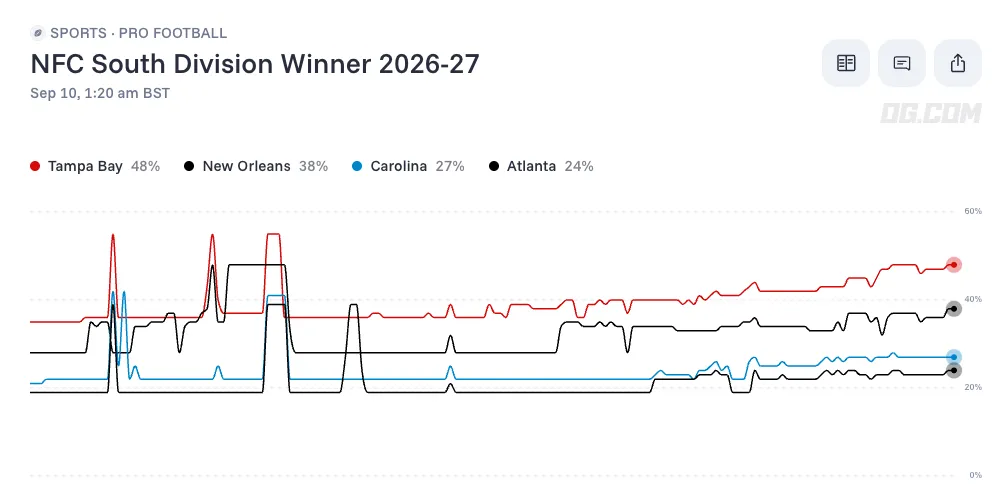
NFC South predictions and odds: Who will win the NFC South in 2026?
Tampa Bay enters as the NFC South favorite despite missing the playoffs last season, while New Orleans has surged into second and defending champion Carolina begins as only the third choice.
Football
By Chris Old
The NFC South finished last season with three teams on exactly the same record.
Carolina, Tampa Bay and Atlanta all went 8-9, with the Panthers taking the division on the relevant tiebreakers and hosting the franchise's first playoff game in a decade. New Orleans finished 6-11, although that final record disguises a much stronger finish once rookie Tyler Shough took over at quarterback.
Prediction markets have responded by producing a very different order for 2026.
Tampa Bay is back on top at 48% even after its five-year playoff streak ended last season. Baker Mayfield returns, Bucky Irving is healthy again and a receiving group containing Chris Godwin Jr., Emeka Egbuka and Jalen McMillan now has to move forward without Mike Evans for the first time since 2013. The Buccaneers have also invested heavily in rebuilding a defense that slipped badly against the pass and generated its lowest sack total of the Todd Bowles era.
New Orleans at 38% may be the more interesting development. Shough went 5-4 as a starter after taking over during his rookie season, and the Saints averaged 25 points during a late four-game winning streak. He now enters Year 2 as the unquestioned starter with Chris Olave, first-round receiver Jordyn Tyson and a full offseason in Kellen Moore's system.
Carolina is somehow only third after winning the division, while Atlanta has one of the league's more complicated quarterback situations after naming Tua Tagovailoa its Week 1 starter ahead of a still-recovering Michael Penix Jr.
This article is for informational purposes only and should not be construed as financial or investment advice. Past performance does not guarantee future results.
NFC South prediction and odds 2026
Prediction markets currently make the Tampa Bay Buccaneers the NFC South favorite at 48%, followed by the New Orleans Saints at 38%, Carolina Panthers at 27% and Atlanta Falcons at 24%.
Tampa Bay Buccaneers — 48%
New Orleans Saints — 38%
Carolina Panthers — 27%
Atlanta Falcons — 24%
Market data as of September 9, 2026. For the latest market-implied probabilities, check the OG app.
The market is making two fairly strong judgments.
First, Tampa Bay's 8-9 season is being treated more like a temporary step backward than the beginning of a decline. The Buccaneers were hit heavily by injuries, particularly around Mayfield and the offense, and had ranked in the top five in scoring, total yards, rushing and passing only one season earlier.
Second, last year's standings are not being taken literally.
Carolina won the NFC South but begins 21 percentage points behind Tampa Bay and 11 behind New Orleans. Atlanta finished with the same 8-9 record as the Panthers and Buccaneers but sits fourth at 24%.
There are legitimate reasons for each assessment, although a division that produced three eight-win teams last season probably deserves some caution before anybody is treated as comfortably ahead.
Tampa Bay Buccaneers — 48%
Tampa Bay's argument starts with the most established quarterback situation in the division.
Mayfield enters his fourth season with the Buccaneers after throwing for 3,693 yards, 26 touchdowns and 11 interceptions in 2025. His production fell during the second half as injuries accumulated around both him and the offense, but across his first three Tampa Bay seasons he still ranked third in the NFL in passing yards and second in touchdown passes.
The offense around him looks different.
Evans has left after 12 seasons, removing the most productive offensive player in franchise history and one of football's most consistent outside receivers. Tampa Bay is not trying to replace him with a single equivalent target; instead, Godwin, Egbuka and McMillan give Mayfield a deeper collection of interchangeable receivers, with Cade Otton still at tight end.
Bucky Irving could also restore something the offense lost last year. His rookie season produced 1,122 rushing yards and 1,514 yards from scrimmage before shoulder and foot injuries reduced his second-year output. He enters 2026 healthy, with Kenneth Gainwell added after surpassing 1,000 scrimmage yards for Pittsburgh last season.
That gives new offensive coordinator Zac Robinson plenty to work with. Tampa Bay's challenge is finding the explosiveness of its 2024 offense without Evans while getting more consistent health and protection around Mayfield.
The defensive changes may be even more important.
Tampa Bay finished 21st in points allowed, 19th in total defense and 27th against the pass last season, while the pass rush produced its lowest sack total in Bowles' seven seasons with the team.
The offseason response was concentrated up front. A'Shawn Robinson and Rakeem Nuñez-Roches add size inside, while the edge rotation has been rebuilt around a deeper group. Tampa Bay kept seven interior defensive linemen on its initial roster, an unusually heavy allocation that reflects how deliberately the front office attacked the weakness.
At 48%, the market is effectively betting that the quarterback and offensive foundation remain strong enough while the defense moves back toward average.
That is a sensible favorite.
It is not an overwhelming one.
New Orleans Saints — 38%
New Orleans may have the cleanest improvement case in the division because the strongest version of the Saints appeared late last season rather than early.
The final record was 6-11, but Shough went 5-4 after taking over as starter and was good enough to become a finalist for Offensive Rookie of the Year. New Orleans averaged 25 points during a four-game winning streak with Shough at quarterback, compared with only 15.3 across the other 13 games.
That gives the Saints something they lacked entering his rookie year: clarity.
Shough is not competing for the job this summer. He has had a full offseason to work in Moore's offense, add strength and build chemistry with a receiving group that has also been upgraded.
Olave remains the established No. 1 after earning second-team All-Pro recognition last season. First-round pick Jordyn Tyson adds another high-upside receiver, while Devaughn Vele and Ja'Lynn Polk give the group more depth.
The offense does not need Shough to become an elite quarterback overnight. Sustaining the level shown during the stronger half of his rookie season would already represent significant progress for a team that spent much of 2025 struggling to score.
Defensively, New Orleans enters Year 2 of Brandon Staley's system with more continuity. Chase Young produced a career-high 10 sacks last season, Cam Jordan added 10.5 and Carl Granderson finished with six, giving the Saints an established edge rotation before even considering the younger players behind them.
There have still been important changes. Kaden Elliss replaces Demario Davis at linebacker, while Kool-Aid McKinstry, Justin Reid and Jonas Sanker form part of a secondary the Saints believe can remain one of the defense's stronger units.
The 38% probability makes sense because New Orleans does not require a complete reinvention to contend.
It needs the team that finished 2025 strongly to become the team that plays most of 2026.
Carolina Panthers — 27%
Carolina is the defending division champion and only the third choice.
That is probably the most interesting contradiction on the board.
The Panthers went 8-9, the same record as Tampa Bay and Atlanta, and won the NFC South on tiebreakers. Bryce Young produced career highs in passing yards, touchdowns, completion percentage and passer rating while leading six game-winning drives in the fourth quarter or overtime.
His final line — 3,011 yards, 23 touchdowns and 11 interceptions — was not spectacular by modern passing standards, but the progression was obvious enough that Carolina exercised his fifth-year option without hesitation.
Year 4 is about pushing that development further.
Tetairoa McMillan and Jalen Coker enter as the leading receivers, with Xavier Legette still trying to establish more consistent production. John Metchie III also made the roster after a strong preseason and existing chemistry with Young.
The defense has probably changed more dramatically.
Derrick Brown remains the centerpiece inside, while Jaelan Phillips was one of Carolina's major free-agent additions on the edge. Devin Lloyd joins the linebacker level after an All-Pro season in Jacksonville, although the loss of Nic Scourton to a season-ending knee injury removes one of the young pass rushers Carolina expected to develop alongside Phillips.
Those moves were necessary.
Carolina allowed 380 points last season and finished with a -69 point differential, substantially worse than Tampa Bay or Atlanta despite ultimately finishing above both in the standings.
That explains part of the 27%.
The Panthers proved they could win close games and navigate the division. The market is less convinced that their underlying performance was strong enough to make them the most likely repeat winner.
Young can change that quickly.
If his development continues and the defensive additions produce the intended jump, the defending champion could look underpriced.
Atlanta Falcons — 24%
Atlanta finished last season in a strangely encouraging way.
The Falcons were 4-9 and already eliminated from postseason contention before winning their final four games to finish 8-9, the same overall record as both Carolina and Tampa Bay.
Almost everything around that finish has since changed.
Kevin Stefanski is the new head coach, while the quarterback position became an offseason competition between Penix and Tagovailoa. Penix spent much of the summer working back from ACL surgery and was only cleared for full 11-on-11 work in late August; Atlanta has since named Tagovailoa the Week 1 starter, with Penix inactive while he continues returning toward full health.
Tua inherits a strong group of skill players.
Bijan Robinson remains the centerpiece of the backfield, Drake London leads the receivers and Kyle Pitts Sr. remains at tight end. Brian Robinson Jr., Jahan Dotson and Olamide Zaccheaus give the offense further veteran depth around them.
There is enough talent here for Stefanski to build a functional offense without asking Tagovailoa to create everything himself.
The quarterback uncertainty still lowers the floor. Tua has to settle quickly into a new organization, while Penix's recovery means Atlanta does not currently have the straightforward succession plan it hoped to establish when the offseason began.
Defensively, Jessie Bates III and A.J. Terrell Jr. remain the established leaders, and Atlanta has added Za'Darius Smith and Gervon Dexter Sr. up front. The group suffered a major setback in camp when Jalon Walker tore his ACL, removing a second-year edge defender who had produced 5.5 sacks and 27 pressures as a rookie.
That makes 24% a reasonable position.
Atlanta is not short of offensive playmakers and finished last season better than its early record suggested. It simply has more uncertainty at the sport's most important position than any of the three teams currently above it.
Can Tampa Bay replace Mike Evans without losing its offensive identity?
Evans' departure is not a normal receiver change.
For 12 seasons, Tampa Bay could rely on one of football's most consistent outside threats to win vertically, create space for other receivers and give the quarterback a reliable option in contested situations. He leaves as the most productive offensive player in franchise history.
The Buccaneers have prepared for this more intelligently than simply trying to find another version of Evans.
Egbuka, Godwin and McMillan all offer positional flexibility, and the roster has been built so Robinson can move receivers around rather than leaving everybody in fixed roles. Bucky Irving's return to health also gives the offense another explosive element underneath, where a productive running game can stop defenses simply widening coverage around Mayfield's receivers.
The concern is what happens in the highest-leverage passing situations.
Third-and-long, red-zone snaps and late drives often become less about the design of the offense and more about whether one player can beat tight coverage. Evans supplied that answer for more than a decade.
If Egbuka takes another step and Godwin stays healthy, Tampa Bay probably has enough collective receiving quality to absorb the loss. If the group becomes easier to defend when games tighten, the favorite's 48% begins to look less secure.
Is Tyler Shough's strong finish the beginning of something bigger?
New Orleans is being priced much more aggressively than a conventional 6-11 team.
Shough is the reason.
A 5-4 record as a rookie starter already changes the context, particularly because New Orleans produced some of its best offensive football during the late stretch with him behind center.
The normal Year 2 advantages are also substantial.
Shough now understands Moore's terminology, protections and route concepts. Instead of spending training camp competing to establish himself as QB1, he has been able to work as the offense's clear leader from the start.
Tyson gives him another potential difference-maker alongside Olave, and Moore's entire scheme is now entering a second season rather than being installed from scratch.
There is still a difference between looking promising across nine starts and leading a winning team for 17 games.
Defenses now have meaningful professional tape on Shough. They can identify the concepts he handled best, the pressure looks that caused problems and where he preferred to throw when moved off his first read.
If he answers those adjustments, New Orleans may have found its long-term quarterback and a genuine division contender at the same time.
Can Bryce Young push Carolina beyond close-game football?
Young's late-game record was one of Carolina's strengths last season.
Six game-winning drives helped turn an 8-9 team with a negative point differential into the NFC South champion, and his 101.2 passer rating in one-score games ranked behind only Josh Allen and Lamar Jackson among qualifying quarterbacks.
Carolina would still prefer fewer games to require that kind of rescue.
The Panthers scored only 311 points last season, the lowest total among the three 8-9 NFC South teams.
Young's next step is therefore less about proving he can handle pressure late and more about creating separation earlier. McMillan gives him a legitimate top receiver, the offensive system is familiar and his line has been reinforced further through the offseason.
There should be fewer excuses for an offense that spends long periods struggling before finding its best football in the fourth quarter.
If Young can turn some of those comeback wins into more controlled performances, Carolina has a good chance of outperforming 27%.
If the Panthers again depend heavily on late-game execution, repeating last season's close margins becomes a more difficult proposition.
Which Atlanta quarterback ultimately gives the Falcons the higher ceiling?
Atlanta enters Week 1 with an answer.
It may not be the answer for the entire season.
Tagovailoa has won the opening job because Penix's recovery prevented the competition from unfolding under completely equal circumstances. Stefanski described the decision as an all-encompassing evaluation, while Penix has acknowledged that he is close to — but not yet at — 100%.
Tua's appeal is easy to understand.
He has significant NFL starting experience, gets the ball out quickly and joins an offense containing Robinson, London and Pitts. Stefanski can build timing and play-action concepts around that group without asking Tua to become a constant off-script creator.
Penix offers a different ceiling through his arm strength and ability to attack vertically, but his immediate job is getting fully healthy after knee surgery.
If Tagovailoa plays well, the issue disappears and Atlanta gains stability at exactly the position where the market has the most questions.
If the offense struggles while Penix gets healthier, the quarterback discussion will return quickly. In a division where only 24 percentage points separate first from fourth, even a few weeks of uncertainty can matter.
Was last season's NFC South chaos a warning for 2026?
Carolina, Tampa Bay and Atlanta all finished 8-9.
New Orleans went 6-11 but finished strongly enough to create optimism around Shough.
Every team went 3-3 inside the division.
That is remarkably little separation.
There was no team capable of dominating its direct rivals, and the eventual champion finished with a losing overall record. The NFC South may be stronger this season, but there is still no evidence that one roster has separated enough to expect a runaway.
Tampa Bay is only two years removed from an elite offensive season and has the most established quarterback.
New Orleans may have found its own quarterback.
Carolina actually won the division and has continued building around Young.
Atlanta has enough offensive talent that stable quarterback play alone could produce a significant jump.
The six divisional games may therefore become even more important than normal. Last year's universal 3-3 records meant nobody gained an advantage there; a team going 5-1 in 2026 could create the separation the overall roster quality does not currently provide.
NFC South prediction overview
Tampa Bay has the strongest case, although the 48% probability feels more like a narrow favorite than a team that should control the division.
Mayfield is the most proven current quarterback in the South, Irving returns healthy and the receiving group has enough depth to remain productive without Evans. The bigger variable is whether the rebuilt defense can improve enough after finishing near the bottom of the league against the pass.
New Orleans is the most interesting challenger. Shough's 5-4 rookie record and the Saints' stronger late-season offense provide genuine evidence rather than offseason speculation, and he now has a full year of development plus additional receiving help around him.
Carolina should not be dismissed simply because prediction markets have pushed the defending champion to third. Young improved significantly, the Panthers know how to win tight games and their defense has added experienced talent. The concern is that last year's negative point differential suggests there was less underlying strength than the division title itself implies.
Atlanta has the widest range of outcomes. Robinson, London and Pitts give the offense a strong core, while the defense still has established high-end pieces. The quarterback position and Penix's recovery make the Falcons harder to trust before the season begins.
What could move NFC South odds during the season?
Tampa Bay's passing game should provide the first major signal.
If Egbuka, Godwin and McMillan absorb Evans' departure without Mayfield losing efficiency in high-leverage situations, the Buccaneers will have answered the most obvious offensive concern. Improvement from the rebuilt pass rush would strengthen the case further.
New Orleans could move faster than anybody if Shough opens the season at the same level he finished the last one. His 38% already assumes meaningful improvement; a strong September would provide evidence that the late-2025 run was sustainable rather than simply a promising rookie stretch.
Carolina's market is likely to follow Young. Another jump in efficiency, particularly earlier in games, would make the defending champion difficult to leave at 27%. The new-look front seven also needs to show it can create more consistent pressure after the offseason investment around Brown and Phillips.
Atlanta's quarterback position is the most obvious source of volatility. Tua begins as the starter, but Penix is now back in full-team work and continuing toward complete health. Strong early quarterback play creates stability. Struggles immediately reopen the competition.
Then come the six NFC South games.
Nobody finished better than 3-3 inside the division last season, which helped create the three-way 8-9 tie at the top. A team capable of establishing genuine control over those direct matchups could alter the entire race before the wider standings ever begin to separate.
Important Information
Prediction is an event contract that is a derivatives product offered by North American Derivatives Exchange, Inc. (NADEX), a CFTC-regulated exchange, which does business under the brand OG.com Prediction Markets (OG). Crypto.com | Derivatives North America uses a CFTC-regulated exchange that uses OG.com technology.
Trading on OG.com involves risk and may not be appropriate for all. By trading you risk losing your cost to enter any transaction, including fees. You should carefully consider whether trading on OG.com is appropriate for you in light of your investment experience and financial resources. Any trading decisions you make are solely your responsibility and at your own risk.