NFL rules explained: a beginner-friendly guide for every fan
New to NFL? This beginner-friendly guide explains how the game works, including quarters, downs, scoring, player positions, common penalties, and overtime rules.
Football
By Sam Bloomquist
Parachuting into the football season for the first time? You may be asking yourself, “How does NFL work?”
At first, it can seem like a lot is going on, but if you understand the structure of an NFL game, you’ll be able to follow along much more easily. There are rules in place to ensure a level playing field for both sides, and referees assess penalties based on these rules.
Penalties can swing games if they happen during a crucial sequence, so you’ll surely want to brush up on everything before the ball is snapped. In this article, we’ll go over all of the football rules for beginners.
This article is for informational purposes only and should not be construed as financial or investment advice. Past performance does not guarantee future results.
How is an NFL game structured?
NFL games have four 15-minute quarters, equaling 60 minutes of game time. There is a break between quarters where teams switch sides of the field, including a roughly 13-minute-long halftime period.
The teams decide who gets the ball first by flipping a coin. The visiting team calls heads or tails in the air. If they call it correctly, they can choose to receive the ball, kick, choose which side of the field to defend, or defer their choice until the second half. The other team then chooses from the remaining options.
Downs-and-yardage system
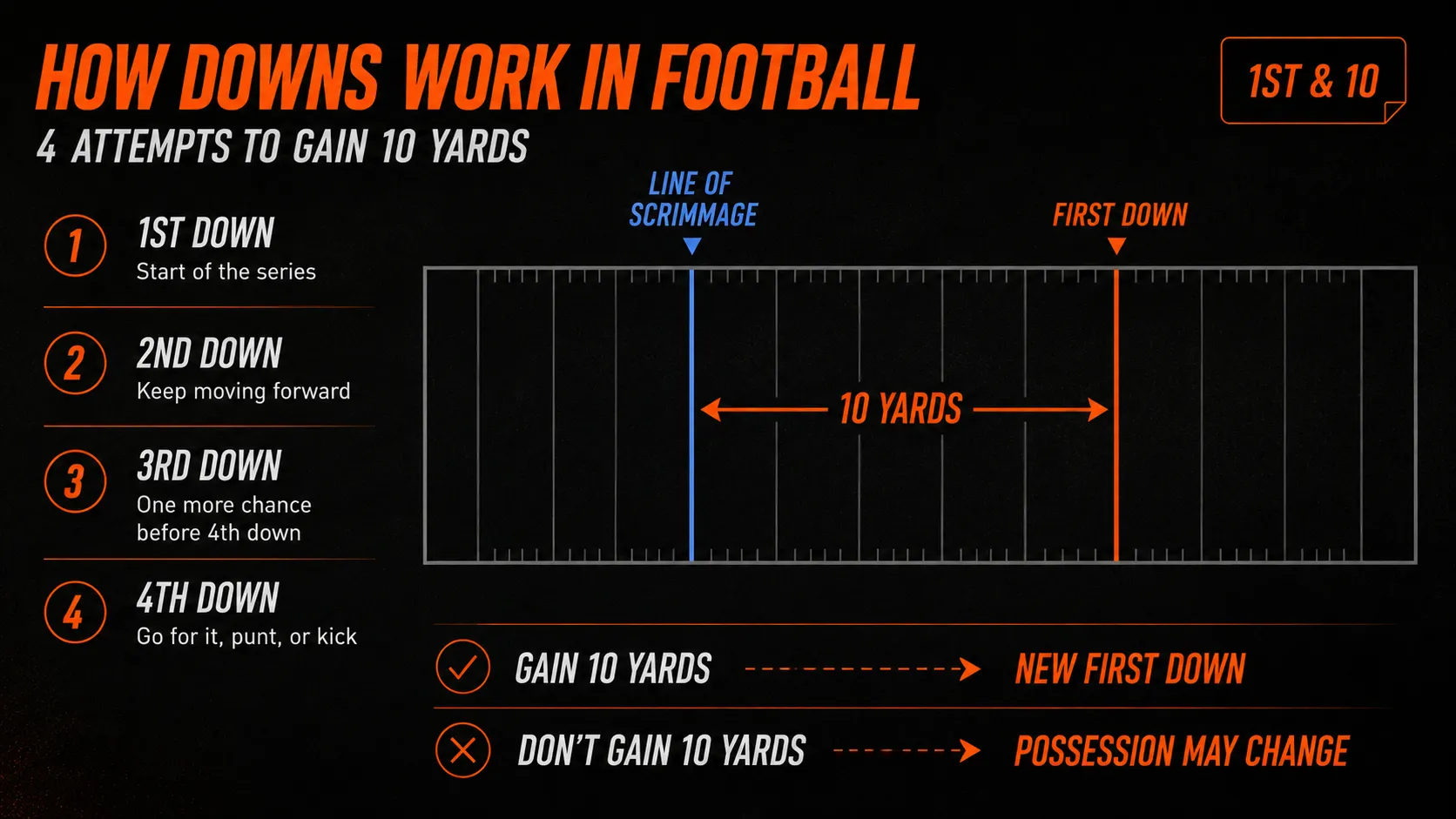
The offense has four downs to gain ten yards. If they are successful, then they convert a first down and get four more chances to advance the ball again. If they fail to gain ten yards in four downs, then they turn the ball over to the other team wherever it's spotted at the end of fourth down.
If the team is stuck on their own side of the field, rather than trying to convert a first down, they will punt the ball to the other side of the field so that the other team’s offense starts further away from the end zone. If either team scores, then they will kick the ball off to the other team, as they do in the opening kickoff.
How scoring works in football
1. Touchdown and extra points
The football scoring rules all begin with the almighty touchdown. When a player carries the ball into the opposing team’s end zone or catches it there, it’s considered a touchdown.
A touchdown is worth six points. The offense can elect to kick an extra point or go for two. An extra point is essentially a field goal attempt from the 15-yard line worth one point. When a team goes for two, they get one untimed down from the 2-yard line, and if they make it to the end zone, they are awarded two points.
2. Field goals
If the team is within the kicker’s range and doesn’t believe they can convert a touchdown on fourth down, you’ll see them line up for a field goal. The ball is snapped to a holder, who places it for the kicker. If the kicker sends it through the uprights, the team scores three points.
3. Defensive touchdowns
If the defense takes an interception, fumble, or blocked kick into the opposing team’s end zone, they score a touchdown.
4. Safeties
Safeties are one of the other few ways the defense can score. If the offense is tackled in their own end zone, the defense is awarded two points for a safety. The team that conceded the safety then kicks the ball back to the other team.
Field, players and positions
An NFL field is 100 yards long, with a 10-yard end zone at each end. The field is 53.3 yards wide.
There are 11 players on each team allowed on the field at a time. The offense is made up of a Quarterback, Running Back, Wide Receivers, Tight End, Fullback and Offensive Line. The Defense has a Defensive Line, Linebackers, Cornerbacks, and Safeties. Learn more about football positions and their roles.
Football penalty rules: Common penalties and what they mean
Offsides: An offside penalty occurs when a player is in or beyond the neutral zone when the ball is snapped. Offside is a 5-yard penalty.
Holding: A holding penalty occurs when a player blocks a defender or covers a receiver, and they grab onto them so they can’t get away from the opposing player. Holding on offense is generally a 10-yard penalty, while defensive holding is a 5-yard penalty and gives the offense an automatic first down.
Pass Interference: Pass interference can occur on either offense or defense. When a pass is thrown, if a receiver or defender pushes or tackles the other player pursuing the pass, they are given an interference call. Offensive pass interference is a 10-yard penalty from the original line of scrimmage, while defensive pass interference is a spot foul. A spot foul means the team gets the ball where the foul occurred.
Roughing the Passer: Roughing the passer can only be called on the defense, and they throw the flag when a defender puts a hit on the Quarterback that is deemed unnecessary. This could be anything from hitting them after the ball is thrown to driving the Quarterback into the ground with their full body weight. Roughing the passer is a 15-yard penalty and results in an automatic first down.
Illegal Formation: When you snap the ball on offense, seven of your players must be lined up on the line of scrimmage, meaning you cannot have more than four players in the backfield. If the offense has too many players off the line, they are assessed a 5-yard penalty and replay the down.
NFL overtime rules explained: regular season and playoffs
If the score is tied after four quarters of regulation time, the game goes into overtime. They redo the coin toss like the beginning of the game to decide possession. Then, they play one 10-minute overtime period where both teams normally get an opportunity to possess the ball.
If the score is still tied after each team has possession, then the next team to score wins the game. In the regular season, if the teams are still tied after the 10-minute overtime period, the game results in a tie.
In the playoffs, most of the rules are the same, but instead of a 10-minute overtime period, they set the clock to 15 minutes. Playoff games also cannot result in a tie, meaning if the teams are still tied after the initial 15-minute period, they play another until the game is decided.
FAQs about NFL rules
What does 1st and 10 mean in football?
The offense is on first down, and they have to gain ten yards to gain another first down. They have four downs to gain the necessary yardage.
How many players are on the field at one time?
There are 11 players on offense and 11 players on defense, so during a normal play there are 22 players on the field altogether.
What is the two-minute warning?
In football, when the game clock reaches 2:00 remaining in the second quarter or fourth quarter, play is stopped. Think of it as an extra, automatic timeout built into the rules. Neither team has to use one of its own timeouts.
How long is an NFL game?
An NFL game lasts four 15-minute quarters, which equals to 60 minutes of official playing time.
What happens if a football game is tied after overtime?
In the regular season, the game ends in a tie if the score is still level when overtime expires. In the playoffs, they continue playing additional overtime periods until there is a winner.