NFL positions explained: a complete guide to every role on the field
Every NFL team must adhere to a standard roster of 53 players throughout the season, but how each team builds that roster differs slightly from team to team.
Football
By Sam Bloomquist
To understand what is going on with your favorite NFL team and some of the roster moves they make throughout the season, you have to know football positions and their roles.
Each team follows a basic outline to cover the depth at each position, but makes minor tweaks at the end depending on the kind of personnel they have. Getting the right formula of players is the key to winning a championship.
This article is for informational purposes only and should not be construed as financial or investment advice. Past performance does not guarantee future results.
How NFL rosters are organized
Each year, NFL teams welcome upwards of 90 players into their training camps. Those players are all competing for a spot on the regular season 53-man roster. The team also keeps 17 players that comprise the practice squad, and many of those spots are earned in training camp as well.
Practice squad players cannot compete on game days. Each week, teams are only allowed to activate 48 players from their roster to play in the game, which is called the active roster.
Offensive positions in NFL
Offensive backfield
: What is the hardest position in NFL? It has to be the Quarterback. He calls the plays, gets the ball snapped to him to start every play, and then he will either hand the ball off, run it, or pass it.
Quarterback
Running Back: This is the team's primary rusher and receives nearly all handoffs from the Quarterback. The Running Back may also block or go out for a pass when a passing play is called.
Fullback: The Fullback's primary responsibility is to block for whoever is running the ball, but they are also allowed to run the ball themselves or go out for a pass, depending on the play called. Many teams elect not to use a Fullback on a majority of their plays, and it is considered to be the rarest position in NFL.
Where do the pass catchers line up?
Wide Receivers: These are the players on the edge of the offensive formation that run downfield. Their primary responsibility is getting open for the Quarterback to catch the ball.
Tight Ends: These players can line up between the Offensive Line and the Wide Receivers. They can either go down in a three-point stance like the Offensive Line, or stand up in the space between the two units in the slot. Tight Ends can catch the ball like Wide Receivers and Running Backs, but will also be asked to block more often than not.
Makeup of an Offensive Line
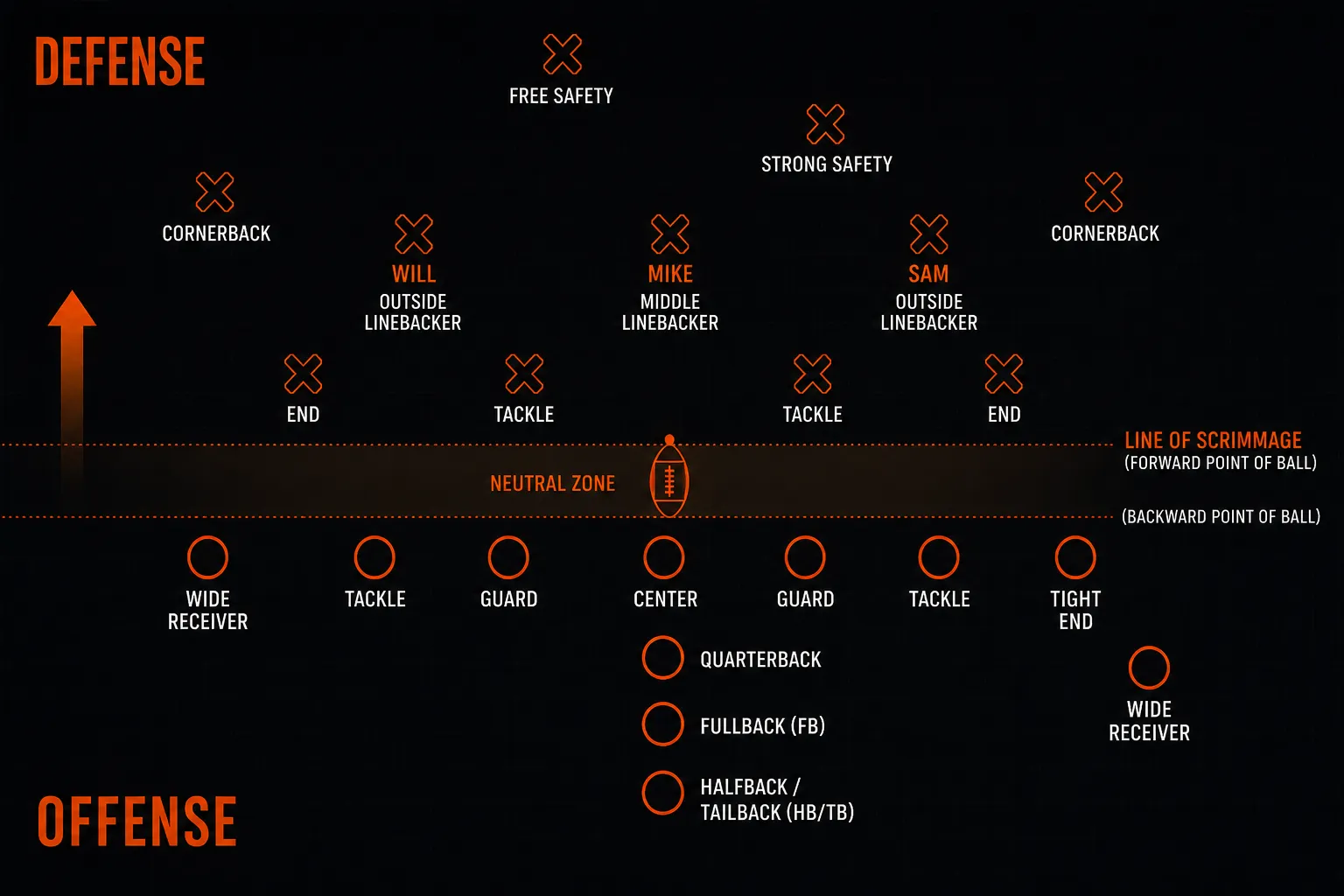
Offensive Tackles: The Offensive Line is the five players down in a three-point stance to start the play. Their only responsibility is to block for the other positions. The two outermost players on the line are the Offensive Tackles. They are tasked with securing the edge of the line and blocking the pass rushers.
Offensive Guards: The two players directly next to the Offensive Tackles are the Offensive Guards. They block for the interior of the offense. Having strong Offensive Guards can bolster a team’s rushing attack.
Centers: The player lined up in the middle of the Offensive Line is the Center. The Center is basically another Offensive Guard, but they are the one who snaps the ball to the Quarterback to start the play.
Defensive positions in NFL
Who is in the Secondary?
Cornerbacks: The Secondary is your main coverage unit on the field. Cornerbacks will directly cover the Wide Receivers every play. These are the players lined up on the outside in the back “corner” of the defense.
Safeties: The Safeties may be covering a player or providing the Cornerbacks help in their assignments. They are the last line of defense for the team. The offense will not throw the ball on every play, though, so whenever there is a run play, these players will help tackle the rusher further down the field.
Linebackers are all over the field
Outside Linebackers: They are the Swiss Army knives of the defense. At any point, they could be rushing the Quarterback, covering a Running Back or Tight End on a pass play, or coming down and tackling the Running Back on a run play.
Inside Linebackers/Middle Linebackers: Some teams play with two on the inside, others will only use one, which is a Middle Linebacker. The Middle Linebacker is like the Quarterback of the defense and is often tasked with calling out coverages and making sure the entire unit is on the same page before the play happens.
The Defensive Line
Defensive Ends/Edge Rushers: At any point, there could be three to five players on the Defensive Line. The two players on the outside edge are tasked with going after the Quarterback and shutting down the run game.
Defensive Tackles/Nose Tackles: The players on the interior of the Defensive Line are called Defensive Tackles. They are meant to plug up the middle of the offense so that other defenders can get through and make their tackles. If there is an odd number of Defensive Linemen on the field, the Tackle in the middle of the line is referred to as a Nose Tackle.
Special team positions in NFL explained
Only two players can kick the ball
When you hear the term “Special Team positions”, it refers to the units that come onto the field for Field Goals, Punts, and Kickoffs.
Kicker: The Kicker attempts all of the Field Goals for their team.
Punter: The Punter will punt the ball on fourth down if the team is not within scoring range at the end of their drive, signalling the end of the possession. Either player can take the Kickoff for their team.
Holder: For a Field Goal Unit, there is a holder, usually the Punter or a backup Quarterback, who hikes the ball and holds it for the kicker.
Long Snapper: The Long Snapper plays Center for the Field Goal and Punting units, but instead of snapping it to the Quarterback, they snap it nearly ten yards to the Holder on the play.
NFL position abbreviations
QB - Quarterback
RB - Running Back
FB - Fullback
WR - Wide Receiver
TE - Tight End
OL - Offensive Line
OT - Offensive Tackle
OG - Offensive Guard
C - Center
CB - Cornerback
FS - Free Safety
SS - Strong Safety
OLB - Outside Linebacker
ILB - Inside Linebacker
MLB - Middle Linebacker
DL - Defensive Line
EDGE - Edge Rusher
DE - Defensive End
DT - Defensive Tackle
NT - Nose Tackle
Jersey-number rules by position
Players have to follow the rules set by the league, where specific positions can only wear numbers in a certain range. This helps officials differentiate between the roles the players are playing on the field.
NFL jersey number rules by position
Quarterback: 0-19
Running Backs, Wide Receivers, Tight Ends, and Fullbacks: 0-49, 80-89
Defensive Backs/Secondary: 0-49
Linebackers: 0-49, 90-99
Offensive Linemen: 50-79
Defensive Linemen: 50-79, 90-99
Kickers and Punters: 0-49, 90-99
FAQs about NFL positions
What are the main positions in NFL?
On the offense, there is a Quarterback, Running Back, Fullback, Wide Receivers, Tight End, and the Offensive Line. The Offensive Line has two Offensive Tackles, two Offensive Guards, and a Center. On Defense, there are Cornerbacks, Safeties, Linebackers, and the Defensive Line. The Defensive Line has a combination of Defensive Ends and Defensive Tackles.
How many positions are there on a football team?
There are unique positions on the offensive side of the ball and five unique positions on the defensive side of the ball. Each team has 11 players on the field at a time.
What does each offensive lineman do?
Each offensive lineman has a responsibility to block the defense. The Tackles set the edge, and the Guards and Center handle the interior of the line, forming a “pocket” around the Quarterback.
What is the hardest position to play in NFL?
The hardest position is Quarterback. The Quarterback orchestrates the entire offense, passes the ball, and is in charge of calling out the plays. A good Quarterback is the most important part of your team.
What is the rarest position in NFL?
The Fullback is the rarest position in football. Modern teams have moved away from the position, but still have a Tight End handle the responsibilities that a Fullback would normally have in the offense.
What positions can wear single-digit numbers after the 2021 rule change?
After the 2021 rule change, both offensive and defensive positions in NFL can wear single digits on their jersey. Quarterbacks, Running Backs, Wide Receivers, Tightends, Defensive Backs, Linebackers, Kickers and Punters are now allowed to wear single-digit jersey numbers.