Will the Fed cut interest rates at its next meeting? Will the next inflation reading come in above 3%? Economic prediction markets let traders take positions on questions like these, with prices reflecting an implied probability of an event happening.
Economics
By Barbara Pazur
This guide explains how economic event contracts work, what can move prices, how settlement differs across Fed, recession and labor-market markets and why the wording behind the question needs close attention.
This article is for informational purposes only and should not be construed as financial or investment advice. Past performance does not guarantee future results.
What are economic prediction markets?
Economic prediction markets are markets for event contracts based on measurable economic outcomes.
A contract may ask whether the U.S. enters a recession within a defined period, what decision the Federal Reserve (Fed) makes at a specific meeting, whether an inflation or employment measure reaches a stated level or whether a labor-market measure rises or falls compared with an earlier period.
How do economic prediction markets work?
Economic headlines often turn on broad expectations around rate cuts, recession risk, inflation and jobs. Economic prediction markets make those expectations more specific by tying them to a defined event contract.
Instead of reacting only to an economic forecast, in prediction markets, the question is narrower than the headline, and the settlement rules decide the result.
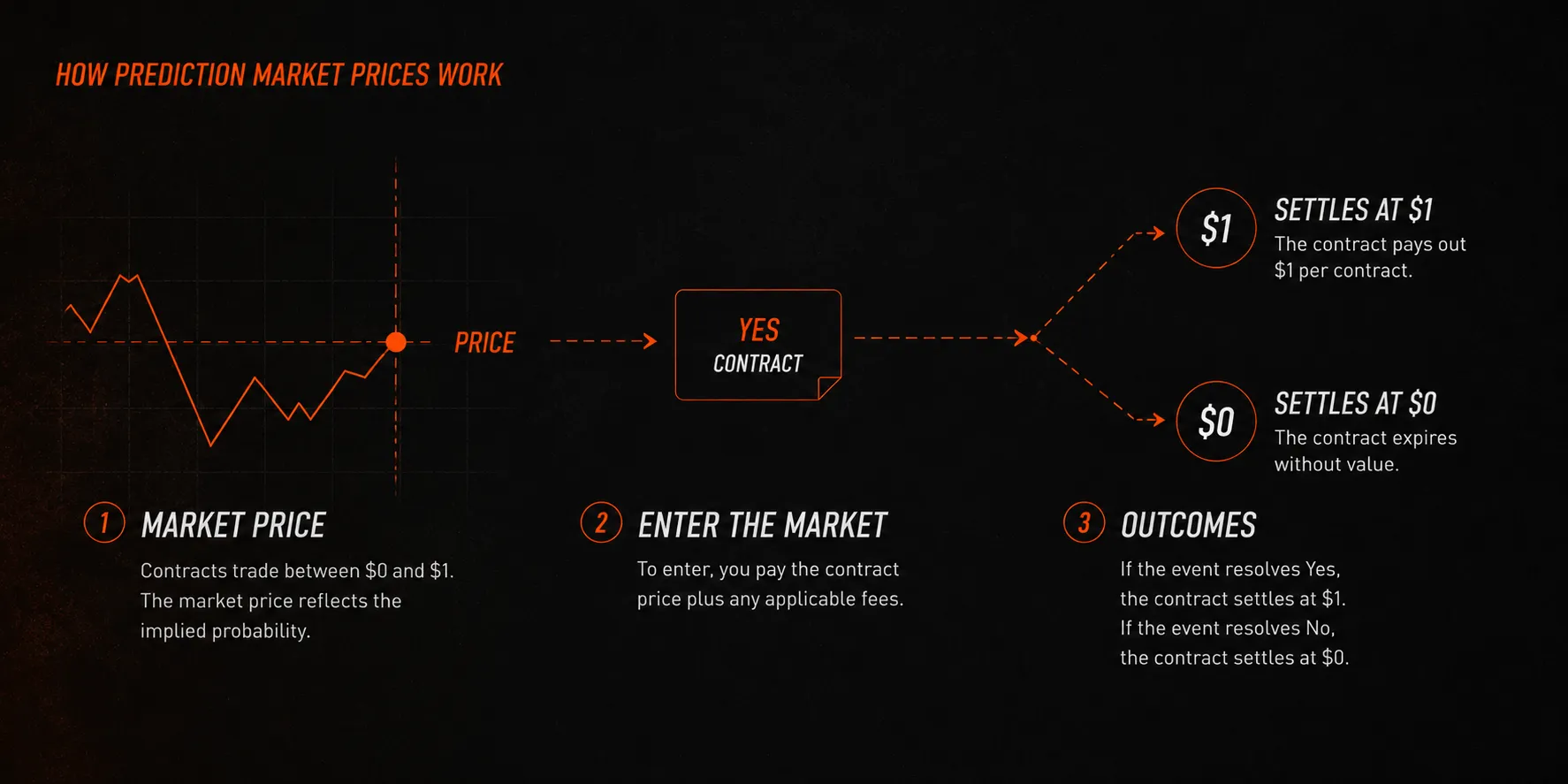
Traders can interpret the contract price as a market-implied probability. For example, if a Yes contract trades at 30¢, the market is broadly pricing the defined event at about 30%. That’s the market’s current view, not a guarantee or official economic forecast. Contracts settle either at $1 or $0, depending on the outcome.
Economics markets differ from financial prediction markets on OG.com. Economics focuses on real-world economic events and indicators, such as central-bank decisions, recession outcomes, inflation and employment. Financials focus on prices of commodities, FX, or market indexes.
Which economic prediction markets can you trade?
Available markets can change over time, but common formats include:
Central-bank decisions: Whether rates rise, fall or stay unchanged at a specified meeting.
Recession outcomes: Whether a recession occurs within a defined period under the contract’s stated criteria.
Inflation: Whether an inflation measure lands above, below or within a specified range.
Employment and labor markets: Unemployment, payroll data, layoffs or other measurable labor-market developments.
Economic growth: Gross domestic product (GDP) or another defined measure of economic activity.
Other economic events: Policy or economic outcomes that can be measured and settled clearly.
How do different economic prediction markets settle?
Settlement depends on the source, definition and timing written into the contract. That’s why a Fed decision market, a recession market and a labor market can resolve in very different ways.
Below are examples of how economic event contracts settle on OG.com.
Question
What determines the result
Fed decision
What rate decision will the Fed make at a specified meeting?
Official policy decision
Recession
Will a recession occur by a defined date?
OG.com’s 2026 recession contract defines a recession as two consecutive quarters of negative annualized real GDP growth, based on U.S. Bureau of Economic Analysis data.
Labor market
Will the unemployment rate reach a specified level?
Will jobs added reach a specified level?
OG.com contracts settle using data from the BLS monthly Employment Situation report, based on the definition stated in the contract.
A recession contract doesn’t settle on a general feeling that the economy is weak. It settles on the definition, source and deadline named in the rules.
Labor-market contracts can be just as narrow, especially when they name a data series, release date, industry, measurement period or treatment of revised figures. For example, OG.com contracts use BLS monthly Employment Situation reports.
Fed decision markets have a different kind of precision. A market may separate no change, a 25-basis-point move and a larger policy move. That means a correct broad view, such as expecting rates to fall, may still miss the exact outcome the contract measures.
What affects economic prediction market prices?
Scheduled releases and policy events often drive the biggest price moves, but the relevant input depends on the contract.
Fed decision markets tend to react to inflation releases, employment data, growth figures, financial conditions, previous policy decisions and policymaker statements. If new data make a rate cut look more or less likely than traders expected, the Fed rate cut probability reflected in the market price can change.
Recession markets usually absorb information over a longer period. Employment, growth, consumer activity, credit conditions, business surveys, revised data and unexpected economic or geopolitical developments can all change recession probability or recession odds.
Labor-market contracts may react more directly to company announcements, layoff data, payroll reports, unemployment figures or other reliable employment measures.
Markets often react to the gap between new information and prior expectations. A headline that confirms the consensus economic forecast may do little. A release that cuts against expectations can lead to faster repricing.
Why do traders use economic prediction markets?
Traders use economic prediction markets to take a position on measurable outcomes like inflation, unemployment, or a Fed rate decision.
If they think the market is pricing an outcome too high or too low, they can trade based on their own view. A trader can profit if the contract price moves in their favor or if the contract settles in line with their position, after fees.
Economic prediction markets vs. traditional economic forecasts
An economic forecast, a market-based indicator and a prediction-market price can all point to future expectations, but each one is built from a different source.
What it shows
How it updates
Main limitation
Economic prediction markets
Market-implied probability for a defined event
Can update continuously
Rules and liquidity shape the price
Economist surveys
Consensus economic forecast
Periodically
May lag new information
Market-based indicators, like futures pricing
Expectations implied by instruments like fed funds futures for interest rates
Continuously
Can require more interpretation
For interest-rate expectations, you may also see interest rate prediction tools derived from interest-rate instruments. Economic prediction markets frame the question more directly by tying the market price to a defined event outcome, such as a rate decision at a specified meeting.
Each source answers a different question. An economic prediction market ties the price to a defined event outcome and settlement rule, while surveys and market-based indicators use different inputs.
What are the risks of economic prediction markets?
An economic contract may settle the other way, leaving you with a loss that includes what you paid to enter the trade and any fees.
Prices can move quickly after policy surprises or unexpected economic data. There are risk management tools traders can use, for example, setting a limit price.
Liquidity can also vary by contract, which may make it harder to enter or exit at the price a trader expects.
Economic contracts can be especially sensitive to definitions and deadlines, therefore it’s always important to review settlement rules before trading.
How to trade economic prediction markets on OG.com
With OG.com, you can trade event contracts on real-world outcomes across different market categories, including economics.
Create an account: Open an account and complete sign-up, including identity verification. You can use our web or mobile platforms.
Economic prediction markets let traders take a position on outcomes such as an inflation rate, jobs figure or interest-rate decision. Contracts are typically priced between $0 and $1, with the price reflecting the market-implied probability of an outcome.
How do Fed decision prediction markets work?
Fed decision prediction markets focus on a specific policy meeting. A market may separate several outcomes, such as no change, a rate increase or a rate cut of a defined size, so traders need to check the exact categories.
How are recession prediction markets settled?
Recession prediction markets settle according to the contract’s stated definition, deadline and settlement source. A weak economy alone may not be enough if the contract’s settlement definition isn’t met.
What economic indicators can affect prediction markets?
Inflation forecasts and releases, employment reports, growth data, central-bank statements, revised figures, financial conditions and unexpected economic or geopolitical developments can affect prediction market prices.
How do economic prediction markets differ from economic forecasts?
An economic forecast is usually a projection from an economist, survey or model. An economic prediction market lets people trade contracts based on a specific economic outcome, such as whether inflation will exceed a certain level. The contract price reflects the market-implied probability of that outcome, based on the activity of prediction traders.
Important information: Prediction is an event contract that is a derivatives product offered by North American Derivatives Exchange, Inc. (NADEX), a CFTC-regulated exchange, which does business under the brand OG.com Prediction Markets (OG). Crypto.com | Derivatives North America uses a CFTC-regulated exchange that uses OG.com technology.
Trading on OG.com involves risk and may not be appropriate for all. By trading you risk losing your cost to enter any transaction, including fees. You should carefully consider whether trading on OG.com is appropriate for you in light of your investment experience and financial resources. Any trading decisions you make are solely your responsibility and at your own risk.