How to trade financial prediction markets
You may have a view that the U.S. dollar could strengthen or that a stock index could rise. A financial prediction market makes that view more specific by asking whether a chosen market will be above or below a set price at a set time.
Financials
By Barbara Pazur
This guide explains how prediction markets work in finance, how FX and index markets differ, why timeframes shape the trade, what can move event contract prices and what to check before trading.
This article is for informational purposes only and should not be construed as financial or investment advice. Past performance does not guarantee future results.
What are financial prediction markets?
Financial prediction markets are event markets based on measurable financial-market outcomes. In this article, we’ll focus on two familiar market families: foreign exchange pairs and major U.S. stock indexes.
A forex prediction market can ask whether EUR/USD, USD/JPY, AUD/USD or GBP/USD will be above or below a set price at a specific time.
A stock index contract can ask the same type of question about the S&P 500, Nasdaq 100, Dow Jones or Russell 2000.
Traders can read the contract price as a market-implied probability. If a contract trades at 36¢, the market is pricing the defined outcome at about 36%.
That probability belongs to the event contract. It doesn’t mean the underlying currency pair or index is expected to gain or lose 36%. It reflects how traders are pricing that specific outcome under the contract rules.
On OG.com, there is a difference between Financials and Economics market categories. Financials focuses on price outcomes of FX pairs and stock indices. Economics markets offer event contracts tied to economic events and data, such as inflation, interest-rate decisions, recession outcomes and employment releases.
How do financial prediction markets work?
A financial event contract depends on the reference market, the target price and the observation time.
Take a EUR USD prediction as an example where the contract asks if EUR/USD will be above a stated price at 10:00 a.m. ET. The trade comes down to whether that currency pair clears the level named in the rules when the observation time arrives.
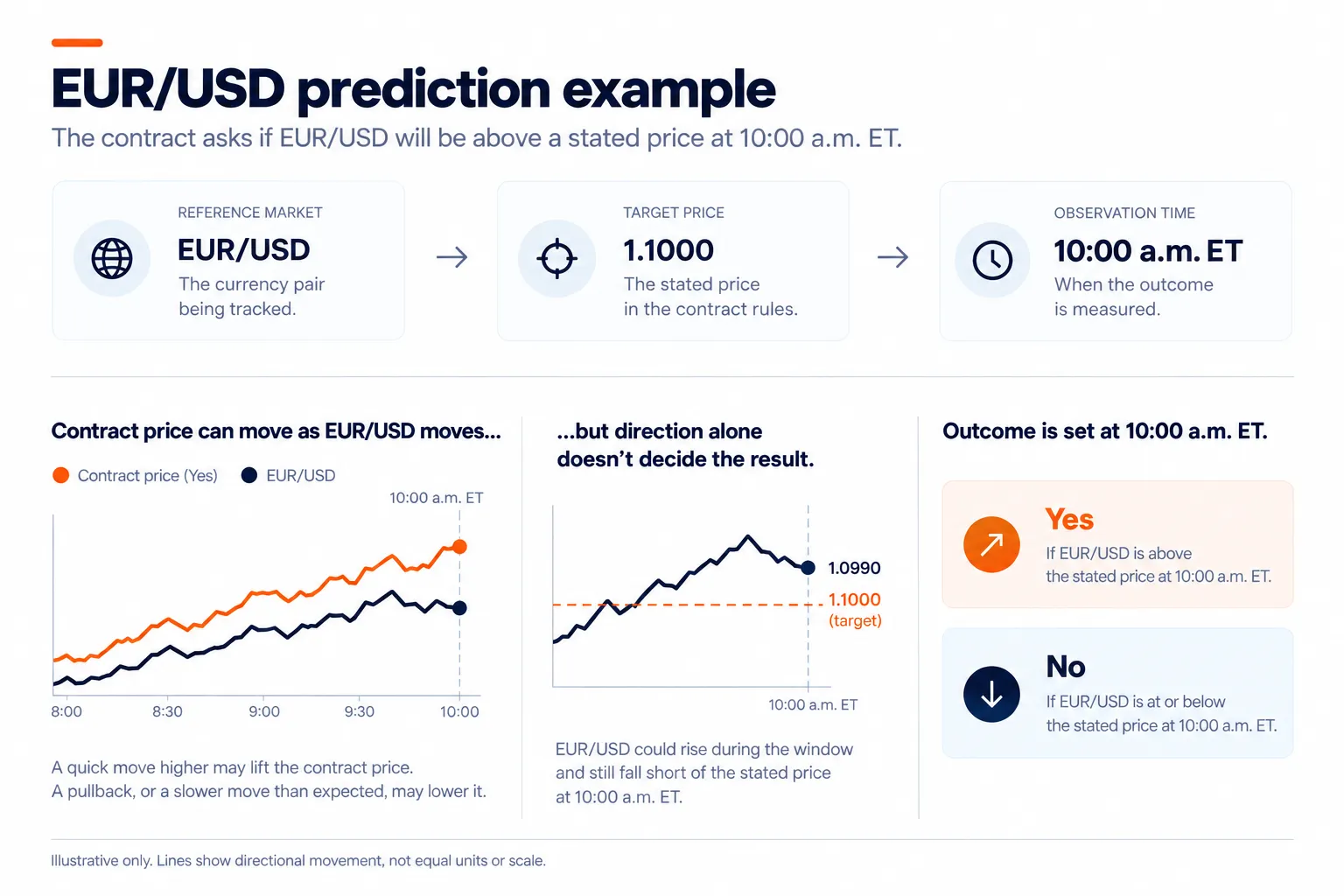
So the EUR/USD is the reference market, the stated price is the target and 10:00 a.m. ET is when the outcome gets measured. Those details define the contract before price direction even enters the picture.
The contract price can move as EUR/USD moves, but it can also change when traders reassess the path to the threshold. A quick move higher may lift the contract price. A pullback, or a slower move than traders expected, may lower it.
EUR/USD could rise during the window and still fall short of the stated price at 10:00 a.m. ET. That’s why direction alone doesn’t decide the result.
A similar setup can apply to an S&P 500 prediction. A contract tied to it may ask whether the index will be above a stated level at the end of the trading day. The underlying market changes, but the result still depends on the price level and observation time written into the rules.
Which financial events can you trade on prediction markets?
Major forex pairs and major U.S. stock indexes give you two main options for financial prediction markets on OG.com. Available contracts can change over time, but common formats include:
- Major forex pairs include EUR/USD, USD/JPY, AUD/USD and GBP/USD. These pairs measure one currency against another.
- S&P 500 is a major large-cap U.S. stock index often used for stock market prediction.
- Nasdaq 100 is a technology-heavy index, which can make Nasdaq prediction markets react differently from wider index markets.
- Dow Jones tracks a smaller group of major U.S. companies, giving Dow Jones prediction markets their own market profile.
- Russell 2000 is a smaller-company index that can be more sensitive to financing conditions and domestic growth expectations.
While these names can look familiar, the contract still needs a precise setup. Before judging the price, identify the market, the target level and the time when the outcome will be measured.
How do financial prediction markets work across different timeframes?
The same price target can mean something different depending on the clock. A five-minute currency contract gives the market very little time to move. A daily index contract leaves more room for data, headlines and volatility to change the outcome.
OG.com financial event contracts can be grouped across five-minute, two-hour and daily intervals. That doesn’t mean every currency pair or index appears in every interval.
Typical focus | What traders may watch | Key consideration | |
5 minutes | Immediate price outcome | Current price, short-term volatility, market activity | Little time for conditions to change |
2 hours | Intraday outcome | Momentum, economic releases, developing news | More room for repricing |
Daily | Session-level outcome | Data, rates, sentiment, wider market moves | More information can arrive |
In a five-minute AUD/USD market, the current exchange rate and short-term volatility may dominate. But in a daily S&P 500 prediction market, economic releases, interest-rate expectations, company news and market sentiment have more time to affect the final result.
What affects forex prediction market prices?
A currency pair compares one currency with another. EUR/USD measures the euro against the U.S. dollar, so an EUR USD prediction depends on both sides of that relationship.
Forex prediction market prices can move when traders reassess interest-rate expectations, inflation and employment releases, growth expectations, political or geopolitical developments, demand for the U.S. dollar, or current price momentum.
Those inputs affect the underlying currency pair first, then the event contract price can adjust as traders reassess whether the pair will clear the stated threshold.
The source of the move can come from either side of the pair. A dollar-driven move can affect EUR/USD, USD/JPY, AUD/USD and GBP/USD at the same time, while a currency-specific development can matter more for one pair than another. That’s why a USD JPY prediction may not move the same way as an EUR USD prediction, even when both involve the U.S. dollar.
For the contract, the final question stays narrow. The market driver may explain why the pair moved, but settlement still depends on whether the reference price meets the contract condition at the observation time.
What affects stock index prediction market prices?
An index represents a group of companies rather than one business. That means index contracts can react to market-wide information and to moves inside the index.
Interest-rate expectations, inflation and employment data, growth expectations, earnings, major constituent moves, sector performance, geopolitical developments and investor risk sentiment can all affect index prices.
These drivers move the underlying index first, then the event contract price can adjust as traders reassess whether the index will meet the contract’s price condition.
When people say “the stock market,” they usually mean stocks as a whole. A financial event contract is more specific because it tracks a named index, and different indexes can react differently.
For example:
- S&P 500 prediction markets track a large-cap index with wider U.S. market exposure.
- Nasdaq prediction markets may respond more sharply to technology and growth-stock moves.
- Russell 2000 contracts can be more sensitive to smaller-company conditions, financing costs and domestic growth expectations.
- Dow Jones prediction markets can behave differently because the index has a smaller company set and a different weighting method.
Why do traders use financial prediction markets?
Financial prediction markets take a market view, such as “the dollar could strengthen” or “the index could rise,” and turn it into a defined outcome with a target price and observation time. With these event contracts, traders can earn money if their view materializes.
Financial prediction markets vs traditional forex and index trading
Two traders may both think EUR/USD or the S&P 500 is heading higher, but they’re not necessarily trading the same question.
A traditional market position follows the price movement of the underlying market. A financial event contract trades the market’s expectation that a defined outcome will happen by a specific observation time.
That contract still has a price before settlement. A trader may exit before the final result if the contract price moves favorably, depending on market liquidity and the available price at the time.
For example, the S&P 500 could finish higher than where it started and still remain below the level needed for a particular event contract to settle Yes. A trader could also exit earlier if the contract price moved favorably before that final outcome.
Feature | Financial prediction market | Traditional market position | Key difference |
Exposure | Tradeable price on a defined outcome | Movement in the underlying asset or instrument | Different source of return |
Time | Defined observation point | Duration depends on the product | Timing works differently |
Result | Price can change before settlement; final outcome follows contract rules | Value changes with the market | Settlement structure differs |
Main question | How is the market pricing the chance of this outcome? | How far and in which direction will the price move? | Different trading thesis |
What are the risks of financial prediction markets?
Financial event contracts can resolve against your position, and the loss can include the cost of entering the transaction plus fees.
Price moves can be sharp around economic releases, central-bank comments, unexpected news or sudden liquidity changes. Short-term volatility, price gaps and fast market moves can also affect the price a trader can enter or exit.
The threshold is where direction and settlement can split. A currency pair or index may move the way you expected and still fail to meet the contract’s exact price condition.
Timing can create the same problem. A market may cross the threshold earlier in the day, then move back before the official observation point. A contract priced with a high market-implied probability can still resolve the other way.
How to trade prediction markets on OG.com
With OG.com, you can trade event contracts on real-world outcomes across different market categories, including financials.
- Create an account: Open an account and complete sign-up, including identity verification. You can use our web or mobile platforms.
- Browse markets: Explore markets across financials.
- Review and trade: Compare the market price with your own view. Check the rules, fees, and settlement details before opening a position.
- Monitor your position: After trading, your contract appears in your open positions, where you can track price movement as new information comes in.
FAQs about financial prediction markets
What are financial prediction markets?
Financial prediction markets are event markets based on measurable financial-market outcomes, such as whether a currency pair or stock index will be above or below a defined level at a specified time.
How do financial prediction markets work?
They use contracts tied to a reference market, price condition and observation time. The contract settles according to its rules once the relevant price is measured.
How do forex prediction markets work?
Forex prediction markets focus on currency pairs such as EUR/USD, USD/JPY, AUD/USD or GBP/USD. A contract may ask whether the pair clears a specified level at a defined time.
Can prediction markets track the S&P 500?
Yes. An S&P 500 prediction market can use the index as the reference market for a price-based event contract.
What affects forex prediction market prices?
Exchange-rate moves, central-bank expectations, economic data, interest-rate differences, geopolitical developments, U.S. dollar demand, and short-term momentum can affect forex prediction market prices.
What is the difference between financial prediction markets and traditional trading?
Traditional trading follows the value of the underlying asset or instrument. Financial prediction markets settle on a defined price outcome.
How do price targets work in financial prediction markets?
A price target is the level the reference market needs to meet under the contract rules. The contract may ask whether the market finishes above or below that level.
Important information: Prediction is an event contract that is a derivatives product offered by North American Derivatives Exchange, Inc. (NADEX), a CFTC-regulated exchange, which does business under the brand OG.com Prediction Markets (OG). Crypto.com | Derivatives North America uses a CFTC-regulated exchange that uses OG.com technology.
Trading on OG.com involves risk and may not be appropriate for all. By trading you risk losing your cost to enter any transaction, including fees. You should carefully consider whether trading on OG.com is appropriate for you in light of your investment experience and financial resources. Any trading decisions you make are solely your responsibility and at your own risk.