A prediction market is a marketplace where people trade event contracts tied to verifiable outcomes of future events – for example, sport games, election results, or Oscar winners.
Learn
By Ekaterina Drozdovica
The event contract price reflects the current implied probability, but it can change as traders learn new information and adjust their positions.
This article is for informational purposes only and should not be construed as financial or investment advice. Past performance does not guarantee future results.
Prediction markets explained in simple words
The prediction market meaning centers on a simple question with a measurable outcome. Unlike traditional exchanges that trade stocks, these markets trade a contract of an event happening. For example, a market might ask:"Will a city team win a football game?"
Each event contract is structured around a verifiable result. The market price changes as participants react to news, data, and changing circumstances. If a prediction is correct, the contract settles at a predefined value.
Event contract definition by CFTC
Here is how Commodity Futures Trading Commission (CFTC) defines an event contract:
“Event contracts are typically structured as swaps. They can be used to hedge economic risk or speculate on price movements and event outcomes. Like other derivatives (e.g., futures contracts or options on futures), swaps are financial contracts that derive their value from an underlying commodity. In the case of event contracts, this would be the outcome of an event.”
Three parts of every prediction market
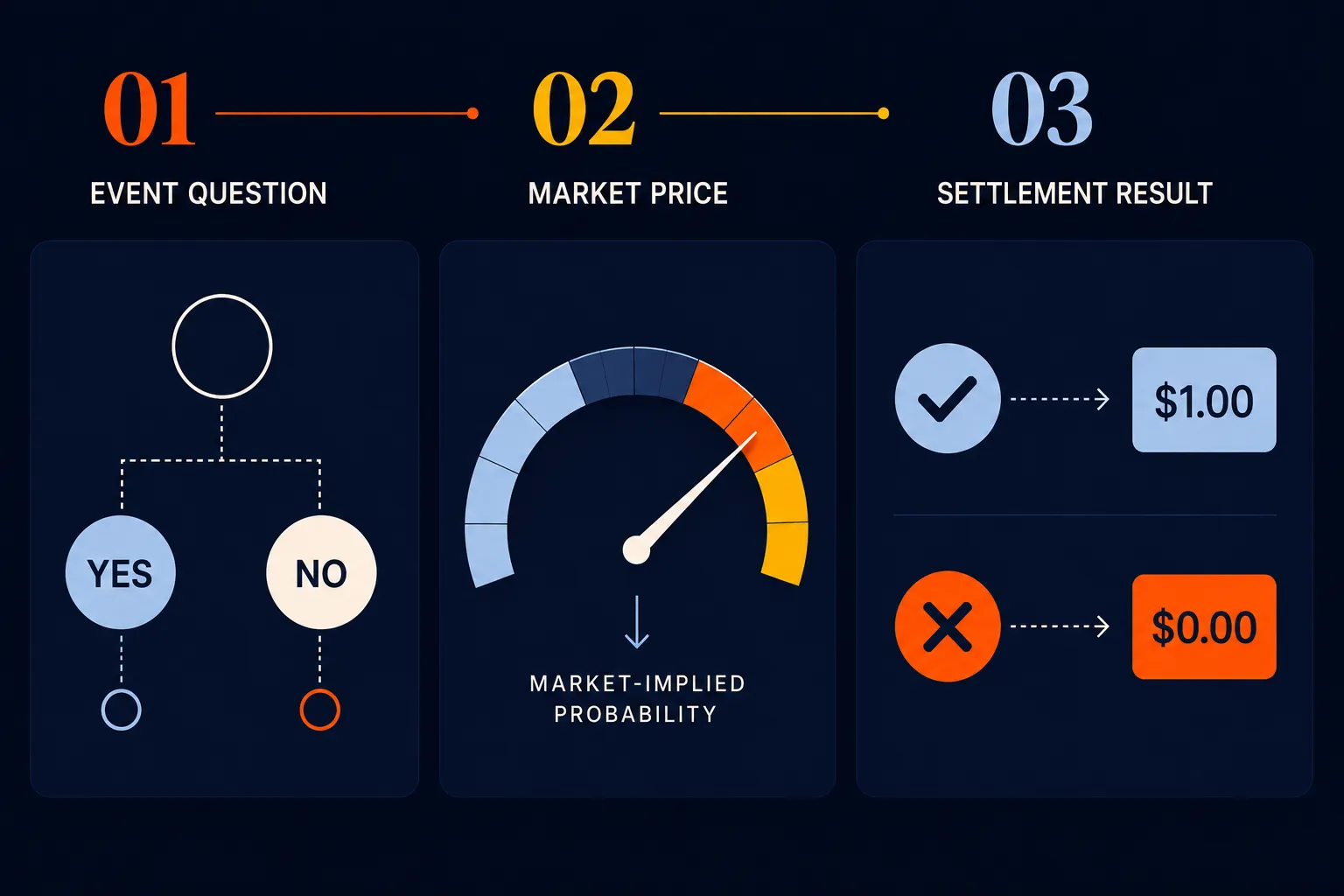
Every prediction market is built on three fundamental building blocks. These components ensure that event contract trading remains transparent and objective for all participants.
Event question: binary or multiple Yes-No
Every market starts with a specific, verifiable question. A good example is "Will annual inflation exceed 2.5% by December 31?".
A poor example would be "Will the economy feel strong?" because it cannot be measured objectively. Clear resolution criteria identify the exact data source used for settlement.
Event questions can be structured in different ways. They may be binary, with a yes-or-no outcome, or they may offer a set of multiple-choice answers. Some markets also use outcome ranges, where payouts can vary depending on how close the result is, rather than following a simple all-or-nothing model.
Market price
The price reflects what traders are currently willing to pay for a contract. In many markets, this price represents the implied probability prediction markets assign to an outcome.
For instance, a contract trading at $0.73 may imply a 73% probability of the event occurring before fees.
Settlement result
Contracts settle according to the actual outcome and the market's specific rules. If the contract settles in your favor, it typically settles at $1.00.
If the event does not occur as predicted, the contract settles at $0.00. This fixed structure defines the maximum potential payout and risk upfront.
It’s best practice to thoroughly research to understand what exactly needs to happen for the contract to be settled.
How do prediction markets work from start to finish?
Understanding how prediction markets work requires looking at the lifecycle of a trade. The process follows a structured path from the creation of a question to the final payout.
Market creation: A market is created around a verifiable event, such as the pro basketball finals or a government employment report.
Reviewing rules: Traders review the specific event question, market price, and resolution criteria.
Executing a trade: Participants buy or sell contracts based on their view of the outcome.
Price updates: Market activity, supply, demand, and new information cause the price to update in real-time.
Managing positions: Traders may exit a position early to lock in a potential profit or limit a loss, or they may hold until the event is resolved.
Market settlement: Once the official result is confirmed, the contract settles based on the predetermined rules.
Why prediction market prices change
Prediction market prices are dynamic. Because they reflect the collective belief of participants, any news that shifts the likelihood of an outcome will impact the price. New economic reports, election results, or injury updates in sports can cause rapid shifts.
For example, if a leading candidate performs well in a debate, the price of their “Yes” contract in a primary market may rise. Similarly, if a sports team performs well during the season, the market may price in a higher chance of that team winning the championship.
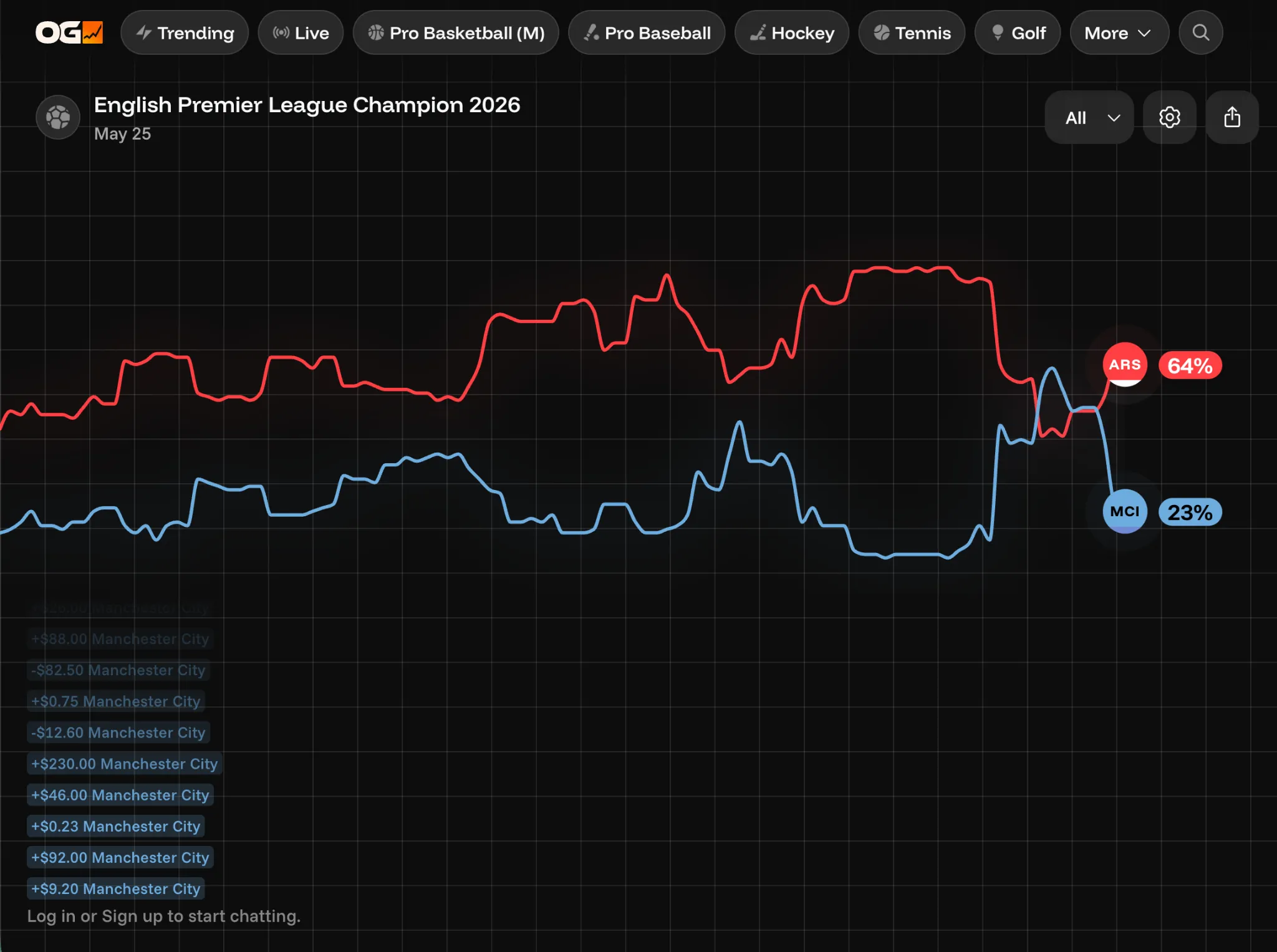
This chart shows the contract price for the English Premier League Champion 2026 market, with Arsenal and Manchester City as the listed options. Prices have been volatile, with the market shifting twice – first, in favor of Manchester City, then moving back to favor Arsenal. These changes suggest traders were reacting to new information, showing just how quickly prediction market prices can move.
Prediction markets vs. sports betting, polls, forecasts
Polls snapshot what surveyed people say they believe at a single moment. Forecasts use statistical models and/or expert judgment to predict outcomes. Sport betting relies on odds set by a bookmaker with embedded margin.
Prediction markets, on the other hand, use live trading activity to reflect how people’s views change over time. As traders react to new information they buy or sell event contracts, so market prices move. These prices are often read as implied probabilities of an event happening.
Polls
Forecasts
Prediction markets
Sports betting
Data Source
Surveys
Models and/or experts
Live trading – prices change
Fixed odds
Model
Statistical
Theoretical
Peer-to-peer event contracts trading
Led by a bookmaker
What can people trade on prediction markets?
Modern platforms such as OG offer a wide variety of categories for event outcome trading. These markets allow participants to trade on most verifiable event outcomes, for example:
Economic indicators: inflation readings, interest-rate decisions, employment data, and much more.
Financials: Price movements of financial assets such as stocks, indices, commodities, cryptocurrencies, and more. These contracts are typically phrased as whether or not a price will be above or below a threshold by a certain date.
Companies: dates of initial public offerings (IPO), outcomes of earning reports, layoffs.
Politics: Election outcomes, primary contests, policy-related measures, and geopolitical events.
Competitive sports: Football, basketball, baseball, hockey, soccer, tennis, F1, any competitive sport depending on the regulatory constraints.
Culture: Major awards such as Oscars and Bafta, top-performing content on platforms like Netflix and Spotify, and headline-driven public events.
Science and weather: Some markets cover data-driven topics like record temperatures or specific scientific milestones.
Availability for event contract trading varies by location. For example:
New York and Arizona residents are not permitted to trade on any markets.
Residents of Nevada, Ohio, Michigan, Maryland, Massachusetts, New Jersey, and Illinois are restricted from sports contracts. They may trade other categories like economics or politics.
Are prediction markets regulated in the US?
New participants often ask: are prediction markets regulated? In the United States, authorized platforms operate through federally regulated frameworks. The Commodity Futures Trading Commission (CFTC) oversees these derivatives and event-contract markets.
CFTC-regulated markets must follow strict rules regarding market integrity and consumer protection. This oversight includes surveillance to prevent manipulation and requirements for transparent settlement. Using a regulated platform helps traders distinguish between authorized US venues and unregulated options.
OG.com offers access to CFTC-regulated markets, ensuring that trading occurs within a structured and supervised environment.
Key risks to understand before trading event contracts
All trading involves risk, and event contracts are no exception. Participants should be aware of several factors before opening a position.
Loss of capital: If an event settles against your position, you can lose the cost to enter the transaction, including fees.
Price volatility: Prediction market prices can move rapidly as new knowledge becomes available.
Liquidity risk: Low activity in a specific market may make it difficult to exit a position at your desired price before settlement.
Uncertainty: No outcome is ever guaranteed. Even a contract with a high implied probability can settle at $0.00.
FAQs about prediction markets
What does the price of a prediction market contract mean?
A contract's market price can reflect the market's implied probability of an event happening. For example, a contract trading at $0.45 may suggest a 45% implied probability, before considering fees and market conditions.
Who decides how an event contract settles?
Event contracts settle according to the rules listed for that market. These rules should identify the official source or criteria used to confirm the outcome.
Can prediction market prices change before an event ends?
Yes. Prices can move as traders react to new information, such as economic data, public announcements, game developments, or election updates.
Are prediction markets the same as polls?
No. Polls record responses from surveyed people at a point in time. Prediction markets reflect live trading activity and may update continuously as new information becomes known.
What should I check before trading an event contract?
Review the event question, market price, settlement rules, fees, expiration time, and whether the market is available in your location.
Can I lose money trading prediction market contracts?
Yes. Trading event contracts involves risk, including the possible loss of the cost to enter a transaction, including fees.
Does OG.com offer access to regulated markets?
OG.com offers access to CFTC-regulated markets, subject to eligibility, location, and market availability.
Are sports contracts available in every US state?
No. Availability varies by state. New York and Arizona residents are not allowed to trade on any markets, and some additional states restrict access to sports contracts.
Do I need to hold an event contract until settlement?
Not always. Depending on market conditions and availability, traders may be able to exit before settlement. The exit price may be higher or lower than the entry price.
Important Information: Prediction is an event contract that is a derivatives product offered by North American Derivatives Exchange, Inc. (NADEX), a CFTC-regulated exchange, which does business under the brand OG.com Prediction Markets (OG) Crypto.com | Derivatives North America and uses a CFTC-regulated exchange that uses OG.com technology.
Trading on OG.com involves risk and may not be appropriate for all. By trading you risk losing your cost to enter any transaction, including fees. You should carefully consider whether trading on OG.com is appropriate for you in light of your investment experience and financial resources. Any trading decisions you make are solely your responsibility and at your own risk