US recession markets explained: how recession probabilities work
Recession fears are back in the headlines. Every new GDP release, inflation report, or jobs number can quickly shift how likely a US recession looks to prediction traders.
Financials
By Sean O'Meara
This guide explains how recession probability markets work, how this impacts market prices and why it’s important to understand the specific rules behind every market.
This article is for informational purposes only and should not be construed as financial or investment advice. Past performance does not guarantee future results.
What is a US recession probability market?
A US recession probability market is a prediction market where people trade event contracts based on whether the US will experience a recession by a certain date or within a set period of time. Rather than predicting the exact depth or duration of an economic slowdown, it focuses on a yes or no outcome.
How recession probabilities work in prediction markets
The market price represents something called the market-implied recession probability.
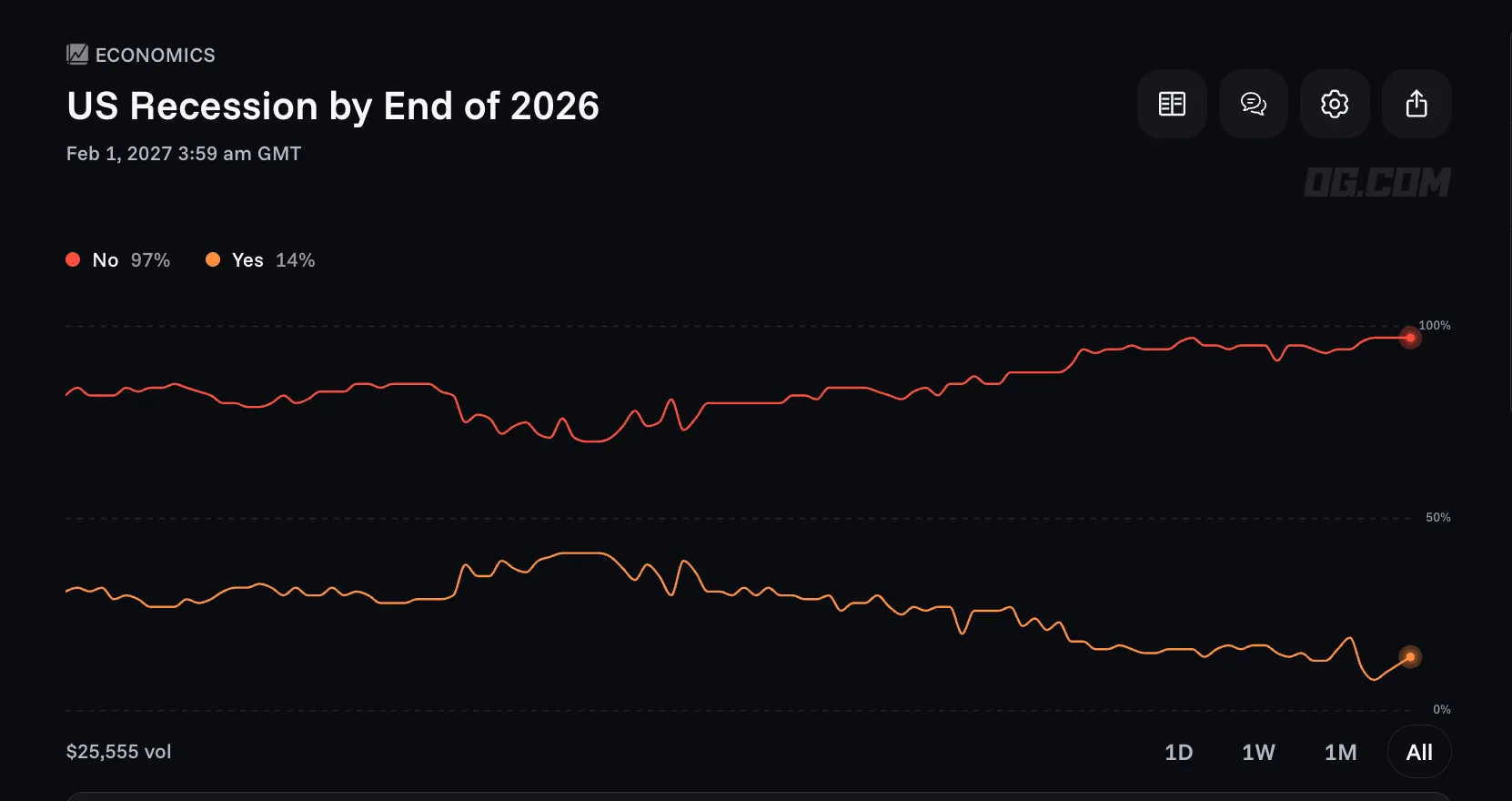
This means that if a recession event contract trades at 14 cents, the market is implying a roughly 14% chance that the recession will take place before the contract expires.
Market data as of 11 August 2026. For the latest prediction data, check the
This isn’t a guarantee though. Market price simply reflects expectations based on information available. This means that as new data becomes available, expectations and prices can change.
Typically, a recession is described as two consecutive quarters of negative GDP growth. But some experts also rely on broader measures of economic activity that include employment, income, industrial production and consumer spending.
In prediction markets, settlement rules are defined in advance to avoid ambiguity. Some of the most common approaches include:
Official dating: Contracts may settle according to whether an official organization determines that a recession has happened.
Data-based definitions: Many contracts rely on predefined economic indicators or published data thresholds of official recession announcements.
This means that different outcomes can occur. A contract tied to an official determination might not settle until well after economic conditions have deteriorated and a data-based contract could resolve sooner if specified conditions are met. This is why it’s important to read exact settlement rules before interpreting any recession odds.
For example, on OG.com, the "US Recession by End of 2026" contract settles "Yes" if the US Bureau of Economic Analysis (BEA) reports at least two consecutive quarters in 2026 where seasonally adjusted annualized real GDP growth is negative.
What moves recession odds?
As mentioned, when new information becomes available, recession markets react and this can impact the price. Prediction markets have to deal with new signals continuously meaning recession markets often adjust within minutes.
Data surprises
Employment reports, inflation data, GDP releases, retail sales, manufacturing surveys and consumer confidence can all influence the perceived probability of recession within 12 months.
For example, a weak US jobs report in the summer of 2025 raised alarm that the economy might be slipping toward a recession, sending stocks tumbling before they later recovered. The scare was compounded when annual revisions showed the economy had added more than 900,000 fewer jobs than previously estimated over the 12 months to March 2025.
Central bank signals
Interest rate decisions, policy statements and speeches from officials can all affect Fed recession probability expectations. If markets believe monetary policy will become more restrictive it may increase the implied probability of an economic slowdown.
In December 2025, for instance, the Fed cut rates but paired the move with firmer language about the "extent and timing" of further adjustments – a "hawkish cut" that analysts read as raising the bar for additional easing. Earlier in the cycle, the odds of zero rate cuts for the year jumped to 25% on prediction markets immediately after one of Chair Powell's press conferences
Credit and liquidity stress
Financial market disruption can raise concerns that businesses and consumers will face greater difficulty borrowing and spending. Again, this can increase recession expectations.
On 16 October 2025, regional bank stocks plunged after Zions Bancorporation and Western Alliance disclosed loan losses and a collateral dispute, reigniting fears reminiscent of earlier financial stresses. Around the same period, JPMorgan CEO Jamie Dimon warned that credit problems are rarely isolated – "when you see one cockroach, there are probably more."
Forecasts and major headlines
Economic forecasts, geopolitical events and trade disputes can also cause rapid repricing.
The clearest recent case was President Trump's "Liberation Day" tariffs on 2 April 2025: a Wall Street Journal survey of 64 economists saw their average recession probability jump from 21% in January to 46% by mid-April, while Goldman Sachs raised its 12-month recession odds from 20% to 35%, citing the tariffs.
Notably, those odds then fell back as markets rebounded — a good illustration of how quickly headline-driven repricing can reverse.
Recession markets vs. traditional recession probability indicators
There are various factors that influence market price and while traditional indicators remain valuable, it does mean results can vary.
For example, the New York Fed recession probability model estimates recession risk using the treasury yield curve. Using both approaches together can provide a broader perspective.
Approach
What it measures
Strength
Main limitation
Prediction market price
Market-implied probability of event contract traders
Fast, real-time market sentiment
Depends on contract rules and liquidity
Yield curve model
Model-implied recession risk
Clear methodology
Model risk and regime changes
Economist surveys
Forecast consensus
Efficient context and narrative
Slow to update, can herd
Official dating
Confirmation of recession periods
Definitive for history
Happens after the fact
Common contract mechanics in economics markets
While contracts can vary, most recession markets follow a similar process.
The market opens and participants buy or sell contracts.
Prices change as traders react to new information and expectations.
The contract reaches its expiration or observation deadline.
The settlement source determines whether the stated condition has been met and the contract resolves.
Before taking part, you should check three things:
The exact question being asked
The deadline or observation window
The official source used for settlement
And remember, because settlement depends on the published rules, understanding those is just as important as following the economic data.
Risks and limits of reading recession markets as forecasts
Prediction markets can provide useful insight into changing expectations but they’re not a guarantee. For example, a market showing a 70% recession probability doesn’t mean a recession is certain and a market pricing only a 20% chance can still end up being correct.
There are several factors that can affect interpretation including:
Definition mismatch: Different contracts may define recession differently.
Time-window confusion: A recession occurring outside the contract period won't count toward settlement.
Headline-driven volatility: Prices can move quickly after major news.
Overconfidence: Market probabilities reflect current expectations, not guaranteed outcomes.
This is why recession markets are most useful when broader economic indicators are viewed alongside them.
How to trade recession predictions on OG.com
With OG.com, you can trade event contracts on real-world outcomes across different market categories.
Create an account: Open an account and complete sign-up, including identity verification. You can use our web or mobile platforms.
FAQs about US recession probability forecasts in 2026
What are the odds of a recession in 2026?
There’s no fixed answer to this as recession markets update continuously. Current market prices reflect the latest implied probabilities and aren’t guaranteed outcomes.
What are the odds of a recession?
The odds of a recession vary depending on the timeframe and definition as well as prediction markets, economist forecasts and statistical models.
How should I interpret ‘probability of recession within 12 months’?
This describes the estimated chance that a recession will begin during the next year. However, different models and markets may calculate or define that probability differently so you should review individual rules.
What is the difference between recession probability and recession odds?
Probability refers to the estimated likelihood of an event occurring, while odds compare the likelihood of the event occurring against it not occurring.
What is the Fed recession probability measuring?
Fed recession probability refers to recession models published by Federal Reserve institutions, such as yield-curve-based estimates rather than prediction market prices.
Important Information: Prediction is an event contract that is a derivatives product offered by North American Derivatives Exchange, Inc. (NADEX), a CFTC-regulated exchange, which does business under the brand OG.com Prediction Markets (OG) Crypto.com | Derivatives North America and uses a CFTC-regulated exchange that uses OG.com technology.
Trading on OG.com involves risk and may not be appropriate for all. By trading you risk losing your cost to enter any transaction, including fees. You should carefully consider whether trading on OG.com is appropriate for you in light of your investment experience and financial resources. Any trading decisions you make are solely your responsibility and at your own risk