How to trade Fed rate cut odds on prediction markets
Open any “Fed rate-cut odds” prediction market and you’ll see a clean number, until the next inflation print or jobs report headline snaps it in a new direction.
Financials
By Barbara Pazur
This guide breaks down how those prediction markets are priced, what typically moves them, and how to trade a view on US Federal Reserve (Fed) interest rate decisions using event contracts.
This article is for informational purposes only and should not be construed as financial or investment advice. Past performance does not guarantee future results.
What are ‘Fed rate cut odds’ in a prediction market?
Fed rate cut odds show the tradable, market-implied chance of a specific decision outcome by a specific deadline.
In a prediction market, that usually means a contract tied to whether the Fed cuts rates at a specific meeting, by year-end or below a certain target range.
The exact wording of the contract defines what has to happen for it to settle. A contract asking ‘Will the Fed cut at the next meeting?’ focuses on a single decision, while a year-end contract covers a wider window with multiple paths.
For example, at the time of writing, the OG.com market for the Federal Reserve's July 30, 2026 decision was pricing a 96% chance that interest rates would stay unchanged. The market also implied a 6% chance of a rate cut smaller than 25 basis points, a 5% chance of a rate cut larger than 25 basis points, and a 5% chance of a rate hike.
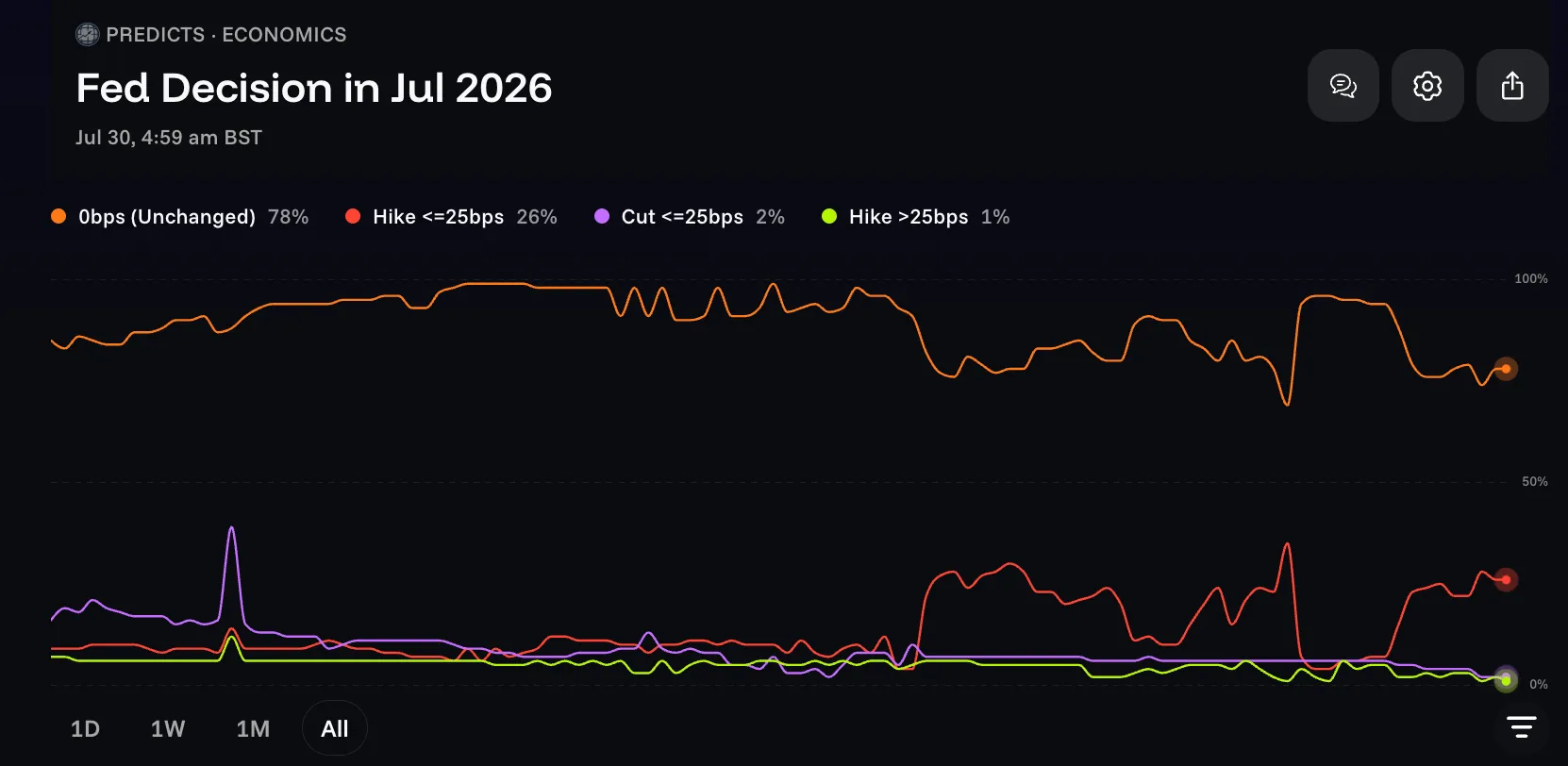
Market data as of 29 July 2026. For the up-to-date pricing, check OG.com app
At the time of writing, the contracts were priced as follows:
- No change: 78¢
- Rate hike smaller than 25 basis points: 26¢
- Rate hike larger than 25 basis points: 1¢
- Rate cut smaller than 25bpc: 2¢
That price can change as new information comes in, especially when inflation, jobs data or Fed communication shifts market expectations.
How Fed rate cut markets turn prices into probabilities
Fed rate cut markets turn prices into probabilities through event contracts. Buyers and sellers set the market price, that price implies a probability and the settlement rules determine the final payout.
In many yes-or-no event contracts, a correct outcome settles at $1.00, while the other side settles at $0.00.
The market price isn’t a perfect prediction. It’s a baseline for what traders are pricing at that exact moment.
What actually moves rate cut odds day to day
Rate cut odds move when new information changes how traders view inflation, employment, Fed policy or financial conditions. Markets react to surprises, not just headlines.
Inflation data is one of the biggest drivers. If the Consumer Price Index (CPI) comes in lower than expected, the Fed rate cut probability may rise because traders may see less pressure on the Fed to keep rates high. If inflation surprises higher, cut odds can fall.
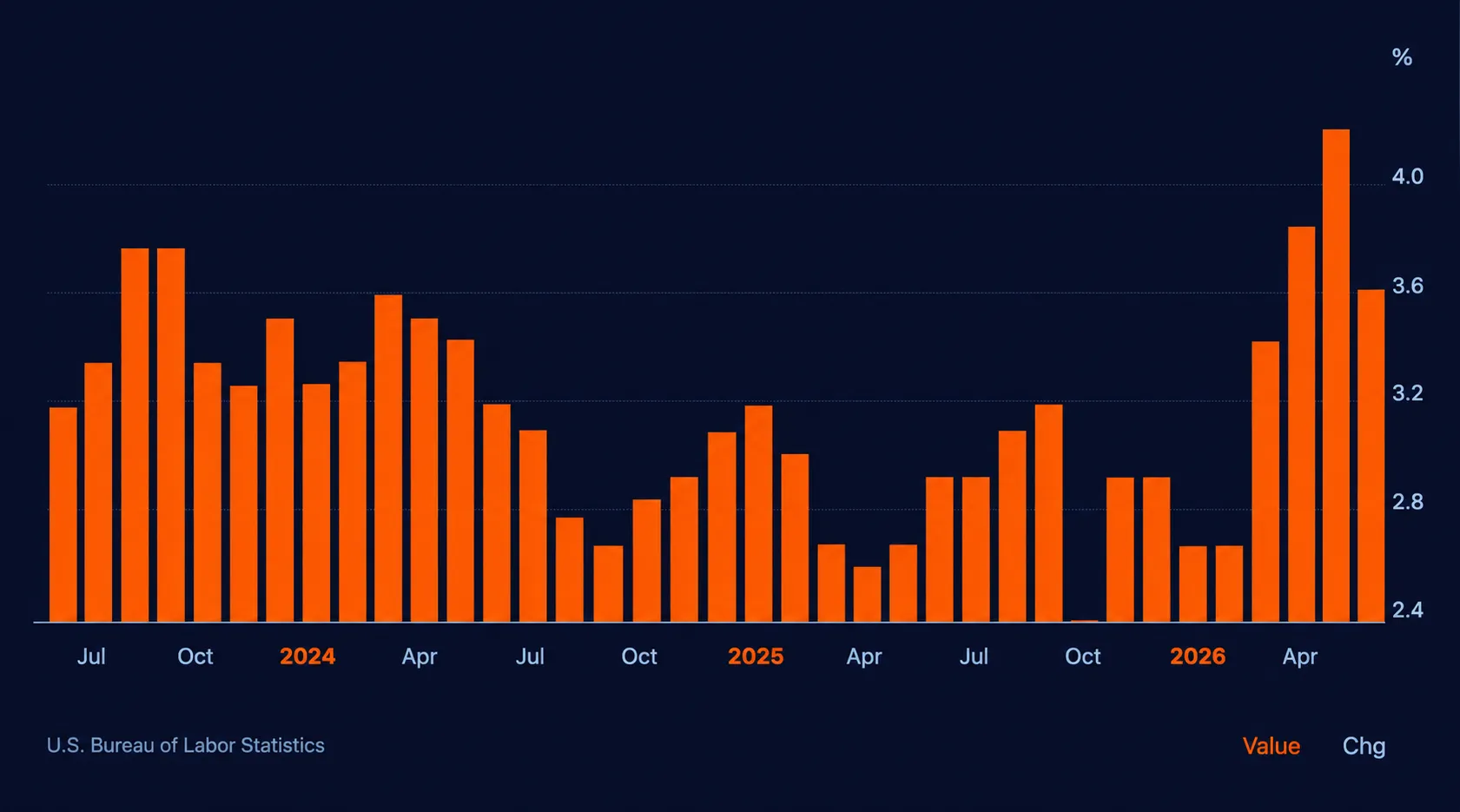
US inflation rate 2023-2026; Source: Trading Economics, BLS
Labor market signals can push rate cut odds in either direction. Strong job growth, low unemployment or firm wage growth can make cuts look less likely. Softer jobs data can raise the chance that the Fed may ease policy sooner.
Fed communication can move markets even without a rate decision. Press conferences, meeting minutes, speeches and policy statements can all change how traders read the next move.
Broader market conditions can also change how traders price the path of rates. Financial stress, oil shocks, growth scares or tighter credit conditions can shift expectations if traders think the Fed may need to respond.
As a Fed meeting gets closer, each remaining data release can carry more weight because there are fewer chances left for the market to change its view. One CPI print, jobs report or Fed comment can move Fed rate cut odds more sharply when traders are running out of new information before the decision.
Calendar that matters for pricing Fed odds
Fed rate cut markets are tied to deadlines, so the timing of each data release can change how traders read the contract. A market about the next Fed meeting may react differently from a year-end market because the next-meeting contract has fewer events left before settlement.
Before the meeting
This is when traders usually watch CPI, jobs reports, wage growth, retail sales, consumer spending and Fed speakers. The market may move when new data changes the case for a cut.
Meeting week
Attention shifts to the Fed statement, target range decision, press conference and updated projections when available. Even if rates stay unchanged, Fed language can still shift Fed rate cut probability for the next meeting.
Between meetings
Markets keep adjusting as new information comes in. That’s why Fed rate cut odds today may look different from last week’s market view, even without a new Fed decision.
What to review before trading
Before you trade, check:
- The next CPI, jobs and Fed communication dates.
- What the market price currently implies.
- The exact contract deadline.
- The settlement source and outcome definition.
- Fees and the maximum amount you could lose.
Prediction markets vs. CME FedWatch – what’s the difference?
Prediction markets and CME FedWatch offer two different views of rate expectations. CME FedWatch shows probabilities implied by Fed funds futures, while prediction markets show pricing for event contracts with defined outcomes.
Source | What it reflects | Strength | Limitation |
|---|---|---|---|
CME FedWatch | Fed funds futures-implied probabilities | Widely followed rate expectations tool | Not an event contract |
Prediction markets | Prices on defined outcomes | Clear yes-or-no framing | Liquidity and rules vary |
CME FedWatch can help you read how futures markets are pricing possible Fed decisions. Prediction markets can help you read how traders are pricing a specific yes-or-no outcome. But neither one tells you what the Fed will do.
How to read the rules and settlement criteria before you trade
The rules tell you exactly what must happen for the contract to settle in favor of the outcome. Before trading, read the contract question, deadline, settlement source and any special cases in the rules.
The settlement source is the official reference used to decide the result. For Fed markets, that may be the Federal Open Market Committee (FOMC) statement, the published target range or another source listed in the rules.
Check the deadline first. A next-meeting contract isn’t the same as a year-end contract.
Then check the outcome definition. ‘Any cut’ is different from ‘target range below a specific level.’
Also check special cases, including unscheduled meetings, changes in target range conventions or date cutoffs. Headlines can move the market, but the rules decide settlement.
Common mistakes when trading Fed odds
One common mistake is treating ‘odds moved’ as if the outcome is decided. A move from 40¢ to 65¢ shows a change in market expectations, but uncertainty still remains.
Another mistake is ignoring the deadline. A contract about the next meeting isn’t a broad view that cuts may happen eventually.
Traders can also react to Fed rate cut odds news without checking what the market expected. If inflation is high but lower than expected, the market may move differently than the headline suggests.
Don’t open a position larger than you can afford to lose. Event contracts can settle at $0 if the outcome doesn’t happen. Trading involves risk, including the risk of losing your cost to enter the transaction and fees.
How to trade Fed rate odds on OG.com
With OG.com, you can trade event contracts on real-world outcomes across different market categories.
- Create an account: Open an account and complete sign-up, including identity verification. You can use our web or mobile platforms.
- Browse markets: Explore markets across economics, including event contracts about the Fed meeting outcomes.
- Review and trade: Compare the market price with your own view. Check the rules, fees, and settlement details before opening a position.
- Monitor your position: After trading, your contract appears in your open positions, where you can track price movement as new information comes in.
FAQs about trading Fed rate cut odds on prediction markets
What is the CME FedWatch tool and how does it work?
The CME FedWatch Tool shows futures-implied probabilities for Fed rate decisions based on 30-Day Federal Funds futures pricing. Traders often use it to compare market expectations across upcoming FOMC meetings.
What are the odds of a Fed rate cut?
At the time of writing, the OG.com prediction markets are pricing a 78% change of no rate change; 26% chance of rate hike smaller than 25 basis points, 2% chance of a rate cut smaller than 25 basis points, and 1% change of a rate hike larger than 25 basis points.
Important Information: Prediction is an event contract that is a derivatives product offered by North American Derivatives Exchange, Inc. (NADEX), a CFTC-regulated exchange, which does business under the brand OG.com Prediction Markets (OG) Crypto.com | Derivatives North America and uses a CFTC-regulated exchange that uses OG.com technology.
Trading on OG.com involves risk and may not be appropriate for all. By trading you risk losing your cost to enter any transaction, including fees. You should carefully consider whether trading on OG.com is appropriate for you in light of your investment experience and financial resources. Any trading decisions you make are solely your responsibility and at your own risk