F1 United States Grand Prix 2026 prediction: Can anyone stop Verstappen in Austin?
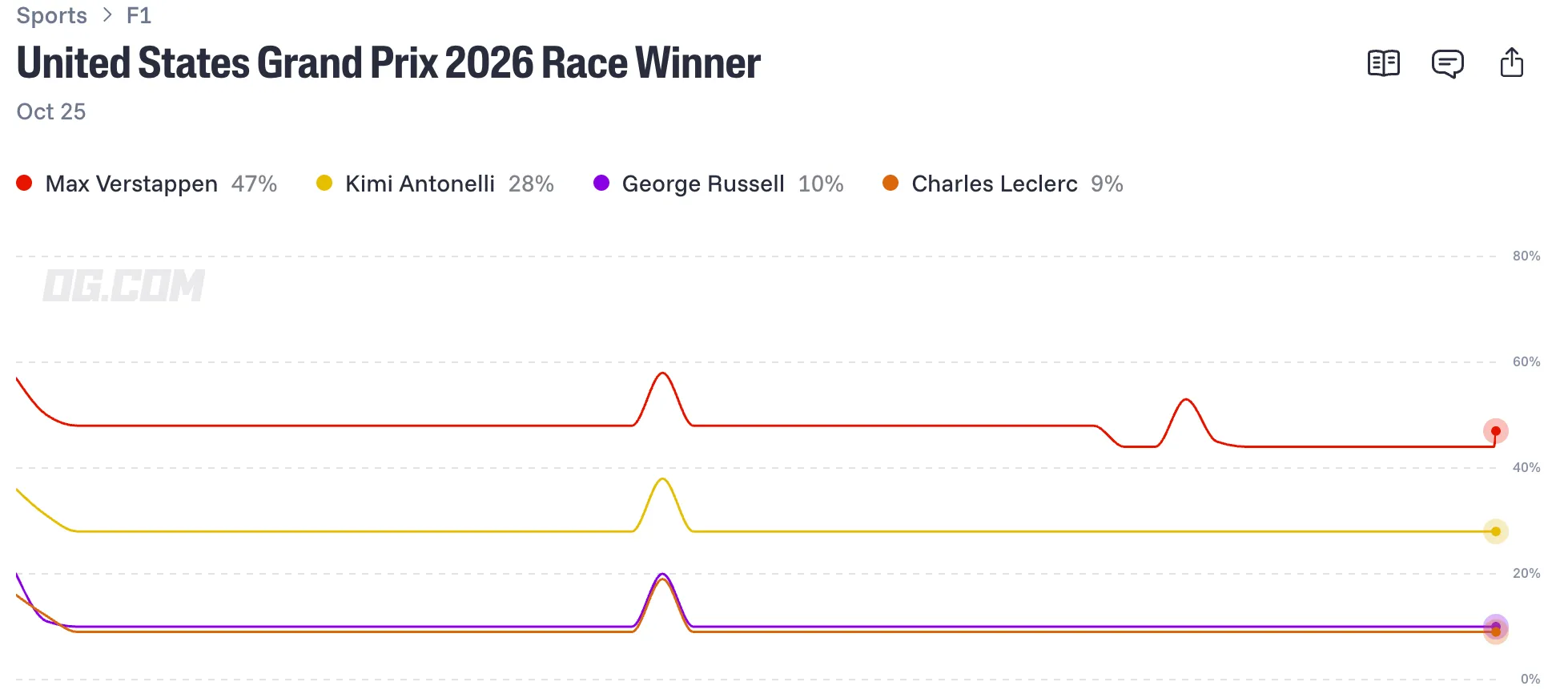
Max Verstappen leads the United States Grand Prix probabilities at 47%, with Kimi Antonelli at 28% as Mercedes seeks a response in Austin.
Motorsports
By Chris Old
Max Verstappen arrives in Texas with a much more cooperative Red Bull and two consecutive Grand Prix victories.
Kimi Antonelli arrives with his first opportunity to become world champion. Those two stories meet at a circuit capable of exposing weaknesses that Singapore could hide.
Red Bull’s recent improvement has made its car more predictable, giving Verstappen the confidence to extract performance that was missing earlier in the season. His victories at Sepang and Marina Bay suggest the gains extend across different circuit types.
Mercedes now gets three practice sessions to work on the upgrade it has struggled to exploit over the past two rounds. That additional preparation could be particularly valuable at Austin, where a car must handle fast direction changes without sacrificing its performance through slower corners.
This article is for informational purposes only and should not be construed as financial or investment advice. Past performance does not guarantee future results.
F1 United States Grand Prix 2026 weekend snapshot
Circuit: Circuit of The Americas, Austin, Texas
Format: Conventional weekend – no Sprint
, approximately
Race distance:
56 laps
308 km
Schedule
Practice 1: Friday, October 23 – 12:30 p.m. CT
Practice 2: Friday, October 23 – 4 p.m. CT
Practice 3: Saturday, October 24 – 12:30 CT
Qualifying: Saturday, October 24 – 4 p.m. CT
Grand Prix: Sunday, October 25 – 3 p.m. CT
Austin remains on Central Daylight Time this weekend, one hour behind Eastern Daylight Time.
The F1 Drivers’ Championship picture shows Antonelli leading the championship on 340 points, ahead of Russell on 238, Hamilton on 229 and Verstappen on 221.
His 102-point advantage creates the possibility of an early title celebration, but winning this particular race remains a substantial challenge.
Who will win the 2026 F1 United States Grand Prix?
Prediction markets for United States Grand Prix 2026 Race Winner give Verstappen a 44% market-implied probability in the featured snapshot, ahead of Antonelli at 28% and Russell at 10%.
Max Verstappen – 44%
Kimi Antonelli – 28%
George Russell – 10%
Charles Leclerc – 9%
Lando Norris – 6%
Lewis Hamilton – 6%
Isack Hadjar – 3%
Oscar Piastri – 2%
Market data as of October 9, 2026. For the latest market-implied probabilities, check the OG app.
Verstappen’s position is supported by recent results. He won the Singapore Grand Prix from pole, with Leclerc second and Antonelli third. Ferrari could challenge near the front, but Red Bull converted its starting position into control of the race.
Antonelli remains the strongest challenger. His championship lead reflects a season of results, while his Austin probability depends more immediately on whether Mercedes can recover the performance it has recently lost relative to Red Bull.
Russell’s 10% keeps a second Mercedes in the discussion. Leclerc’s 9%, meanwhile, gives Ferrari a credible place in the contest after its Singapore podium.
The market favors Verstappen, but there is enough development activity and preparation time this weekend for the order to change before qualifying.
Verstappen brings the clearest recent benchmark, having taken Grand Prix pole at both Sepang and Singapore. Leclerc and Hamilton qualified second and third at Marina Bay, ahead of Antonelli, Norris and Russell.
Austin asks a different question. Through the fast opening sector, a driver needs the front of the car to respond immediately without making the rear unstable. A correction in one change of direction can compromise the entry to the next corner.
The slower sections create another demand: rotate the car cleanly, then accelerate without excessive wheelspin. A setup that feels secure through the fast corners can still lose time when the driver asks for traction.
That makes sector performance more informative than an isolated practice position. Friday should show which cars can combine those requirements; Saturday will test who can deliver the complete lap when track position is at stake.
How could tire strategy shape the race?
Pirelli has nominated C2 Hard, C3 Medium and C4 Soft tires. The Hard is one step softer than last year’s C1, while the Medium and Soft retain the same compound designations.
The change could make the Hard a more useful race option. Pirelli noted that teams favored the softer choices in Austin last year, limiting the role of the hardest tire. This weekend’s allocation gives them a different balance between pace and stint length.
The strategic consequence will depend on degradation. If the Hard offers competitive pace over a long stint, it could help a driver extend the race without conceding too much time. If fresh tires produce a large enough advantage, an additional stop becomes more attractive.
Austin’s rapid direction changes load the tires heavily, while the range of corner speeds demands a versatile setup. A driver who pushes hard early in a stint could pay for it later if tire temperatures become difficult to control.
Friday’s longer runs should help establish that trade-off. There is no current-weekend evidence yet to rank the contenders over a sustained stint.
Can Mercedes turn additional practice into a better-balanced car?
Mercedes has been trying to understand the upgrade introduced in Malaysia, with its performance over the following two rounds falling short of expectations.
The conventional format gives the team more time to compare settings before qualifying.
The useful question is where that work produces a gain. More confidence in the fast corners would help the opening sector; cleaner traction would improve acceleration onto the straights.
Finding one improvement without creating a weakness elsewhere is the challenge.
For Antonelli, a more consistent car would also reduce the need to rescue a weekend through overtaking and strategy.
Will Red Bull’s improved predictability survive Austin’s changing demands?
Verstappen has described the improved Red Bull as easier to drive and more predictable. That gives a sporting explanation for its recent results: a driver can approach the limit more consistently when the car’s response is dependable.
Austin tests that confidence in several ways within one lap. Stability through the fast sequence must coexist with braking control and low-speed rotation. If Red Bull can preserve its recent balance across those demands, Verstappen has a strong platform for another win.
Can McLaren’s next developments restore front-running pace?
McLaren has confirmed that further developments will begin appearing from Austin. Andrea Stella’s assessment after Singapore qualifying was that the team was fluctuating between third and fourth in the performance order, with Red Bull and Ferrari ahead there.
That leaves Norris and Piastri with something more concrete to test than a general hope that the next circuit will suit them. The first task is to establish whether the changes improve the car’s usable performance across a complete lap.
A better qualifying position would also widen their strategic choices. Starting among the leaders gives McLaren more opportunities to influence pit-stop timing without first having to clear traffic.
Could Antonelli become champion in Austin?
Yes, but three results must align:
Antonelli wins.
Russell finishes ninth or lower.
Hamilton finishes fifth or lower.
Those are the current full-points clinching conditions. Victory alone would not secure the championship.
Our 2026 F1 Drivers’ Championship analysis explains the arithmetic. For now, the immediate consequence is straightforward: Antonelli needs to beat a resurgent Verstappen before results elsewhere can deliver the title.
What could move United States Grand Prix odds before the race?
Friday’s practice should provide the first useful comparison of Mercedes’ setup progress, McLaren’s developments and Red Bull’s performance at Austin.
The longer runs should then show whether one team can maintain its pace with less tire degradation. A quick qualifying simulation could attract attention, but sustained performance would give a stronger basis for judging Sunday’s race.
Saturday’s qualifying will establish the starting order, subject to penalties. Confirmed component changes, reliability problems or a material shift in the weather forecast could alter the picture further.
Verstappen arrives with the strongest recent results and the highest featured probability. Austin gives his rivals the preparation time to challenge that position – and gives Antonelli a chance to turn a race victory into something much bigger.
Important information
Prediction is an event contract that is a derivatives product offered by North American Derivatives Exchange, Inc. (NADEX), a CFTC-regulated exchange, which does business under the brand OG.com Prediction Markets (OG). Crypto.com | Derivatives North America uses a CFTC-regulated exchange that uses OG.com technology.
Trading on OG.com involves risk and may not be appropriate for all. By trading you risk losing your cost to enter any transaction, including fees. You should carefully consider whether trading on OG.com is appropriate for you in light of your investment experience and financial resources. Any trading decisions you make are solely your responsibility and at your own risk.