Who will win the F1 2026 Drivers' Championship? Prediction and odds
Kimi Antonelli has opened a commanding lead in the 2026 F1 Drivers' Championship, but McLaren's resurgence and the development race leave plenty to settle before Abu Dhabi.
Learn
By Chris Old

Kimi Antonelli could hardly have made a stronger statement about the 2026 F1 Drivers' Championship.
He began the Italian Grand Prix 19th after a power-unit penalty.
George Russell, his closest championship rival, started on the front row.
Antonelli still came through the field to win, catching and passing his Mercedes teammate in the closing stages and extending an already substantial points advantage.
A Virtual Safety Car gave Antonelli the opportunity to switch onto fresher tires while Russell remained on older hards, so it was not a straight comparison of equal strategies. Getting himself into position to capitalize from 19th was nevertheless a formidable recovery.
Antonelli now has 267 points to Russell's 201. Lewis Hamilton is third on 191, defending champion Lando Norris has 171, Charles Leclerc 155, Max Verstappen 127 and Oscar Piastri 116.
The championship still has time to change. The current calendar runs through another 10 Grands Prix, beginning with Spain and ending in Abu Dhabi in December.
But the burden has changed. Antonelli no longer simply needs to keep winning. Everybody else needs to start taking substantial chunks out of his lead.
This article is for informational purposes only and should not be construed as financial or investment advice. Past performance does not guarantee future results.
F1 Drivers' Championship 2026 standings
- Kimi Antonelli: 267 points
- George Russell: 201 points — 66 behind
- Lewis Hamilton: 191 points — 76 behind
- Lando Norris: 171 points — 96 behind
- Charles Leclerc: 155 points — 112 behind
- Max Verstappen: 127 points — 140 behind
- Oscar Piastri: 116 points — 151 behind
Antonelli has also won seven of the opening 13 Grands Prix. Russell has two victories, Norris two, while Hamilton and Leclerc have one each. Verstappen and Piastri are yet to win a Grand Prix in 2026.
Who will win the 2026 F1 Drivers' Championship?
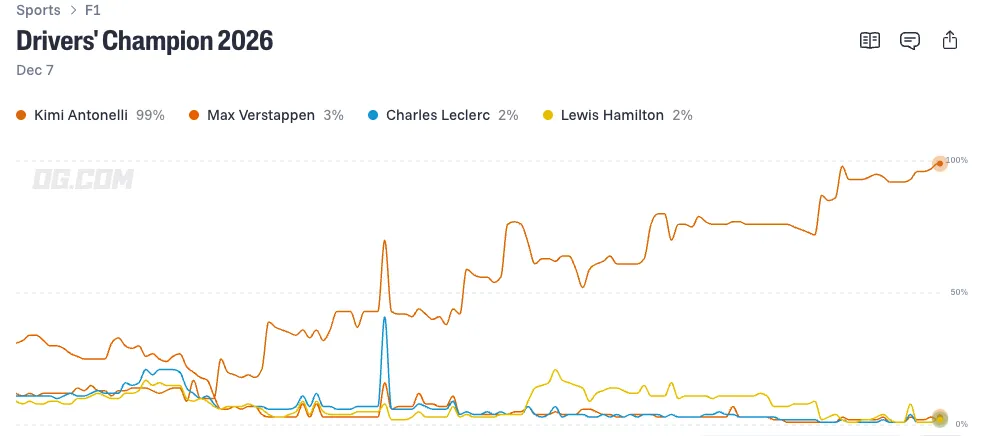
Prediction markets for Drivers' Champion 2026 currently give Antonelli an 87% market-implied probability of becoming F1 Drivers' Champion, comfortably ahead of Russell at 6%.
- Kimi Antonelli — 87%
- George Russell — 6%
- Lando Norris — 3%
- Lewis Hamilton — 2%
- Charles Leclerc — 1%
- Max Verstappen — 1%
- Oscar Piastri — 1%

Market data as of September 7, 2026. For the latest market-implied probabilities, check the OG app.
The hierarchy is difficult to argue with.
Antonelli has the largest points total, the strongest cushion and a Mercedes that has provided a winning platform across a wide range of circuits.
The Italian Grand Prix strengthened all three parts of that case: even a weekend that began with a penalty and a back-row start ended with another victory.
Russell is the nearest driver in the standings and therefore the most obvious challenger. His difficulty is that beating the rest of the grid is no longer enough. He needs to start beating Antonelli consistently in effectively the same machinery.
Norris presents a different threat. He is much further behind, but McLaren has undergone a significant development push and the reigning champion won consecutive races in Hungary and the Netherlands.
If that pace proves representative of most of the remaining calendar rather than a brief circuit-specific peak, his 96-point deficit becomes more interesting than it first appears.
Ferrari and Red Bull still have enough performance to influence the championship. The harder question is whether either has enough time and consistency to win it.
Kimi Antonelli — 87%
Antonelli's championship case begins with arithmetic.
A 66-point advantage over Russell means he can afford weekends in which his teammate finishes ahead of him.
A 96-point cushion over Norris gives him even more protection against a sustained McLaren revival. Hamilton, Leclerc and Verstappen need increasingly dramatic swings.
The stronger argument, though, is the Mercedes.
Nine of the opening 13 Grands Prix have been won by either Antonelli or Russell.
Antonelli alone has won seven, at China, Japan, Miami, Canada, Monaco, Belgium and Italy. Mercedes has therefore demonstrated front-running performance at street circuits, conventional permanent tracks, high-speed layouts and low-downforce Monza.
Antonelli has also increasingly looked capable of converting difficult weekends rather than only winning from the front.
Italy was the extreme example. He started 19th, worked through the field and ultimately put himself in position to use the Virtual Safety Car and fresher tires to attack Russell for the lead.
That does not prove Antonelli will always have Russell's measure on pure pace, but championships are won through weekends like that as much as through clean pole-to-flag victories.
The 87% market probability reflects how many things are now working in his favor simultaneously.
He has the lead. He has the car. And so far, he has been the Mercedes driver converting that combination into the most points.
George Russell — 6%
Russell remains the championship's most immediate threat.
He is second in the standings, has won in Australia and Austria and came within four seconds of Antonelli in Italy despite ultimately losing the lead late in the race.
The problem is the size of the gap, and little evidence of him being able to dominate his younger teammate.
Sixty-six points is recoverable with 10 races remaining, but Russell cannot rely on Mercedes simply continuing to dominate. If Mercedes finishes one-two with Antonelli ahead, the championship moves further away from him.
Even reversing that order produces relatively modest gains.
That changes the nature of Russell's season. He needs weekends where he wins and Antonelli finishes several positions lower. Reliability, strategy, qualifying errors and races where rival teams can split the Mercedes pair all become important.
Russell has already shown that he can beat Antonelli on merit. What he has not yet done is sustain that advantage for long enough to stop his teammate building the championship around him.
Lando Norris — 3%
Norris is the outsider with the clearest sporting argument for a late run.
The points gap is enormous: 96 points. But McLaren's recent trajectory is different from Ferrari's or Red Bull's.
The team's major Hungary package included an all-new floor, wakeboards and floor slots. McLaren followed that with further aerodynamic development at Zandvoort, including a new rear wing, engine cover, diffuser changes and revised front wheel rims. The result was immediate: Norris won both Grands Prix from pole.
That makes the defending World Champion difficult to dismiss purely on his current points position.
The crucial issue is how transferable that package is.
McLaren's gains were spectacular at Hungary and Zandvoort. Italy was less convincing: Norris finished fourth, nearly 20 seconds behind Antonelli, with Piastri fifth.
Monza is an unusual low-downforce circuit, so one weaker weekend does not invalidate the progress McLaren has made.
The question for the remaining races is whether the upgraded MCL40 is now genuinely a Mercedes-level car across different circuit types.
If it is, Norris has the recent form to exploit it.
If Mercedes remains the superior all-round package, Antonelli's 96-point head start should be far too much.
Lewis Hamilton — 2%
Hamilton sits third in the championship and is actually 20 points closer to Antonelli than Norris.
The market nevertheless gives Norris the higher probability.
That distinction says a great deal about the perceived trajectories of McLaren and Ferrari.
Ferrari has unquestionably been capable of winning in 2026. Hamilton won in Barcelona-Catalunya and Leclerc won at Silverstone, while both drivers have regularly appeared around the podium places.
The issue has been turning that speed into a consistently championship-level package.
Ferrari brought further floor and diffuser development after the summer break, targeting additional aerodynamic load and more robust airflow to the rear of the car. It then introduced another power-unit development for Italy.
The latest result did little to suggest Ferrari has closed the gap completely. Hamilton finished sixth at Monza while Leclerc crashed early, leaving Ferrari with only eight points from the weekend. Hamilton's race was not disastrous, but the outright pace was not sufficient to threaten the leading Mercedes cars.
Hamilton's remarkable consistency — he is yet to record a Grand Prix DNF this season — keeps him relevant.
To become a serious title threat, though, Ferrari needs more than points accumulation. It needs another performance step capable of turning podium contention into repeat victories.
Charles Leclerc — 1%
Leclerc has already demonstrated that Ferrari can win in the right circumstances.
His Silverstone victory remains one of Ferrari's strongest performances of the year, and he followed Antonelli home in second at Belgium.
But the championship deficit has reached 112 points.
That leaves Leclerc needing virtually everything Hamilton needs — a faster Ferrari, sustained wins and Antonelli losing significant points — while also recovering another 36 points relative to his teammate.
His early crash in Italy made that equation harder still.
Leclerc remains capable of influencing who wins the championship by taking victories and podiums away from the Mercedes or McLaren drivers.
Winning it himself now requires a much more dramatic reversal.
Max Verstappen — 1%
Red Bull's season is more encouraging than Verstappen's 140-point championship deficit suggests.
The team started 2026 well behind the leading pace but made an important step with its major Austrian upgrade package.
Changes to the floor and rear suspension helped Verstappen finish second there, less than two seconds behind Russell, and Red Bull described itself as having moved back within striking range of the leaders.
That improvement has not disappeared.
Verstappen finished on the podium again in Belgium and took third at Monza, while also finishing second in Hungary.
The championship is another matter.
At 140 points behind Antonelli, simply becoming capable of winning races is unlikely to be sufficient. Verstappen needs a period of Red Bull superiority combined with repeated trouble for Antonelli.
There is also less margin for inconsistency. Verstappen has already recorded multiple DNFs this season, including China, Monaco, Great Britain and the Netherlands.
Red Bull can still become a major factor in the title fight.
It is increasingly difficult to see Verstappen himself becoming the beneficiary.
Oscar Piastri — 1%
Piastri's championship position illustrates the other side of McLaren's resurgence.
The car has recently become capable of winning races. Norris has taken advantage. Piastri has not.
He sits seventh on 116 points, 151 behind Antonelli, and has yet to win a Grand Prix this season. His recent run includes a DNF in Hungary, sixth in the Netherlands and fifth in Italy.
That does not make his remaining season unimportant.
If McLaren maintains its improved pace, Piastri can take major points from Mercedes, Ferrari and Red Bull and materially affect Norris' championship route.
But at 1%, the market is effectively treating his own title challenge as dependent on an extraordinary sequence of results.
See more prediction markets
F1 Drivers' Championship key factors
Can Mercedes maintain the strongest all-round package?
This is the biggest question in the championship.
Antonelli's points lead matters because it is being defended from what has so far been the most consistently competitive car. Mercedes has won nine of 13 Grands Prix, and those victories have arrived on fundamentally different types of circuit.
That makes the Mercedes advantage harder for its rivals to attack.
A car that excels only in high-downforce conditions can be exposed when the calendar reaches Monza. A low-drag specialist can struggle elsewhere. Mercedes has so far avoided being boxed into one narrow performance window.
Its recent development also appears comparatively evolutionary rather than desperate. For Zandvoort, for example, Mercedes introduced only a modified front-corner arrangement while Ferrari and McLaren arrived with broader aerodynamic changes. Despite that, Antonelli and Russell finished second and third there before Mercedes returned to a one-two in Italy.
That is an important distinction.
McLaren, Ferrari and Red Bull are trying to find enough development to change the championship hierarchy. Mercedes mainly needs to avoid losing its baseline advantage.
If it does, Antonelli can accumulate rather than chase.
Can McLaren's upgraded package work across the remaining calendar?
McLaren may represent the most credible threat to the existing order because there is already evidence that its development has worked.
The Hungary package was the team's largest of the year, led by major floor changes. More parts followed at Zandvoort, and Norris immediately produced consecutive poles and victories.
That is a genuine performance trend rather than one unusual race result.
What we do not yet know is the size of the operating window.
Hungary and Zandvoort both gave McLaren opportunities to exploit aerodynamic grip. Monza's long straights and low-drag demands created a different test, and the Mercedes was clearly stronger over the full weekend.
The remaining calendar is varied enough to answer the question properly. Street circuits, conventional tracks and different downforce requirements mean McLaren cannot build a title challenge around two favorable configurations.
If Norris starts regularly qualifying and racing at the front again, the championship becomes more uncomfortable for Antonelli even before the points gap itself looks close.
If McLaren continues oscillating between race-winning and third-best-team performance depending on the circuit, the title is unlikely to reopen.
Can Ferrari turn development into consistent race-winning pace?
Ferrari's season has contained enough good weekends to make its underlying potential obvious.
Hamilton has won. Leclerc has won. Both have finished on the podium repeatedly.
The car has also continued to develop. Ferrari made substantial floor, diffuser and beam-wing changes after the summer break and followed those with a power-unit upgrade for Monza.
Yet the results still lack the consistency of Mercedes.
Silverstone produced a Ferrari victory and a double podium. Belgium put Leclerc second. Zandvoort brought both Ferraris home within 17.3 seconds of Norris. Then Italy produced sixth place for Hamilton and an early retirement for Leclerc.
That variation matters more than any single upgrade specification.
For Hamilton or Leclerc to pull themselves back into genuine title contention, Ferrari needs to reach a point where victory is an expectation at several successive races rather than something available when a particular circuit, setup or race situation suits the car.
Even if that never happens, Ferrari can still shape the championship by getting between Antonelli and his pursuers.
Has Red Bull's recovery arrived too late for Verstappen?
Red Bull has probably made the largest relative improvement of the leading teams.
Team principal Laurent Mekies said the RB22 began the year more than a second from race-winning pace. After development in Miami and the much larger Austria package, he assessed the car as having closed to within striking distance.
The results broadly support that.
Verstappen was second in Austria, third in Belgium, second in Hungary and third in Italy. Red Bull is no longer operating like a team hopelessly detached from the front.
But improvement and championship contention are two different questions.
Even if Verstappen starts winning, Antonelli can absorb a lot of damage while continuing to finish near the podium. A 140-point deficit requires more than Red Bull finding another few tenths.
It requires an extraordinary combination of Red Bull performance and Mercedes problems.
That is why Verstappen may become increasingly important to who wins the championship without becoming likely to win it himself.
How much will circuit characteristics change the competitive order?
The recent run has shown how quickly F1's hierarchy can move.
McLaren won in Hungary and the Netherlands. Mercedes responded with a dominant championship result in Italy. Red Bull has been substantially stronger since Austria. Ferrari has shown winning pace without yet sustaining it.
The remaining races include very different challenges, from street circuits to high-speed layouts and tracks where tire management or aerodynamic efficiency can shift the balance.
That favors the team with the widest operating window.
So far, that has been Mercedes.
But it also gives McLaren an opportunity. Norris does not necessarily need the MCL40 to become the unquestioned fastest car everywhere. He needs enough circuits where it can beat Mercedes to start applying pressure.
The same principle applies to Ferrari and Red Bull, even if their drivers' championship deficits are larger.
The title could therefore become less about one decisive upgrade and more about which car remains competitive when the circuit requirements change.
Can Antonelli keep avoiding championship-changing weekends?
A large points lead changes the type of risk that matters.
Antonelli does not need to win every remaining Grand Prix. Regular podiums, combined with occasional victories, make the arithmetic increasingly difficult for everyone behind him.
The danger comes from zeros.
Mechanical failures, contact, penalties or a poor weekend can remove 20-plus points from a championship advantage immediately. Two such races can completely change what currently looks comfortable.
Antonelli has already experienced that vulnerability. A technical issue cost him heavily at Silverstone, while his Italy power-unit penalty should have turned another weekend into damage limitation.
Instead, he won from 19th.
That ability to salvage difficult situations may end up being every bit as important as Mercedes' raw speed.
F1 Drivers' Championship prediction
Antonelli has the strongest case by a considerable margin.
The 87% market-implied probability is aggressive, but it reflects a championship situation in which the leader also has the season's most successful car and seven victories already behind him.
Russell remains the nearest challenger because of both the points table and the Mercedes beneath him. But his central problem is unusually difficult: the performance advantage that helps him beat Ferrari, McLaren and Red Bull also helps the driver he is trying to catch.
Norris is the more intriguing external threat.
McLaren's development has produced real performance, and the defending champion has already shown he can convert it into consecutive victories. Ninety-six points remains a huge deficit, but another run like Hungary and the Netherlands would at least begin asking Antonelli questions.
Ferrari is not yet consistently quick enough. Red Bull's recovery looks increasingly credible but Verstappen has too much ground to regain. Piastri is further back again.
For now, the championship is Antonelli's to control.
The clearest route to making it competitive again is either Russell establishing a sustained advantage within Mercedes or McLaren proving its upgraded package can challenge the W17 across a much broader range of circuits.
What could move F1 Drivers' Championship odds?
The championship market should continue to react most strongly to evidence about the relative pace of Mercedes and McLaren.
A further run of Norris victories would quickly change the conversation, particularly if Antonelli begins finishing behind multiple rivals rather than immediately behind the McLaren.
Development will matter too. Ferrari has continued bringing aerodynamic and power-unit changes, Red Bull's recent package has already produced a substantial gain, and McLaren's summer upgrades transformed its performance.
Another major step from any of those teams could change how easily Antonelli is able to accumulate points.
Within Mercedes, Russell versus Antonelli remains the most direct fight. If Russell starts consistently qualifying ahead and winning races, the 66-point deficit can shrink. If Antonelli keeps finishing ahead or immediately behind him, time increasingly works in the championship leader's favor.
Reliability may ultimately create the largest individual swings. At this stage of the season, one retirement can be worth more to a title challenger than several races of gradually finishing one position ahead.
And as the calendar moves through different circuit types, the central question will become clearer: does Mercedes still have the best car across the season as a whole, or has one of its rivals developed a package capable of taking control of the final stretch?
Important Information
Prediction is an event contract that is a derivatives product offered by North American Derivatives Exchange, Inc. (NADEX), a CFTC-regulated exchange, which does business under the brand OG.com Prediction Markets (OG). Crypto.com | Derivatives North America uses a CFTC-regulated exchange that uses OG.com technology.
Trading on OG.com involves risk and may not be appropriate for all. By trading you risk losing your cost to enter any transaction, including fees. You should carefully consider whether trading on OG.com is appropriate for you in light of your investment experience and financial resources. Any trading decisions you make are solely your responsibility and at your own risk.