F1 Spanish Grand Prix 2026 prediction: race winner odds
Kimi Antonelli starts as the favorite for F1's first race at Madring, but the new Spanish Grand Prix circuit could bring McLaren and Ferrari much closer to Mercedes than Monza did.
Motorsports
By Chris Old
Kimi Antonelli arrives in Madrid with another statement win behind him.
The championship leader started the Italian Grand Prix 19th after a power-unit penalty and still won, recovering through the field before catching Mercedes teammate George Russell late in the race.
A Virtual Safety Car and fresher tires helped create the opportunity, but Antonelli still had to put himself close enough to exploit it.
It continued a significant recent pattern between the two Mercedes drivers.
Antonelli has now finished ahead of Russell at each of the last four Grands Prix: Belgium, Hungary, the Netherlands and Italy. He leads the Drivers' Championship by 66 points and has won seven of the opening 13 races.
Spain presents a completely different problem.
Formula 1 is racing at Madring for the first time. The 5.416-kilometer circuit combines public roads and permanent sections, with 22 corners, major elevation changes, speeds expected to reach around 340 kph and a 550-meter banked section at Turn 12.
There is no previous Grand Prix data telling the teams which design philosophy should work best.
That uncertainty is key for McLaren.
Lando Norris won from pole in Hungary and followed it with another pole and victory in the Netherlands before McLaren's straight-line weakness was exposed at Monza.
If Madrid rewards more of the aerodynamic performance that suited the MCL40 at the previous two rounds, Norris could again become Antonelli's most dangerous challenger.
Ferrari enters with a different question. The team has won twice this season and has continued developing the SF-26, but Italy did not produce the home result it wanted.
Madrid may offer a better opportunity — and Ferrari is the only team to have already completed laps of Madring in a current F1 car, albeit under tightly restricted filming-day conditions.
This article is for informational purposes only and should not be construed as financial or investment advice. Past performance does not guarantee future results.
F1 Spanish Grand Prix 2026 weekend snapshot
Practice
Practice 1: Friday, September 11 — 1:30 p.m. local / 7:30 a.m. ET
Practice 2: Friday, September 11 — 5:00 p.m. local / 11:00 a.m. ET
Practice 3: Saturday, September 12 — 12:30 p.m. local / 6:30 a.m. ET
Race weekend
Qualifying: Saturday, September 12 — 4:00 p.m. local / 10:00 a.m. ET
Race: Sunday, September 13 — 3:00 p.m. local / 9:00 a.m. ET
Race distance: 57 laps / 308.524 km
Context
Drivers' Championship leader: Kimi Antonelli — 267 points
Teams' Championship leader: Mercedes — 468 points
Last race winner: Kimi Antonelli — Italian Grand Prix
Madring is unlike anything else on the 2026 calendar because the teams arrive without historical race data. There are high-speed sections, heavy braking zones, slower street-style corners and a long banked turn, while elevation changes add another setup variable.
That should make Friday particularly important.
The fastest package may not simply be the car with the highest peak performance. Teams also need to understand ride height, braking stability, tire behavior and how much downforce they can carry without becoming vulnerable on the faster sections.
Who will win the 2026 F1 Spanish Grand Prix?
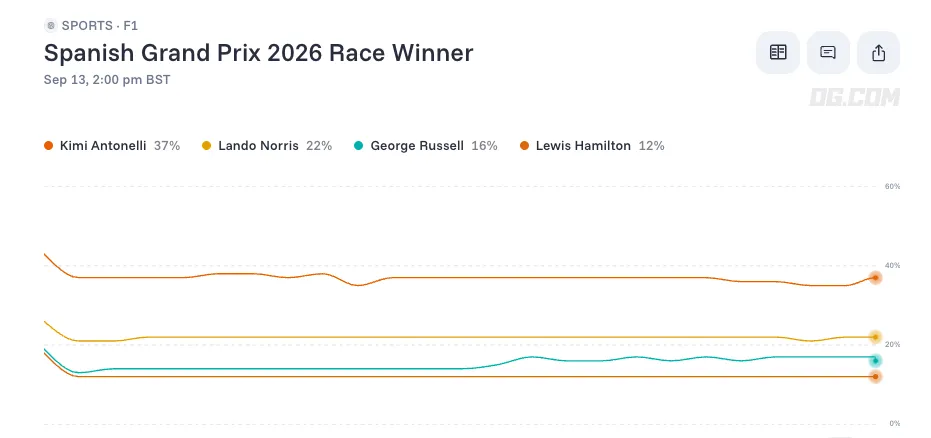
Prediction markets for Spanish Grand Prix 2026 Race Winner currently make Kimi Antonelli the favorite at 37%, with Lando Norris second at 22% and George Russell third at 16%.
Kimi Antonelli — 37%
Lando Norris — 22%
George Russell — 16%
Lewis Hamilton — 12%
Max Verstappen — 9%
Charles Leclerc — 8%
Oscar Piastri — 6%
Market data as of September 9, 2026. For the latest market-implied probabilities, check the OG app.
Antonelli's position at the top is easy to understand.
Mercedes has won nine of the opening 13 Grands Prix, seven through Antonelli himself, and the Italian has finished ahead of Russell across the last four race weekends. He also just turned what should have been damage limitation at Monza into another victory.
The more interesting number is Norris at 22%.
McLaren did not look like a 22% winning proposition at Monza. Norris finished fourth and Piastri fifth, and the team described itself as only the third-quickest package on Sunday. Norris specifically highlighted straight-line speed and qualifying performance as weaknesses.
But Monza is an extreme circuit.
Immediately before it, Norris won consecutive Grands Prix in Hungary and the Netherlands, both from pole, after McLaren introduced a major aerodynamic package in Hungary and further development at Zandvoort.
Madring may therefore tell us much more about McLaren's true post-upgrade level than Italy did.
Ferrari sits immediately behind the two Mercedes drivers and Norris in the market through Hamilton and Leclerc.
That feels reasonable rather than aggressive. Ferrari has won with both drivers this season, but the car has not yet demonstrated Mercedes-level performance consistently enough to make either driver an obvious favorite before practice begins.
This is much less obvious than the race-winner market.
Antonelli is the race favorite because of the combination of Mercedes performance, current form and his ability to convert Sundays.
Over one lap, Norris may have the stronger recent evidence.
The McLaren driver took pole in Hungary and then did it again at Zandvoort, beating Russell and Antonelli at the latter by just over a tenth. Monza was much harder because McLaren needed a tow to compensate for its straight-line deficit, but Madring presents a broader mix of corner types.
Russell also deserves to be separated slightly from Antonelli when discussing qualifying alone.
He started second at Monza and again qualified ahead of Antonelli at Zandvoort. Antonelli has had the stronger run of race results, but that does not automatically make him Mercedes' strongest one-lap driver entering Madrid.
Then there is Ferrari.
Hamilton qualified second in Hungary and fifth at Zandvoort, while Leclerc was third in Hungary and started third at Monza after Piastri's grid penalty. Ferrari clearly has enough one-lap performance to enter the discussion.
The small complication is that nobody knows exactly where the lap time will come from at Madring yet.
Learning the circuit quickly could be unusually valuable.
Ferrari has at least completed limited running there already, with Leclerc and Hamilton driving the SF-26 during a filming day in July. The mileage was restricted and the car used promotional Pirelli tires, so it should not be treated as a proper test, but Ferrari does possess some real-world reference points that its rivals do not.
Before practice, the qualifying picture therefore looks more open than the race market:Norris has the clearest recent pole form. Russell remains extremely strong over one lap. Antonelli has the strongest overall momentum. Ferrari cannot be dismissed.
Who has the edge on long-run pace?
Mercedes has to begin as the reference.
Nine victories from 13 races is not a track-specific run. Antonelli and Russell have won on very different layouts, which is one reason the W17 has looked like the strongest all-round package rather than a car requiring one particular type of circuit.
Italy reinforced that.
Russell controlled much of the race from the front before Antonelli recovered from 19th and ultimately passed him on fresher tires. Mercedes finished first and second, while Norris ended almost 20 seconds behind Antonelli.
Madrid nevertheless gives McLaren a better argument than Monza did.
The MCL40's summer development produced a genuine step forward. At Zandvoort, Norris stayed with Antonelli before taking the lead and then pulled more than 11 seconds clear despite remaining on older tires after a late Virtual Safety Car.
That is much stronger race evidence than the Monza result.
The difficulty is determining which circuit is more representative.
Madring includes long straights and speeds around 340 kph, so McLaren cannot completely escape the straight-line weakness that hurt it in Italy. But there are also far more corners, elevation changes and medium- and high-speed sections where aerodynamic performance should carry greater weight.
Ferrari is harder to judge.
Hamilton won the earlier Barcelona-Catalunya Grand Prix by almost 20 seconds from Russell, proving that the SF-26 is capable of producing outstanding race pace in Spain — but that happened at an entirely different circuit. Leclerc then won at Silverstone, while Ferrari remained close to Mercedes and McLaren in Belgium and the Netherlands.
Italy was less convincing.
Hamilton finished sixth and Leclerc's race ended on the opening lap. Ferrari therefore arrives at Madring with enough evidence to contend, but not enough recent consistency to start above Mercedes or McLaren.
Does Antonelli deserve to be favorite?
Yes. The strongest case is no longer simply that he drives the fastest car.
Antonelli is increasingly becoming the driver extracting the most from it.
He has finished ahead of Russell at Belgium, Hungary, the Netherlands and Italy, building his championship advantage from 59 points before Monza to 66 afterward.
Italy was particularly persuasive. Russell started on the front row. Antonelli started 19th. Yet by the closing laps they were fighting each other for victory.
The Virtual Safety Car and tire offset were important, so it would be wrong to treat the final pass as a pure same-strategy pace comparison. But Antonelli had already made up enough of the deficit to turn those circumstances into an opportunity.
That has become part of his 2026 profile. He does not need everything to run cleanly in order to produce a strong result.
At an unfamiliar circuit where mistakes, setup changes and unexpected race situations are more likely than usual, that adaptability strengthens his case.
Thirty-seven percent still leaves plenty of room for somebody else.
It should. Nobody has raced at Madring before.
Is Verstappen being overlooked?
Not really.
Eight percent gives Verstappen respect without pretending Red Bull's recent improvement has already turned into victories.
The RB22 has unquestionably become faster.
A major Austria upgrade involving the floor and rear suspension produced Red Bull's strongest performance of the season, with Verstappen finishing just 1.6 seconds behind Russell. He subsequently finished on the podium at Belgium and Italy and was second in Hungary.
But there is an obvious line the team still has not crossed. Red Bull has not won a Grand Prix in 2026.
Verstappen's best results have been strong enough to establish the team as a threat again, but not enough to show it can consistently beat Mercedes, McLaren and Ferrari.
The new circuit introduces uncertainty in his favor.
A team that finds the setup window quickly can gain ground on one that spends Friday chasing the car. Red Bull's performance has also improved enough that Verstappen no longer needs a freak race simply to reach the front.
Eight percent looks appropriate. He has a route but he has not yet shown the car that makes victory the baseline expectation.
Can Antonelli maintain his advantage over Russell?
This has become one of the defining questions of Mercedes' season.
Russell started the year strongly. He won the opening Grand Prix in Australia, added another victory in Austria and remains second in the championship.
But the recent trend belongs to Antonelli.
Belgium ended with Antonelli winning and Russell retiring. At Hungary, Antonelli finished third while Russell was seventh. At Zandvoort they finished second and third respectively. Then came Monza, where Antonelli started 17 places behind Russell and still ended the afternoon ahead of him.
Not all of those results are pure driver comparisons. Russell's Belgium retirement removes that race as useful pace evidence, and Antonelli's Italian strategy gave him a tire advantage late on.
But championships are not decided through theoretical equal-condition comparisons.
Antonelli keeps converting weekends into more points.
Madrid is particularly interesting because neither Mercedes driver arrives with meaningful circuit experience. Setup direction, confidence in the braking zones and how quickly each understands the unusual banked section could expose differences that established tracks sometimes hide.
If Antonelli is immediately the stronger Mercedes again, his current position as race favorite becomes even harder to challenge.
If Russell establishes the advantage early, the 16% market probability could begin to look conservative.
Does Madring bring McLaren back into the fight?
This may be the biggest team question of the weekend.
McLaren's Hungary development changed its season. Norris took pole and won there, then repeated both achievements at Zandvoort. The MCL40 looked capable of beating Mercedes over one lap and over a race distance rather than merely capitalizing when the leading cars had problems.
Then Monza exposed the other side of the package.
Norris and Piastri lacked straight-line speed, struggled to create competitive qualifying laps without a tow and finished fourth and fifth. McLaren itself assessed Mercedes as clearly faster on Sunday.
Madrid should provide a much more balanced examination.
The circuit still contains long full-throttle sections, so McLaren's drag efficiency cannot be ignored. But 22 corners, elevation changes, heavy braking zones and a very long banked corner mean this is not another Monza-style exercise in stripping away downforce.
If McLaren returns to the level seen in Hungary and Zandvoort, Norris at 22% may be the most credible alternative to Antonelli.
Piastri's 6% tells a different story. He has the same machinery but has not been extracting the same level from it recently. He finished sixth at Zandvoort and fifth at Monza while Norris won the former and beat him again in Italy.
A strong Madrid weekend would therefore tell us something not only about McLaren, but about whether Norris' current advantage within the team is becoming entrenched.
Can Ferrari turn potential into a complete weekend?
Ferrari is difficult to price because the ingredients are there.
Hamilton and Leclerc have both won in 2026.
Hamilton won the Barcelona-Catalunya Grand Prix in June. Leclerc won at Silverstone three weeks later. Ferrari then introduced another substantial set of aerodynamic changes after the summer break and followed them with a power-unit development at Monza.
That is not the profile of a car hopelessly behind Mercedes.
What Ferrari has lacked is repeatability.
It looked competitive at Zandvoort without threatening Norris for victory. Monza started promisingly in practice and qualifying, but Hamilton ultimately finished sixth while Leclerc crashed on Lap 1.
Madrid may offer a small preparation advantage. Ferrari completed the first laps of the circuit by a current Formula 1 car in July, with both Leclerc and Hamilton participating in the filming day.
Those runs were mileage-limited and used promotional tires, so there is no meaningful performance comparison to draw from them.
But familiarity still has some value. The drivers have seen the sightlines at F1 speed. The team has gathered at least some physical information about bumps, kerbs and how its car behaves through parts of the lap.
That may disappear as an advantage within a few practice runs.
On a brand-new circuit, though, even a small head start could help Ferrari arrive at a useful baseline more quickly.
How quickly can the teams understand Madring?
This is the factor that makes Spain fundamentally different from the races around it.
Every circuit involves simulation work.
Madrid relies on it more heavily because there is no previous F1 Grand Prix data.
Teams have modeled the layout, drivers have spent time in simulators and engineers will arrive with predicted setup windows. Friday tells them how accurate those predictions actually were.
There are several competing demands.
The circuit needs enough efficiency for sections where speeds approach 340 kph. It needs braking confidence for slower corners following those fast runs. Ride and mechanical grip matter through the more street-like sections. Then there is La Monumental, the long banked Turn 12 that should be taken at very high speed before creating another potential overtaking opportunity immediately afterward.
That increases the chance of the competitive order moving considerably between FP1 and qualifying.
A team that looks ordinary on Friday morning may simply have started too far from the right setup. A team that tops FP1 may discover that rivals have more development headroom.
That is why the Spanish Grand Prix market deserves slightly more caution than a conventional race at a familiar circuit.
The simulations have provided the starting point and this weekend provides the first real answer.
Important information
Prediction is an event contract that is a derivatives product offered by North American Derivatives Exchange, Inc. (NADEX), a CFTC-regulated exchange, which does business under the brand OG.com Prediction Markets (OG). Crypto.com | Derivatives North America uses a CFTC-regulated exchange that uses OG.com technology.
Trading on OG.com involves risk and may not be appropriate for all. By trading you risk losing your cost to enter any transaction, including fees. You should carefully consider whether trading on OG.com is appropriate for you in light of your investment experience and financial resources. Any trading decisions you make are solely your responsibility and at your own risk.