F1 Singapore Grand Prix 2026 prediction: Can Verstappen turn Sprint speed into victory?
Max Verstappen leads the featured race-winner probabilities at 49% after setting the fastest Sprint Qualifying time, but Sunday’s grid and race-pace picture remain unsettled.
Motorsports
By Chris Old
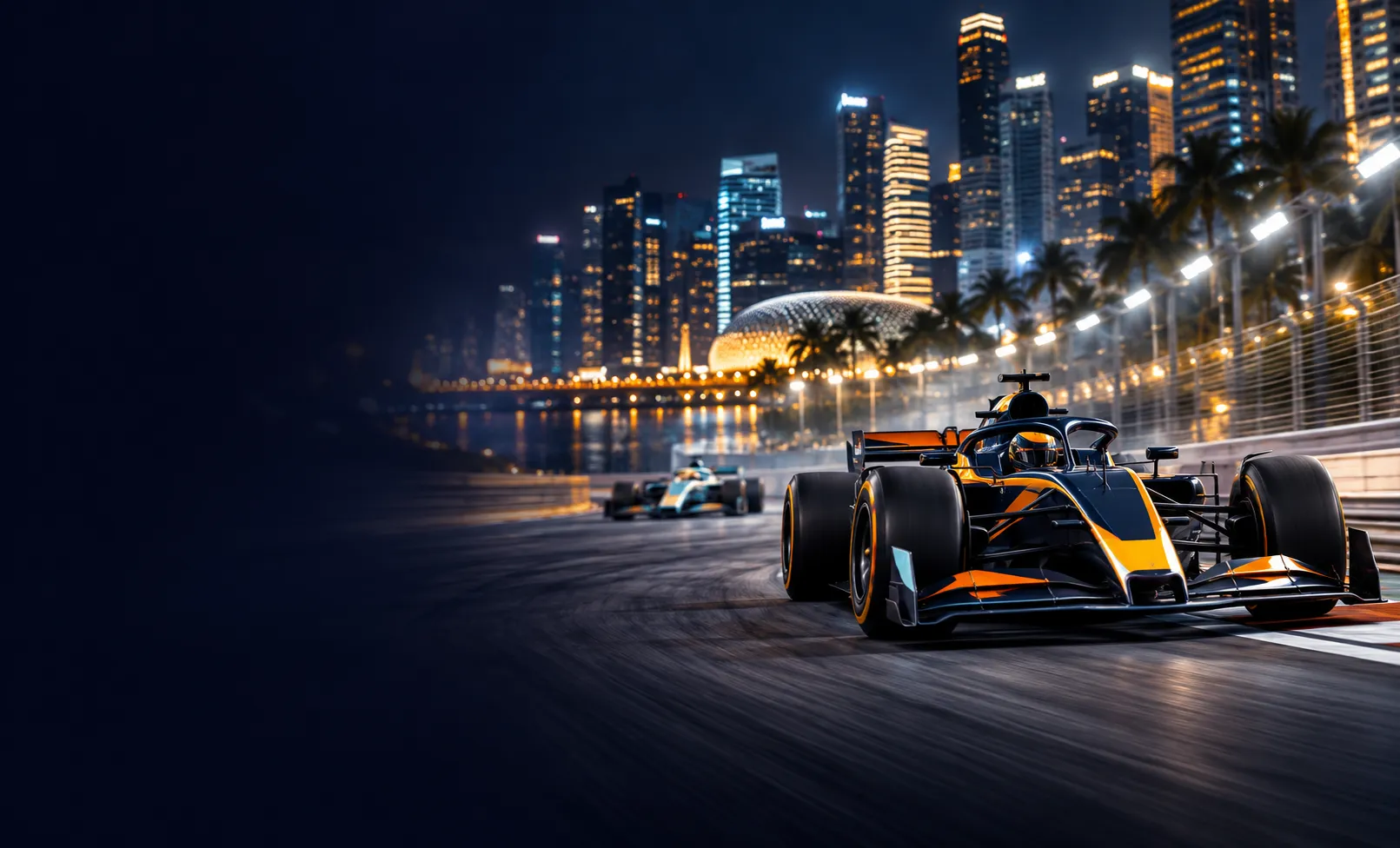
Max Verstappen has given Red Bull another reason to believe its Sepang breakthrough can carry into Singapore.
He finished Sprint Qualifying fastest, with George Russell and Charles Leclerc his nearest challengers. The result remains provisional while the stewards investigate a possible yellow-flag infringement, but his speed has added substance to the case for another strong weekend.
Sunday presents a different problem for Russell. The Mercedes driver has a confirmed 40-place Grand Prix grid penalty following power-unit changes, leaving him facing a recovery race regardless of his Sprint performance.
For the rest of the contenders, Saturday offers two opportunities to change the picture: sustained running in the Sprint, then the qualifying session that determines the Grand Prix grid.
This article is for informational purposes only and should not be construed as financial or investment advice. Past performance does not guarantee future results.
F1 Singapore Grand Prix 2026 weekend snapshot
- Circuit: Marina Bay Street Circuit, Singapore
- Format: Sprint weekend
- Race distance: 62 laps, approximately 305 km
Schedule
- Sprint: Saturday, October 10 — 5 p.m. SGT / 5 a.m. ET
- Grand Prix qualifying: Saturday, October 10 — 9 p.m. SGT / 9 a.m. ET
- Grand Prix: Sunday, October 11 — 8 p.m. SGT / 8 a.m. ET
Singapore is 12 hours ahead of US Eastern time this weekend. Sprint Qualifying establishes the Sprint starting order; Sunday’s starting positions are determined separately by Grand Prix qualifying and applicable penalties.
The F1 Drivers’ Championship picture gives this weekend another dimension: a strong result in the Championship for Antonelli does not require a race win.
Who will win the 2026 F1 Singapore Grand Prix?
The Singapore Grand Prix race-winner market gives Verstappen a 49% market-implied probability in the featured snapshot, ahead of Antonelli at 23% and Leclerc at 18%.
- Max Verstappen — 49%
- Kimi Antonelli — 23%
- Charles Leclerc — 18%
- Lando Norris — 16%
- Lewis Hamilton — 16%
- Oscar Piastri — 6%
- Isack Hadjar — 6%
- George Russell — 6%
Market data as of October 9, 2026. For the latest market-implied probabilities, check the OG app.
Friday’s running strengthens Verstappen’s sporting case. His practice position understated his one-lap performance: he finished sixth, but set his best time on Medium tires while the five drivers ahead used Softs.
The subsequent Sprint Qualifying result provides more direct evidence that Red Bull can compete at the front here. It does not establish that Verstappen has the fastest car over a full race, or that he will secure Sunday’s pole.
Antonelli’s 23% now sits against a more difficult Friday than his championship position might suggest. He qualified seventh for the Sprint, leaving work to do before Grand Prix qualifying.
Russell illustrates why Sprint competitiveness and Grand Prix probability must be kept separate. His pace is encouraging, but Sunday’s grid penalty creates a substantial obstacle to converting it into victory. His 6% should be read in that race-specific context.
For the wider current F1 market picture, see F1 prediction markets and our F1 Drivers' Championship prediction and odds.
What did Singapore Sprint Qualifying tell us?
Verstappen’s 1:31.156 was 0.120 seconds quicker than Russell. The leading ten finished the session in this order:
- Max Verstappen
- George Russell
- Charles Leclerc
- Oscar Piastri
- Lando Norris
- Lewis Hamilton
- Kimi Antonelli
- Liam Lawson
- Isack Hadjar
- Pierre Gasly
Session classification, subject to any subsequent stewards’ decisions.
Piastri finished just 0.055 seconds behind Leclerc, while Hadjar and Gasly both had laps deleted in SQ3. Verstappen’s possible yellow-flag infringement occurred in SQ1.
The useful takeaway is that four teams remain involved near the front. Red Bull has the quickest completed lap, but Mercedes, Ferrari and McLaren have enough one-lap evidence to keep Saturday’s Grand Prix qualifying interesting.
For Piastri in particular, Friday gives a stronger sporting argument than his 6% alone conveys. Starting near the front of the Sprint offers a chance to demonstrate whether that qualifying speed holds up through a sustained stint.
Who has the edge on long-run pace?
Friday has not established a clear long-run favorite.
FP1 included longer runs, but it also took place with track temperatures reaching 53°C, considerably warmer than the conditions expected for the night sessions. That limits how directly teams can translate its tire behavior into Sunday’s race.
The fastest-lap classification is especially easy to misread. Verstappen and Antonelli recorded their best laps on Mediums, while Russell and the leading Ferrari and McLaren drivers used Softs. Antonelli also ran deep at Turn 16 on his final attempt. Those details help explain the practice order; they do not provide a reliable comparison of sustained race pace.
A meaningful long-run comparison needs representative stints, with attention to compound, tire age, traffic and changing conditions. Fuel loads remain another uncertainty.
Saturday’s Sprint will offer a better competitive test. Watch who can stay close without sliding the rear tires, whose pace fades later in the run, and whether a driver’s speed depends on clean air. Even then, a shorter late-afternoon race will not reproduce every demand of Sunday night.
How could tire strategy shape the race?
Pirelli has supplied C3 Hard, C4 Medium and C5 Soft tires. Its pre-weekend assessment favors a one-stop Grand Prix, with the Hard and Medium expected to be the main race compounds, although the Soft could also feature.
That creates a familiar strategic tension: stop early to benefit from fresh tires, or protect track position and extend the opening stint.
An undercut becomes less useful if the driver rejoins behind slower traffic. Staying out carries its own risk if the tires lose enough performance for a rival to gain the position through the pit-stop sequence.
Pirelli expects rear-tire performance under acceleration to be a more significant degradation factor than outright mechanical stress. That makes clean corner exits relevant beyond qualifying: repeated sliding could reduce a driver’s options later in the stint.
See more prediction markets
Singapore Grand Prix key factors
Can Verstappen convert one-lap speed into control of the race?
Red Bull’s immediate task is to carry Friday’s performance through Saturday. The Sprint can reveal how the car behaves in sustained running, while Grand Prix qualifying determines whether Verstappen begins Sunday with track position on his side.
The stewards’ investigation is a separate issue. Until a decision is published, his provisional Sprint pole should not be described as a confirmed starting position.
Can Antonelli recover before Grand Prix qualifying?
Seventh in Sprint Qualifying is a setback, but it does not condemn Antonelli to seventh on Sunday’s grid.
His championship credentials remain relevant, as the 2026 F1 Drivers’ Championship analysis explains. For this race, however, the immediate requirement is more specific: produce a cleaner, faster qualifying performance and avoid leaving himself dependent on strategy to reach the leaders.
Can Ferrari and McLaren make both cars count?
Having two competitive cars can widen a team’s strategic choices. One driver may be able to stop earlier while the other extends, forcing a rival to decide which threat to cover.
That opportunity depends on proximity. Ferrari and McLaren first need both drivers close enough to the leaders for different pit-stop timings to create a real problem. Friday’s qualifying order makes that worth watching, but does not guarantee it.
How far can Russell recover on Sunday?
Russell’s confirmed penalty totals 40 grid places, arising from four additional power-unit elements. It applies to the Grand Prix rather than undoing his Sprint Qualifying performance.
His race challenge is therefore about more than outright speed. Traffic, tire management and the timing of any Safety Car intervention could determine how much of that speed he can use.
A strong Sprint would reinforce confidence in the car. It would not remove the difficulty of passing through the Grand Prix field.
What could move Singapore Grand Prix odds before the race?
The next immediate development is the stewards’ verdict on Verstappen. After that, Saturday’s Sprint should provide the clearest competitive evidence yet about sustained pace and tire behavior.
Grand Prix qualifying follows later the same day. That session could reshape Sunday’s prospects more sharply than the Sprint finishing order, especially for drivers who struggled to put together their best lap on Friday.
Further penalties, reliability problems and changing weather conditions could also alter the race picture before lights out.
Verstappen has supplied the strongest one-lap evidence so far. The remaining question is whether Red Bull can turn that speed into the starting position, tire performance and execution needed to win on Sunday.
Important information
Prediction is an event contract that is a derivatives product offered by North American Derivatives Exchange, Inc. (NADEX), a CFTC-regulated exchange, which does business under the brand OG.com Prediction Markets (OG). Crypto.com | Derivatives North America uses a CFTC-regulated exchange that uses OG.com technology.
Trading on OG.com involves risk and may not be appropriate for all. By trading you risk losing your cost to enter any transaction, including fees. You should carefully consider whether trading on OG.com is appropriate for you in light of your investment experience and financial resources. Any trading decisions you make are solely your responsibility and at your own risk.