US presidential election winner 2028: early frontrunners and field analysis
Jon Ossoff, JD Vance, Alexandria Ocasio-Cortez, and Marco Rubio are among the leading names in early 2028 presidential predictions. Neither party has chosen its nominee.
Politics
By Barbara Pazur

Early prediction markets have Georgia Senator Jon Ossoff and Vice President JD Vance among the most closely watched potential candidates for the 2028 presidency.
With less than two years until Election Day, neither party has chosen its nominee. Early polls and market prices offer some clues about the potential field, but there's still a long road between today's predictions and the final result.
This article is for informational purposes only and should not be construed as financial or investment advice. Trading involves risk.
Who was the frontrunner for the 2028 presidential election?
The latest 2028 presidential election odds put Jon Ossoff ahead of the other potential candidates in our presidential winner market, followed by JD Vance, Alexandria Ocasio-Cortez and Marco Rubio.
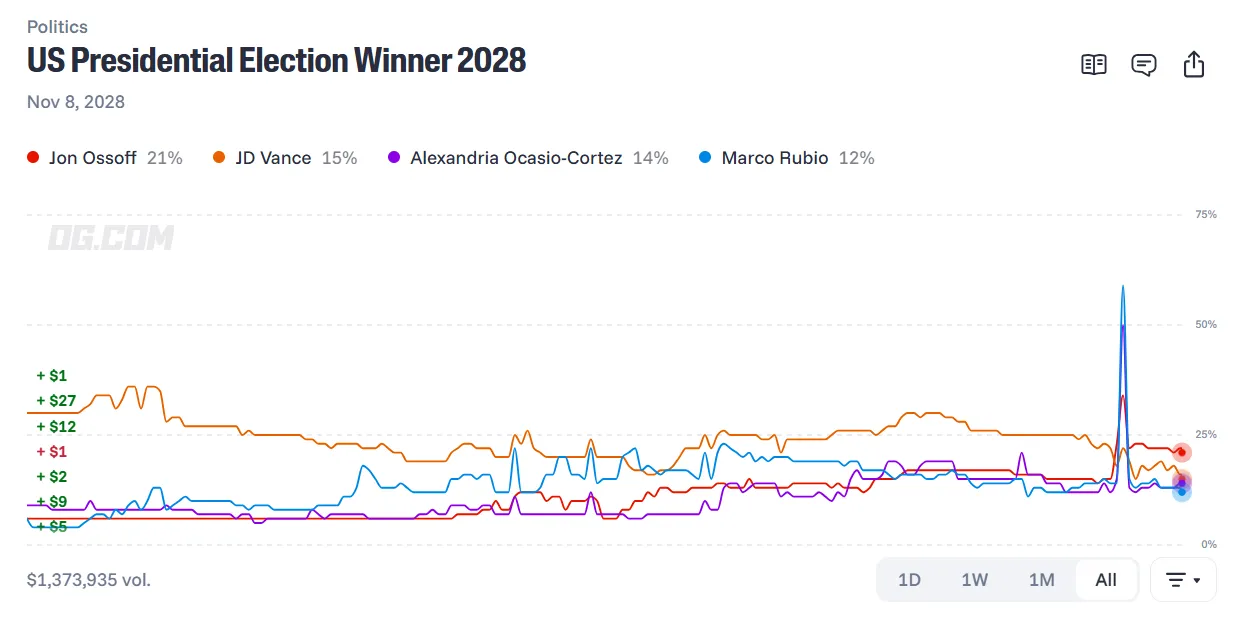
Based on publicly available information as of November 25, 2026.
The question of who will win the 2028 presidential election is far from settled. Even with the highest individual price, Ossoff’s 21% market-implied probability leaves plenty of room for other candidates.
Prediction market prices move as traders respond to new campaign developments. They aren't guarantees, and a candidate's current price doesn't establish who the eventual winner will be.
Republican nominee race: JD Vance, Marco Rubio, and the early field
JD Vance has a substantial lead in Republican primary polling, with Marco Rubio his closest potential challenger. Donald Trump Jr. and Ron DeSantis trail further behind.
Potential Republican nominee | National primary polling average |
Marco Rubio | 35.4% |
JD Vance | 34% |
Ron DeSantis | 10.2% |
Tucker Carlson | 3% |
Based on publicly available information as of November 25, 2026. Source: RealClearPolling.
Rubio leads Vance by just 1.4 percentage points, leaving them closely matched in Republican primary polling. But support among Republican voters doesn't necessarily translate into the same advantage in November 2028.
As vice president, Vance would have to defend the Trump administration's record, particularly if economic conditions become a concern for voters. Rubio’s role as a Secretary of State also connects him to the administration.
DeSantis and Carlson remain further back in the polls. None of the four has formally entered the 2028 race.
The eventual nominee could face a very different general-election contest depending on how voters judge the administration over the next two years.
Democratic nominee race: Kamala Harris, Jon Ossoff, and emerging contenders
Democratic nominee 2028 predictions show a more divided field than the Republican race. Jon Ossoff has the highest price in our nomination market, followed by Alexandria Ocasio-Cortez and Gavin Newsom. Kamala Harris, meanwhile, leads national primary polling.
Potential Democratic nominee | National primary polling average |
Kamala Harris | 16.5% |
Jon Ossoff | 15% |
Pete Buttigieg | 14% |
Alexandria Ocasio-Cortez | 14% |
Gavin Newsom | 11.3% |
Based on publicly available information as of November 25, 2026. Source: RealClearPolling.
Harris leads Ossoff just slightly, but her advantage in polling isn't reflected in prediction-market prices. Her experience as the 2024 Democratic nominee gives her widespread name recognition, although another campaign would also bring renewed attention to her loss to Trump.
Newsom has become a vocal critic of the Trump administration, while Ocasio-Cortez has built a following among progressive Democrats.
With several potential candidates attracting support, Democrats have yet to settle around one likely nominee. That leaves more uncertainty over who might eventually represent the party in the 2028 general election.
Why do the party-winner market and individual-candidate market diverge?
The difference comes down to how the probabilities are spread across candidates.
A party-winner contract covers whichever candidate represents that party in the general election. An individual-winner contract depends on one named candidate securing the nomination and then winning the presidency.
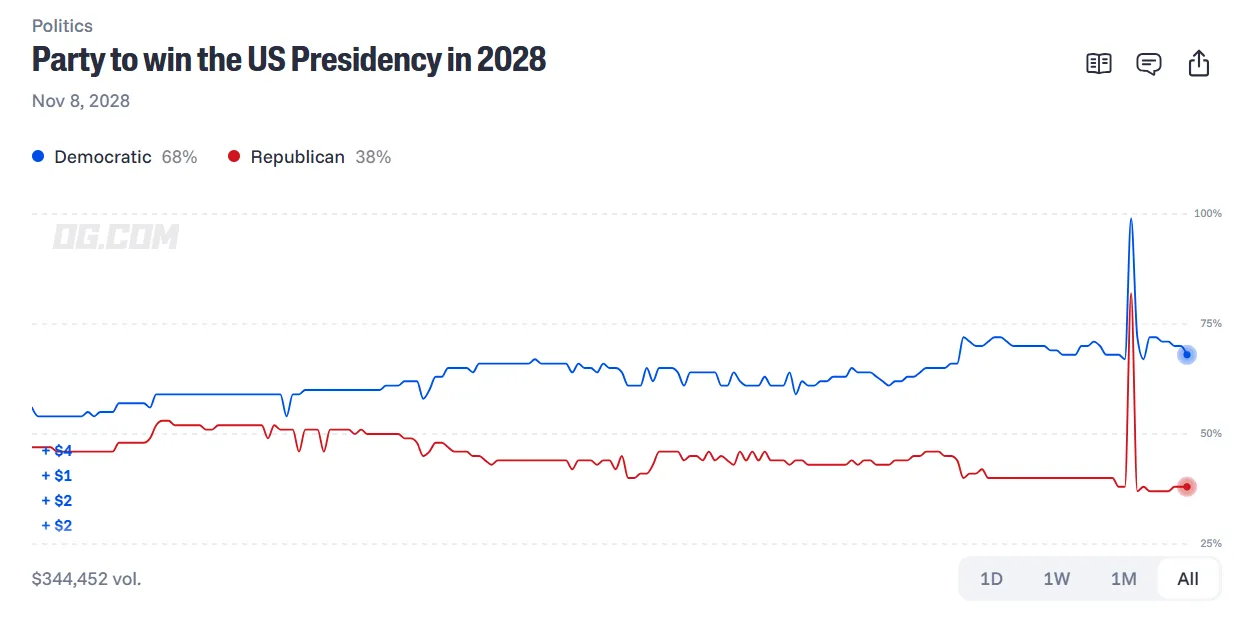
For example, Democrats could have a 68% market-implied chance of winning, with that probability divided among several potential nominees. No single Democrat would need to trade anywhere near 68%.
Ossoff's 21% individual price sits well below the Democratic Party's overall price because he still needs to secure the nomination and win the general election. The party-winner contract, on the other hand, covers any Democrat who wins the presidency.
Prices can also differ because of trading activity and liquidity, particularly when comparing markets across different platforms.
How accurate are prediction markets years before an election?
Election prediction markets have beaten polls in some past presidential forecasting studies, but most of that evidence comes from forecasts made much closer to Election Day.
Researchers studying the Iowa Electronic Markets compared their predictions with 964 polls covering five US presidential elections from 1988 through 2004. The markets produced forecasts closer to the final two-party vote result 74% of the time.
They also performed particularly well compared with polls more than 100 days before an election.
The historical study measured vote-share forecasts, not the chances of individual candidates winning a presidential election more than two years away. And with neither party's nominee decided, even today's hypothetical matchups could change considerably.
Early general-election polls show how much voter preferences can shift. An October 2025 Emerson College survey had JD Vance narrowly ahead of Gavin Newsom, 46% to 45%. By August 2026, Newsom had taken a five-point lead, 49% to 44%.
Factors that could reshape the 2028 presidential field
The 2028 race won't be decided by today's polling or market prices alone. The midterm results and economic conditions could change how voters view the potential candidates.
The 2026 midterm elections
Democrats won control of both the House and Senate in the November 3, 2026 midterms, ending Republican control of Congress. The results showed widespread voter dissatisfaction with the Trump administration and could influence how both parties approach the 2028 presidential race.
For potential Democratic candidates, the results could also affect their national standing, particularly those campaigning in closely contested races.
The economy and the administration's record
Economic conditions could weigh heavily on the 2028 race, especially for Republican candidates closely associated with the Trump administration.
An October Economist/YouGov poll found that 37% of Americans considered inflation and rising prices the country's biggest concern. If concerns about inflation or employment persist, those issues could follow the eventual Republican nominee into the general election.
The primary calendar and candidate decisions
Democrats begin voting in South Carolina on January 22, 2028, while Republicans have retained Iowa, New Hampshire, Nevada, and South Carolina as their early states.
Candidates’ decisions on whether to run could quickly change nomination-market prices, particularly on the Democratic side, where the early field is more divided.
How to trade political event contracts on OG.com
With OG.com, you can trade event contracts on real-world outcomes across different market categories.
- Create an account: Open an account and complete sign-up, including identity verification. You can use our web or mobile platforms.
- Browse markets: Explore markets across politics, economics, culture, sports, and other real-world events.
- Review and trade: Compare the market price with your own view. Check the rules, fees, and settlement details before opening a position.
- Monitor your position: After trading, your contract appears in your open positions, where you can track price movement as new information comes in.
FAQs about 2028 presidential election predictions
Who is the frontrunner to win the 2028 presidential election?
Jon Ossoff has the highest individual-candidate price in our presidential winner market at 21%, followed by JD Vance at 17%.
Which party is favored to win the 2028 presidential election?
Democrats have a higher market-implied chance of winning the White House than Republicans, according to most major prediction market platforms.
Who are the top Republican candidates for 2028?
Marco Rubio leads national Republican nomination polling at 35.4%, with JD Vance close behind at 34%. Ron DeSantis is at 10.2% with Tucker Carlson further behind at 3%.
Who are the top Democratic candidates for 2028?
Kamala Harris leads national nomination polling at 16.5%, followed by Jon Ossoff at 15%. Pete Buttigieg and Alexandria Ocasio-Cortez are tied at 14% and are among the prominent names in nomination markets.
How do prediction markets work for presidential elections?
You can trade Yes or No contracts on a candidate winning the presidency. Prices change as traders buy and sell, and contracts settle according to the official election outcome and market rules.
How accurate are prediction markets two or more years before an election?
Past election markets have sometimes outperformed polls, but there's little evidence that prices set several years before Election Day reliably predict the eventual winner.
What is implied probability in a prediction market?
A Yes contract priced at 40¢ suggests roughly a 40% market-implied chance of the candidate winning, although the outcome remains uncertain.
Has any candidate officially declared for the 2028 presidential race?
As of November 25, 2026, none of the major potential Democratic or Republican candidates have formally announced a campaign, although some lesser-known candidates have filed.
What factors could change the 2028 presidential election odds?
The November 2026 midterm results where Democrats have won both the Senate and the House of Representatives, and changes in the economy could influence market prices. Once the parties choose their nominees, traders will also have a clearer picture of the general-election contest.
Are prediction markets on US elections regulated?
Yes. Election event contracts offered on Commodity Futures Trading Commission (CFTC)-registered exchanges are subject to federal derivatives rules, including market surveillance and contract-listing requirements.
Important Information: Prediction is an event contract that is a derivatives product offered by North American Derivatives Exchange, Inc. (NADEX), a CFTC-regulated exchange, which does business under the brand OG.com Prediction Markets (OG) Crypto.com | Derivatives North America and uses a CFTC-regulated exchange that uses OG.com technology.
Trading on OG.com involves risk and may not be appropriate for all. By trading you risk losing your cost to enter any transaction, including fees. You should carefully consider whether trading on OG.com is appropriate for you in light of your investment experience and financial resources. Any trading decisions you make are solely your responsibility and at your own risk.