Prediction market platforms compared: how to find the best one
The right platform for you depends on the markets you follow, where you live, how the platform handles fees and funding, and which rules determine settlement.
Learn
By Barbara Pazur
Prediction market platforms let you browse, compare, and trade contracts tied to sports, politics, crypto, economics, culture, and other current affairs through a web browser.
This guide compares the web platforms from OG.com, Kalshi, and Polymarket using publicly available information as of July 2026.
This article is for informational purposes only and should not be construed as financial or investment advice. Past performance does not guarantee future results.
What is a prediction market platform?
A prediction market platform lets you browse, compare and trade contracts tied to politics, crypto, economics, culture, sports, technology, climate and other verifiable outcomes through a web browser.
A web platform gives you more room to compare related markets, read full contract rules, review price movement and manage open positions from one place.
What makes a good prediction market platform?
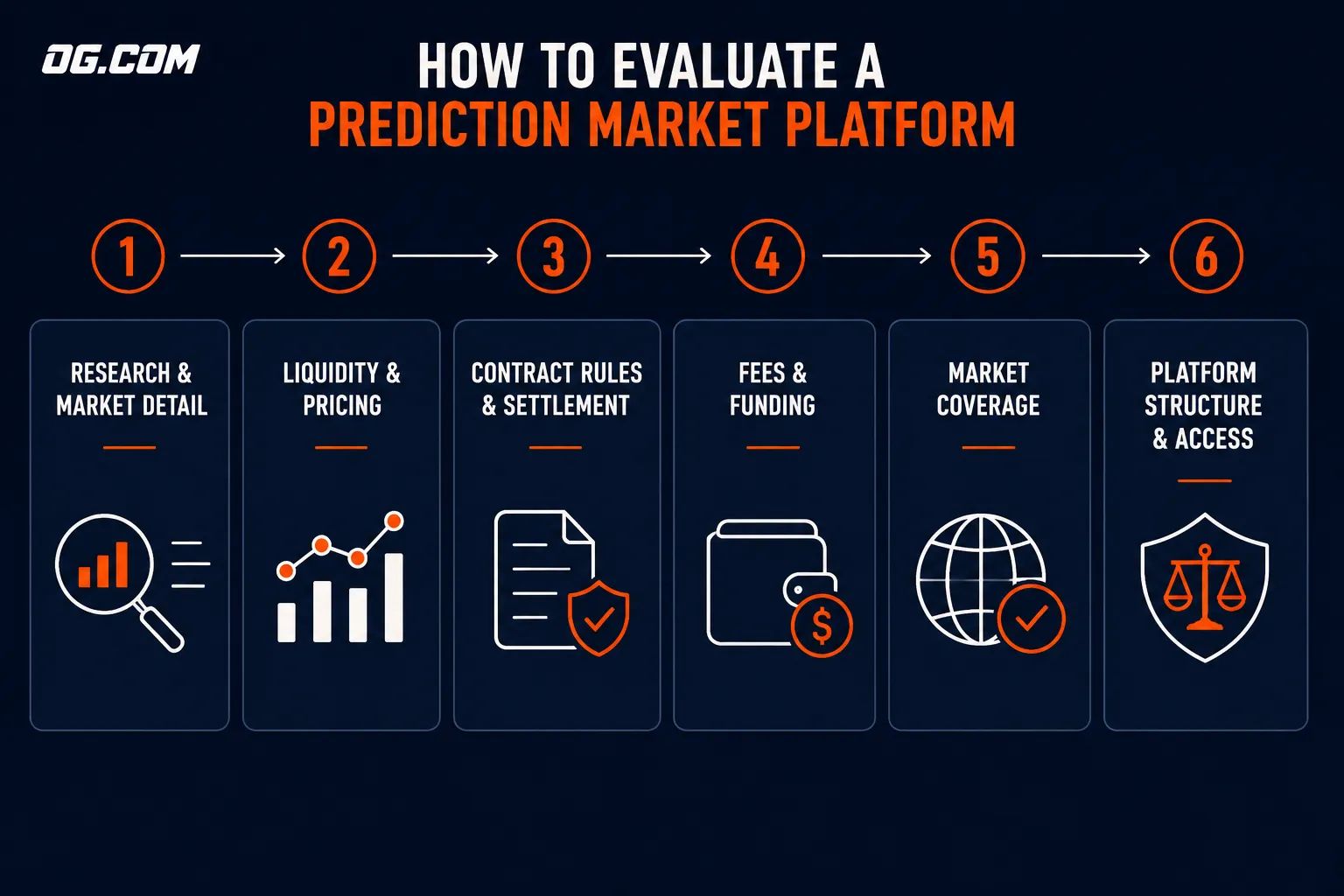
A good prediction market platform gives you enough information and control to judge a market before you trade. You should be able to see how the contract is priced, what event it tracks, which rules determine settlement, what fees apply and how easily you can manage the position afterward.
1. Research and market detail
A web platform has more room to show the information behind a market. Price history, related contracts, full settlement terms, order controls and position data should be easy to review without opening several separate pages.
OG.com’s web platform guides you from browsing markets and checking live prices to reviewing contract details and monitoring open positions. The layout keeps the information needed to assess a market within easy reach as you move through the platform.
2. Liquidity and pricing
A listed price doesn’t tell you how easy it may be to enter or exit at that level. Trading volume, available orders and the bid-ask spread can all affect the price you actually receive.
Check several active markets rather than relying on one headline number. A platform with broader participation may show tighter spreads in some contracts, while quieter markets can move more sharply when new orders arrive.
3. Contract rules and settlement
Two platforms can list markets about the same event and still use different deadlines, thresholds or settlement sources. Read the full contract terms before assuming the markets are interchangeable.
OG.com market pages explain what determines the outcome, when the contract expires and which source or rule governs settlement.
4. Fees and funding
Fees can look very different across prediction market sites. Some charge explicit transaction fees, while others may involve blockchain network costs, wallet transactions or payment-processing fees.
Looking at the total cost of entering and exiting a position usually gives a more accurate comparison than focusing on a single fee.
Before confirming an OG.com trade, you can review the amount at risk, potential payout and applicable fees tied to that transaction.
5. Market coverage
A long market list isn’t useful if the platform rarely covers the events you follow. Look at how often new contracts appear, how specific the questions are and whether the platform offers enough depth within each category.
Markets available through OG.com include sports, crypto, economics, politics, tech, culture and climate.
Regulation, eligibility and platform structure shape who can use a service and how the contracts are offered. Some platforms operate as regulated exchanges, while others use crypto-based or different market models.
Prediction event contracts available through OG.com are offered by Crypto.com | Derivatives North America (NADEX), a CFTC-regulated exchange. OG.com provides the technology for accessing those contracts.
Market search, category pages, live pricing, contract details, trade slip, position monitoring
Linked bank account, ACH, wire, PayPal, debit card, Apple Pay, Google Pay, Venmo and crypto-to-cash deposits; applicable fees shown before confirmation
Depends on location, eligibility and product availability
Kalshi
CFTC-designated contract market
Economics, politics, sports, weather, culture, financial markets and other events
Charts, order book, limit orders, contract rules, portfolio tracking
Politics, news, sports, crypto, economics, technology, culture and other events
Polymarket US: Order placement, position monitoring, settlement details
Global: Wallet integration, order book, blockchain settlement
Polymarket US: Debit card, ACH, wire, published fee schedule
Global: USDC funding, trading fees, possible third-party fees
Polymarket US: Eligible U.S.
Global: U.S. trading restricted
OG.com
OG.com’s web platform keeps the research process straightforward. You can browse markets by category, compare live prices, review contract rules and monitor open positions without switching between multiple tools.
U.S. funding options include linked bank accounts, ACH and wire transfers, PayPal, debit cards, Apple Pay, Google Pay, Venmo and crypto-to-cash deposits through Mesh. Funding outside of the U.S. has different options.
Before confirming a trade, you can review the contract cost, potential payout and any applicable fees.
Kalshi's web platform centers on exchange-style trading. Market pages include charts, contract rules, an order book and portfolio tools, while its markets cover economics, politics, sports, weather, culture, financial markets and other real-world events.
Funding options include ACH transfers, debit cards, wire transfers, PayPal, Venmo, Cash App and supported crypto methods. Kalshi publishes its fee schedule, with transaction costs varying by market, contract price and order type.
Polymarket
Polymarket operates separate U.S. and global web platforms. Polymarket US is operated by QCX LLC as a CFTC-designated contract market, while the global platform uses crypto wallets, USDC and blockchain-based settlement.
Both versions cover a wide range of markets, including politics, news, sports, crypto, economics, technology and culture, but funding methods, fees and trading access differ. Eligible U.S. users access Polymarket US, while trading on the global platform remains restricted in the U.S.
Polymarket US supports payments like card, ACH, Apple Pay and wire funding, while the global platform uses crypto and USDC deposits and withdrawals, with possible intermediary or bridge fees.
How to compare prediction market platforms
Don't compare platforms based on one headline price or the number of markets available. Open a few contracts you're interested in and read the settlement rules, deadline and source used to determine the outcome. Similar-looking markets can still resolve differently.
It's also worth checking how each platform handles fees, funding and order execution. A platform with lower visible trading fees may still involve other costs or use a different market structure. Looking at the full trading experience gives a more meaningful comparison than focusing on a single feature.
Are prediction market prices the same across platforms?
Not necessarily. Even when two platforms cover the same event, prices can differ because each market reflects the activity of its own participants. Liquidity, trading volume, open orders and new information all influence where a contract trades at any given moment.
The contracts themselves may not be identical either. Settlement sources, deadlines, thresholds and market rules can vary across platforms, even when the headline question looks similar.
Reviewing the contract terms, fees and settlement criteria can give you a better understanding of why one platform is pricing an event differently from another.
How to start trading prediction markets on OG.com
With OG.com, you can trade event contracts on real-world outcomes across different market categories.
Create an account: Open an account and complete sign-up, including identity verification. You can use our web or mobile platforms.
Browse markets: Explore markets across economics, culture, politics, sports, and other real-world events.
Review and trade: Compare the market price with your own view. Check the rules, fees, and settlement details before opening a position.
Monitor your position: After trading, your contract appears in your open positions, where you can track price movement as new information comes in.
A prediction market platform lets you trade event contracts based on whether a defined outcome happens. The platform shows current prices, contract rules, settlement criteria and available markets.
What is the best prediction market platform?
There isn’t one platform that’s best for everyone. Some options include OG.com, Kalshi, and Polymarket. Compare regulation, eligibility, available markets, liquidity, fees, funding methods, platform features and settlement rules based on what you plan to follow.
Who is the leading prediction market?
That depends on the measure. A platform may lead in trading activity, market coverage, U.S. regulatory access or crypto-native functionality, so there isn’t one objective answer across every category.
How does a prediction market work?
Participants buy and sell contracts tied to future events. Prices move as orders and new information enter the market, and the contract settles according to the rules and official source listed for that market.
What is the Kalshi prediction market?
Kalshi is a U.S. prediction market and CFTC-designated contract market where users trade event contracts tied to questions about economics, politics, sports, weather, culture and other events.
What is the Polymarket prediction market?
Polymarket has separate U.S. and global products. Polymarket US is operated by QCX LLC as a CFTC-regulated designated contract market, while the global product is a separate crypto-native prediction market.
Which prediction market has the best prices?
No platform consistently has the best price. Prices can vary by contract rules, liquidity, open orders, participant activity, fees and when you check the market.
Are prediction market platforms legal in the US?
Some are. CFTC-designated contract markets can offer regulated event contracts in the U.S., while access to other platforms may be restricted or depend on their legal structure and the user’s location.
Can prices differ between prediction market platforms?
Yes. Separate platforms have different participants, liquidity, order books, fees and contract terms, so two markets about the same event can show different prices.
Important Information: Prediction is an event contract that is a derivatives product offered by North American Derivatives Exchange, Inc. (NADEX), a CFTC-regulated exchange, which does business under the brand OG.com Prediction Markets (OG) Crypto.com | Derivatives North America and uses a CFTC-regulated exchange that uses OG.com technology.
Trading on OG.com involves risk and may not be appropriate for all. By trading you risk losing your cost to enter any transaction, including fees. You should carefully consider whether trading on OG.com is appropriate for you in light of your investment experience and financial resources. Any trading decisions you make are solely your responsibility and at your own risk