How to trade political and election prediction markets
Polls can show how a sampled group says it plans to vote. Election prediction markets ask what outcome the market is pricing, and what rules decide whether that outcome is met.
Learn
By Barbara Pazur
Political prediction markets aren’t just popularity trackers. They are event contracts tied to specific outcomes, such as a candidate winning a primary or a party winning an elected office.
This article explains how candidate and party winner contracts work, what can move prices, how primary and general election prediction markets differ, and what traders need to check before settlement.
This article is for informational purposes only and should not be construed as financial or investment advice. Past performance does not guarantee future results.
What are political prediction markets?
Political prediction markets let traders buy and sell event contracts based on clearly defined political outcomes. These might include which candidate wins a primary, which party wins an elected office, or whether a specific political event takes place.
How do political prediction markets work?
Political prediction markets are built around event contracts tied to clearly defined outcomes. For example, a contract might ask whether Candidate A will win a party’s nomination.
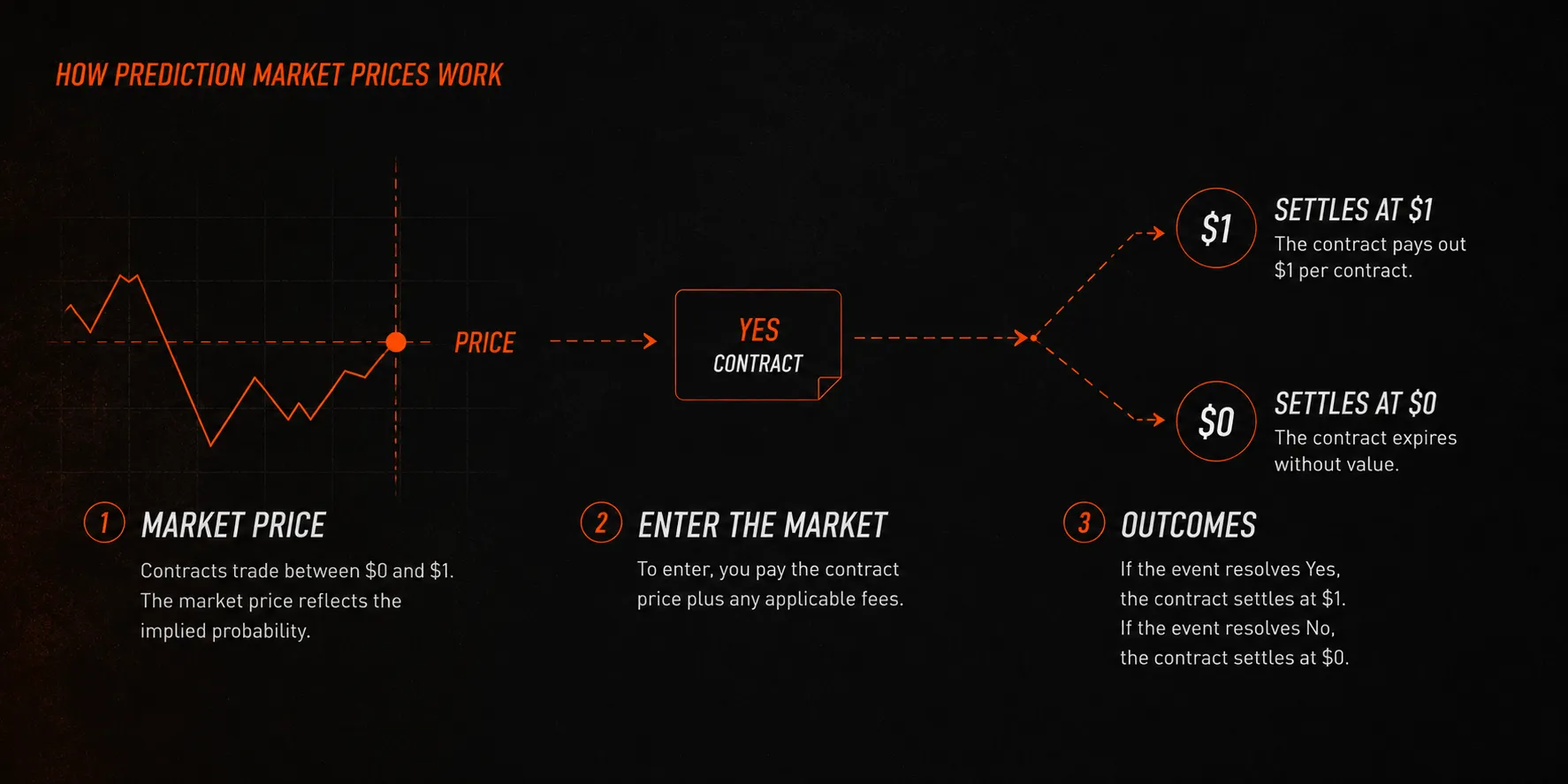
OnOG.com, these outcomes are shown as percentages. The percentage represents the market’s implied probability and determines the contract price. For example, an outcome trading at 60% costs about $0.60 per contract.
This is not a polling figure, vote-share forecast, or guarantee. It reflects the market’s current price, based on trading activity and traders’ expectations. Percentages across different outcomes should not be read like poll results.
Each contract settles at either $1 or $0. If the outcome happens according to the settlement rules, it settles at $1. If it does not, it settles at $0.
In a primary market, separate contracts may cover Candidate A and Candidate B winning the nomination. As the race develops, new information and trading activity can change their prices.
A state-level market might instead focus on whether Party A or Party B wins an office. The mechanics are similar, but traders are assessing the party result rather than a specific candidate.
What types of political prediction markets are there?
Political prediction markets can focus on candidates, parties, offices, nominations, chamber control, seat counts, or another clearly defined political result. The main thing is to identify what the contract is asking and how the result will be settled.
Political contracts usually fall into a few typical formats:
Primary winner markets: Several named candidates compete to become their party’s nominee.
General election winner markets: The contract focuses on who wins an elected office. Depending on the market, that may mean a named candidate or the party of the winning candidate.
Party winner markets: A Senate, governor, presidential prediction markets, or chamber-control market may focus on whether one party wins rather than on one candidate’s name.
Other political outcomes: Political prediction markets can also cover other objectively verifiable political events, as long as the contract rules clearly define the result.
Before trading, you need to know what the contract is actually asking. A nomination market, office winner market, party market, and seat-count market can all follow politics, but each one defines the outcome differently.
Candidate and party winner contracts are easy to confuse because they can involve the same race. The difference is what the contract uses for settlement.
Contract format
Example question
What the trader is assessing
Settlement focus
Candidate winner
Which candidate wins a primary?
Probability of each candidate winning
Official winner
Party winner
Which party wins an office?
Probability of each party winning
Party of winning candidate
Election outcome
Will a defined political outcome occur?
Probability of the stated event
Contract-specific rule
In a candidate winner market, the named candidate is the outcome. A contract tied to Candidate A winning a primary settles based on Candidate A’s result, not on how Candidate A’s party performs later.
A party winner market works differently. Individual candidates can still change the price because their campaigns affect the party’s chances. But the contract settles on the party result, not the candidate’s name.
This can change how traders read the same news. In one market, the central issue may be which candidate wins the nomination. In another, the central issue may be whether that nominee’s party wins the office.
Primary vs general election prediction markets
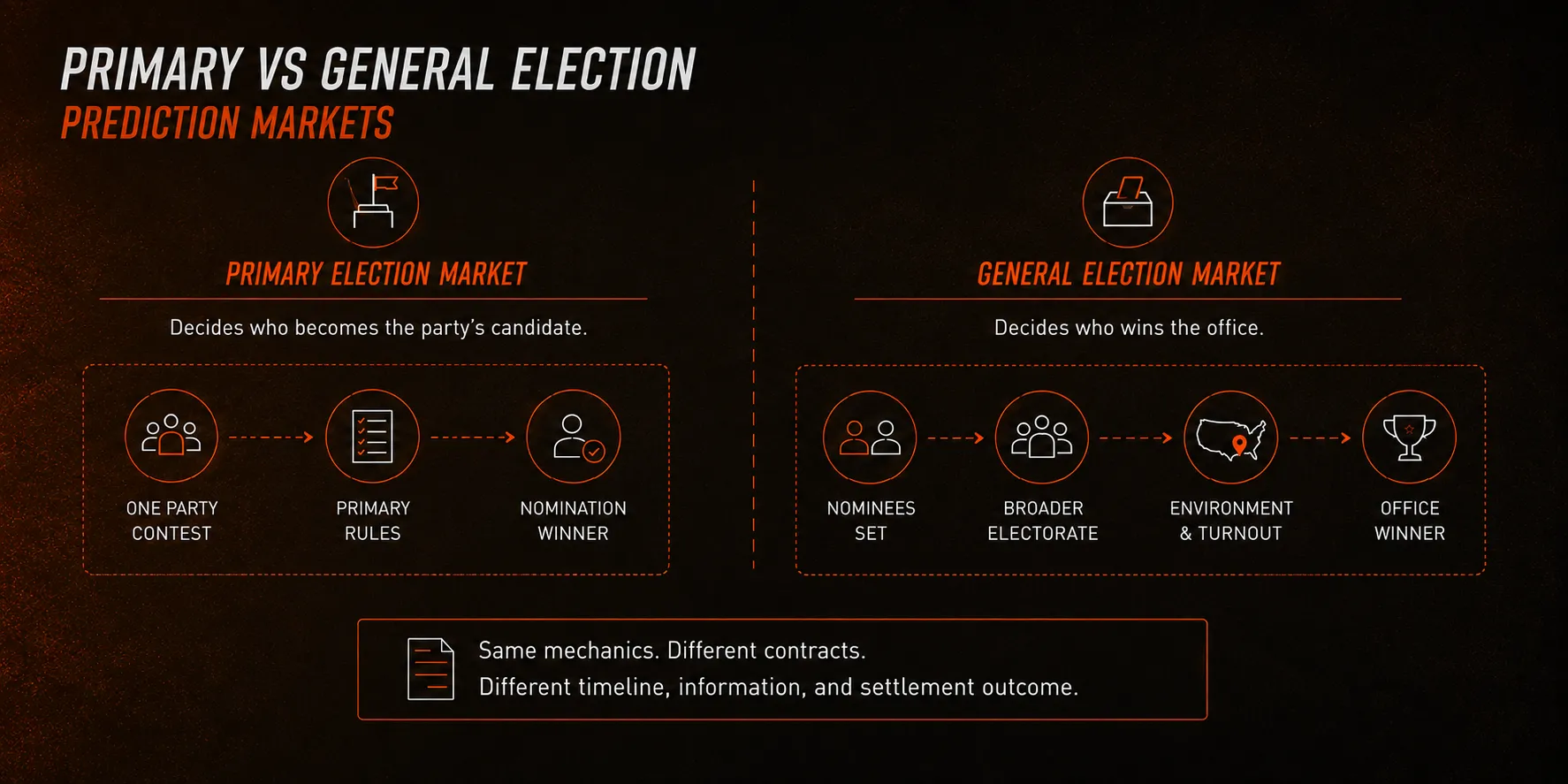
A primary decides who becomes a party’s candidate. A general election decides who wins the office. That changes what traders are assessing.
In a primary prediction market, the contract is usually narrower. It focuses on the contest inside one party, so traders are assessing which candidate can win that nomination under the rules of that primary.
A general election prediction market has a wider frame. The nominees are already part of the setup, but the contract may depend on the broader electorate, the state or district environment, turnout, and the path to winning the office.
The same office can therefore produce very different contracts. One market may ask which candidate wins a party primary. Another may ask which party wins the general election for that office. The mechanics can look similar, but the timeline, information, and settlement outcome aren’t the same.
What affects political prediction market prices?
Political prediction market prices can move when new information changes what traders think
Polling: New polls can shift expectations, especially when they show a clear change in the race. A poll that confirms what traders already expect may have little impact.
Candidate announcements or withdrawals: A candidate entering or leaving a race can change the field and affect how traders assess the remaining contenders.
Debates and endorsements: A strong debate performance or influential endorsement may change public perception and generate momentum.
Fundraising updates: Strong fundraising can signal campaign support and give a candidate more resources for advertising and outreach.
Ballot access: Decisions about whether a candidate appears on the ballot can directly affect their chances of winning.
Court decisions and election rules: Legal rulings or changes to voting rules can alter how a race is run and who may have an advantage.
Turnout expectations: New information about which groups are likely to vote can shift expectations, particularly in close races.
Campaign developments: Credible reporting, campaign problems, and official announcements can change how traders view an outcome.
Local updates: State and district markets may react to local rulings, ballot changes, or campaign issues that receive little national attention.
The effect depends on what is already priced in.
How are prediction markets different from political polls?
A poll asks a sample of people about their preferences or intended behavior. A prediction market reflects the prices at which traders are willing to buy and sell event contracts for.
That means a candidate polling at 48% doesn’t automatically have a 48% election prediction market probability of winning. Vote share and probability of winning are different concepts.
A candidate can be narrowly ahead in polls and have a higher market-implied probability if traders think that lead is likely to hold. In a close race with more uncertainty, the market price may stay lower because traders see more ways the outcome could change.
Prediction markets are also different from statistical election models. A model applies a defined method to data. A market price emerges through trading activity. None of these approaches is automatically more reliable in every race.
Why do traders use political prediction markets?
Traders use political prediction markets to take a position on an election outcome and earn money if that position is correct.
They compare the market’s implied probability with their own view of the race. If they believe an outcome is more likely than its current percentage suggests, they may buy a Yes contract. If they think it is less likely, they may buy No.
What are the risks of political prediction markets?
Political event contracts can resolve against your position, and the loss can include the cost of entering the transaction plus fees.
Election prediction markets can reprice sharply. The move may happen before a trader has time to react, especially when liquidity is lower or the update is unclear.
Information quality can also create problems. Political markets often react to partial reports, early signals, disputed claims, or changing official updates. If the information turns out to be wrong or incomplete, the price can move again.
Some races may have less active trading than others. In a thinner market, entering or exiting at the price a trader expects can be harder.
A trader may correctly expect a broader political development but still be wrong if it happens outside the period defined by the contract.
Contract wording can change the outcome being traded. “Winning a primary,” “winning a general election,” and “which party wins the office” can point to different settlement outcomes, even when they involve the same race.
What to check before trading political event contracts
Exact outcome: Check what must happen for the contract to settle at $1.
Type of market: Confirm whether it covers a primary, general election, candidate, party, or another political event.
Location and office: Check the relevant state, district, jurisdiction, and elected position.
Key dates: Review the event date, trading deadline, and expected settlement date.
Settlement rules: Check the official result source and any conditions that determine the outcome.
Unusual scenarios: Read how the rules handle recounts, delayed certification, postponements, or other complications.
Fees: Check what you will pay to open or close the position.
Similar contracts are not interchangeable. For example, “Will Candidate A win the primary?” and “Will Candidate A’s party win the general election?” can settle differently.
How to trade political prediction markets on OG.com
With OG.com, you can trade event contracts on real-world outcomes across different market categories, including political events.
Create an account: Open an account and complete sign-up, including identity verification. You can use our web or mobile platforms.
Browse markets: Explore markets across politics.
Review and trade: Compare the market price with your own view. Check the rules, fees, and settlement details before opening a position.
Monitor your position: After trading, your contract appears in your open positions, where you can track price movement as new information comes in.
Election prediction markets let traders take positions on defined election outcomes. Prices can move as new information changes expectations, and contracts settle according to their stated rules.
How accurate are political prediction markets?
Political prediction markets can reflect collective expectations, but they aren’t guarantees. Accuracy can vary by race, liquidity, information quality, market structure, and late-breaking events.
What is an election prediction market?
An election prediction market is a market tied to a defined election outcome, such as a candidate winning a primary or a party winning an office.
How do political prediction market prices work?
A political prediction market price can be read as a market-implied probability. That probability reflects the current market price, not a guaranteed result.
What is the difference between election prediction markets and polls?
Polls measure responses from a sample of people. Election prediction markets show the prices traders are willing to accept for contracts tied to future outcomes.
How do primary election prediction markets work?
Primary election prediction markets focus on the result of a party primary. The contract may settle based on which candidate becomes that party’s nominee.
How do political prediction markets settle?
Political prediction markets settle according to their contract rules. Those rules define the outcome, timing, official source, and any special conditions.
Important Information: Prediction is an event contract that is a derivatives product offered by North American Derivatives Exchange, Inc. (NADEX), a CFTC-regulated exchange, which does business under the brand OG.com Prediction Markets (OG) Crypto.com | Derivatives North America and uses a CFTC-regulated exchange that uses OG.com technology.
Trading on OG.com involves risk and may not be appropriate for all. By trading you risk losing your cost to enter any transaction, including fees. You should carefully consider whether trading on OG.com is appropriate for you in light of your investment experience and financial resources. Any trading decisions you make are solely your responsibility and at your own risk.