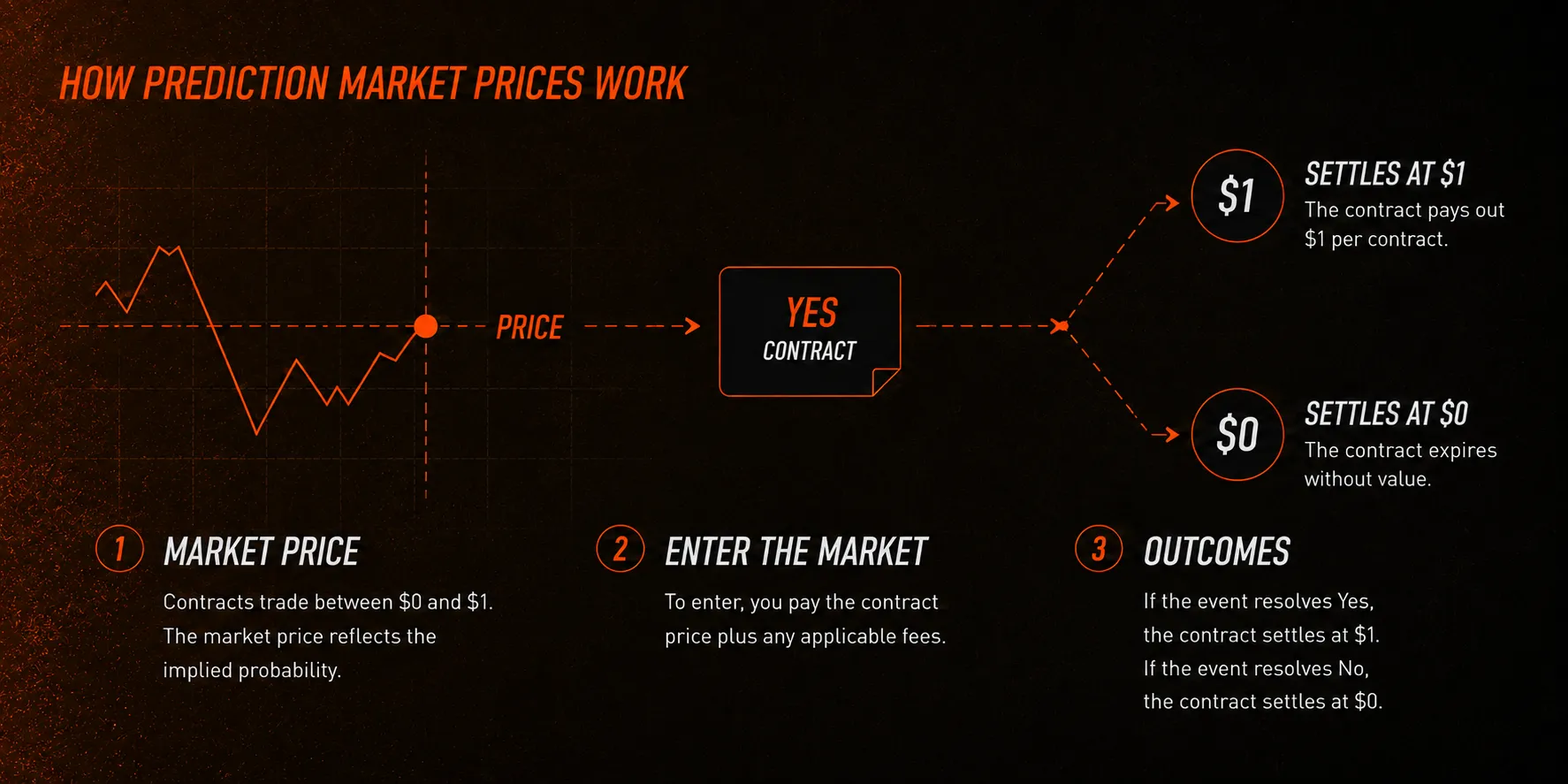
What does a prediction market price tell you, and why don’t the percentages always add up to 100%? Learn how to read the numbers, calculate potential payouts and make sense of the gaps.
Learn
By Ekaterina Drozdovica
Open a prediction market platform and you might see 59% beside an outcome, with 1.69x nearby. The percentage expresses the market-implied probability. The x-number puts the potential settlement payout in relation to the purchase price.
So, how do prediction markets work, and what are those numbers telling you? Once you understand the link between price, probability and payout, you can read the screen without confusing a likely outcome with a guaranteed result.
This article is for informational purposes only and should not be construed as financial or investment advice. Past performance does not guarantee future results.
What does a prediction market price mean?
On OG.com, prices appear as percentages. For a standard contract that pays $1 if your outcome happens, 59% corresponds to a price of 59¢. Reading that as approximately a 59% chance is a useful starting point, with some qualifications.
What is market-implied probability?
Those percentages are market-implied probabilities – the likelihood of an event happening suggested by a contract’s trading price. It reflects what buyers and sellers are willing to trade at, rather than a verified measurement of the future.
For example, a 75% price suggests an outcome is more likely than a 25% price does. It doesn’t mean 75% of traders agree, or that the outcome is certain. Prediction markets reflect orders and transactions, not one-person-one-vote surveys.
The basic calculation is: contract price ÷ settlement payout × 100. For a $1 payout, the conversion is straightforward:
Contract price
Implied probability
Potential total payout multiple*
25¢
25%
4.00x
50¢
50%
2.00x
59¢
59%
Approximately 1.69x
75¢
75%
Approximately 1.33x
Illustrative calculations before fees, assuming the contract settles at $1.
What does x number mean?
The x-number shows how much you could receive for each dollar you spend if your chosen outcome happens. For example, 1.69x means a total payout of about $1.69 for every $1 spent, before fees. That includes your original $1, so the profit would be about 69¢.
Using the 59¢ example, buying 100 contracts costs $59 before fees. If your outcome happens, you receive $100: your original $59 plus $41 in profit. If it doesn’t, the contracts settle at $0 and you lose your $59 plus fees.
A bigger x-number means a higher potential payout compared with what you spend, but it also reflects an outcome the market considers less likely. Always check the actual cost and fees before trading, as the displayed multiple may be rounded.
Why don’t probabilities always add up to 100%?
For two outcomes that cover every possibility and cannot both happen, their underlying probabilities should total 100%. Displayed trading prices can differ because buying and selling prices aren’t necessarily the same.
Consider a hypothetical order book: the highest offer to buy Yes is 55¢, while the lowest price to buy it from a seller is 59¢. That four-cent gap is the bid-ask spread. The corresponding No purchase price can be 45¢, giving displayed buy prices of 59% and 45%, or 104% combined.
That extra four percentage points reflects the spread in this example, not an extra possible outcome. Rounding or quotes recorded at different times can also affect totals. For multiple outcomes, check whether options overlap or whether the screen shows only part of the field before adding percentages together.
Why do contracts settle at either $0 or $1?
Standard binary event contracts have two settlement values because they answer a defined yes-or-no question. As the CFTC explains, these contracts commonly have a fixed payout and an expiration. The applicable rules determine which outcome qualifies.
For example, a contract asking whether a reference price finishes above $85,000 pays according to that threshold. Finishing $1 above it or $5,000 above it produces the same \$1 payout for Yes. Special cases, including cancellations, follow the contract rules.
You may also be able to sell before settlement, depending on trading availability and liquidity. Selling those 100 contracts at 70¢ after buying at 59¢ would produce $11 profit before fees. That result comes from the price change, rather than waiting for a $1 settlement.
What should you check besides the displayed price?
A percentage helps you understand the market’s current view. The contract terms explain what you’re actually trading.
Exact question and outcomes: What must happen, and are you selecting Yes, No or another listed outcome?
Settlement criteria and source: Which result counts, and which official source determines it?
Deadline: When does trading close, what observation time applies, and when is settlement expected?
Fees: What charges apply to entering, closing or settling the position?
Other rules: How are ties, postponements, cancellations or revised data handled?
Liquidity: Are enough contracts available at your chosen price? Low liquidity can mean your order fills only partly or not at all, and may make it harder to sell before settlement.
Risk management tools: For example, OG.com offers limit orders to protect you from loss.
How to trade prediction markets on OG.com
With OG.com, you can trade event contracts on real-world outcomes across different market categories.
Create an account: Open an account and complete sign-up, including identity verification. You can use our web or mobile platforms.
Browse markets: Explore markets across economics, culture, politics, sports, and other real-world events.
Review and trade: Compare the market price with your own view. Check the rules, fees, and settlement details before opening a position.
Monitor your position: After trading, your contract appears in your open positions, where you can track price movement as new information comes in.
Prediction markets let people trade event contracts tied to specified real-world outcomes, such as an economic release or sports result.
What is implied probability?
It’s the likelihood expressed by a price. For a standard $1 binary payout, a 40¢ price implies approximately 40%.
How do event contracts work?
Standard binary contracts settle at $1 if your selected outcome qualifies and $0 otherwise. Where available, you can also trade out before settlement.
Important Information: Prediction is an event contract that is a derivatives product offered by North American Derivatives Exchange, Inc. (NADEX), a CFTC-regulated exchange, which does business under the brand OG.com Prediction Markets (OG) Crypto.com | Derivatives North America and uses a CFTC-regulated exchange that uses OG.com technology.
Trading on OG.com involves risk and may not be appropriate for all. By trading you risk losing your cost to enter any transaction, including fees. You should carefully consider whether trading on OG.com is appropriate for you in light of your investment experience and financial resources. Any trading decisions you make are solely your responsibility and at your own risk