Perpetual futures vs event contracts: what’s the difference?
See how perpetual futures and event contracts differ in mechanics and payouts – including what happens when you exit early.
Perps
By Ekaterina Drozdovica

Bitcoin (BTC) price rises, but your trade still loses money. How? With an event contract, getting the direction right may not be enough: Bitcoin might also need to finish above a specific price at a specific time.
That’s the central difference in perpetual futures vs event contracts. Perps provide ongoing exposure to price movements. Event contracts, which are part of prediction markets, pay according to whether a defined outcome happens. The same market view can produce very different results.
This article is for informational purposes only and should not be construed as financial or investment advice. Past performance does not guarantee future results.
What are perpetual futures?
Perpetual futures, or perps, are derivatives that track an underlying asset’s price without a scheduled expiration. You can go long to take a position on rising prices, or short on falling prices, without owning the asset.
You post initial margin – collateral supporting the trade. Your profit or loss depends on the position’s size and price movement. Keeping it open requires meeting ongoing margin requirements.
What are event contracts?
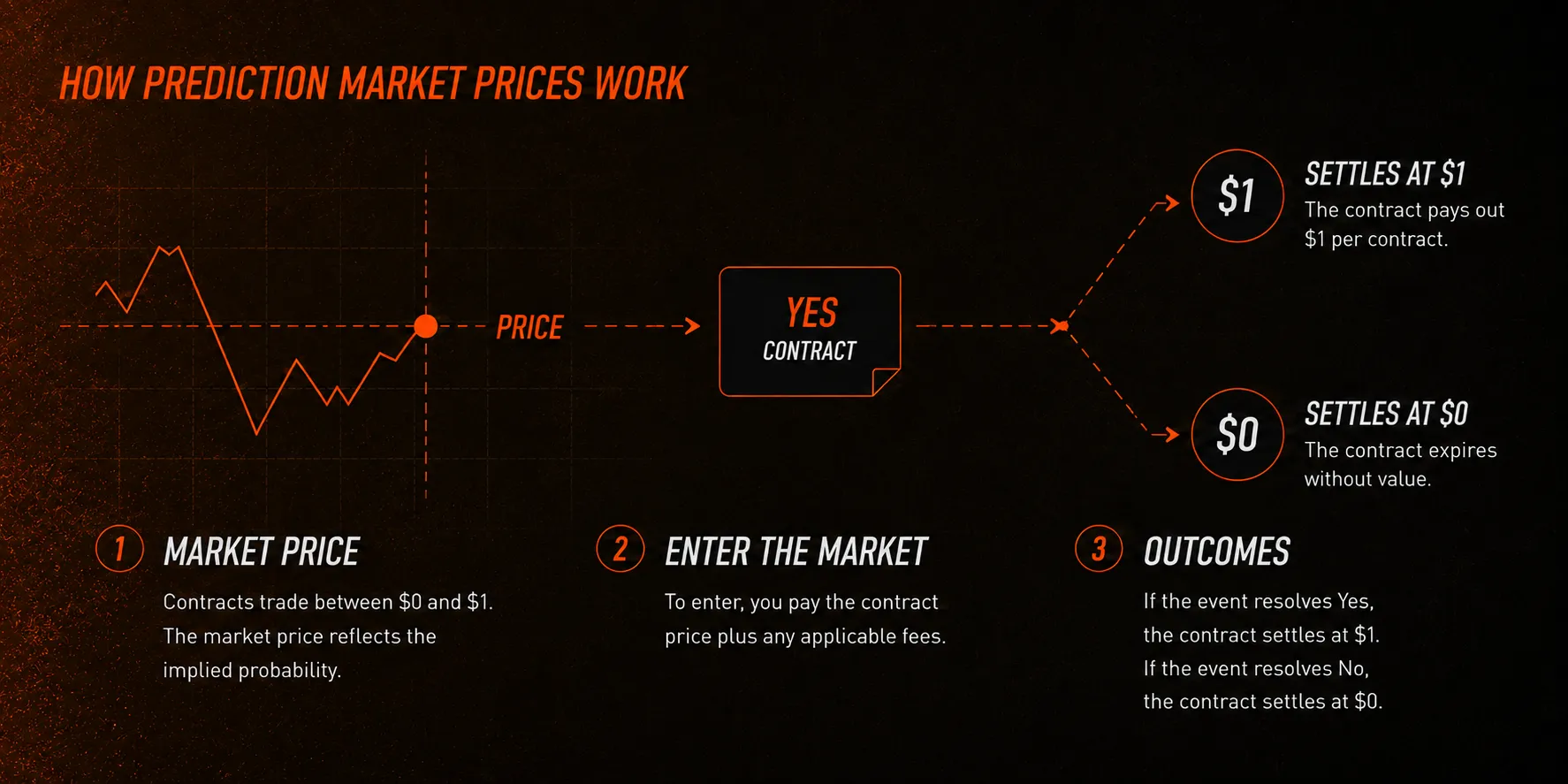
Event contracts let you trade on a defined outcome, such as whether Bitcoin finishes above $85,000 on Friday. A contract settles at $1 if your chosen outcome happens, or $0 if it doesn’t.
Before settlement, prices change as traders buy and sell. A $0.60 price implies a 60% market-assessed probability. That reflects trading activity, rather than an objective forecast or guarantee.
Perpetual futures vs event contracts: key differences?
Both contracts let you trade on a market view, but they turn that view into profits and losses differently. Here’s how they compare, from what moves their prices to the costs of keeping a position open.
Asset price exposure vs a specific event outcome
A Bitcoin perp responds to Bitcoin’s price movement. A Bitcoin event contract responds to the market’s assessment of a particular question. The threshold, time remaining and settlement rules all matter alongside Bitcoin’s current price.
Ongoing positions vs scheduled settlement
Perps generally stay open until you close them or they’re forcibly closed. Event contracts have defined expiration and resolution rules, but traders can also sell contracts before settlement.
Variable profits and losses vs fixed settlement payouts
For a simple dollar-settled perp, a larger favorable price move produces a larger profit for the same position size.
An event contract’s price can also move in your favor, letting you sell early for a profit if there’s available liquidity. Buying at $0.60 and selling at $0.80 earns $0.20 per contract before fees.
If you hold until settlement, the payout is fixed at $1 or $0. A correct outcome earns $0.40 per contract bought at $0.60, before fees – regardless of how decisively the outcome happens.
Margin, leverage and liquidation risk
Perps commonly allow leverage: A $500 initial margin might support a $2,500 position at 5× leverage. Gains and losses reflect the full $2,500 exposure.
The fully funded event contracts discussed here require payment upfront. Their maximum loss is the entry cost, including fees, with no ongoing maintenance-margin requirement.
How would a Bitcoin trade work with each contract?
Bitcoin could rise and leave one trade in profit while the other loses its entire entry cost. Here’s how that plays out in two hypothetical trades, with different amounts at risk and fees and funding left out for simplicity.
Trading Bitcoin’s price with perpetual futures
Suppose Bitcoin is $80,000. You post $800 in margin for a 5× long position worth $4,000, equivalent to 0.05 BTC.
If you close at $84,000, the profit is $200: The $4,000 price increase multiplied by 0.05 BTC. Closing at $76,000 produces a $200 loss. Each is 25% of your initial margin, despite Bitcoin moving only 5%.
Trading whether Bitcoin with event contracts
Now let’s look at a hypothetical event contract: “Will Bitcoin finish above $85,000 at Friday’s specified observation time?”
You buy 100 Yes contracts at $0.40 each, spending $40. If traders become more confident that Bitcoin will clear the threshold, the contract price could rise. Selling all 100 at $0.65 would return $65 – a $25 profit before fees, without waiting for Friday. But an early exit depends on available liquidity.
If you hold until settlement, the outcome determines your payout. A reference price above $85,000 pays $100 for your contracts, giving you $60 profit before fees. At or below that threshold, they settle at $0, and you lose your $40 entry cost plus fees.
How do trading goals differ between the two products?
Perpetual futures trading expresses a view on price direction and the size of a move. Event contracts express a view on a particular outcome within defined rules. That distinction matters more than simply being bullish or bearish.
To see how event questions work in practice, explore OG.com markets and review their settlement criteria, prices and fees. Access depends on eligibility and location.
Risk management when trading perps vs event contracts
Risk management starts with knowing how much you could lose and how you plan to exit, and is important for both types of contacts. These tools can help, though availability varies by platform and contract:
- Position sizing: Limit how much you commit to each trade. For perps, consider the full position value, not just the initial margin.
- Limit orders: Set limit orders – the highest price you’ll pay or the lowest price you’ll accept when selling. They give you price control, but may fill only partially or not at all.
- Stop-loss orders: Where available, set an order to trigger an exit if the market moves against you. Execution at your chosen price isn’t guaranteed, especially during sharp moves.
- Take-profit orders: Set an exit target to capture a favorable move. For event contracts, a limit sell order can serve this purpose before settlement, provided there’s a buyer.
- Leverage and margin controls: For perps, lower leverage reduces exposure relative to your collateral. Monitoring available margin helps you understand how close a position is to liquidation.
- Price and deadline alerts: Track market moves, funding payments and event-contract trading cutoffs. Alerts prompt a review; they don’t close positions automatically.
This article is for informational purposes only and should not be construed as financial or investment advice. Make sure to conduct your own research.
How to trade perpetual futures with OG.com
- Create an account: Sign up and complete identity verification. Access to perpetual futures is subject to eligibility.
- Explore crypto perps: Choose an available cryptocurrency contract and review its margin requirements, fees and funding arrangements.
- Review and trade: Fund your account, choose your position size and decide whether to go long or short. A limit order lets you set the highest price you’ll pay or the lowest price you’ll accept, but execution isn’t guaranteed.
- Monitor your position: Track price movements, funding payments and your margin balance. Leverage amplifies gains and losses, and insufficient margin can lead to liquidation.
FAQs about perpetual futures and event contracts
Are event contracts the same as futures?
They’re both financial derivatives, but event contracts settle on defined outcomes. Their legal classification depends on their structure; they don’t function like ordinary price-tracking futures.
Do perpetual futures expire?
True perpetuals have no scheduled expiration. Some products marketed as “perpetual-style” have long-dated expirations, so check the specifications.
Do event contracts have funding payments?
The fully funded event contracts don’t have perp-style funding payments. But other treading fees may apply.
Can you close either type of contract before settlement?
Generally, yes, while trading is open and liquidity is available. Perps usually have no final settlement deadline; event contracts do.
Can you lose more than your initial margin trading perpetual futures?
Yes, depending on the venue’s rules and protections. Initial margin isn’t automatically your maximum loss.
Are event contracts less risky than perpetual futures?
Fully funded event contracts avoid leveraged liquidation risk, but you can still lose your entire entry cost. Traders are encouraged to use limit orders for risk management.
Important Information: OG.com provides technology in order to onboard and trade products on OG.com’s CFTC-regulated exchange and clearinghouse: North American Derivatives Exchange, Inc., which does business under the brands OG.com Markets and OG.com Prediction Markets, as well as, through OG.com’s CFTC-registered Futures Commission Merchant (Foris DAX FCM LLC or OG.com Broker).
OG.com Markets offers both prediction market event contracts (Prediction Markets Contracts), as well as margined derivatives, including single stock futures and perpetuals (Futures) (Prediction Markets Contracts and Futures are collectively referred to as OG.com Markets Products). Prediction Markets Contract can be accessed directly on OG.com Markets or through a CFTC-registered FCM, including OG.com Broker, or an Introducing Broker (IB). Futures must be accessed through a CFTC-registered FCM, including OG Broker or an IB.
Trading OG.com Markets Products involves risk and may not be appropriate for all. By trading you risk losing your cost to enter any transaction, including fees. You should carefully consider whether trading OG.com Markets Products is appropriate for you in light of your investment experience and financial resources. Any trading decisions you make are solely your responsibility and at your own risk.