Party to win the US presidency in 2028 – predictions and early analysis
JD Vance leads the early 2028 presidential ranking, but his party doesn’t. Prediction markets currently give Democrats the better chance of winning the White House.
Politics
By Barbara Pazur
Democrats have the advantage in early prediction markets for the 2028 presidential election, even though Republican Vice President JD Vance leads the individual-candidate rankings. The race is already showing how differently traders assess political elections and the two parties' prospects.
It's still too early to say who will win the 2028 presidential election. Neither party has chosen its nominee, and the November 2026 midterms could change expectations well before voters head to the polls.
This article is for informational purposes only and should not be construed as financial or investment advice. Trading involves risk.
What are Democrats vs. Republicans predictions?
The OG party to win the US presidency in the 2028 market currently puts Democrats at 70%, compared with 40% for Republicans. This reflects the market's view of which party could win the White House, regardless of who eventually appears on the ballot.
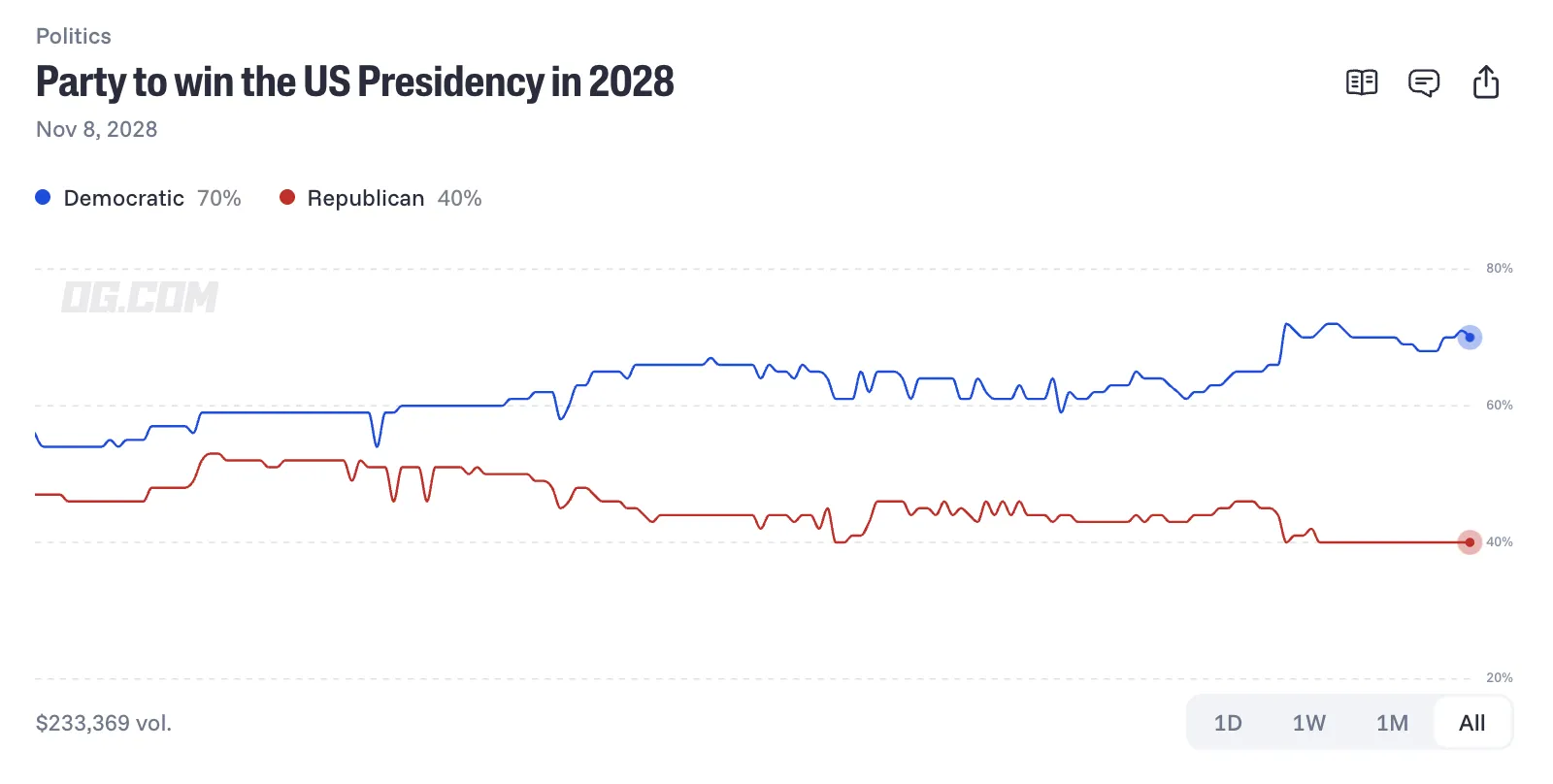
That doesn't mean Democrats have settled on a presidential candidate. In fact, the Republican nomination market is more concentrated around Vance, whereas several Democrats are attracting comparable attention in nomination markets.
The 2028 election odds by party can look different from the individual-candidate rankings. A party's probability covers all its possible nominees, but each candidate's prediction market price reflects their own path to the White House.
For example, Democrats could have a 60% market-implied chance of winning, with that probability divided among several potential nominees. Meanwhile, Republicans could have a lower overall probability but a single candidate with the highest individual price.
A Yes contract priced at 60¢ can be read as roughly a 60% market-implied chance of the specified outcome. A correct contract typically settles at $1 and an incorrect one at $0, subject to the market rules. Prices can change as traders respond to new information, and trading involves risk.
Who are the leading Republican contenders for 2028?
Vice President JD Vance leads national Republican primary polls by a wide margin, with Secretary of State Marco Rubio in second place. Donald Trump Jr. and Ron DeSantis are drawing considerably less support.
Potential Republican nominee | National primary polling average | OG market price |
JD Vance | 39.2% | 46% |
Marco Rubio | 24.2% | 21% |
Donald Trump Jr. | 10.9% | 8% |
Ron DeSantis | 7.9% | 6% |
Based on publicly available information as of October 28, 2026. Source: RealClearPolling.
JD Vance
Vance's 15-point advantage gives him a strong position among Republican primary voters, but the party still needs a candidate who can appeal beyond its own base.
As the sitting vice president, Vance would enter a general-election campaign closely associated with Trump's presidency, including voters' views of the economy.
Marco Rubio
Rubio has been gaining attention as a potential Republican nominee. His role as secretary of state connects him to the current administration, and he ran in the 2016 Republican presidential primary.
The nomination could shape the Republican chances of holding the White House, especially if voters' assessment of the administration changes before Election Day.
Other Republicans, including DeSantis and Trump Jr., also appear in early polling but attract less support nationally. None of the four has formally announced a 2028 campaign.
Who are the leading Democratic contenders for 2028?
Unlike Republicans, Democrats don’t have a clear frontrunner across both polls and prediction markets. Kamala Harris leads national primary polling, but Jon Ossoff, Gavin Newsom, and Alexandria Ocasio-Cortez are among the Democrat favorites attracting higher prices in most prediction markets.
Potential Democratic nominee | National primary polling average | OG market price |
Kamala Harris | 25.9% | 9% |
Gavin Newsom | 14.4% | 17% |
Pete Buttigieg | 12.9% | 11% |
Alexandria Ocasio-Cortez | 11.1% | 17% |
Jon Ossoff | 8.6% | 21% |
Based on publicly available information as of October 28, 2026. Source: RealClearPolling.
Kamala Harris
Harris leads Newsom by 11.5 percentage points in national polling. She was the Democratic presidential nominee in 2024, so voters already know her, but another campaign would also bring renewed attention to her loss to Trump.
Her lower price in nomination markets also suggests traders aren't as convinced by her polling advantage, particularly with her decision on another presidential run still outstanding.
Gavin Newsom
Newsom has become one of the Trump administration's most outspoken Democratic critics, drawing national attention beyond his role as California's governor.
Newsom is second behind Harris in national polling, but he’s among the leaders in prediction markets. Several other Democrats are also competing for the nomination.
Pete Buttigieg and Alexandria Ocasio-Cortez also attract double-digit support in national surveys. Jon Ossoff faces a more immediate test with his Senate reelection campaign in November 2026.
Democrats have several potential nominees attracting support, and it's still unclear who could emerge as the party's strongest candidate for 2028.
What are key factors that could shift party predictions?
The November 3, 2026 midterm elections could provide an early indication of how voters feel about the Trump administration. But the results are only one factor that could change the 2028 presidential election predictions.
Other developments to watch include:
- Economic conditions: Inflation, employment, and consumer confidence could influence how voters assess the administration and the party seeking to replace it.
- The 2026 midterms: Strong results could give either party momentum heading into 2028 and increase the visibility of potential presidential candidates.
- Candidate announcements: The Republican and Democratic fields could look very different once leading contenders confirm their plans.
- Fundraising and endorsements: Financial backing and support from influential party figures could help candidates compete in the primaries.
- Early primary results: Unexpected wins or disappointing performances could change which candidates appear most likely to secure their party's nomination.
- Swing-state polling: Changes in Pennsylvania, Michigan, Wisconsin, and other competitive states could affect expectations about which party can reach 270 electoral votes.
The Republicans also face an open-seat election, with Trump unable to seek another elected term under the 22nd Amendment. His successor would have to make the case for another Republican presidency without the incumbent president on the ballot.
For Democrats, the midterms could bring more attention to potential candidates such as Jon Ossoff, who faces reelection in Georgia. As the parties move closer to choosing their nominees, voters and traders will have more information to judge their chances in November 2028.
What’s the 2028 presidential election timeline?
The 2028 presidential election cycle begins well before the November vote. Both parties must choose nominees through their primary processes, followed by national conventions.
Date | Event |
November 3, 2026 | Midterm elections |
Throughout 2027 | Potential candidate announcements and campaign organization |
January 22, 2028 | First scheduled Democratic primary in South Carolina |
Early 2028 | Republican early contests beginning with Iowa, dates pending |
March 7, 2028 | Super Tuesday |
Spring to summer 2028 | Remaining primaries and national conventions |
November 7, 2028 | Presidential Election Day |
January 20, 2029 | Presidential inauguration |
Based on publicly available information as of October 28, 2026.
Republicans have retained Iowa, New Hampshire, Nevada, and South Carolina as their early states, but specific dates remain to be finalized. Democrats have already approved a six-state early schedule beginning with South Carolina.
The primaries will narrow the field before the parties meet at their national conventions. Only then will voters know the candidates competing for the White House.
How to trade political event contracts on OG.com
With OG.com, you can trade event contracts on real-world outcomes across different market categories.
- Create an account: Open an account and complete sign-up, including identity verification. You can use our web or mobile platforms.
- Browse markets: Explore markets across politics, economics, culture, sports, and other real-world events.
- Review and trade: Compare the market price with your own view. Check the rules, fees, and settlement details before opening a position.
- Monitor your position: After trading, your contract appears in your open positions, where you can track price movement as new information comes in.
FAQs about 2028 presidential election predictions
Which party is favored to win the 2028 presidential election?
Democrats currently lead in our party-winner market at 70%, compared with 40% for Republicans.
Who is the Republican frontrunner for the 2028 presidential race?
JD Vance leads national Republican nomination polling at 39.2%, ahead of Marco Rubio at 24.2%, according to the latest RealClearPolling average.
Who are the top Democratic candidates for the 2028 election?
Kamala Harris leads national Democratic nomination polling, but Gavin Newsom, Pete Buttigieg, Alexandria Ocasio-Cortez, and Jon Ossoff are also receiving support in early surveys.
What swing states will decide the 2028 presidential election?
Pennsylvania, Michigan, Wisconsin, Georgia, Arizona, Nevada, and North Carolina were major battlegrounds in 2024 and could remain important in 2028, although the competitive map may change.
How accurate are prediction markets at forecasting presidential elections?
Historical studies have evaluated prediction market accuracy and found that prediction markets sometimes outperform polls, but their accuracy more than two years before a presidential election remains uncertain.
When does the 2028 presidential campaign officially begin?
There isn’t an official campaign launch date. Candidates can announce at different times, and primary voting is expected to begin in early 2028.
How does the open-seat dynamic affect 2028 predictions?
Trump can't be elected to a third presidential term under the 22nd Amendment, so Republicans must choose a new nominee rather than run the sitting president again.
What role do midterm election results play in 2028 forecasts?
The 2026 midterms could change expectations about each party's standing, but congressional election results don't necessarily predict the next presidential outcome.
How do party-level predictions differ from candidate-level predictions?
Party-level contracts cover whichever nominee wins for a party, whereas candidate-level contracts require one specific person to secure the presidency.
What economic indicators could influence the 2028 presidential outcome?
Inflation, employment, consumer confidence, and economic growth could all influence how voters judge the administration's record and the parties' proposals.
Important Information: Prediction is an event contract that is a derivatives product offered by North American Derivatives Exchange, Inc. (NADEX), a CFTC-regulated exchange, which does business under the brand OG.com Prediction Markets (OG) Crypto.com | Derivatives North America and uses a CFTC-regulated exchange that uses OG.com technology.
Trading on OG.com involves risk and may not be appropriate for all. By trading you risk losing your cost to enter any transaction, including fees. You should carefully consider whether trading on OG.com is appropriate for you in light of your investment experience and financial resources. Any trading decisions you make are solely your responsibility and at your own risk.