Minnesota Vikings at Chicago Bears prediction and odds
The Chicago Bears are 69% favorites against the Minnesota Vikings after a record-setting opener, although Minnesota's quarterback depth and disruptive defense complicate the market gap.
Football
By Chris Old

The Minnesota Vikings and Chicago Bears combined for 98 points in separate Week 1 wins. Neither took a straightforward route there.
Chicago allowed Carolina to tie the game at 31 before scoring 28 of the next 34 points in a 59-37 victory. Caleb Williams generated 334 yards and four touchdowns, while the Bears rushed for 291 yards behind D'Andre Swift and Kyle Monangai.
Minnesota lost starting quarterback Kyler Murray to a concussion after his first pass was intercepted. Carson Wentz entered, threw three touchdown passes and helped turn a 22-10 third-quarter deficit into a 39-22 win over Green Bay.
The market prefers the home team and the more settled quarterback situation. The Vikings' response against the Packers makes this a much more interesting divisional game than the 69%-32% split initially suggests.
This article is for informational purposes only and should not be construed as financial or investment advice. Past performance does not guarantee future results.
Minnesota Vikings vs Chicago Bears game snapshot
- Date: Sunday, September 20, 2026
- Kickoff: 1 p.m. ET / 6 p.m. BST
- Competition: NFL Week 2
- Home team: Chicago Bears
- Minnesota Vikings record: 1-0
- Chicago Bears record: 1-0
- Minnesota Vikings win: 32%
- Chicago Bears win: 69%
Minnesota Vikings vs Chicago Bears prediction
Prediction markets currently make the Chicago Bears 69% favorites, with the Minnesota Vikings at 32%.
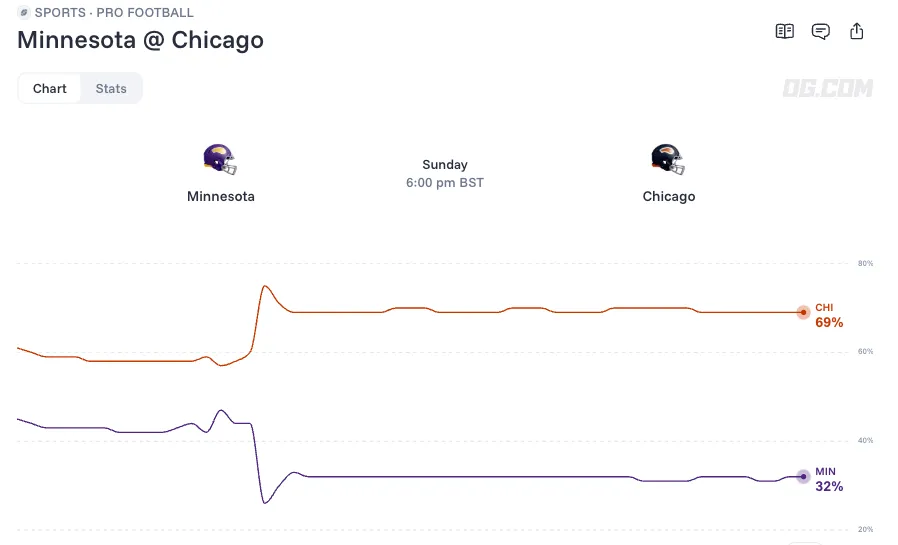
Market data as of September 15, 2026. For the latest market-implied probability, check the OG app.
Chicago deserves to lead. Williams looked comfortable operating Ben Johnson's offense, completing 72.4% of his passes for 269 yards and two touchdowns while adding 65 yards and two scores as a runner.
He did not commit a turnover. The Bears then supported him with two 100-yard running backs and eight offensive touchdowns.
That balance creates the first problem for Minnesota. Brian Flores cannot devote the entire defensive plan to crowding Williams' passing lanes when Swift and Monangai have just produced 224 rushing yards between them.
If the Vikings widen in response to Chicago's formations, the Bears can run downhill. If they tighten the box, Williams gains cleaner one-on-one opportunities outside.
The quarterback uncertainty explains part of the market gap. Murray remains in the concussion protocol after leaving Minnesota's opening possession, and Kevin O'Connell has not named a Week 2 starter.
Wentz is a credible alternative rather than an emergency option. He completed 12 of 19 passes for 133 yards and three touchdowns, then directed four touchdown drives across the second half.
Chicago's defense also gives the underdog room. Carolina scored 37 points and produced several explosive passes before the Bears pulled away. Justin Jefferson scored twice against Green Bay, while T.J. Hockenson's presence through the middle helped exploit the extra attention devoted to the receiver.
The Vikings can affect Williams before those routes develop. They recorded four sacks and 15 quarterback hits in Week 1, with Dallas Turner responsible for seven hits and Andrew Van Ginkel forcing a fumble during a sack. Flores can present pressure from several levels without revealing before the snap which defenders are coming.
Chicago still has the cleaner route. Williams is healthy, the running game offers two different backs and the offense can punish pressure with screens, checkdowns and quarterback movement.
Minnesota's comeback showed that either Murray or Wentz can make this competitive. It did not remove the uncertainty around who will start or how the offense will look from the opening snap.
Our broader 2026 NFL outlook identified the NFC North as a division without an obvious runaway team. Both clubs strengthened their case in Week 1. Chicago's offensive ceiling and greater clarity at quarterback justify the market lead here, but 69% leaves a meaningful opening for a Vikings team that already handled one divisional test.
Minnesota Vikings vs Chicago Bears odds
- Minnesota Vikings win: 32%
- Chicago Bears win: 69%
Chicago's 69% probability reflects its explosive opener, home advantage and Minnesota's unresolved quarterback status. The Vikings remain a substantial underdog despite beating Green Bay by 17 points, which shows how heavily the market is weighting Williams and the Bears' offensive continuity.
Minnesota Vikings vs Chicago Bears game outlook
Chicago's Week 1 offense was built around more than Williams improvising. Swift ran for 124 yards and three touchdowns, Monangai added 100 yards and a score, and the line created movement for a team total of 291 rushing yards. Williams' own 65 yards gave Carolina another gap to defend when he kept the ball.
The Vikings have to set firmer edges than the Panthers managed. Van Ginkel and Turner are dangerous attacking upfield, but doing that too aggressively can open cutback lanes or allow Williams to escape outside. Blake Cashman will have a central role fitting the run while still accounting for Cole Kmet and the backs as receivers.
Flores is unlikely to abandon disguise. Minnesota can threaten pressure from the slot, walk linebackers toward the line and then drop unexpected defenders into Williams' throwing lanes. The Bears' answer should involve quick decisions. Kalif Raymond caught eight passes for 84 yards in his Chicago debut, and Swift can turn a checkdown into a productive play before the rush arrives.
Rome Odunze gives the passing game a different route. His 47-yard contested catch against Carolina came after Williams escaped the pocket, a reminder that the Bears do not need every play to remain inside its original structure. Jefferson provides Minnesota with the same type of problem at a higher volume.
Whether Murray or Wentz starts, O'Connell will move Jefferson around the formation to prevent Chicago from treating him as one cornerback's responsibility. The receiver's gravity also created room for Hockenson's touchdown against Green Bay. If the Bears commit a safety over Jefferson, Minnesota can attack the linebackers with Hockenson or release Aaron Jones into space.
The running game matters to the Vikings for another reason. Jordan Mason and Jones combined for 99 yards against Green Bay, and Minnesota stayed with the run after several early losses. That patience helped keep the offense on the field for 32:58 and prevented the Packers from controlling possession.
Chicago's defense gave up 37 points in Week 1, but it also generated three takeaways across defense and special teams. Minnesota cannot offer the same short fields, particularly if Wentz starts and the Bears challenge him with simulated pressure and late rotations.
This game should be more tactical than either Week 1 score implies. Chicago wants to force Minnesota to defend every part of the field. The Vikings want to create hesitation for Williams, control possession and let Jefferson dictate coverage. Whichever offense stays out of long-yardage situations will have the better chance of keeping its full playbook available.
Team news and injuries
Minnesota Vikings
Murray is in the NFL's concussion protocol. O'Connell said Monday that the quarterback felt relatively good and was able to attend meetings, but his progression through the protocol will determine whether he can start against Chicago.
Wentz is the experienced alternative. His Week 1 relief performance included three touchdown passes and a 123.5 passer rating, with Minnesota scoring touchdowns on four consecutive drives across the third and fourth quarters. The offense would change with Wentz: fewer designed quarterback runs, but no need to strip the game plan down to basic concepts.
Jefferson caught two touchdown passes against Green Bay. Hockenson added another, while Jones and Mason shared the rushing workload. Jones scored on a three-yard run and Mason finished with a team-high 59 rushing yards before adding a short touchdown following Van Ginkel's forced fumble.
Minnesota entered Week 1 without an injury designation for any player on its 53-man roster. Murray's concussion is therefore the major new personnel issue emerging from the opener.
Chicago Bears
Williams is the confirmed starter and enters Week 2 after one of the most efficient performances of his career. He completed 21 of 29 passes, threw two touchdowns, ran for two more and avoided a turnover.
Odunze was active against Carolina after being listed as questionable with a calf injury. He made a 47-yard catch down the sideline and remains one of Williams' primary downfield targets. His ability to complete a full week of work will help determine how much Chicago asks him to do against Minnesota's pressure packages.
Swift and Monangai both reached 100 rushing yards in the same game for the second time in seven regular-season appearances. That is a genuine shared backfield rather than a nominal starter receiving every meaningful carry. Swift handled 18 attempts; Monangai needed only 10 to reach 100 because of a 61-yard touchdown.
Luther Burden III lost a fumble on Chicago's third offensive play. Raymond then became the most frequent receiver, catching eight passes, while Kmet scored on a 22-yard throw. The variety of options should help Williams when Minnesota rotates coverage toward Odunze or brings pressure away from the expected side.
Key factors that could decide Minnesota Vikings vs Chicago Bears
Who starts at quarterback for Minnesota?
Murray brings movement that can change the Bears' rush angles, but he played only two possessions in Week 1 and threw an interception on his first pass. Wentz lacks the same designed-rushing threat yet operated O'Connell's passing concepts calmly and found three different touchdown opportunities.
The uncertainty affects more than the quarterback position. Chicago's pressure plan, Minnesota's run-pass balance and the amount of movement built into the pocket will all depend on who is cleared to start.
Can the Vikings slow Chicago's rushing rotation?
The Bears did not reach 291 rushing yards through one hot running back. Swift, Monangai and Williams all threatened different parts of the defense.
Minnesota must tackle better than Carolina and maintain discipline when Williams reads the edge. If Chicago repeatedly reaches second-and-medium, Johnson can move between the running game, play action and quick throws without letting Flores dictate the call.
Can Minnesota's pressure confuse Williams?
Turner produced seven quarterback hits against Green Bay, while Van Ginkel, Cashman and Levi Drake Rodriguez all contributed to the sack total. Flores can create one-on-one opportunities by making the protection account for more possible rushers than it can block.
Williams handled Carolina's pressure without turning the ball over. Minnesota presents a different challenge because the picture can change after the snap. His willingness to take the checkdown may be as important as his ability to escape.
How does Chicago contain Jefferson?
Jefferson scored twice in the opener and influences coverage even when the ball goes elsewhere. Chicago can use Jaylon Johnson at the line, add safety help or vary the matchup by formation. None removes the problem completely.
The Bears must also avoid letting their attention to Jefferson expose the middle. Hockenson can settle behind the linebackers, and Jones remains a receiving option from the backfield. Minnesota's best passing sequences may begin by making Chicago choose which secondary threat receives less help.
Can the Bears' defense avoid another shootout?
Fifty-nine points disguised some defensive problems. Carolina reached 31 points early in the third quarter and created several explosive passes before Chicago finally separated.
The Bears did produce takeaways and a decisive fourth-down stop. They may need that opportunism again. Minnesota has enough receiving talent to move the ball if its quarterback receives time, so Chicago cannot rely on the offense scoring on every possession.
Minnesota Vikings vs Chicago Bears head-to-head
The teams split two close meetings in 2025. Minnesota rallied from an 11-point second-half deficit to win the opener 27-24, while Chicago answered with a 19-17 road victory in November on Cairo Santos' field goal as time expired.
Those games remain useful because O'Connell, Johnson, Williams, Jefferson and many of the central defensive players return. They also underline how quickly this matchup can change. Chicago led both games entering the fourth quarter, but neither result was secure until the final moments.
The quarterback comparison is different now. J.J. McCarthy led Minnesota's comeback in the first meeting and threw two interceptions in the second; the Vikings will use Murray or Wentz on Sunday. The recent series therefore informs the coaching and coverage battle more than it predicts how Minnesota's offense will function.
This is also an early division result with potential January consequences. The Learn Hub's guide to NFL playoff probabilities explains why divisional records can influence both the standings and later tiebreakers. One of these teams will leave Week 2 with a 2-0 record and two wins over NFC North opponents.
What could move Minnesota Vikings vs Chicago Bears odds?
Murray's progress through the concussion protocol is the largest variable. Clearance would restore Minnesota's intended starter and add a designed-rushing threat. Confirmation that Wentz will start would provide certainty, but it would also change how the market assesses the Vikings' ability to stress Chicago horizontally.
Odunze's calf is the main Bears issue carried into the week. He played in the opener and supplied a 47-yard catch, though any restriction would reduce Chicago's most established outside pairing with DJ Moore.
Practice participation for Minnesota's offensive tackles and Chicago's defensive backs will also matter. The Vikings need time for Jefferson's intermediate and deep routes to develop, while the Bears need enough healthy coverage options to disguise where the safety help is going.
Important information
Prediction is an event contract that is a derivatives product offered by North American Derivatives Exchange, Inc. (NADEX), a CFTC-regulated exchange, which does business under the brand OG.com Prediction Markets (OG). Crypto.com | Derivatives North America uses a CFTC-regulated exchange that uses OG.com technology.
Trading on OG.com involves risk and may not be appropriate for all. By trading you risk losing your cost to enter any transaction, including fees. You should carefully consider whether trading on OG.com is appropriate for you in light of your investment experience and financial resources. Any trading decisions you make are solely your responsibility and at your own risk.