You might know which side looks stronger, where an underdog could cause problems, or when momentum is beginning to shift.
Learn
By Barbara Pazur
A sports prediction market asks another question: How much of that view is already reflected in the price?
This guide explains how sports event contracts work, which sports can be traded, what moves prices, how sports prediction markets differ from sports betting, and what to check before trading.
This article is for informational purposes only and should not be construed as financial or investment advice. Past performance does not guarantee future results.
The product data is as of August 2026. Please check the prediction platforms websites for up-to-date information.
What are sports prediction markets?
Sports prediction markets let traders take a position on a defined sporting outcome through an event contract. Each contract asks a specific question. It may ask whether a team wins a game, a player reaches a stated result, or a competitor finishes in a certain position.
The outcome has to be measurable. The contract also needs clear settlement rules, so traders know what result counts, when the market closes, and what source confirms the outcome.
How do sports prediction markets work?
Sports prediction markets can cover a team winning a game, a specific score or another clearly defined outcome. Traders can take a Yes or No position on each question.
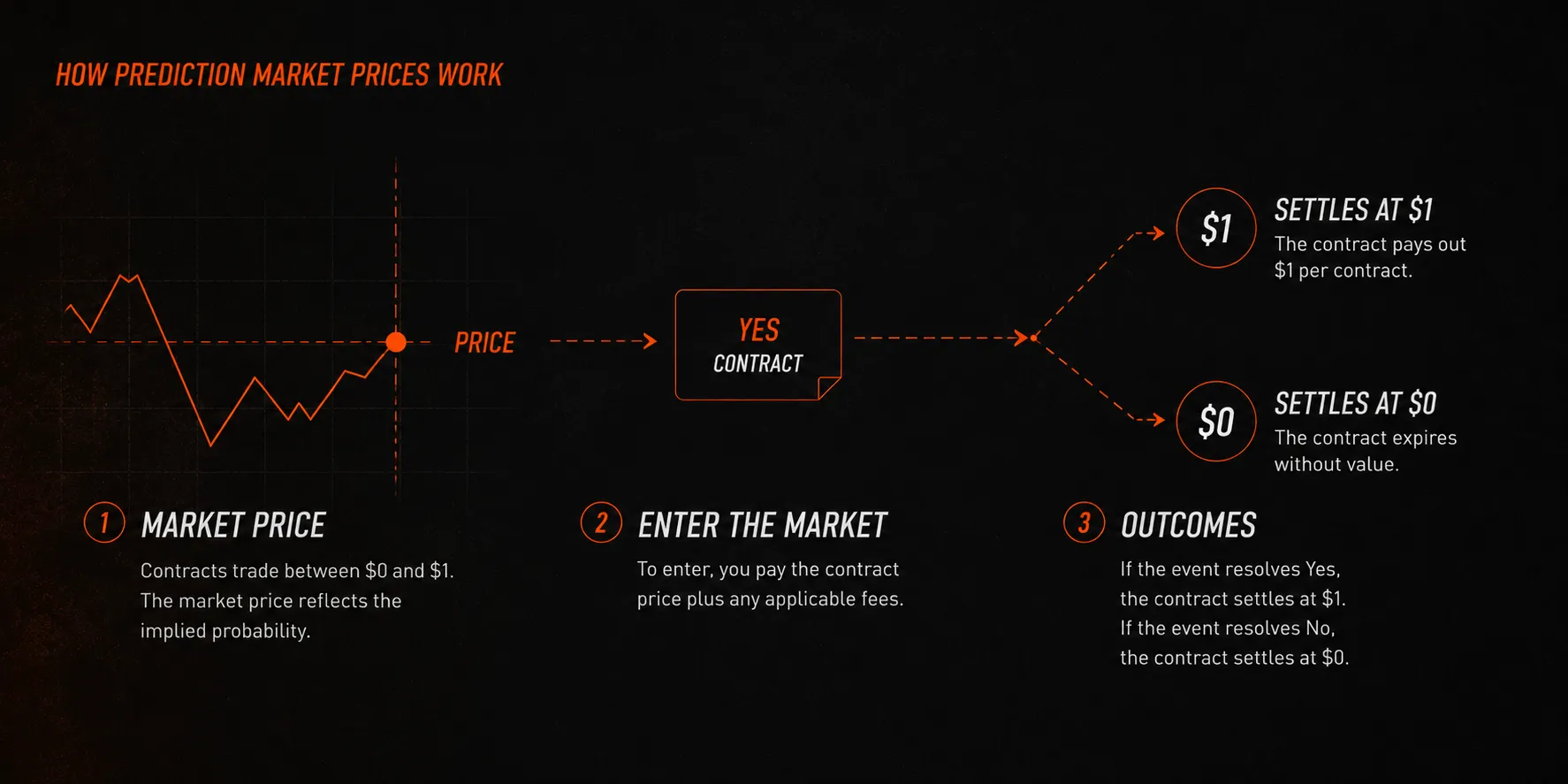
On OG.com, contract prices are shown as percentages that reflect the market-implied probability. If Yes trades at 40%, for example, the contract costs 40¢ and No would typically trade at 60¢.
At settlement, each contract is worth either $1 or $0. If the outcome you traded does not happen, your contract settles at $0 and you lose the amount paid, including fees. You may also be able to sell your contract before the market settles, depending on available liquidity.
Which sports can you trade in prediction markets?
Sports prediction markets can cover more than one kind of sporting outcome. On OG.com sports markets are organized across categories such as football, baseball, soccer, tennis, basketball, golf, fighting, esports, motorsports, sailing, and hockey.
The exact contracts available can change with the event schedule and market rules.
Common prediction market sports categories can include:
Football: Individual games, scoring-related events, competition progress, and longer-term futures where available.
Baseball: Game results, scoring outcomes, series or competition results, and season-long outcomes.
Soccer: Match outcomes, goals-related markets, tournament progression, and competition winners.
Tennis: Individual matches, tournament progress, and outright competition results.
Basketball: Game outcomes, scoring-related results, and longer competition or season outcomes.
Golf: Tournament winners, finishing positions, and defined competition outcomes.
Fighting: Bout results or other clearly defined fight outcomes.
Esports: Match, map, tournament, or competition outcomes depending on the event.
Motorsports: Race results, finishing positions, qualifying, or competition outcomes.
Sailing: Race or competition outcomes where clearly defined contracts are available.
Hockey: Game results, scoring-related outcomes, and longer-term competition results.
A football contract and a tennis contract may both trade a sports outcome, but the market question, timing, and settlement rules can be very different. Before trading, check what the contract measures and how it settles.
How to trade sports prediction markets on OG.com
With OG.com, you can trade event contracts on real-world outcomes across different market categories, including sports for both pre-game and live in-game trading.
Create an account: Open an account and complete sign-up, including identity verification. You can use our web or mobile platforms.
Browse markets: Explore markets across economics, culture, politics, sports, and other real-world events.
Review and trade: Compare the market price with your own view. Check the rules, fees, and settlement details before opening a position.
Monitor your position: After trading, your contract appears in your open positions, where you can track price movement as new information comes in.
Sports don’t all reward the same read. In some types of prediction markets, the biggest signal comes before the event. In others, the live state does most of the work. That is why a strong opinion on the sport is only useful if it matches the information the contract is likely to react to.
Let’s look at how price drivers differ across different kinds of sports.
Team sports: football, baseball, and more
In team sports like football, baseball, soccer, basketball, and hockey, the market is usually reading a mix of team form, player availability, matchups, venue, score, and time left.
The same update can carry a different weight depending on the sport. One goal in soccer can change the whole match state. One basket in basketball usually means less on its own because scoring happens more often. A late injury can also matter more if it changes the role or matchup that the market had already priced in.
Individual sports: tennis, golf
In tennis, golf, and fighting, the market has less room to hide behind team backup. If a tennis player is carrying an injury or a golfer struggles with a course setup, that information can move expectations quickly.
Tournament structure can also change the read. A difficult draw, a specific course, or a tough set of possible matchups can make the same competitor look stronger in one setup and more vulnerable in another.
Racing and competition sports
In motorsports and sailing, the event often depends on conditions as much as form. Starting position, qualifying, weather, course or track setup, equipment, penalties, and race progress can all change how the market reads the outcome.
A competitor can have the strongest pre-event case and still lose ground because of a mechanical issue, a tactical call, a shift in wind, or a bad restart. These markets can reprice quickly because the event state can change without warning.
Esports
Esports markets often react to information that casual viewers may miss. Roster changes, game updates, map selection, tournament format, and recent form can all affect the pre-event price.
During live play, the market may respond to score, objectives, economy, map control, momentum, or the state of a series. A team can look strong before the match and still face a difficult setup if the map pool or format works against it.
The contract structure may look similar from sport to sport, but the information behind the price can be very different. A 60¢ football contract and a 60¢ tennis contract both suggest roughly a 60% market-implied chance, but the reasons behind that price may have almost nothing in common.
Why do traders use sports prediction markets?
Sports prediction markets give traders a way to do more than watch a game unfold. They can take a view on a defined outcome, then see how that view compares with the market price.
That price is observable, so traders can see where the market stands before the result is known. It also points to a market-implied probability, which helps translate the price into the market’s current view of the outcome.
The settlement conditions are set in advance. They explain how the result will be judged and help keep the trade tied to the contract’s exact outcome, not just a general read on the game.
However, a strong read on the sport can still be wrong. Favorites can lose, underdogs can win, and one unexpected moment can change both the game and the market.
Sports prediction markets vs sports betting
Sports prediction markets and sports betting can both be tied to sporting outcomes, but they are structured differently. The main difference is how prices are formed, how positions work, and how outcomes are settled.
Sports prediction markets
Sports betting
Key difference
Pricing
Based on the current trader sentiment
Sportsbooks set odds for an outcome
Prediction-market prices are formed by current trading activity, while sportsbook odds come from the operator.
Position
Traders trade a Yes or No event contract
Customers enter an odds-based wager
Prediction markets are built around contracts, while sports betting is built around wagers.
Market movement
A position may change in value before settlement
Changes depend on the sportsbook product
Prediction-market positions can be sold before settlement where available.
Neither structure is automatically better. The point is to understand the price, rules, fees, risk, and settlement process before entering a sports event contract.
What are the risks of sports prediction markets?
All trading involves risk. In sports prediction markets, you can lose the cost of entering a transaction, including fees.
Sports event contracts can move quickly as new information arrives before and during events. As we mentioned earlier, injuries, withdrawals, lineup changes, weather, penalties, score changes, and unexpected performance swings can all affect prices.
Information can also be incomplete or wrong. A rumored injury or early weather read can change before the event starts. If the market reacts to information that later proves inaccurate, prices can move again.
Liquidity can vary by market category and contract, and with fewer active traders, it may be harder to enter or exit at the price a trader expects.
There is also probability risk. A contract trading at 80¢ can still settle No. A high market-implied probability means the market sees the outcome as more likely at that moment, not certain.
A trader also has to understand the exact contract outcome. A team can control most of the game and still fail to meet the outcome defined by the contract.
What should you check before trading a sports event contract?
Before trading a sports event contract, read the contract details closely. The first thing to understand is what outcome the contract actually measures.
Check the exact question, the participating teams or competitors, event and settlement deadlines, official result source, fees, and contract-specific conditions. Also check whether overtime or equivalent additional periods count, and how postponed or canceled events are handled.
Two contracts can look similar but settle differently. One soccer contract might ask whether a team wins in regulation time. Another might include extra time or another defined result window.
A trader can read the stronger side correctly and still be wrong for that contract if the rules define the outcome differently.
Sports prediction markets are markets where traders take positions on defined sporting outcomes through event contracts. Each contract has rules that explain what outcome counts and how settlement works.
How do sports prediction markets work?
A contract asks a specific sports-related question. Traders compare their view with the market price, prices move as expectations change, and the contract settles according to the stated rules.
How are prediction markets different from sports betting?
Prediction markets use event contracts with market prices that can change through trading activity. Sports betting uses odds provided through sportsbook products. The product structure and regulatory framework can differ.
Which sports can you trade in prediction markets?
Sports prediction markets can cover football, baseball, soccer, tennis, basketball, golf, fighting, esports, motorsports, sailing, hockey, and other sports where clearly defined contracts are available.
Where can I find prediction markets for sports?
You can find sports prediction markets on platforms that offer sports event contracts. On OG.com, sports markets appear alongside other real-world market categories.
How do sports prediction market prices work?
A contract price can be read as a market-implied probability. For example, a contract trading at 40¢ suggests roughly a 40% market-implied chance, though the outcome can still change.
How do sports event contracts settle?
Sports event contracts settle according to their rules. Those rules explain the outcome being measured, the settlement source, the timing, and how unusual cases like postponements or cancellations are handled.
Does OG.com offer live in-game trading?
Yes. OG.com offers live in-game trading on eligible sports event contracts, allowing traders to open or close positions while a game is underway. Availability may vary by market, location and trading status, so check the individual contract page for current availability, rules and closing times.
Important Information: Prediction is an event contract that is a derivatives product offered by North American Derivatives Exchange, Inc. (NADEX), a CFTC-regulated exchange, which does business under the brand OG.com Prediction Markets (OG) Crypto.com | Derivatives North America and uses a CFTC-regulated exchange that uses OG.com technology.
Trading on OG.com involves risk and may not be appropriate for all. By trading you risk losing your cost to enter any transaction, including fees. You should carefully consider whether trading on OG.com is appropriate for you in light of your investment experience and financial resources. Any trading decisions you make are solely your responsibility and at your own risk.