Futures vs. options: What are the differences?
Learn how futures and options work, including their obligations, upfront costs, expiry rules and risks, and see how they compare with prediction markets.
Perps
By Ekaterina Drozdovica

Futures and options both let traders take a position on an asset’s price without buying the asset outright. That is where the similarity ends.
Trading a futures contract creates an obligation for both sides. An option gives its buyer the right, but not the obligation, to trade at a set price.
That difference shapes everything from upfront costs to potential losses. Here is how each contract works, why traders use them and where event contracts fit into the wider derivatives market.
This article is for informational purposes only and should not be construed as financial or investment advice. Past performance does not guarantee future results.
Futures vs options: key takeaways
- Futures require the buyer and seller to meet the contract terms unless they close the position before expiration.
- Perpetual futures work similarly to traditional futures but have no expiration date.
- Options give the buyer the right, but not the obligation, to buy or sell the underlying asset.
- Futures traders post margin, while options buyers pay a premium upfront.
- An options buyer’s maximum loss is generally limited to the premium paid. Futures losses can exceed the amount initially deposited.
- Event contracts focus on whether a defined real-world outcome happens, rather than tracking an asset’s price over time.
How futures contracts work
A futures contract is a standardized agreement to buy or sell an underlying asset at a set price on a future date. The exchange defines the contract size, expiration date and settlement terms.
Both sides take on an obligation. The buyer agrees to buy, and the seller agrees to sell, under the contract’s terms. Traders can usually close their positions before expiration, so many contracts never result in physical delivery. Some futures settle in cash instead.
How margin works in futures
Traders do not usually pay the full value of a futures position upfront. They post initial margin – money required to open the position and support the contractual obligation.
Suppose a crude oil futures contract covers 1,000 barrels and oil trades at $70 per barrel. The contract’s notional value is $70,000. If the initial margin is $7,000, the trader can open the position without paying its full notional value upfront.
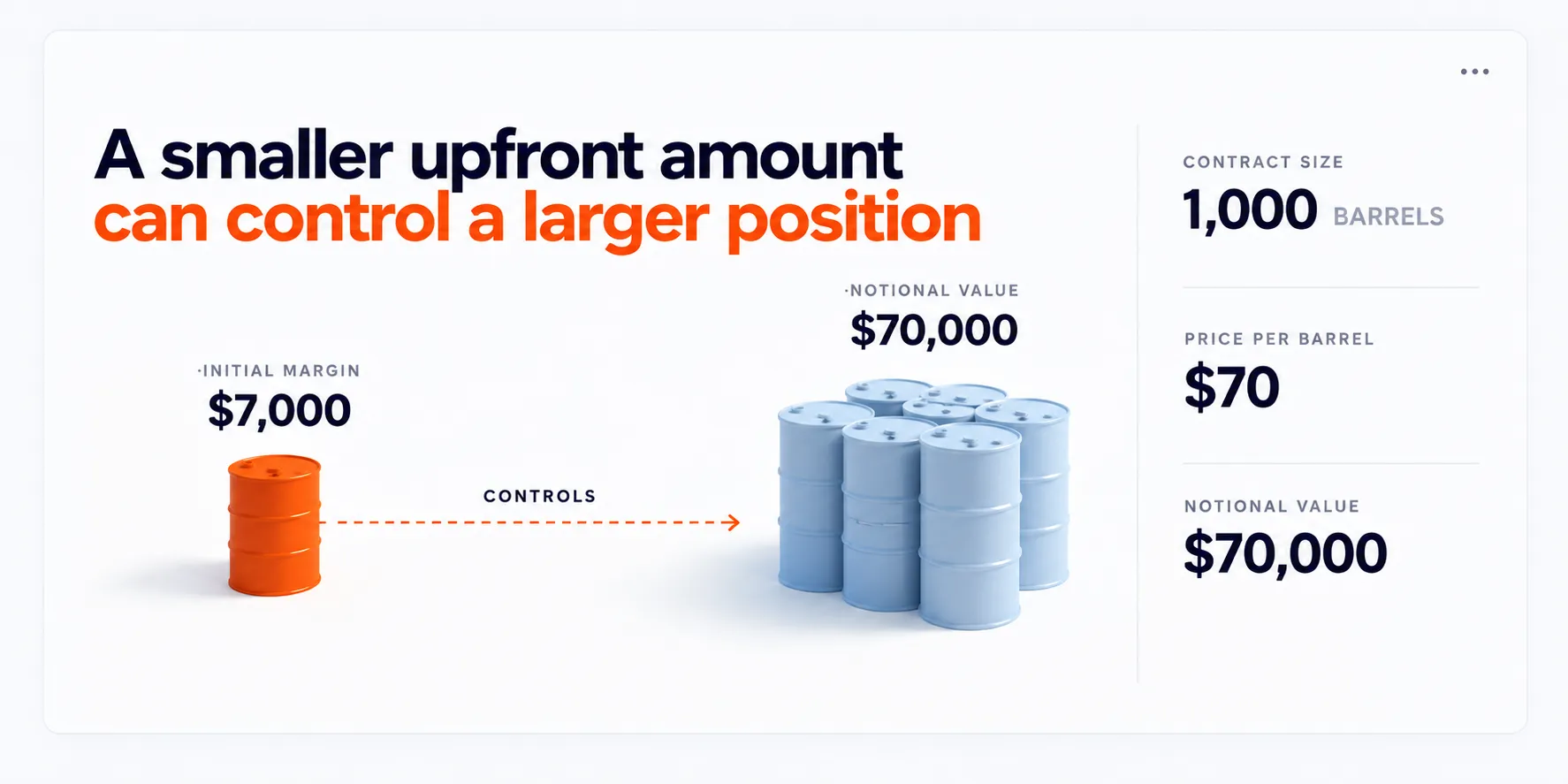
This creates leverage. A relatively small move in the futures price can produce a much larger percentage gain or loss compared with the amount posted as margin. If losses reduce the account below the required level, the trader may need to add funds or face the position being closed.
Futures positions are also marked to the market. The exchange calculates gains and losses using its daily settlement price, and those changes are reflected in traders’ accounts.
What are perpetual futures?
Perpetual futures, or perps, work similarly to traditional futures but have no expiration date. Traders can keep a position open as long as they maintain the required margin.
Because there is no settlement date, perps use periodic funding payments between long and short traders to help keep the contract price close to the underlying market price. Like traditional futures, they use leverage, which can amplify both gains and losses.
How to trade crypto perpetual futures on OG.com
With OG.com, you can trade perpetual futures on cryptocurrency prices.
- Create an account: Open an account and complete sign-up, including identity verification. You can use the web or mobile platform.
- Browse markets: Find a perpetual future contract on the cryptocurrency you’re willing to trade.
- Review the details: Check the market price, rules, and fees, before opening a position.
- Set risk protection: Set up your stop-loss and take-profit levels to ensure risk controls.
- Monitor your position: Track how the contract price changes as new information comes in.
Why traders use futures
Futures can help producers and businesses lock in prices. A farmer may use corn futures to reduce uncertainty about the price of a future crop, while an airline may use energy futures to manage fuel-cost risk.
Traders also use futures to take a directional view on markets. The appeal is direct exposure to price moves, but margin means losses can build quickly. Futures are complex, high-risk products and are not suitable for everyone.
How options contracts work
An option gives its buyer the right, but not the obligation, to buy or sell an underlying asset at a set price by a specified date. That set price is called the strike price.
The buyer pays an upfront fee called a premium for this right. The seller receives the premium but takes on an obligation if the buyer exercises the option.
Call options vs. put options
There are two main types of options:
- A call option gives the buyer the right to buy the underlying asset.
- A put option gives the buyer the right to sell the underlying asset.
For example, suppose a stock trades at $50 and a trader buys a put option with a $45 strike price. The option costs $2 per share, or $200 for a standard contract covering 100 shares.
If the stock falls to $35, the option gives the trader the right to sell at $45. If the stock remains above $45, the trader can let the option expire. Their maximum loss would be the $200 premium, excluding fees.
The seller faces a different risk profile. Depending on the option and whether the position is covered, potential losses can be substantial and may be unlimited.
Why traders use options
Options can be used to take a view on whether an asset will rise or fall, to trade expected volatility or to limit risk on another position.
Their flexible payoff structure is also what makes them more complex. The result depends not only on direction, but also on the strike price, premium, time remaining and market volatility. Buyers can lose the full premium, while sellers may face much larger losses.
Futures vs. options compared
Futures | Options | |
|---|---|---|
Core structure | Both sides have an obligation. | The buyer has a right; the seller has an obligation. |
Upfront amount | Initial margin. | Premium paid by the buyer. |
Buyer risk | Losses can exceed the initial margin. | Generally limited to the premium paid. |
Seller risk | Losses can exceed the initial margin. | Can be substantial and, for some uncovered calls, theoretically unlimited. |
Expiration | Traditional futures expire; perpetual futures have no set expiration date. |
Obligation vs. choice
A traditional futures contract commits both sides to the agreed terms, while an option buyer can choose whether to exercise the contract.
Perpetual futures work differently from traditional futures because they have no settlement date, but traders still take on gains or losses as the market moves.
That flexibility has a price: the option premium. Futures and perpetual futures do not require buyers to pay a premium, but traders must maintain enough margin to keep their positions open.
Margin vs. premium
Margin is not the purchase price of a futures or perpetual futures contract. It is collateral that supports the position. The required amount can change as market conditions and the value of the position change.
An option premium is the price the buyer pays for the option. The buyer pays it upfront and does not get it back if the option expires worthless. Perpetual futures may also involve funding payments between long and short traders.
Risk and potential losses
For an options buyer, the maximum loss is generally known at the start: the premium paid. The position can still lose its entire value.
Traditional and perpetual futures have a different risk profile. Gains and losses move with the underlying market, and losses can exceed the initial margin. Perpetual futures also carry funding-rate and liquidation risks. Option sellers can face large losses, depending on the contract and strategy.
Expiration and time decay
Traditional futures and options expire, but time affects them differently. Options can lose time value as expiration approaches, a process known as time decay.
Futures do not have the same built-in erosion of time value, although their prices can change as settlement approaches.
Perpetual futures have no expiration date and therefore do not need to be rolled into a later contract. Instead, funding payments help keep their prices close to the underlying market.
How are prediction markets different from futures and options?
Prediction markets also use derivatives, but the question is usually more direct. Instead of tracking how far an asset’s price moves, an event contract asks whether a specific outcome will happen.
For example, a contract could ask whether an economic figure will be above a stated level on its release date. A Yes contract priced at 60¢ can be read as a 60% market-implied chance of that outcome. If the rules say the contract settles at $1 when the event happens and $0 when it does not, the maximum settlement value is defined from the start.
That does not make the outcome certain. Prices change as traders react to new information, and any position can lose value. Before trading, check the exact question, settlement source, closing time, fees and market rules.
FAQs about futures vs. options
What is the main difference between futures and options?
Futures create an obligation for both the buyer and seller. An option gives the buyer the right, but not the obligation, to buy or sell the underlying asset. The option seller must meet the contract terms if the buyer exercises it.
Are futures riskier than options?
It depends on the position. Futures losses can exceed the initial margin. For buyers, option loss is generally limited to the premium, but an option seller can face substantial or potentially unlimited losses. Both products carry risk.
Do futures and options both expire?
Traditional futures and options have expiration dates. Options generally lose time value as expiration approaches. Futures do not experience the same option-style time decay, although their prices still move toward settlement.
Can you trade futures or options without owning the underlying asset?
Yes. Traders can open futures or options positions without first owning the underlying asset. Settlement depends on the contract and may involve cash or physical delivery.
Are prediction markets the same as options?
No. Both can have defined outcomes, but their structures differ. An option gives its buyer the right to buy or sell an underlying asset at a strike price. A prediction-market contract settles according to whether a specified event happens under the market’s rules.
Important Information: OG.com provides technology in order to onboard and trade products on OG.com’s CFTC-regulated exchange and clearinghouse: North American Derivatives Exchange, Inc., which does business under the brands OG.com Markets and OG.com Prediction Markets, as well as, through OG.com’s CFTC-registered Futures Commission Merchant (Foris DAX FCM LLC or OG.com Broker).
OG.com Markets offers both prediction market event contracts (Prediction Markets Contracts), as well as margined derivatives, including single stock futures and perpetuals (Futures) (Prediction Markets Contracts and Futures are collectively referred to as OG.com Markets Products). Prediction Markets Contract can be accessed directly on OG.com Markets or through a CFTC-registered FCM, including OG.com Broker, or an Introducing Broker (IB). Futures must be accessed through a CFTC-registered FCM, including OG Broker or an IB.
Trading OG.com Markets Products involves risk and may not be appropriate for all. By trading you risk losing your cost to enter any transaction, including fees. You should carefully consider whether trading OG.com Markets Products is appropriate for you in light of your investment experience and financial resources. Any trading decisions you make are solely your responsibility and at your own risk.