What is futures trading? A guide to futures and perpetual futures
Learn how futures and perpetual futures work, including margin, leverage, funding rates, liquidation, expiry and the risks to understand before trading.
Learn
By Ekaterina Drozdovica

Futures let traders take a position on an asset's price without buying the asset itself. A trader can go long if they expect the price to rise or short if they expect it to fall.
That sounds simple. The contract behind the trade is not. While traditional futures expire, perpetual futures keep running unrestricted by an expiration date. Both use margin and can magnify price moves, but perpetuals add funding payments and different liquidation mechanics to the mix.
This guide explains how both products work, where they differ and what traders need to check before opening a position.
This article is for informational purposes only and should not be construed as financial or investment advice. Past performance does not guarantee future results.
Futures trading at a glance
A futures contract tracks the price of an underlying market, such as gold, crude oil, a stock index or a cryptocurrency. The trader does not usually pay the full value of the position upfront. Instead, they deposit an initial margin to open it.
The contract's value then rises or falls with the market. A long position gains value when the contract price rises and loses value when it falls. A short position works in the opposite direction.
There are two main structures to understand:
- Traditional futures have an expiration date. Depending on the contract, they settle in cash or through physical delivery of the underlying asset – e.g. gold or crude oil.
- Perpetual futures, often called perpetuals or perps, have no scheduled expiry. They use recurring funding payments to help keep their price close to the underlying spot market.
How a futures position changes in value
Profit and loss depend on three things: the direction of the trade, the size of the position and the market's price movement.
Consider a hypothetical trader who opens a short futures position with a notional value of $8,000. Notional value means the total market exposure represented by the position, not the cash deposited as margin.
If the contract price falls by 3%, the position gains $240 before fees and other costs. If it rises by 3%, the position loses $240.
The cash placed as margin does not change that $8,000 exposure. It determines how much collateral supports the position.
If the trader deposited $800, the position would be using 10x leverage. A 3% move in the market would therefore equal a 30% gain or loss relative to that initial $800, before costs.
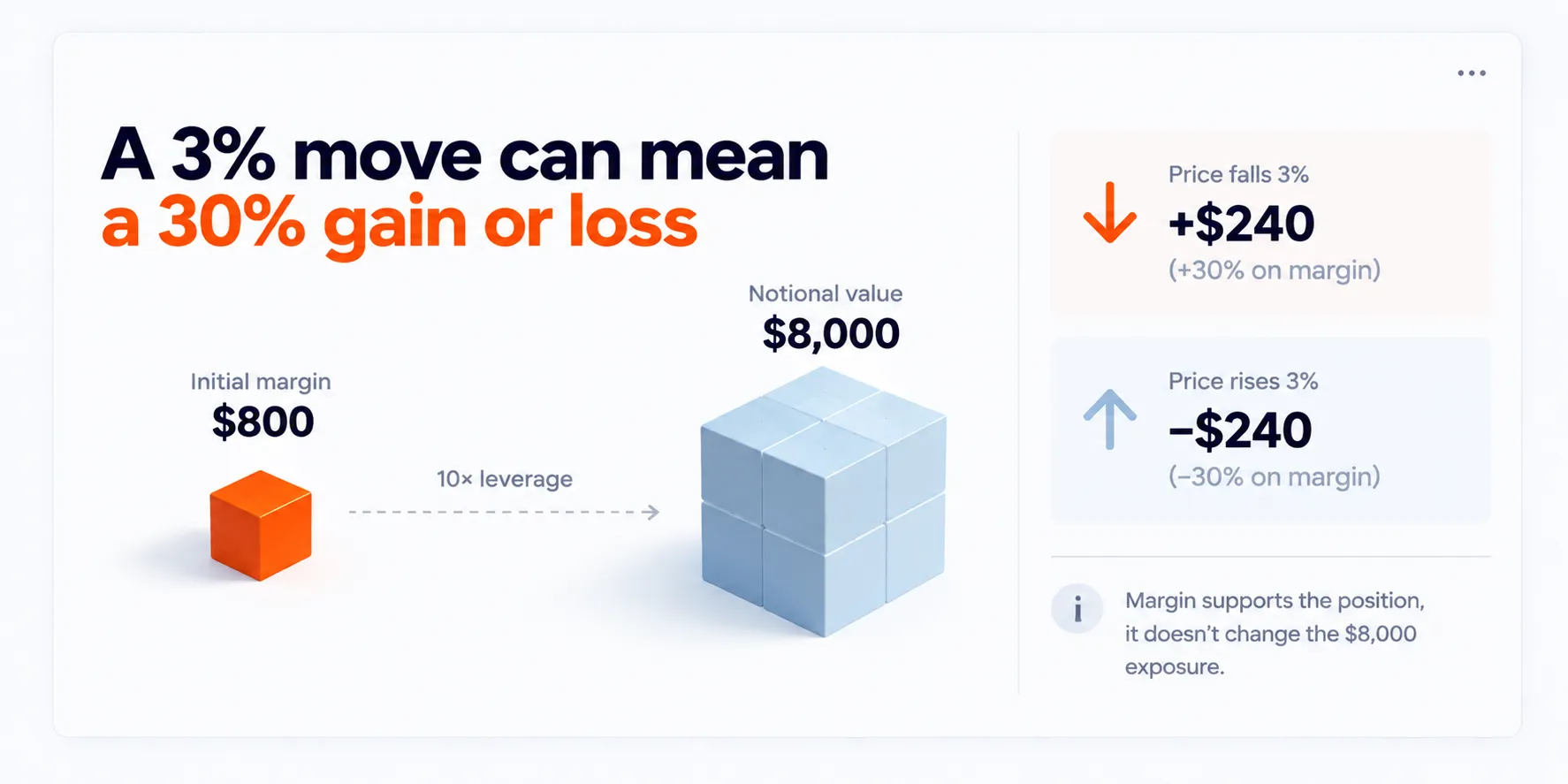
This is why leverage matters. It increases exposure, but it also leaves less room for the market to move against the position before losses consume the available margin.
Margin, leverage and liquidation
Margin is collateral, not a fee or a down payment on the underlying asset. Platforms usually distinguish between:
- Initial margin: The minimum collateral required to open a position.
- Maintenance margin: The minimum account equity required to keep it open.
If losses push the account below the maintenance requirement, the trader may need to add funds or reduce the position. The platform may also liquidate some or all of the position automatically.
Liquidation is not the same as a normal exit. It is a risk-control process designed to close exposure when the account can no longer support it. The precise trigger may depend on the platform's mark price, maintenance-margin formula, fees and available collateral.
A stop-loss order may help manage an exit, but it cannot guarantee a specific price. Fast markets, thin liquidity or a gap in price can cause an order to execute away from its trigger.
Isolated margin and cross margin
Some perpetual futures platforms offer more than one way to allocate collateral.
With isolated margin, a set amount of collateral supports one position. Losses on that position are generally contained to the margin assigned to it, subject to the platform's rules.
With cross margin, eligible collateral is shared across positions. A profitable position or unused balance may help support another trade, but one losing position can also put more of the account at risk.
These settings can materially change liquidation risk. Traders should check which mode applies before placing an order rather than assuming the platform's default.
Why perpetual futures need funding rates
A dated futures contract has an expiry and a settlement process that connects it to the underlying market. A perpetual contract has neither an expiry date nor a final settlement date, so it needs another mechanism to discourage its price from drifting too far from spot.
That mechanism is the funding rate.
Funding is a periodic payment between traders holding long and short positions. In the common model:
- When the perpetual trades above its reference spot price, the funding rate is positive and longs pay shorts.
- When it trades below the reference price, the rate is negative and shorts pay longs.
The platform normally calculates the payment from the position's notional value, not from the amount of margin deposited.
Suppose a trader holds a hypothetical $12,500 long position when a 0.01% funding charge applies. The payment would be $1.25 for that interval:
$12,500 × 0.01% = $1.25
One payment may look small, but funding can repeat while the position remains open. The rate may also change from one interval to the next. A trade that is profitable from price movement can therefore produce a smaller net gain after funding, while a trader on the receiving side may earn funding even if the position itself loses value.
Funding frequency, calculation and caps vary by venue and contract. For example, funding is commonly exchanged every eight hours in crypto perpetual markets. However, the timing, calculation method and rate caps vary by contract, platform and asset class.
Mark price can matter more than the last trade
Perpetual futures platforms often use a mark price to calculate unrealized profit and loss and assess whether a position should be liquidated. This is designed to reduce the effect of a brief or unusual trade on the platform's own order book.
The mark price may draw on an index of spot prices, the perpetual's market price and other inputs. The exact method differs by platform.
This creates an important distinction:
- The last price shows where the most recent trade took place.
- The index price estimates the underlying spot market using selected data sources.
- The mark price is the platform's reference for calculations such as profit, loss or liquidation.
A trader can therefore see a last-traded price that has not yet triggered liquidation because the mark price remains farther away. The reverse is also possible. Contract specifications should explain which price controls each calculation.
Traditional futures and perpetuals compared
Traditional futures | Perpetual futures | |
Expiry | Fixed expiry date. | No expiry date. |
Price alignment | Converges with spot price at settlement. | Uses funding payments. |
Position management | Close, settle or roll. | Hold while margin is maintained. |
The practical difference is not simply “expiry versus no expiry.” A trader holding a traditional future must manage the calendar and the price difference between contract months. A perpetual trader avoids the roll, but takes on a funding stream that can change over time.
What happens when a traditional future expires?
A dated futures position does not continue forever. Before expiry, a trader can usually:
- Close the position with an equal and opposite trade.
- Roll the exposure by closing the expiring contract and opening a later one.
- Allow the contract to settle under its stated terms.
Rolling is not a free extension. The later contract may trade at a different price, and the trader may pay trading fees or experience slippage when moving between contracts.
Settlement also varies. Some contracts settle in cash against a reference value. Others can lead to physical delivery. A trader who does not want delivery needs to understand the last trading day, notice period and broker cutoffs well before expiry.
Can you really hold a perpetual forever?
“No expiry” does not mean “guaranteed to stay open.” A perpetual position can continue only while the contract remains listed, the account meets margin requirements and the trader complies with the platform's rules.
Several things can end or materially change the position:
- Adverse price movement can trigger liquidation.
- Funding charges can reduce available collateral.
- Margin requirements can increase during volatile conditions.
- A platform may delist or settle a contract under its rules.
- Maintenance, outages or liquidity shortages can affect the ability to exit.
- Changes to eligible collateral can alter account equity.
Perpetuals remove a fixed calendar deadline. They do not remove the cost or risk of maintaining exposure.
What moves futures and perpetual futures prices?
Both products respond to the underlying market, but their prices do not have to match spot exactly.
Traditional futures can reflect interest rates, storage costs, expected dividends, supply conditions and the time remaining to expiry. Different contract months may trade at different prices, creating a futures curve.
Perpetual futures are more heavily shaped by short-term positioning. Strong demand for long exposure can push a perp above spot and lift funding rates. Heavy short positioning can pull it below spot and make funding negative.
Other factors include:
- Liquidity and the width of the bid-ask spread.
- Changes in open interest and leveraged positioning.
- Volatility around economic releases or market news.
- The construction and reliability of the reference index.
- Forced liquidations, which can add to rapid price moves.
A positive funding rate does not prove that the market will fall, just as a negative rate does not guarantee a rebound. It shows which side is paying at that point under the contract's formula.
Why traders use futures and perpetuals
Traders use derivatives for different reasons.
- Taking a directional view: Futures make it possible to take long or short exposure without owning the underlying asset.
- Hedging another position: A trader or business may use a futures position to offset part of an existing price risk. The hedge may be imperfect if the contract does not move in line with the exposure being protected.
- Using capital more efficiently: Margin can provide more market exposure than an equivalent cash position. The same feature also magnifies losses and increases liquidation risk.
- Trading relative value: More experienced traders may compare spot and derivatives prices, different expiry months or funding across venues. These strategies introduce execution, liquidity and basis risk and are not automatically low risk.
Perpetuals can be convenient for continuous exposure because there is no contract roll. Whether they are cheaper than dated futures depends on funding, fees, spreads and how long the trade remains open.
How to start trading perpetual futures with OG.com
- Create an account: Sign up and complete identity verification. Access to perpetual futures is subject to eligibility.
- Explore crypto perps: Choose an available cryptocurrency contract and review its margin requirements, fees and funding arrangements.
- Review and trade: Fund your account, choose your position size and decide whether to go long or short. A limit order lets you set the highest price you’ll pay or the lowest price you’ll accept, but execution isn’t guaranteed.
- Monitor your position: Track price movements, funding payments and your margin balance. Leverage amplifies gains and losses, and insufficient margin can lead to liquidation.
FAQs about futures and perpetual futures trading
Do perpetual futures have a closing date?
No scheduled expiry date applies to a perpetual future. The position can still close through a trader's order, liquidation, delisting or another process allowed under the contract rules.
How is a perpetual different from buying the asset?
Buying a spot normally gives the buyer ownership of the asset. A perpetual is a derivative position linked to its price. It may involve leverage, funding payments and liquidation, and it does not provide the same ownership rights.
Who receives a perpetual futures funding payment?
That depends on the rate. Under the common model, longs pay shorts when funding is positive, while shorts pay longs when it is negative. Platforms may use different formulas and intervals.
Does the margin set the most you can lose?
Not necessarily. Margin is the collateral supporting a position. Losses may exceed the initial margin in some products or market conditions, so the contract and platform risk disclosures matter.
Why can the mark price differ from the market price?
The last price comes from the most recent trade. A mark price usually uses a broader calculation intended to represent fair value and reduce the influence of short-lived price moves. Platforms may use it for profit-and-loss and liquidation calculations.
Are perpetuals cheaper than traditional futures?
Not in every case. Perpetuals avoid rollover, but funding can add an ongoing cost. Traditional futures have expiry and roll costs but do not normally use the same recurring funding-payment model. The cheaper structure depends on the contract, holding period and market conditions.
Can a futures position be closed before expiry?
Usually, yes. A trader can generally offset a dated futures position by placing an equal and opposite trade in the same contract. Execution still depends on market liquidity and the platform's rules.
Important Information: OG.com provides technology in order to onboard and trade products on OG.com’s CFTC-regulated exchange and clearinghouse: North American Derivatives Exchange, Inc., which does business under the brands OG.com Markets and OG.com Prediction Markets, as well as, through OG.com’s CFTC-registered Futures Commission Merchant (Foris DAX FCM LLC or OG.com Broker).
OG.com Markets offers both prediction market event contracts (Prediction Markets Contracts), as well as margined derivatives, including single stock futures and perpetuals (Futures) (Prediction Markets Contracts and Futures are collectively referred to as OG.com Markets Products). Prediction Markets Contract can be accessed directly on OG.com Markets or through a CFTC-registered FCM, including OG.com Broker, or an Introducing Broker (IB). Futures must be accessed through a CFTC-registered FCM, including OG Broker or an IB.
Trading OG.com Markets Products involves risk and may not be appropriate for all. By trading you risk losing your cost to enter any transaction, including fees. You should carefully consider whether trading OG.com Markets Products is appropriate for you in light of your investment experience and financial resources. Any trading decisions you make are solely your responsibility and at your own risk.