F1 Azerbaijan Grand Prix 2026 prediction: race winner odds
Kimi Antonelli arrives in Baku as the clear favorite after consecutive victories, but Azerbaijan presents a very different test for Mercedes — and one that gives Lando Norris, Max Verstappen and Ferrari genuine reasons for optimism.
Motorsports
By Chris Old
Antonelli's 2026 season is becoming increasingly difficult to contain.
The championship leader followed his recovery win at Monza with another victory at the Spanish Grand Prix, taking advantage of a Virtual Safety Car to move ahead of polesitter Norris before controlling the remainder of the race.
It was his eighth win from 14 Grands Prix and extended his F1 Drivers' Championship advantage to 81 points over George Russell.
Baku complicates the picture.
The 6.003-kilometer street circuit combines some of the slowest and narrowest corners on the calendar with a 2.2-kilometer flat-out section along the Caspian Sea.
Teams need enough downforce and mechanical grip for the old-city section without carrying so much drag that they become vulnerable on one of Formula 1's longest straights.
Small mistakes are punished immediately by the walls, while slipstream and wind can materially alter a lap.
That combination is particularly relevant after the last two races.
Mercedes dominated Monza, where Antonelli and Russell finished first and second, suggesting the W17 can operate extremely well in a low-drag environment.
Madrid was different: Norris took pole by just 0.011 seconds over Antonelli and appeared capable of winning before the timing of the Virtual Safety Car worked against McLaren.
Verstappen qualified third and finished second, while Ferrari put both cars inside the top five on the grid.
The market still puts Antonelli comfortably ahead, but Baku has enough competing demands — and enough history of disruption — to make 41% very different from certainty.
This article is for informational purposes only and should not be construed as financial or investment advice. Past performance does not guarantee future results.
F1 Azerbaijan Grand Prix 2026 weekend snapshot
Practice
- Practice 1: Thursday, September 24 — 12:30 p.m. local / 4:30 a.m. ET
- Practice 2: Thursday, September 24 — 4:00 p.m. local / 8:00 a.m. ET
- Practice 3: Friday, September 25 — 12:30 p.m. local / 4:30 a.m. ET
Race weekend
- Qualifying: Friday, September 25 — 4:00 p.m. local / 8:00 a.m. ET
- Race: Saturday, September 26 — 3:00 p.m. local / 7:00 a.m. ET
- Race distance: 51 laps / 306.049 km
Context
- Drivers' Championship leader: Kimi Antonelli — 292 points
- Teams' Championship leader: Mercedes — 503 points
- Last race winner: Kimi Antonelli — Spanish Grand Prix
- 2025 Azerbaijan Grand Prix winner: Max Verstappen
Formula 1 is operating a Thursday-to-Saturday schedule in Baku this year, with qualifying on Friday and the Grand Prix on Saturday.
Antonelli arrives 81 points clear of Russell, while Mercedes leads Ferrari by 145 points in the Teams' Championship.
Baku is one of the most unusual setup compromises on the calendar.
The first part of the lap contains repeated heavy braking zones, the middle sector threads through the exceptionally narrow old-city section, and the final sequence feeds into a prolonged full-throttle run where drag and energy deployment become critical.
That should make Thursday particularly revealing.
Mercedes has been the best all-round package of 2026, but McLaren, Ferrari and Red Bull have all demonstrated circuit-specific strengths during the European season.
Baku asks questions that do not perfectly match Madrid, Zandvoort or even Monza, so the hierarchy may depend heavily on how much straight-line speed each team is willing to trade for stability through the technical middle sector.
Who will win the 2026 F1 Azerbaijan Grand Prix?
Prediction markets for Azerbaijan Grand Prix 2026 Race Winner currently make Kimi Antonelli the favorite at 41%, with Lando Norris second at 19% and George Russell third at 13%.
- Kimi Antonelli — 41%
- Lando Norris — 19%
- George Russell — 13%
- Max Verstappen — 11%
- Lewis Hamilton — 10%
- Charles Leclerc — 6%
- Oscar Piastri — 4%
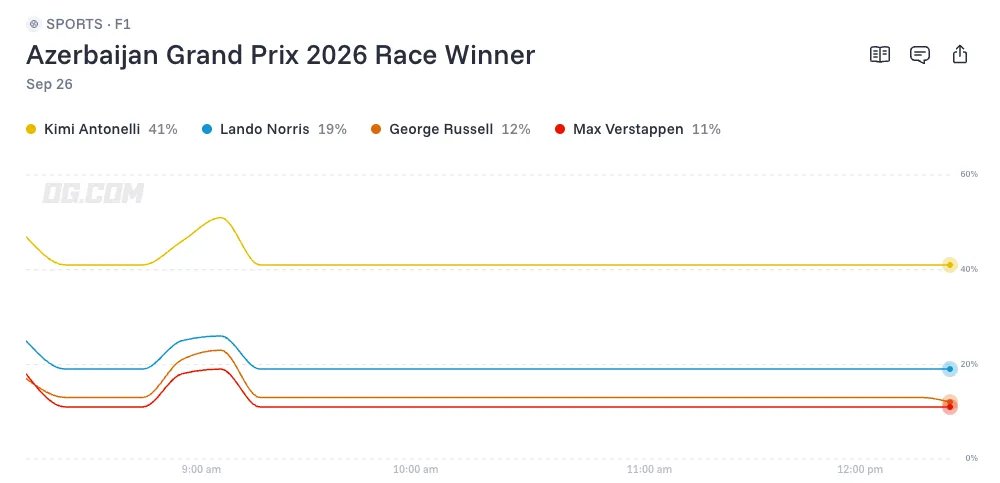
Market data as of September 22, 2026. For the latest market-implied probabilities, check the OG app.
Antonelli's position is easy to understand.
Mercedes has won 10 of the opening 14 Grands Prix, eight through Antonelli and two through Russell.
The team leads the Teams' Championship with 503 points, while Antonelli has now won at Spa, Monza and Madrid during a run that has steadily increased his championship advantage.
The more interesting number is Norris at 19%.
McLaren did not enjoy Baku's closest recent comparison. At Monza, Norris finished fourth and Piastri fifth as the team's straight-line weakness prevented it from matching Mercedes.
But that result sits between much stronger performances: Norris won Hungary and the Netherlands, then took pole in Madrid and led before the Virtual Safety Car changed the strategic order.
Baku therefore asks whether McLaren's aerodynamic strengths can compensate for the long straight more effectively than they did at Monza.
Verstappen at 11% is another interesting case. Red Bull has still not won a Grand Prix in 2026, but he finished third at Monza and second in Madrid, and he returns to a circuit where he took pole and won convincingly last season.
Ferrari is split between Hamilton at 10% and Leclerc at 6%, despite both showing considerable pace in Madrid.
Hamilton qualified fourth and believed Ferrari had a car capable of fighting for victory before brake trouble forced his retirement, while Leclerc finished fourth after leading 32 laps through an aggressive long first stint.
Before practice, Antonelli deserves to lead the market.
The gap behind him looks considerably less settled.
Who will win the 2026 F1 Drivers' Championship?\
Who has the edge in qualifying?
Baku qualifying deserves to be considered separately from the race market.
Antonelli starts with the strongest overall 2026 case, but Norris has taken pole at Hungary, Zandvoort and now Madrid, where he beat Antonelli by only 0.011 seconds. That latest lap came at another high-speed circuit lined extensively by barriers, which is useful evidence heading into Azerbaijan.
Russell cannot be ignored either. He has repeatedly been competitive with Antonelli over one lap even when the championship leader has subsequently delivered the stronger race result, and Mercedes was particularly strong at Monza.
Then there is Leclerc.
Few current drivers have a Baku qualifying record remotely comparable to his. The Ferrari driver took four consecutive Azerbaijan Grand Prix poles from 2021 through 2024, including a 2024 lap that put him more than three tenths clear of Piastri.
That streak ended last season in one of the most chaotic qualifying sessions Baku has produced.
Six red flags interrupted the session, Leclerc crashed and Verstappen eventually took pole ahead of Carlos Sainz and Liam Lawson. Antonelli still qualified fourth and Russell fifth.
Verstappen therefore has both the most recent Baku pole and improving 2026 form behind him.
Before practice, the one-lap picture looks wider than the outright market suggests.
Norris has the best recent qualifying form, Antonelli has been consistently near the front, Verstappen won pole here last year and Leclerc's historic affinity with the circuit is too strong to ignore.
The tow adds another complication.
Slipstream effects are unusually powerful along Baku's enormous flat-out section, so qualifying execution is not simply about producing the cleanest standalone lap.
Track position, timing, traffic and whether a driver catches or loses a useful tow can materially change the final order.
Who has the edge on long-run pace?
Mercedes remains the reference.
Winning 10 of 14 races across fundamentally different layouts is stronger evidence than trying to identify one circuit characteristic that should theoretically suit another team.
The W17 has been competitive on conventional tracks, high-downforce layouts and at Monza, where its low-drag efficiency helped produce a one-two finish.
Antonelli's Madrid victory needs a little more context.
Norris led the opening stint from pole and appeared to have the pace required to control the race before the Virtual Safety Car arrived immediately after he had passed the pit entrance.
Antonelli and Verstappen gained significantly through the timing of their stops, while Norris then suffered a slow pit stop and dropped further back.
That means the final Madrid classification does not prove Mercedes was comfortably faster than McLaren.
It actually strengthens Norris' case entering Baku because the McLaren has now shown front-running race pace at Hungary, Zandvoort and Madrid. The concern remains whether the prolonged straight exposes the same efficiency weakness seen at Monza.
Red Bull is becoming increasingly difficult to dismiss.
Verstappen finished only 4.351 seconds behind Antonelli in Madrid after running competitively near the front throughout the weekend, following his Monza podium two weeks earlier.
Red Bull remains winless in 2026, but its recent performances look much closer to the leading group than its early-season results did.
Ferrari also has a stronger race argument than the raw Spanish result suggests. Hamilton believed the car was capable of fighting for victory before retiring with a brake issue, while Leclerc's 32 laps in the lead demonstrated enough pace and tire control to make an unconventional strategy viable.
The long-run hierarchy before practice is therefore Mercedes first, but not Mercedes alone.
McLaren has genuine recent winning pace, Red Bull is moving closer and Ferrari remains capable of producing weekends where Hamilton or Leclerc can enter the fight.
Does Antonelli deserve to be favorite?
Yes.
But Baku makes 41% more persuasive than something significantly higher.
Antonelli has won eight of the first 14 races and leads Russell by 81 points. Mercedes has won 10 Grands Prix overall and leads the Teams' Championship by 145 points over Ferrari. Those are no longer early-season trends; they represent the strongest performance record of 2026 by a substantial margin.
His recent form strengthens the case further.
Monza required him to recover from the back of the grid after a power-unit penalty. Madrid required him to stay close enough to Norris to capitalize when the Virtual Safety Car changed the race. Neither victory followed a completely straightforward route, but Antonelli kept converting opportunities when they appeared.
Baku also holds positive memories from his rookie season. Antonelli qualified fourth and finished fourth here in 2025, so unlike Madring he arrives with real Formula 1 experience of the circuit.
The caution comes from the track itself.
Baku's long straight raises the importance of aerodynamic efficiency. The narrow middle sector creates a greater risk of qualifying disruption. Safety Cars can transform strategy, while powerful slipstream effects mean cars are less locked into their grid order than at Monaco.
Antonelli has the strongest case.
He does not have an uncontested one.
See more prediction markets
F1 Azerbaijan Grand Prix key factors
Can Antonelli keep winning even when he is not the quickest driver?
This has become one of the defining characteristics of Antonelli's season.
The last two races provide different examples.
At Monza he began 19th and still recovered to victory. Madrid was almost the opposite: he started second, stayed within range of Norris and then received a strategic opportunity when the Virtual Safety Car appeared at precisely the wrong moment for McLaren.
Neither requires pretending that Antonelli simply destroyed everybody on pure pace.
His advantage has increasingly been his ability to keep a weekend alive.
Norris probably had the stronger conventional winning position in Madrid. He took pole, led the opening stint and had built a useful margin before the VSC. Antonelli still emerged with 25 points because he remained close enough for circumstances to matter.
Baku rewards that quality.
A clean qualifying lap can suddenly disappear behind a red flag. Safety Cars can transform pit windows. A driver who starts fifth is not necessarily removed from contention because the enormous straight provides opportunities to recover.
Antonelli does not need another perfectly controlled weekend to justify 41%.
He needs to keep doing what he has done throughout 2026: remain within striking distance when the race changes shape.
Can McLaren survive Baku's straight-line demand?
This is probably the biggest technical question of the weekend.
Norris has been one of the strongest drivers in Formula 1 since the summer break. He won Hungary and the Netherlands, then took pole and led in Madrid before strategy worked against him.
The outlier was Monza.
McLaren could not match Mercedes there and Norris finished almost 20 seconds behind Antonelli. That exposed the part of the MCL40 that remains less convincing: generating enough straight-line performance when the circuit heavily rewards low drag.
Baku is not simply another Monza.
The old-city section requires considerably more downforce, traction and confidence at low speed. Drivers spend more time braking and rotating the car through 90-degree corners, while the grip level typically improves substantially through the weekend as rubber goes down.
But there is no escaping the final sector.
Once the cars exit Turn 16, they remain at full throttle for an enormous portion of the lap. A car that gives away too much speed there becomes vulnerable both on the stopwatch and in wheel-to-wheel racing.
If McLaren finds an efficient setup compromise, Norris' recent form gives him one of the strongest cases behind Antonelli.
If the Monza weakness reappears, 19% could start looking aggressive.
Can Ferrari finally convert its Baku speed into a win?
Ferrari's relationship with Baku has become strangely frustrating.
Leclerc took four successive poles between 2021 and 2024 without winning any of those races. In 2024, he again started first but Piastri ultimately passed him and won by almost 11 seconds.
The circuit clearly suits something about Leclerc's qualifying style.
He is exceptionally committed under braking, comfortable carrying speed toward walls and capable of extracting performance from the car when grip is difficult to judge. Baku has rewarded that combination repeatedly.
Ferrari now arrives with both drivers possessing stronger 2026 evidence than the 6% and 10% probabilities might initially suggest.
Hamilton is third in the championship on 191 points and already has a Grand Prix victory this season. Leclerc is fifth on 167 and won at Silverstone. Ferrari sits second in the Teams' Championship and has nine Grand Prix podiums from the first 14 races.
Madrid was another reminder that the SF-26 can operate near the front.
Hamilton started fourth and believed he had the car to challenge for victory before a brake problem ended his race. Leclerc qualified fifth and then led 32 laps through an extended first stint before eventually finishing fourth.
The missing piece has been converting competitive weekends consistently.
Baku has given Ferrari plenty of grid position in the past.
What it has not given the team recently is the winner's trophy.
Does Verstappen's 2025 Baku win translate to the 2026 Red Bull?
Historical circuit form has limits whenever the technical regulations and cars change.
The current evidence still makes Verstappen's Baku record relevant.
He did not simply win here last season. He took pole in an exceptionally disrupted session and then controlled the race to finish more than 14 seconds clear of Russell.
His 2026 form has also improved at exactly the right time.
Red Bull's season began well behind Mercedes, Ferrari and McLaren, but Verstappen has now followed his Monza podium with P2 in Madrid. During Spanish qualifying he went fastest in Q2 before ultimately taking third, and he described the car as operating in a much better window than earlier in the weekend.
Baku may amplify some of those improvements.
Braking stability matters enormously into Turns 1 and 3. Straight-line efficiency is critical. The slower middle sector asks the car to rotate cleanly without sacrificing traction, while Verstappen's confidence on corner entry can create time in exactly the places where mistakes carry the greatest cost.
The central test is whether recent progress represents genuine front-running pace or simply enough improvement to follow the leaders closely.
Eleven percent says the market believes the win is plausible.
Thursday and Friday will tell us how plausible.
How much chaos does Baku create?
Baku's reputation for unpredictability is not purely narrative.
Last year's qualifying session contained six red flags, with crashes for Alex Albon, Nico Hulkenberg, Franco Colapinto, Oliver Bearman, Leclerc and Piastri. Verstappen eventually took pole, while Sainz and Lawson emerged second and third in a grid few would have forecast beforehand.
The layout creates that volatility naturally.
Drivers repeatedly brake from very high speed toward walls and 90-degree corners. Turns 8 to 10 squeeze through one of the narrowest sections of track on the calendar, while mistakes often leave nowhere for a damaged car to escape without triggering a yellow or red flag.
Wind adds another variable.
The current forecast is for mild and dry conditions, but Baku's position beside the Caspian Sea regularly produces gusts capable of disturbing cars under braking or changing the balance through fast sections.
Then there is strategy.
Safety Cars and Virtual Safety Cars can compress gaps or create cheap pit stops, exactly as Madrid demonstrated for Antonelli. A driver who appears to have the quickest conventional race can lose control of the strategy through timing rather than pace.
That does not make Baku random.
The best cars and drivers still have the strongest chance of winning.
It does make 41% for the favorite feel more appropriate than the sort of overwhelming probability Antonelli might command at a circuit where track position and race strategy are more predictable.
Recent Azerbaijan Grand Prix winners
- 2025 — Max Verstappen, Red Bull Racing
- 2024 — Oscar Piastri, McLaren
- 2023 — Sergio Perez, Red Bull Racing
- 2022 — Max Verstappen, Red Bull Racing
- 2021 — Sergio Perez, Red Bull Racing
- 2019 — Valtteri Bottas, Mercedes
There was no Azerbaijan Grand Prix in 2020.
The recent history reinforces how open Baku can be. Verstappen and Perez are the only multiple winners at the circuit, while Piastri's 2024 victory came after passing polesitter Leclerc and then defending the lead through much of the race.
Important information
Prediction is an event contract that is a derivatives product offered by North American Derivatives Exchange, Inc. (NADEX), a CFTC-regulated exchange, which does business under the brand OG.com Prediction Markets (OG). Crypto.com | Derivatives North America uses a CFTC-regulated exchange that uses OG.com technology.
Trading on OG.com involves risk and may not be appropriate for all. By trading you risk losing your cost to enter any transaction, including fees. You should carefully consider whether trading on OG.com is appropriate for you in light of your investment experience and financial resources. Any trading decisions you make are solely your responsibility and at your own risk.