XRP price prediction: How the CLARITY Act could decide where XRP goes next
XRP spent years waiting for good news, then saw a slew of it: the SEC lawsuit is settled, spot exchange-traded funds (ETFs) are live and the token went on to hit an all-time high (ATH) in 2025.
Financials
By Nic Tse
It sits below the ATH in the 2026 bear market; the next big swing factor is the CLARITY Act, now working its way through the Senate. Here's where XRP stands, the catalysts that could move it through 2030 and how to trade your XRP opinion on OG.com.
This article is for informational purposes only and should not be construed as financial or investment advice. Past performance does not guarantee future results.
Where does XRP stand right now?
XRP coin is the native digital asset of the XRP Ledger, a public blockchain designed for fast, low-cost value transfers.
Although Ripple has developed payment solutions that use XRP and the XRP Ledger, Ripple the company and XRP the asset are legally and operationally distinct. As of mid-July 2026, XRP trades at roughly $1.10, the fifth-largest cryptocurrency by market capitalization, but down sharply from the highs it reached shortly after its 2025 legal victory.
Much of XRP's recent story has been about regulation. In August 2025, Ripple and the US Securities and Exchange Commission (SEC) ended their nearly five-year legal battle, with both sides dropping their appeals. The outcome left in place a 2023 court finding that XRP sold on public exchanges isn't a security and removed the cloud that had hung over the asset for years.
Attention has shifted to the Digital Asset Market Clarity (CLARITY) Act, which could become the most consequential piece of US crypto legislation to date.
The CLARITY Act seeks to establish a clearer regulatory framework for digital assets by distinguishing investment contract assets from digital commodities, while defining when oversight falls under the SEC or the Commodity Futures Trading Commission (CFTC).
Regulatory uncertainty has been one of XRP’s largest triggers behind its price over the past several years. A clearer legal framework could make it easier for exchanges, financial institutions and asset managers to support XRP without the longstanding ambiguity.
As of July 2026, the bill has passed the House of Representatives and is awaiting Senate consideration. US President Donald Trump has publicly urged lawmakers to deliver the legislation before Congress begins its August recess.
Although passage doesn’t guarantee higher XRP prices, many market participants believe it could improve institutional confidence and remove one of the final regulatory hurdles.
XRP's price history: Key moments
XRP's price history has its own turning points, layered on top of the broader ups and downs of the crypto market. Chief among them: a lawsuit that cast a long shadow over the asset, and a resolution years later that lifted it.
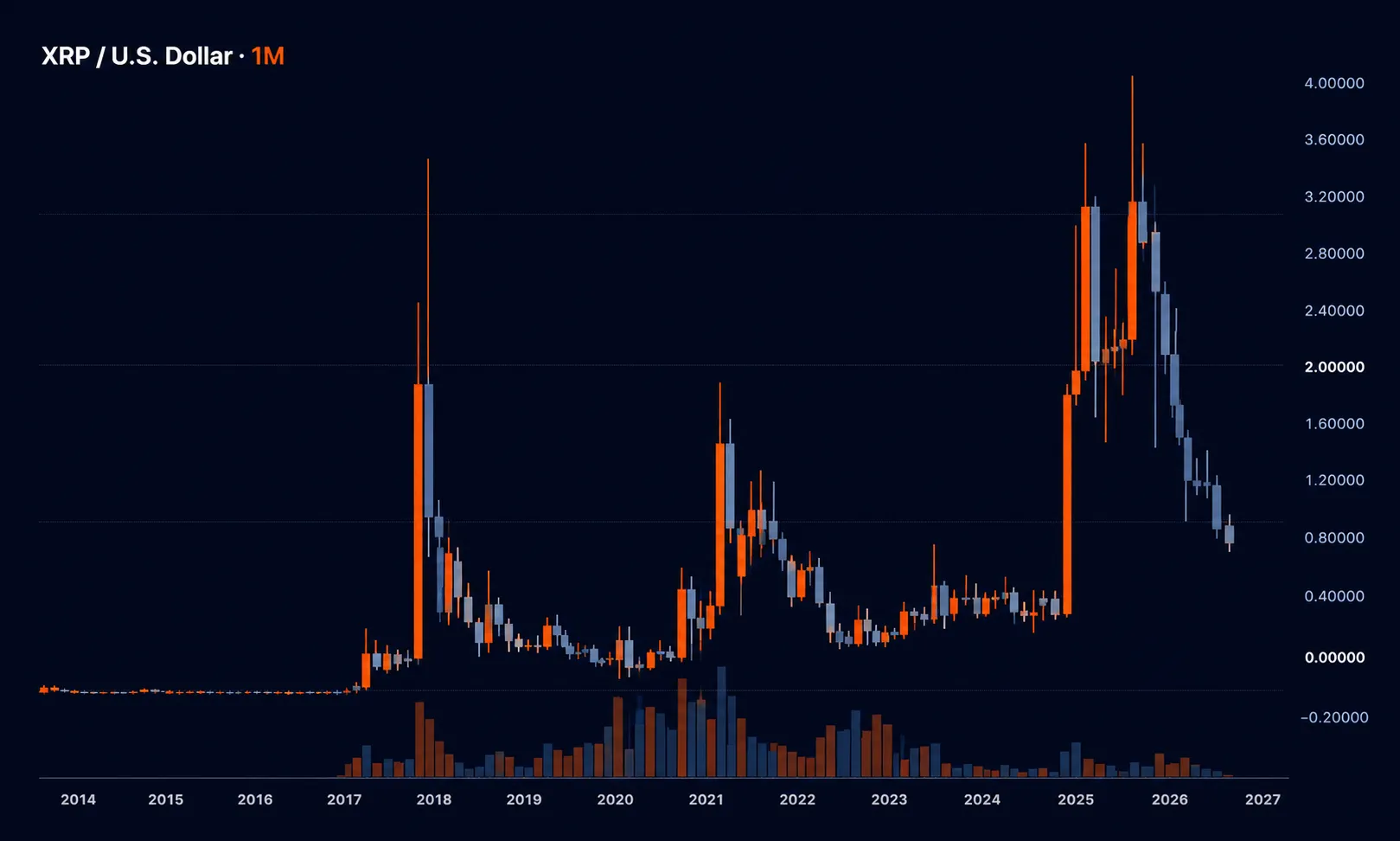
2017: XRP rocketed from under a cent at the start of the year to nearly $3 by year-end, before the January 2018 blow-off top.
January 2018: XRP hit its all-time high of about $3.84 at the top of the market-wide crypto mania. It's a level XRP still hasn't reclaimed.
December 2020: The US Securities and Exchange Commission filed a lawsuit against Ripple Labs alleging unregistered offers and sales of XRP. It led to prolonged uncertainty.
July 2023: A US federal court ruled that certain XRP sales made directly on public exchanges didn't meet the legal test applied in that case for an investment contract. The ruling was limited in scope to programmatic exchange sales.
2025: Ripple and the SEC dropped their appeals in August 2025, ending the case for good. XRP soared to around $3.65 by mid-2025 — its highest level since the 2018 peak — though it couldn't hold those gains.
November 2025: The first US spot XRP ETFs began trading, starting with Canary Capital's fund on Nasdaq, followed within weeks by products from Bitwise, 21Shares and others. XRP traded in the mid-$2 range around the launches.
Early–mid 2026: Despite the legal clarity and live ETFs, XRP slid alongside a broad crypto sell-off, touching a 15-month low near $1.16 in February before drifting to around $1.10 by mid-year, a reminder that good news doesn't always translate into a higher price.
Cryptocurrency prices, including XRP, have historically shown high volatility. Past price performance of XRP doesn't guarantee future price outcomes.
XRP all-time history chart, as of August 2026.
How to trade XRP on prediction markets
Once you've formed a view on where these catalysts might lead, a prediction market gives you a different way to act on it.
Instead of buying and holding XRP, you trade an event contract: a financial instrument whose payout depends on whether XRP's price crosses a defined level by a set date.
Each contract has a fixed expiration, a settlement price from a specified reference source and a maximum gain or loss set by its terms before you trade. You're never holding or custodying XRP itself. In the US, this type of contract falls under Commodity Futures Trading Commission (CFTC) oversight.
OG.com, Crypto.com's prediction markets platform, lets you trade XRP event contracts built around defined price thresholds and dates. Here's how to get started:
Create an account: Sign up on the OG.com web or mobile app and complete identity verification, as required for a CFTC-regulated platform.
Compare and trade: Weigh the contract's price against your own view, check the rules, fees and settlement details, then confirm your trade.
Track your position: Your contract appears under open positions, where you can follow it through to settlement.
As with any financial instrument, trading event contracts risks the capital you put in and the regulatory treatment of prediction markets can vary by jurisdiction and change over time.
Here are some of the most significant ones to take note of.
Regulatory clarity
The CLARITY Act remains one of the biggest variables for XRP.
Rather than regulating most digital assets under a single framework, the legislation proposes clearer distinctions between securities and digital commodities, while defining which regulator oversees different parts of the market.
XRP’s price has historically been sensitive to changes in regulatory expectations. Passage of the legislation may encourage higher levels of institutional participation by reducing legal uncertainty around secondary-market trading.
Conversely, delays or substantial amendments may prolong the cautious approach some market participants have taken toward XRP.
ETF inflows
Spot XRP ETFs are no longer hypothetical. The first US spot XRP ETF, from Canary Capital, began trading on Nasdaq in November 2025 and by early 2026, several more had launched from issuers including Bitwise and 21Shares.
A spot ETF lets investors gain price exposure to XRP through a regulated fund, without holding or custodying the token themselves.
With approval settled, the question now is more about flows. XRP funds gathered more than $1 billion in assets within their first months — among the fastest crypto ETF launches after Bitcoin — but inflows cooled through early 2026.
Sustained buying could tighten available supply and support the price; persistent outflows would do the opposite. Watching whether institutions, rather than mostly retail, drive those flows is one of the clearer signals of where demand is heading.
On-Demand Liquidity adoption
Cross-border payments are one area where XRP's real-world use case gets tested. On-Demand Liquidity (ODL) is a Ripple product that can use XRP as a bridge asset in these transactions. Wider adoption of ODL by financial institutions could increase real-world demand for XRP as a settlement tool.
Escrow supply dynamics
Ripple holds a large share of XRP's fixed 100 billion supply in on-chain escrow — roughly 38 billion tokens as of mid-2026 — and releases up to 1 billion on the first of each month.
Because the schedule is public and mostly re-locked, these releases rarely move the price on their own, but they keep supply growth less open-ended.
Fed policy and macro conditions
Federal Reserve interest rate decisions can have outsized influence on investor risk appetite, including for higher-volatility assets such as cryptocurrencies.
A looser monetary policy may support risk appetite and vice versa. As the adage ‘buy the rumor, sell the news’ goes, expectations preceding rate decisions may cause volatility more than the event itself.
RLUSD stablecoin growth
Ripple's ecosystem extends beyond XRP itself. RLUSD is a US-dollar-denominated stablecoin issued by Ripple that operates under a limited-purpose trust charter issued by the New York State Department of Financial Services. Growth in RLUSD adoption could expand that ecosystem and potentially increase utility-driven demand for XRP.
Mainstream ecosystem adoption
One recent example is Rakuten Wallet, the cryptocurrency arm of Japanese e-commerce giant Rakuten, which continues to support XRP trading within one of the world's most active digital asset markets.
Coupled with Ripple's longstanding partnerships across Japan through SBI Holdings and other regional financial institutions, these developments improve XRP's standing in cross-border payments and digital finance.
While individual partnerships don't determine price on their own, sustained ecosystem growth may strengthen long-term demand for XRP and improve investor confidence.
XRP price predictions
Published XRP forecasts vary widely as they rest on different assumptions about regulation, ETF flows, adoption and the macro backdrop.
The table below frames three near-term scenarios around the technical levels traders watch. With XRP hovering above a dollar as of mid-2026, these are reference zones, not predictions.
Scenario
What happens
Technical price zone*
Bullish
CLARITY Act passes smoothly, ETF inflows accelerate (especially from institutions) and real-world adoption picks up.
It may move toward the 2025 high near $3.65 with time, then challenge the 2018 all-time high around $3.84.
Above that, $5 is the next psychological level and new record territory.
Base case
Regulatory progress continues, but new ETF approvals or adoption take longer than expected.
$1.50 to $2.80. This is a recovery off current levels, roughly the zone Standard Chartered projects as a credible 2026 base case.
Bearish
Legislative momentum stalls, muted ETF flows, or macro conditions deteriorate.
$0.80 to $1.20. A break below the $1 support opens the door toward the next major level near $0.80.
*These price zones are illustrative technical reference levels based on commonly watched areas of historical support, resistance, and market psychology. They are not forecasts or guarantees of future performance.
Longer view: Possible XRP scenarios from 2026 to 2030
2026: A bottoming year
Most analysts treat 2026 as consolidation rather than launch. The catalysts XRP holders waited years for — legal clarity, ETFs — are already here; yet, the price has drifted, so the market is waiting for proof that flows follow.
Standard Chartered has put $2.80 as the ceiling of a base case rather than its floor. More cautious models see XRP ending the year closer to $1.40 to $1.80 and outright bears below $1.
2027 to 2028: Utility test
If ETF inflows scale up (particularly from institutions rather than retail) and the CLARITY Act is law, published targets for this window widen into the mid-single digits and beyond: Standard Chartered maps roughly $7 for 2027 and $12.60 for 2028.
If adoption stalls, more conservative analysts keep XRP range-bound in the low single digits and a few see it slipping back under $1.
2029 to 2030: Infrastructure or afterthought
In the bull case, XRP would have become a working settlement asset with deep institutional flows; Standard Chartered's cited $28 target for 2030 sits at the extremely optimistic end; it would imply a market cap rivaling the largest crypto assets.
Mainstream long-range panels cluster more modestly in the $10 to $28 band for the bull scenario and low single digits for the base case. The bear case is equally plausible on paper: Nasdaq argues XRP could drift back to $0.50 to $1.00 if banks adopt Ripple's rails without ever holding the token.
Across all three horizons, the same short list of catalysts keeps recurring: whether the CLARITY Act passes, ETF flows turn structural, real payment volume routes through XRP and where the Fed stands.
FAQs about XRP price prediction
What is XRP and how does it work?
XRP is a digital asset that operates on the XRP Ledger, a public blockchain network. Validators confirm transactions through a voting-based consensus process rather than mining, and transactions typically settle within a few seconds. Ripple, a US-based payments technology company, has developed products using the XRP Ledger and XRP.
Can XRP reach $5 in 2026?
It would be a highly ambitious move. With XRP near $1.10 in mid-2026, $5 is more than four times the current price and above its all-time high of about $3.84. Most published 2026 forecasts sit well below that; even $5 within 2026 would need several serious catalysts to line up at once.
Can XRP reach $10?
$10 shows up in some long-range forecasts, but usually as a 2028 to 2030 scenario rather than a near-term one. At $10, XRP's market cap would rival Ethereum's past peaks, so getting there would take regulatory clarity, institutional ETF money flowing in at scale and XRP proving genuine settlement utility. Some analysts see paths to $10 and beyond by 2030; others argue the token never captures that value. Crypto is highly volatile, and past performance doesn't guarantee future outcomes.
What will XRP be worth in 2030?
Nobody knows. The published 2030 estimates span a huge range, from roughly $0.50 at the bearish end to $28 at the most bullish, with many mainstream panels clustering in the low-to-mid single digits. That spread reflects one unresolved question: whether XRP the token captures the payment volume moving through Ripple's network, or whether banks use the rails without ever holding it. How regulation, adoption and the macro backdrop evolve will matter more than any single number quoted today.
What factors affect the XRP price?
Regulatory developments like the CLARITY Act, flows into spot XRP ETFs, adoption of On-Demand Liquidity, the escrow release schedule, Federal Reserve policy and growth of the RLUSD stablecoin are all likely factors. Macro conditions like interest rates, risk appetite and the overall crypto cycle are also part of the mix.
How do XRP ETFs affect the price?
Spot XRP ETFs have traded in the US since November 2025, letting investors get XRP exposure through a regulated fund rather than holding the token directly. Their impact on price depends on flows: sustained net inflows can add demand and tighten available supply, while outflows can weigh on it.
What is the CLARITY Act, and why does it matter for XRP?
CLARITY Act is US federal legislation meant to draw a clearer line between digital commodities and securities, and to spell out when the SEC or the CFTC has oversight. It passed the House and, as of July 2026, awaits a Senate vote. For XRP, clearer rules could reduce the legal uncertainty that has shadowed the asset and make it easier for institutions to engage with it.
How can I trade XRP prediction markets?
On OG.com, you can create an account, browse available crypto contracts, review the rules and settlement details and trade a contract based on your view of XRP price outcomes, without purchasing XRP directly.
Is it possible to predict XRP's price accurately?
No method can predict any cryptocurrency's price with certainty. Catalysts and trends can inform a directional view, but published forecasts still range widely and shouldn't be read as guarantees.
What are the risks of trading XRP prediction markets?
Trading event contracts carries the risk of loss of the capital used to take a position. Cryptocurrency prices have historically shown high volatility and regulatory treatment of event contracts can vary by jurisdiction and may change over time. Traders should carefully consider whether trading is appropriate given their experience and financial resources.
Important Information: Prediction is an event contract that is a derivatives product offered by North American Derivatives Exchange, Inc. (NADEX), a CFTC-regulated exchange, which does business under the brand OG.com Prediction Markets (OG) Crypto.com | Derivatives North America and uses a CFTC-regulated exchange that uses OG.com technology.
Trading on OG.com involves risk and may not be appropriate for all. By trading you risk losing your cost to enter any transaction, including fees. You should carefully consider whether trading on OG.com is appropriate for you in light of your investment experience and financial resources. Any trading decisions you make are solely your responsibility and at your own risk.