What moves NBA prediction markets during a season?
Learn what moves NBA prediction market prices during a season, from injuries and roster changes to team form, schedule strength, standings, and playoffs.
Learn
By Sam Bloomquist

Basketball seasons are long. You can’t put too much stock in any individual game. With 82 games on the schedule in pro basketball and 32 in college, a team can look good one night and not have it the next.
However, there are plenty of things that can move NBA prediction markets throughout the basketball season. Obviously if a team is playing well you’ll see the market move in their favor and vice versa. But, what other elements can cause the market to shift?
This article is for informational purposes only and should not be construed as financial or investment advice. Past performance does not guarantee future results.
What is an NBA prediction market?
Basketball prediction markets can be assigned to a specific game or season-long results. For a specific game, you’ll be able to take positions on the point spread, the total points scored and individual player performances.
Season-long positions are like prediction markets for NBA team performance. There’s contracts available for number of wins, making the playoffs, winning the championship or their respective divisions. Season markets will move slower than singular game markets because they’re dictated by a team’s entire body of work instead of individual matchups.
Season-long event contracts are also more susceptible to situations like trades, injuries, and players improving over the course of the season. A team’s rating will change based on how many of these situations they have to endure, and traders can take advantage of the market if their ratings differ from what’s being traded in the market at any given time.
Event contracts prices reflect the market's sentiment and implied probability of that event occurring. They settle at either $0 or $1 – depending on the outcome.
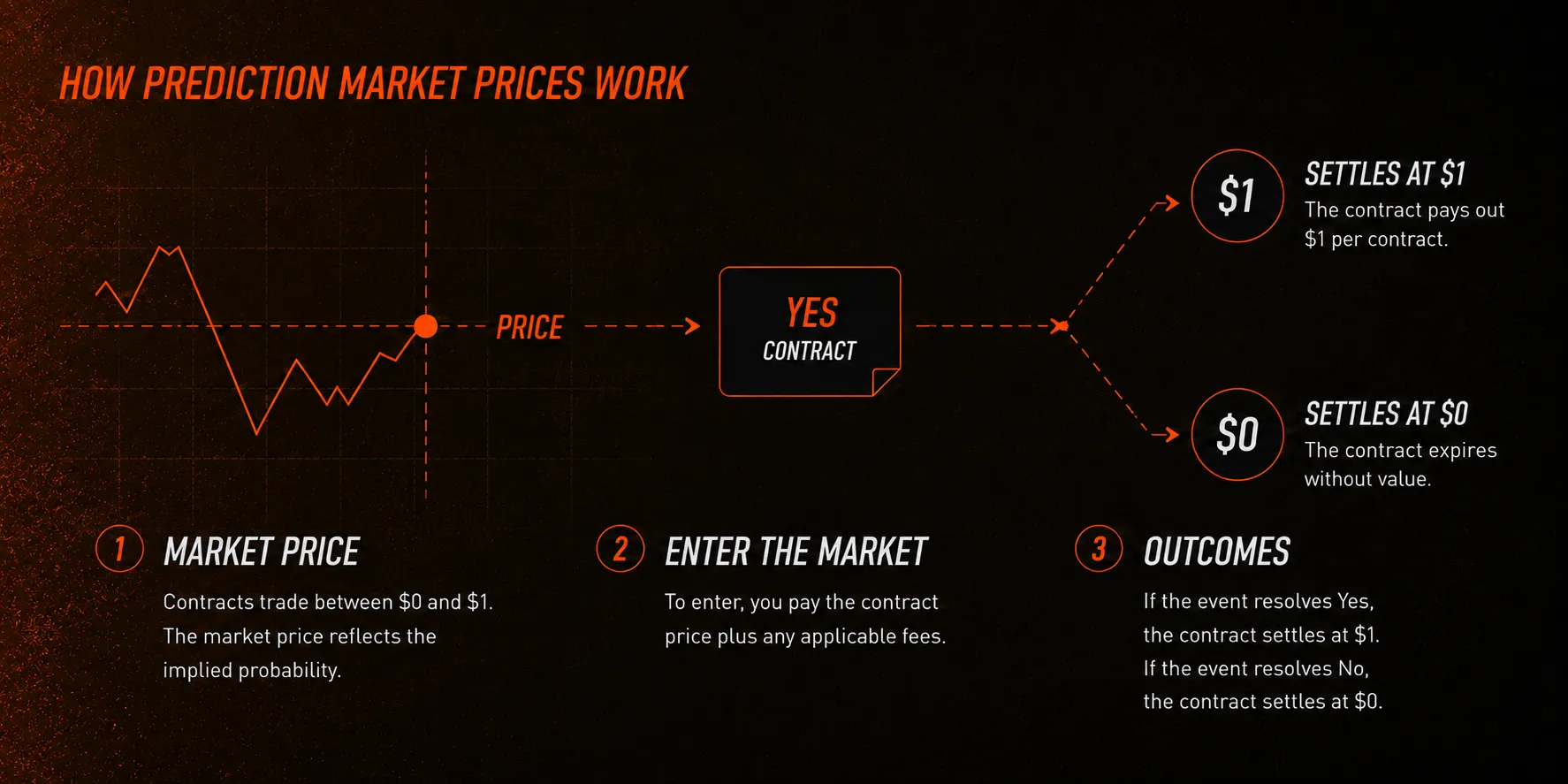
What moves basketball prediction market prices?
- Injuries and player availability.
- Winning and losing streaks.
- Trades and roster changes.
- Starting lineup and rotation changes.
- Strength of schedule.
- Standings and seeding.
- Playoff qualification and the likely postseason path.
Each of these factors carry their own weight throughout the basketball season. It’s your job as the trader to decide how much they should be factored into your position.
Not all teams will suffer an injury to their star player and not all teams will make a ground-breaking trade before the basketball trade deadline. Following along with news and staying close to whatever team you take a position on will help you make decisions throughout the season.
How do injuries affect basketball prediction markets?
Nobody likes injuries. In a perfect world they wouldn’t be a part of any sport. But, if you ask these players to perform at the top of their game night in and night out, sometimes their bodies will give out.
Basketball injuries are never black and white. Some issues can keep a player out of one game, others will hold them out for a long time. Injuries can also seem resolved and then crop up once the player returns to action. It’s all about monitoring the specific issue, what parts of the player’s game will be affected by the injury, and how to trade based on that information. A hamstring can keep a player out of a game short term, but then get easily reinjured once they return to the court. A wrist injury could allow them to play but affect how many shots they take during the game. There’s no one size fits all approach to injuries.
Injuries also challenge a team’s depth. If a team consists of a handful of star players and a subpar cast of backups, you’ll see that team suffer more when one of their star players get hurt. If a team with a lot of depth takes a hit, they may not skip a beat if one player goes down.
Bringing it back to prediction markets, all of these circumstances are up to you to decide how it will impact the game or season. Doing your research on team identities and roster construction will help you understand who withstand a couple injuries and who can’t. Also, keep a close eye on basketball injury reports. It will help you decide if the prices in the market have adjusted enough or if they have more room to move, thus allowing you to make an advantageous decision.
Why do winning and losing streaks move prices?
We can think we know a team before the season, but nothing can top seeing what happens when these players take the court. A team with low expectations can overperform and a team coming off a championship could fall on its face. It’s impossible to know everything these teams and players are dealing with every night, and that could impact them on the court.
In the NBA, strength of schedule dictates a lot of winning and losing streaks.If a team with a lot of new players, whether from a trade or the draft, starts gelling together, they could outperform their preseason expectations. If they continue to win games throughout the season, you’ll see traders reevaluate their ratings on that team and move its prices in the market. The same goes for a highly thought of team that underperforms its preseason expectations.
Not every streak is created equally. Sometimes they can be the result of playing a soft schedule. Maybe they’re playing against a collection of contenders to start the year and will bounce back against lesser competition. Much like injuries, it’s your responsibility as the trader to assign context to the game results.
How to trade NBA prediction markets with OG.com
With OG.com, you can trade event contracts on real-world outcomes across different market categories.
- Create an account: Open an account and complete sign-up, including identity verification. You can use our web or mobile platforms.
- Browse markets: Explore markets across sports, including college NBA.
- Review and trade: Compare the market price with your own view. Check the rules, fees, and settlement details before opening a position.
- Monitor your position: After trading, your contract appears in your open positions, where you can track price movement as new information comes in.
Start predicting: https://og.com/auth
FAQs about NBA prediction markets
How do NBA prediction markets work?
NBA prediction markets allow you to trade on individual games or season-long results for basketball teams. You can take a point spread, total points scored, individual player statistics, teams to make the playoffs, win a championship, and a multitude of other positions.
How do injuries affect NBA prediction market prices?
Injuries can change how a team is rated on any particular night or change how they’re rated long-term.
How does strength of schedule affect NBA markets?
Harder games are tougher to win. It can lower a team’s rating when they play a tough stretch, or if the team wins a lot of games against tough opponents, their rating could increase.
How do trades affect NBA prediction markets?
The prices in the market are based on the opinions and positions of the traders taking positions in that market.
How can standings affect NBA prediction market prices?
Basketball standings can shape how traders view a team and influence their opinions in the market.
What can cause an NBA prediction market price to change during a season?
Injuries, trades, win streaks, losing streaks, and players’ form can alter market prices throughout the season.
Important Information: Prediction is an event contract that is a derivatives product offered by North American Derivatives Exchange, Inc. (NADEX), a CFTC-regulated exchange, which does business under the brand OG.com Prediction Markets (OG) Crypto.com | Derivatives North America and uses a CFTC-regulated exchange that uses OG.com technology.
Trading on OG.com involves risk and may not be appropriate for all. By trading you risk losing your cost to enter any transaction, including fees. You should carefully consider whether trading on OG.com is appropriate for you in light of your investment experience and financial resources. Any trading decisions you make are solely your responsibility and at your own risk.