VAR in soccer explained: how VAR affects prediction markets
VAR can switch the momentum of a game suddenly and sway match outcomes. Here we take a look how it shapes soccer prediction markets.
Soccer
By Sam Bloomquist
Video Assisted Referee (VAR) is used to review goals, penalty decisions, red cards, and cases of mistaken identity (allows officials to correct disciplinary decisions when video review shows the wrong player was penalized).
If you're trading the Soccer Championship 2026 this month, it's worth understanding how VAR is used, as key decisions can quickly change both the outcome of a match and prices in prediction markets.
This article is for informational purposes only and should not be construed as financial or investment advice. Past performance does not guarantee future results.
What is VAR in soccer?
VAR is a video review system that helps referees correct clear and obvious errors in key moments, including goals, penalty decisions, red cards, and cases of mistaken identity.
VAR began as a project in Dutch soccer around 2010. After live trials in 2016, it was approved by the International Football Association Board (IFAB) later that year and made its debut at a major international tournament during the 2017 Confederations tournament.
How does VAR work during a match?
There is usually a separate video referee team watching multiple camera angles from a review room, and they can alert the on-field referee if something needs another look.
The final decision still belongs to the referee on the pitch, who may also go to the screen at the sideline to review the incident personally. That being said, VAR can be influential: they choose what is a clear and obvious error and most of the time the review is stuck with.
When VAR can move live soccer prediction markets
There are four main areas where VAR can significantly switch the momentum of a game, and therefore influence the soccer prediction markets.
Whenever someone scores a goal, they rely on the VAR system to check on the scoring play and make sure every part of the play was legal. If there are any penalties or foul play, the VAR judge can elect to take the goal away. Many times, this will happen if a player is during an offside.
For example, in the Colombia vs Croatia Group Stage match, Colombia scored in the first minute of extra time to take a 1-0 lead over Portugal. After a VAR review, the goal was taken off the board because a small portion of a Colombian player's foot was deemed offside and the match resulted in a draw.
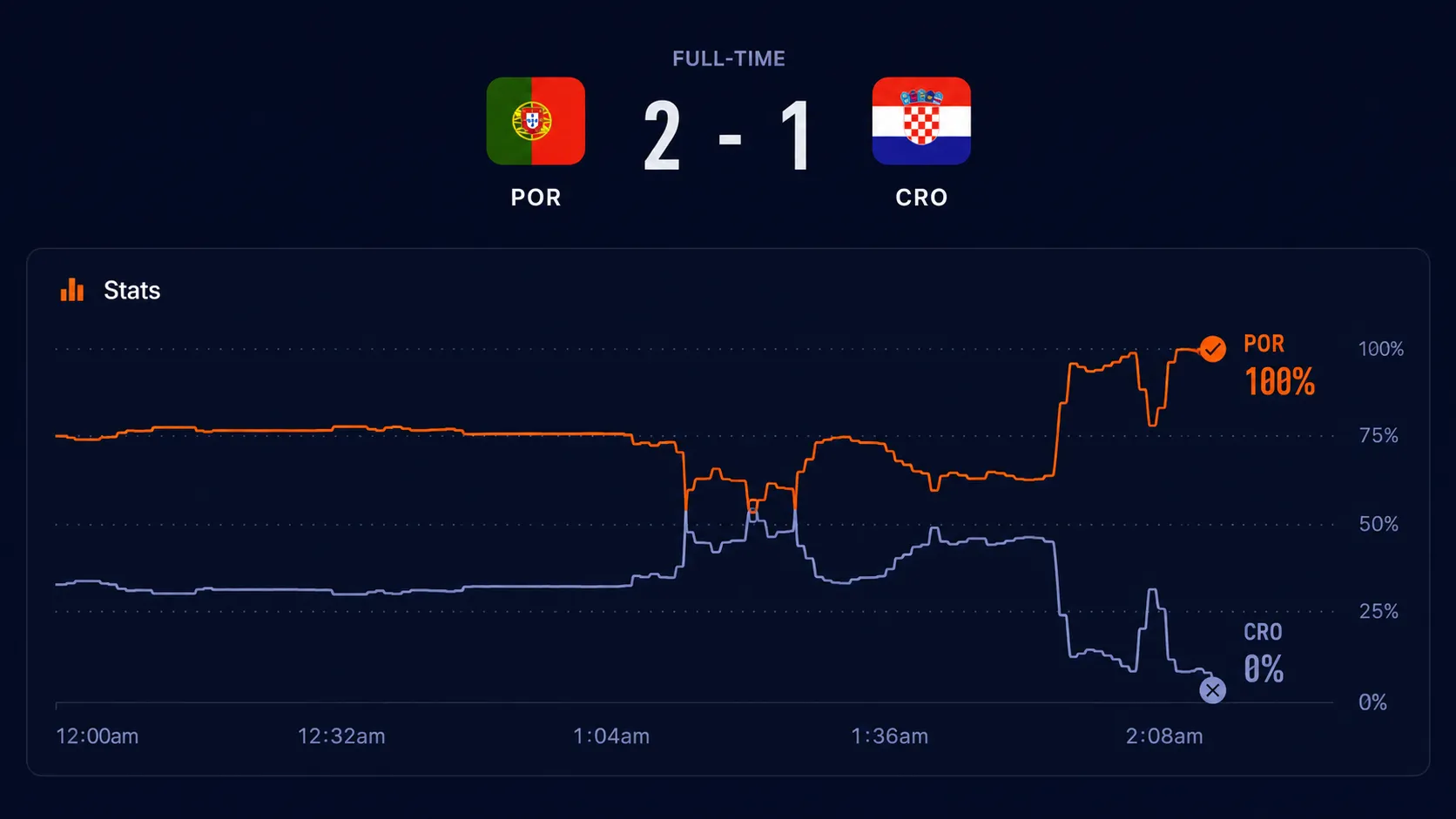
Another example came in Portugal's 2–1 knockout win over Croatia. Croatia appeared to score a stoppage-time equalizer, but after a VAR review, the goal was ruled out for offside in the build-up. Instead of the match going to extra time or penalties, Portugal held on to advance.
The chart shows how this VAR decision moved the market. Around the 103rd minute, Croatia appeared to equalize, causing Croatia's implied probability to jump and Portugal's to fall. Once VAR ruled the goal out for offside, those moves quickly reversed.
Missed penalties
VAR can also swap the odds in the soccer prediction markets on penalty decisions.
Most penalty calls are clear and do not need VAR. Reviews can slow the game down, so VAR is usually used when a decision is unclear, high-impact, or when the referee may have missed something important.
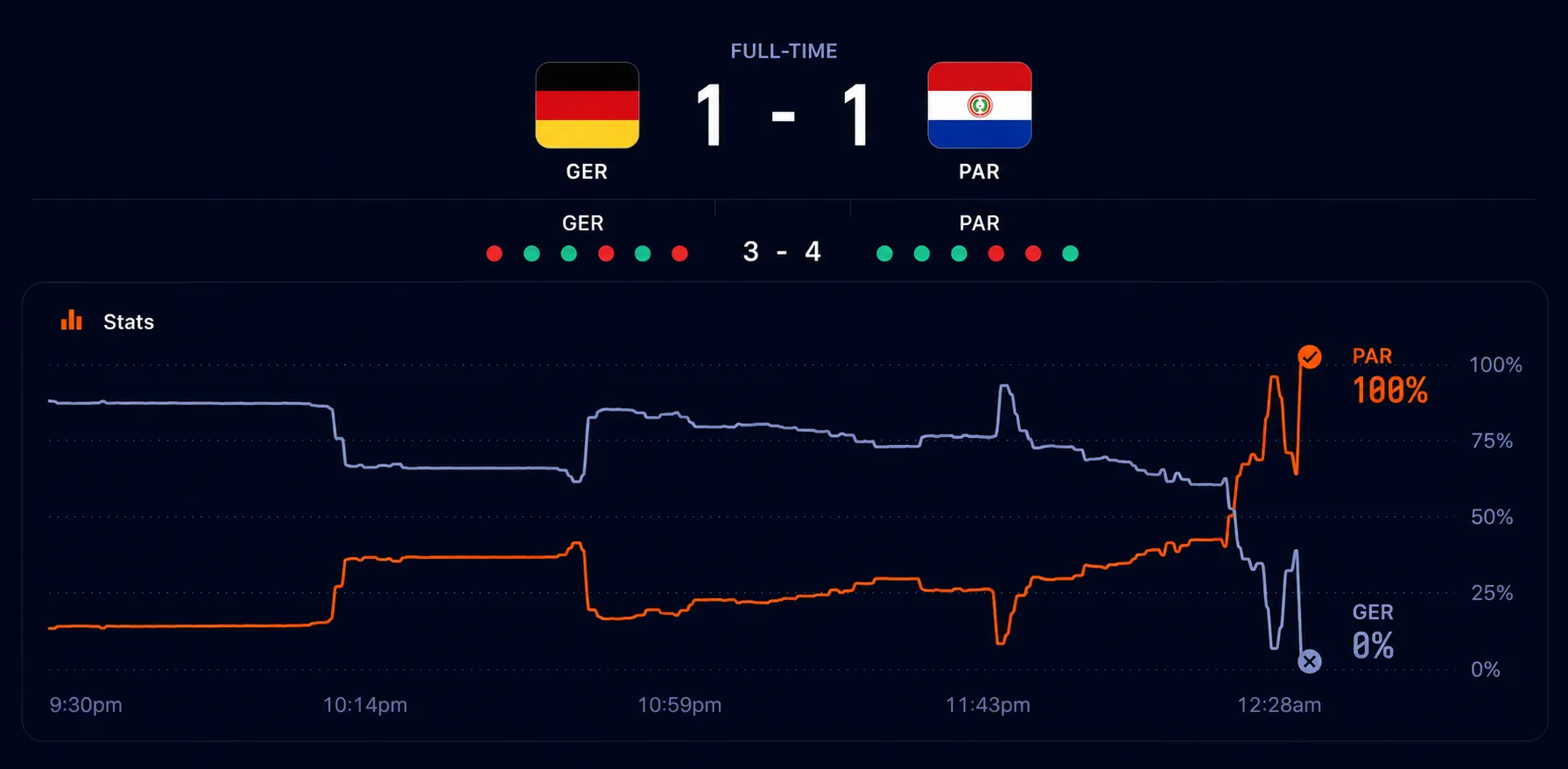
An example of this happened in the Germany vs. Paraguay Round of 32 game when Germany scored a goal and it was taken to review.
The goal appeared to be clean and all players were onside, but after review it appeared a German player impeded the Paraguay goalkeeper and was assessed a penalty. Paraguay was given new life from the call and eventually knocked Germany out of the tournament in a penalty kick shootout.
The chart shows Paraguay’s and Germany’s implied probabilities reversing suddenly to favour Paraguay, followed by a period of heavy movement as the market reacted to the decision.
Red cards
A red card can completely change a match, so VAR is used to check whether an incident meets the criteria for a sending-off. If a player is shown a red card, they are sent off and their team must play with one fewer player for the rest of the game.
Red cards are typically given for serious foul play, violent conduct, or deliberately denying an obvious goalscoring opportunity. Players sent off are also usually suspended for the next match, making these decisions especially important.
A new rule that was instituted for this year’s Soccer Championship where a player can receive a red card for covering their mouth. This is to cut down on any abusive language.
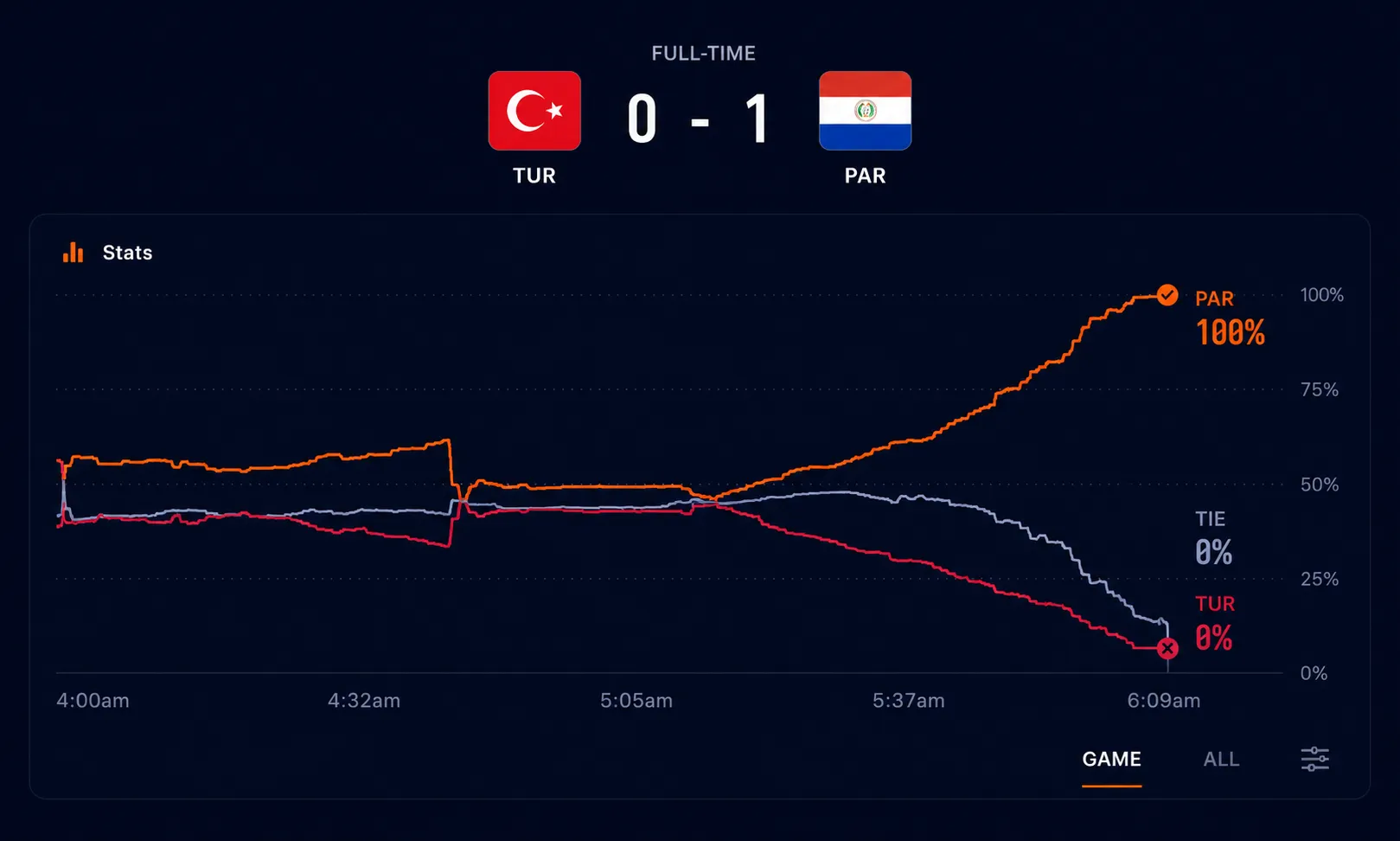
The first player to receive a red card for covering their mouth was during the Paraguay vs Turkey group stage match. Just before halftime, Paraguay’s player covered his mouth while speaking during an altercation and was issued a red card. The judge used VAR to review the conduct.
Paraguay quickly became underdogs despite having a 1-0 lead, because they would be playing 10 vs 11 for the rest of the match. The market initially swung in Turkey's favor before shifting back toward Paraguay as time ran out for Turkey to find an equalizer.
Mistaken identity
VAR can also be used for mistaken identity. This happens when a referee gives a card to the wrong player, and VAR helps make sure the punishment goes to the correct person.
The reason accuracy matters is that the wrong player could be booked or sent off, which would unfairly affect the match. If a foul leads to a penalty, that penalty is awarded to the team that was fouled, and it gives them a major scoring chance.
One example came in the USA vs Paraguay group match, when the referee initially issued a yellow card to a USA player. After a VAR review, the decision was reversed and the yellow card was instead given to a Paraguay player.
These decisions matter because a player who receives two yellow cards in the same stage of the tournament is suspended for one match. Yellow card totals are reset after the group stage and again after the quarterfinals.
Other situations when VAR is used
VAR can now also be used in some situations involving wrongly awarded corners, but only in a limited way.
If a referee gives a corner kick when the correct restart should have been a goal kick, VAR may step in to correct the error, but the review has to happen immediately and cannot hold up the restart of play.
VAR can also intervene when the attacking team commits a clear foul just before the ball is put back into play from a corner or free kick, but only if that offence has a direct effect on a goal, a penalty decision, or a disciplinary action.
This is designed to stop an attacking team from benefiting from a clear infringement at a set piece, while still keeping the focus on major, game-changing errors rather than routine contact or minor incidents.
How to trade soccer prediction markets on OG.com
With OG.com, you can trade event contracts on real-world outcomes across different market categories.
Create an account: Open an account and complete sign-up, including identity verification. You can use our web or mobile platforms.
Browse soccer markets: Explore event contracts for the upcoming soccer matches.
Review and trade: Compare the market price with your own view. Check the rules, fees, and settlement details before opening a position.
Monitor your position: After trading, your contract appears in your open positions, where you can track price movement as new information comes in.
Video Assistant Referee (VAR) is a video review system that helps referees correct clear and obvious mistakes during a match. It is mainly used for goals, penalty decisions, red cards, and cases of mistaken identity.
What does VAR mean in soccer?
VAR stands for Video Assistant Referee. It refers to the video officials who review key incidents and alert the on-field referee if a decision may need another look.
How does VAR work in soccer?
A team of video officials watches the match from a review room using multiple camera angles. If they spot a possible clear error, they alert the referee, who makes the final decision and may review the incident on the pitch-side monitor.
What makes VAR decisions so tricky in soccer?
VAR decisions often come down to tiny details, such as whether a player was offside by a few inches or whether there was enough contact for a penalty. Even with video replays, some calls still depend on the referee's interpretation, which is why they can remain controversial.
What decisions can VAR review?
VAR reviews four main types of decisions: goals, penalty decisions, direct red cards, and mistaken identity when the wrong player is penalized. It is only used for incidents that could have a major impact on the match.
Why do soccer odds change during VAR?
A VAR review can change important decisions, such as awarding or cancelling a goal or penalty. Because these decisions can affect the likely outcome of the match, prediction market prices often move while the review is taking place.
How can VAR affect prediction markets?
VAR can cause prices to move quickly by changing key moments in a match. Goals, penalties, red cards, or other major decisions can all shift the market's view of each team's chances.
Can a VAR decision change a live match market?
Yes. A VAR decision can quickly change live prediction market prices if it alters the expected outcome of the match, such as overturning a goal or awarding a red card.
Why do prices move before the VAR decision is confirmed?
Markets react as traders assess what they think the referee is likely to decide. As new information becomes available during the review, prices can be volatile until the final decision is announced.
Important Information: Prediction is an event contract that is a derivatives product offered by North American Derivatives Exchange, Inc. (NADEX), a CFTC-regulated exchange, which does business under the brand OG.com Prediction Markets (OG) Crypto.com | Derivatives North America and uses a CFTC-regulated exchange that uses OG.com technology.
Trading on OG.com involves risk and may not be appropriate for all. By trading you risk losing your cost to enter any transaction, including fees. You should carefully consider whether trading on OG.com is appropriate for you in light of your investment experience and financial resources. Any trading decisions you make are solely your responsibility and at your own risk