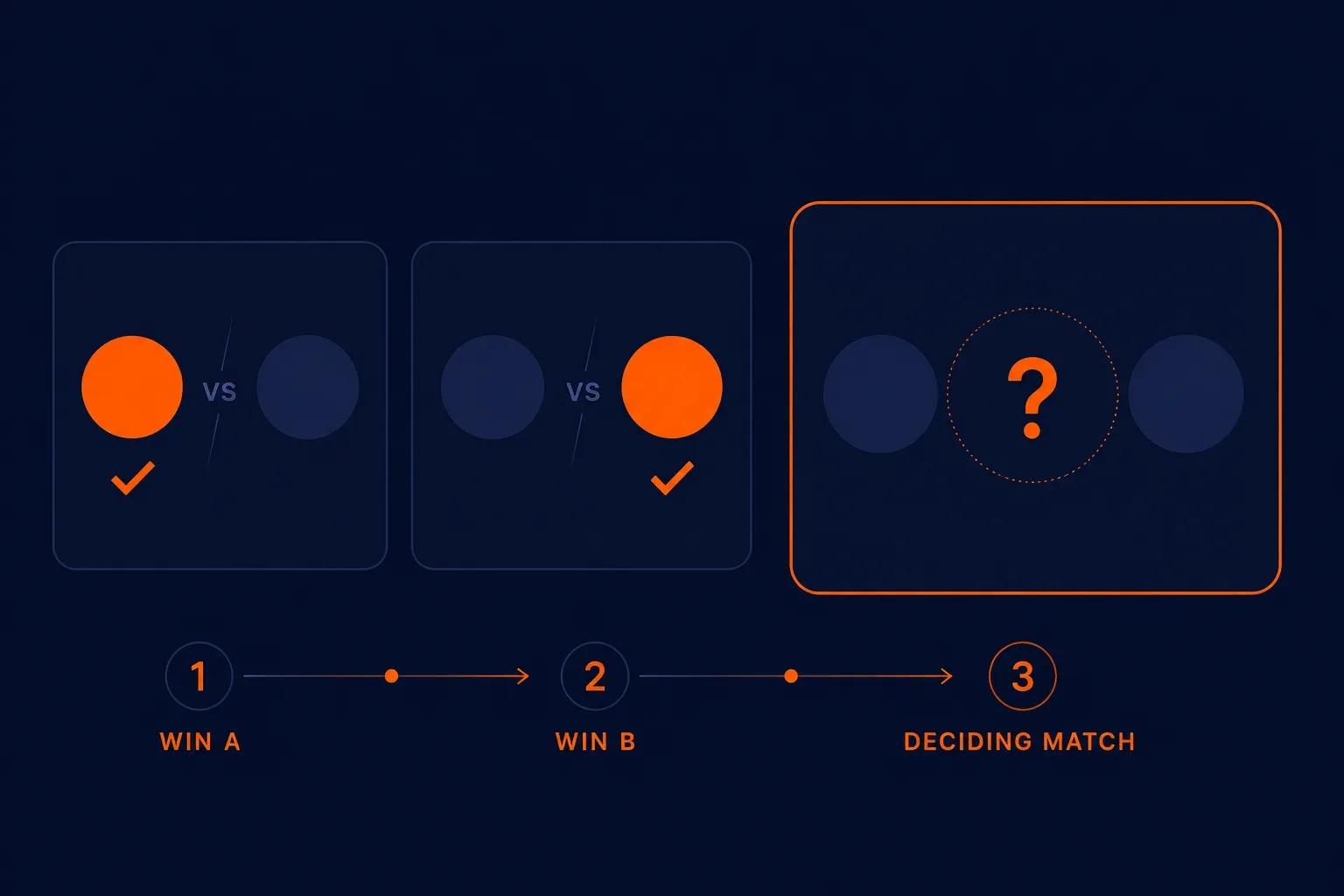
You may have heard of a ‘dead rubber’, but did you know the phrase comes from the term ‘rubber match’? Here we’re exploring the history, the context and what a rubber match means for prediction markets.
Learn
By Sean O'Meara
This article is for informational purposes only and should not be construed as financial or investment advice. Past performance does not guarantee future results.
What does a rubber match mean?
A rubber match is a decider in an odd-numbered series of matches. For example, in a best-of-three scenario where each participant has won one match, the third match becomes the rubber match.
In sports where a tie is possible, the series can be odd or even numbered, with an even number of wins and a draw setting up a rubber match decider. Rubber matches exist in tennis, baseball, golf, soccer, cricket, baseball and any sport where games are played out over a series or tournament format.
Why is it called a rubber match?
The history of the term is up for debate, but many agree the term ‘rubber match’ comes from the game of bowls.
Historians argue that the act of two balls rubbing together, which is a game-ending mistake, gave rise to the phrase ‘rubber’. And from then on people would describe any scenario where a match was a decider as a ‘rubber’.
The term was popularized by the game of bridge, where games are played in a series and it is now used in a variety of sports. While many refer to tie-breaker scenarios as ‘rubber matches’, this isn’t entirely precise.
A tie-breaker is often optional, for example in soccer some games can end in a tie, but some go to penalties to break the tie. Rubber matches describe only deciding matches in a series where a tie is never a possibility.
The related phrase ‘dead rubber’ is perhaps more commonly used than the phrase from which it originates. In a ‘dead rubber’ scenario, the final game is effectively meaningless because the series was already decided. For example, in a best-of-five scenario, if a participant wins the first three matches, the fourth and fifth matches are ‘dead rubbers’.
Rubber match examples in sports
Soccer
Rubber matches are actually less common than dead rubbers, because of the mechanics of tournaments.
Play-off finals, where four teams compete across a five-game series may technically meet the definition, although the ‘rubber’ match is necessarily between two teams who have yet to play against each other in the series.
Soccer play-offs are typically formatted as two, two-legged semi-finals, with the respective winners on aggregate facing off in the final. Language purists might argue that the final isn’t technically a rubber match, even though it is a deciding match, because the previous semi-finals can’t end tied.
While single games within the semi-finals can end in a tie, the aggregate score of both games must result in a win. If the aggregate score is tied, the semi-finals are decided by penalties.
The Baseball Finals can throw up true examples of a rubber match. The teams play three-game series throughout the year. The third game is a rubber match if the first two games are split 1–1 More generally, a rubber match is the deciding game of any tied series, including longer postseason series.
Tennis
Many tennis grand slam tournaments are formatted around a ‘best-of’ template, with the men playing best-of-five and women playing best-of-three sets.
This format regularly lends itself to a rubber match, or ‘rubber set’ scenario. In tennis, to win a set, a player must win at least six games and with a two-game margin over their opponent. In men's tennis, if each player has won two sets, the fifth set is the rubber. In women’s tennis, if each player has won one set, the third set becomes the rubber.
Basketball
Similarly to golf, some of basketball’s most memorable rubber matches were the culmination of years’ long series. The 2010 Pro Basketball Finals showcased the peak of the rivalry between Boston and Los Angeles. The Boston team had won in 2008, the LA team had won in 2009, making the 2010 Finals the ultimate rubber match series decider.
A similar but perhaps more intense scenario played out in 2017. The Golden State team and the Cleveland team had faced off in the previous two years, making the 2017 final a high intensity rubber match which the Golden State team won.
Hockey
Pro Hockey Finals is a seven-game series, making it the ideal format for deciding rubber matches. Internationally, the winter sport competitions may also throw up some enticing rubber matches due to the ‘best-of’ formats.
Recent examples of rubber matches in hockey include Edmonton vs Florida and Los Angeles vs San Jose.
Why rubber matches matter to prediction traders
Unlike dead rubbers, where the result of the match has no influence on a team’s overall finish in a series, a rubber match is often the most important match of an entire season for both teams. This means that they tend to be more tightly contested.
Rubber matches can be tense, high-stakes affairs where victory is decided by fine margins. So traders ought to be looking for small details that can have an outsized influence.
These might include injuries to players in previous games in the series, the form of each team, how they’ve won in the past and whether environmental factors might be an advantage to one team over another.
Factors like weather, altitude, time of year and even the time the game is played at may have an influence on the outcome.
What can move a rubber match market?
Match dynamics and momentum: is one team or competitor dominating the other in a meaningful way? In team games, are key players able to influence the flow or are they being neutralized?
Strategy and tactics: how soon can the market observe the strategies of each participant? Are they effective?
Key moments: Goals in soccer, touch downs in football, broken serves in tennis, missed putts in golf; these are the moments that heavily influence the market.
Unexpected events: Red cards, injuries, dropped serves all move the needle, especially if they happen early on in a rubber match.
Understanding a rubber match in prediction markets
Market-implied probability in prediction markets reflect the crowd's forecast of an event occurring, or not occurring. This is directly reflected in the contract's price.
A contract for a team or player to win trading at 80¢ can be interpreted as roughly a 80% market-implied chance before fees and market rules. Markets move when new information changes how traders assess the outcome. Always check rules, fees, and settlement details before trading.
How to trade sports event contracts on OG.com
With OG.com, you can trade event contracts on real-world sport outcomes across different categories.
Create an account: Open an account and complete sign-up, including identity verification. You can use our web or mobile platforms.
Browse markets: Explore markets across soccer, baseball, hockey, basketball, and many more competitive sports.
Review and trade: Compare the market price with your own view. Check the rules, fees, and settlement details before opening a position.
Monitor your position: After trading, your contract appears in your open positions, where you can track price movement as new information comes in.
A series or tournament-deciding game between two teams or players who’ve played each other already.
What does rubber match mean in sports?
It means the match is a culmination of a ‘best-of’ format series or tournament. It creates an ‘undisputed’ champion.
Why is it called a rubber match?
It’s to do with the game of bowls. Historically, the term rubber was coined to describe a match that settled a ‘best of the best’ argument.
What is a rubber match in baseball?
It’s any game in a series that creates an overall series winner. For example, if two teams have won two games each in a series, the fifth game necessarily becomes the ‘rubber match’ decider.
Can a rubber match happen in any sport?
Not necessarily. Sports where the winner may be determined in a non-series format, like track and field or cycling, motoring or running time trials, it’s unlikely that we’d see a rubber match.
How can a rubber match affect prediction markets?
Rubber matches have a ‘winner-takes-all’ dynamic typically contested between two high performing teams or players, so fine margins are important. Look out for areas where one party can get some marginal gains.
Important Information: Prediction is an event contract that is a derivatives product offered by North American Derivatives Exchange, Inc. (NADEX), a CFTC-regulated exchange, which does business under the brand OG.com Prediction Markets (OG) Crypto.com | Derivatives North America and uses a CFTC-regulated exchange that uses OG.com technology.
Trading on OG.com involves risk and may not be appropriate for all. By trading you risk losing your cost to enter any transaction, including fees. You should carefully consider whether trading on OG.com is appropriate for you in light of your investment experience and financial resources. Any trading decisions you make are solely your responsibility and at your own risk.