Republican presidential nominee 2028 predictions: Front-runners, longshots, and historical context
Donald Trump can’t run for a third term. JD Vance and Marco Rubio are among Republicans who could try to keep his party in the White House in 2028.
Politics
By Barbara Pazur
Vice President JD Vance leads early Republican nomination polls and prediction markets, with Secretary of State Marco Rubio emerging as his closest potential challenger.
With the first primaries still more than a year away, the field remains open. Candidate announcements, endorsements, and shifts in voter support could change the race before Republicans choose their 2028 presidential nominee.
This article is for informational purposes only and should not be construed as financial or investment advice. Trading involves risk.
2028 Republican primary calendar: What we know so far
The 2028 Republican primaries and caucuses are expected to begin in early 2028. As of October 23, 2026, the Republican National Committee (RNC) has established the early-state framework, but the full calendar and many individual contest dates are still being finalized.
Iowa, New Hampshire, Nevada, and South Carolina retain their traditional early positions in the Republican nomination process. The order gives candidates an opportunity to establish momentum before voting expands to larger groups of states.
Under the typical presidential nomination timeline, primaries and caucuses run from January through June of the election year. The Republican National Convention follows in the summer, when delegates formally select the party's presidential nominee.
The early calendar can affect how candidates organize their campaigns. A strong showing in Iowa or New Hampshire may attract greater attention, while disappointing results can put pressure on candidates to reconsider their plans.
However, early contests don't determine the nomination on their own. Candidates must accumulate delegates across the primary calendar to secure the party's nomination.
What are the 2028 Republican candidate predictions?
JD Vance currently leads the Republican nomination market on OG, followed by Marco Rubio. Donald Trump Jr. and Ron DeSantis are among the other potential candidates attracting attention.
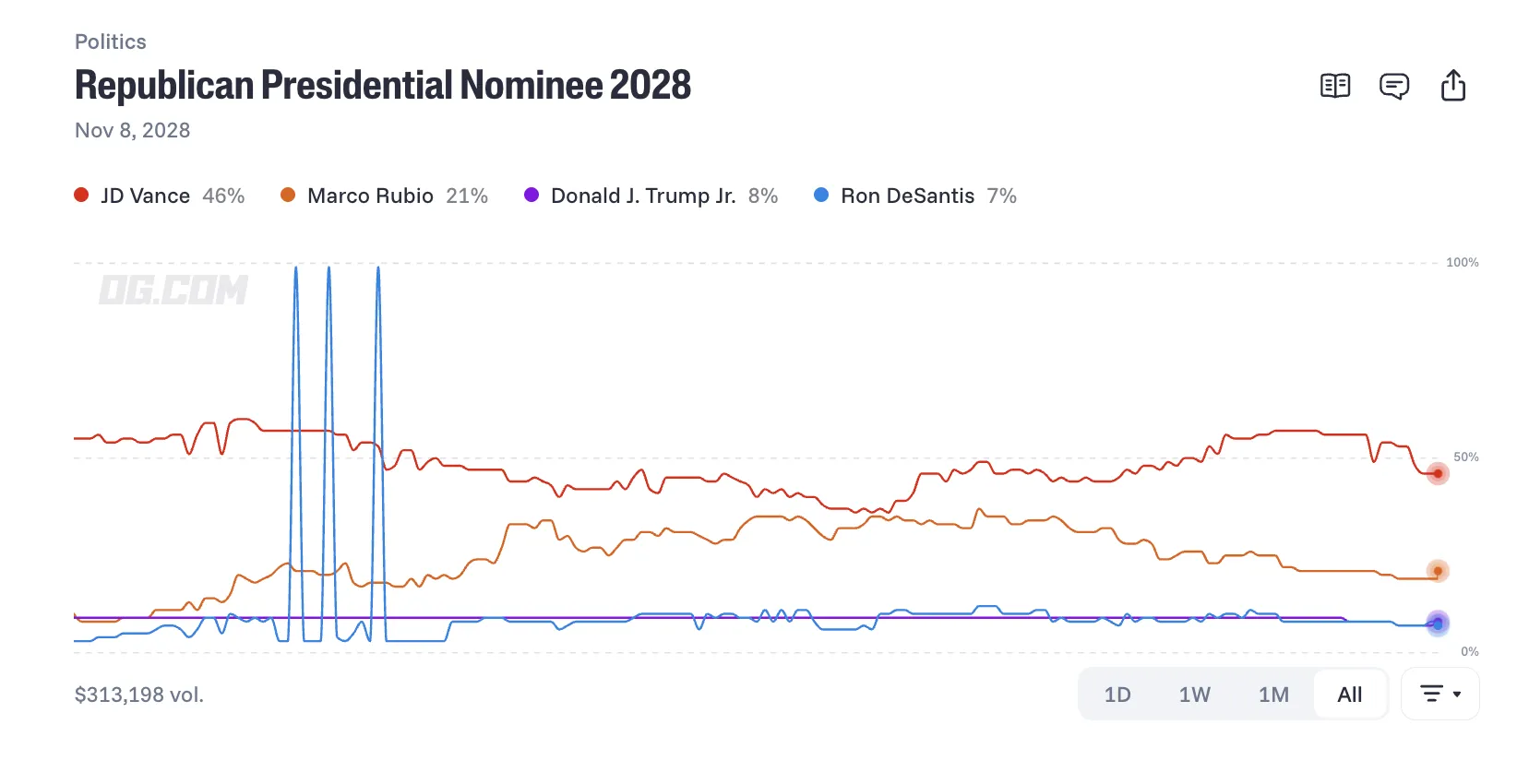
The national polling average shows a similar picture, with Vance holding a double-digit advantage over Rubio.
Potential Republican nominee | OG market-implied probability | National polling average |
JD Vance | 46% | 39.1% |
Marco Rubio | 21% | 23.8% |
Donald Trump Jr. | 8% | 11.3% |
Ron DeSantis | 7% | 7.9% |
Robert F. Kennedy Jr. | N/A | 4.5% |
Nikki Haley | N/A |
Based on publicly available information as of October 23, 2026. Source: RealClearPolling
OG percentages reflect displayed Yes contract prices traded on the prediction markets. rather than independently verified executable quotes. N/A indicates that a price wasn't verified. Market prices can change as traders react to new information. new information emerges, and trading involves risk.
Prediction-market prices and polling percentages aren't interchangeable. A poll measures how respondents answer a question about potential nominees, while a prediction market reflects the price of an event contract tied to the eventual nomination.
For example, a Yes contract trading at 46¢ can be read as roughly a 46% market-implied chance of the candidate winning the nomination. If that candidate becomes the nominee, the contract typically settles at $1. Otherwise, it settles at $0, subject to the market rules.
JD Vance: The front-runner and the VP-to-nominee question
As the sitting vice president, Vance has a national profile and a direct connection to President Donald Trump's administration. His position gives him visibility that many potential challengers would need to build through a presidential campaign.
A JD Vance 2028 presidential run would also follow an established historical path. Fifteen vice presidents went on to become president. Nine took office following the death or resignation of a president, while six were elected to the presidency (four while serving as vice president and two after leaving office).
There's no constitutional restriction preventing a sitting vice president from seeking the presidency. The 22nd Amendment restricts presidential terms, but serving as vice president doesn't count toward that limit.
Vance's connection to the current administration could also shape voter perceptions. Economic conditions and public approval of the administration may influence support for him as the primary approaches.
President Trump's eventual endorsement, if he makes one, could also affect the Republican field. But the influence of any endorsement would depend on how primary voters respond.
Marco Rubio: The case for the second-most-discussed contender
Rubio trails JD Vance in national Republican nomination polls but has consistently attracted double-digit support. His national political career includes service in the US Senate and a previous presidential campaign.
Rubio competed for the 2016 Republican nomination, winning the Minnesota caucuses and contests in Puerto Rico and Washington, D.C., before suspending his campaign after losing the Florida primary to Donald Trump.
His current role as secretary of state gives him a different political profile from Vance, particularly through his responsibilities in foreign policy.
Rubio's polling support has varied across surveys, although he has generally polled in the 20s and behind Vance, with a few exceptions:
- The September Harvard-Harris survey placed Rubio at 17%, behind Vance at 39% and Donald Trump Jr. at 24%.
- An October 22 New Hampshire Republican primary poll from Saint Anselm College showed Vance and Rubio tied at 38%, a much closer contest than the national polling average suggests.
Marco Rubio 2028 nomination odds could change as the primary race develops, particularly if he gains support in the early voting states.
Second-tier contenders and longshot candidates to watch
Beyond Vance and Rubio, the list of potential 2028 Republican primary candidates includes several familiar names from past elections. Some have previous presidential campaign experience, while others would be entering the nomination process for the first time.
Ron DeSantis
Florida Governor Ron DeSantis entered the 2024 Republican primary after attracting substantial national attention. He ended his campaign following the Iowa caucuses and endorsed Trump.
The latest national polling average puts DeSantis at 7.9%, while OG's October 23 nomination market displayed approximately 7%.
Ron DeSantis' 2028 chances could depend on whether he can rebuild the support that initially made him a prominent contender in the 2024 primary.
Donald Trump Jr.
Donald Trump Jr. hasn't held elected office, but his national political profile and connection to the Trump family have made him a recurring name in early nomination surveys.
His support varies considerably between polls. The September Harvard-Harris survey placed him at 24%, while the October Financial Times survey showed 7%.
Nikki Haley
Former South Carolina Governor Nikki Haley served as US ambassador to the United Nations and challenged Trump for the 2024 Republican nomination.
Her campaign continued after other major rivals withdrew, eventually ending in March 2024.
Haley's experience in a presidential primary provides a potential foundation for another campaign, although current national surveys show substantially less support for her than for Vance or Rubio.
Ted Cruz
Texas Senator Ted Cruz finished second in the 2016 Republican presidential nomination contest and has maintained a national profile through his Senate career.
He appears in early 2028 nomination surveys, but his current national polling support remains in the low single digits.
Tucker Carlson
Political commentator Tucker Carlson is another name appearing in some early Republican nomination polls.
Unlike candidates with previous presidential campaigns or elected executive experience, Carlson would enter the race from a media background. His inclusion in surveys indicates some voter interest, but it doesn't establish that he intends to pursue the nomination.
How the Republican presidential nomination process works
The Republican nominee isn't selected by a single national vote. Instead, candidates compete in state primaries and caucuses to accumulate delegates who represent their states at the Republican National Convention.
A candidate typically needs a majority of convention delegates to secure the nomination.
Here's how the process works:
- Primaries and caucuses. Voters express their preferences through state-run primaries or party-organized caucuses.
- Delegate allocation. States award delegates according to their rules and the national party's requirements.
- National convention. Delegates vote to formally select the Republican presidential nominee.
How Republican delegates are allocated
Delegate allocation rules vary by state. Some contests award delegates proportionally, giving qualifying candidates a share based on their vote totals. Others use winner-take-all systems, where the leading candidate receives all delegates covered by that allocation rule.
Certain states also use hybrid systems, awarding delegates according to statewide results and separate congressional district outcomes.
The RNC's rules determine which allocation methods states can use at different points in the primary calendar. The final 2028 requirements and state allocations should be checked once the party publishes the applicable rules.
A candidate can win several states without immediately securing the nomination. The number of delegates awarded matters as much as the number of contests won.
If no candidate enters the convention with a majority, delegates may need additional rounds of voting to select a nominee.
What past open GOP nomination cycles tell us about early predictions
Early polling hasn't always accurately predicted the eventual Republican nominee. The 2000 and 2016 elections show just how differently a primary race can develop.
The 2000 primary: George W. Bush's early advantage
George W. Bush entered the race with a substantial lead. A March 1999 Gallup poll put him at 52%, compared with Elizabeth Dole's 20%. Bush maintained his lead throughout the primary campaign and eventually went on to secure the nomination.
The 2016 primary: Donald Trump's rise
Trump's path, on the other hand, took a different turn. In March 2015, just 1% of Republican and Republican-leaning voters named him as their first choice. By April 2016, his support had climbed to 44%, and he eventually secured the nomination.
These examples show that an early polling lead can hold, but a candidate with limited initial support can also emerge as the nominee.
What could change the 2028 nomination race?
Several developments could shift the current Republican nomination predictions.
- Candidate announcements. Confirmed campaigns could change voter preferences.
- Trump's endorsement. His support could influence the primary field.
- The 2026 midterms. Results could reshape Republican priorities.
- Economic conditions. Voters' views of the administration could affect support for its potential successors.
- Early primary results. Unexpected outcomes could change polling and prediction-market prices.
With the first primaries still more than a year away, there's plenty of time for new candidates to emerge and voter preferences to shift.
How to trade political event contracts on OG.com
With OG.com, you can trade event contracts on real-world outcomes across different market categories.
- Create an account: Open an account and complete sign-up, including identity verification. You can use our web or mobile platforms.
- Browse markets: Explore markets across politics, economics, culture, sports, and other real-world events.
- Review and trade: Compare the market price with your own view. Check the rules, fees, and settlement details before opening a position.
- Monitor your position: After trading, your contract appears in your open positions, where you can track price movement as new information comes in.
FAQs about 2028 Republican presidential nominee predictions
Who is the current frontrunner for the 2028 Republican presidential nomination?
JD Vance leads current national Republican nomination polling and holds the highest displayed probability in OG's October 23, 2026 nomination market snapshot.
Can JD Vance run for the Republican nomination in 2028 as a sitting vice president?
Yes, the US Constitution allows a sitting vice president to seek the presidency, provided they meet the constitutional eligibility requirements.
What are Marco Rubio's chances of winning the 2028 GOP nomination?
OG's October 23, 2026 snapshot displayed a 21% market-implied probability for Rubio, while the latest national polling average placed his support at 23.8%.
Which candidates are considered longshots for the 2028 Republican nomination?
Ron DeSantis, Donald Trump Jr., Nikki Haley, Ted Cruz, and Tucker Carlson are among the potential candidates registering lower support than Vance and Rubio in early polling.
How does the Republican presidential nomination process work?
Republican candidates compete in state primaries and caucuses to accumulate delegates, who formally select the presidential nominee at the national convention.
When do the 2028 Republican primaries and caucuses begin?
Republican primary voting is expected to begin in early 2028, although the full schedule and individual state dates need to be confirmed.
How accurate have early presidential nomination predictions been historically?
Early predictions have produced mixed results, with George W. Bush maintaining his advantage in 2000 while Donald Trump emerged from limited initial support to win the 2016 nomination.
What factors could change the 2028 Republican nomination race?
Candidate announcements, major endorsements, polling shifts, and the administration's political standing could change the field before primary voting begins.
Has any candidate formally announced a 2028 Republican presidential campaign?
As of October 23, 2026, the major potential Republican candidates discussed here haven't formally announced presidential campaigns.
How does delegate allocation work in Republican primaries?
States award delegates using proportional, winner-take-all, or hybrid systems under Republican Party rules, with candidates seeking the majority needed to secure the nomination.
Important Information: Prediction is an event contract that is a derivatives product offered by North American Derivatives Exchange, Inc. (NADEX), a CFTC-regulated exchange, which does business under the brand OG.com Prediction Markets (OG) Crypto.com | Derivatives North America and uses a CFTC-regulated exchange that uses OG.com technology.
Trading on OG.com involves risk and may not be appropriate for all. By trading you risk losing your cost to enter any transaction, including fees. You should carefully consider whether trading on OG.com is appropriate for you in light of your investment experience and financial resources. Any trading decisions you make are solely your responsibility and at your own risk.