Ohio State Buckeyes at Texas Longhorns prediction and odds
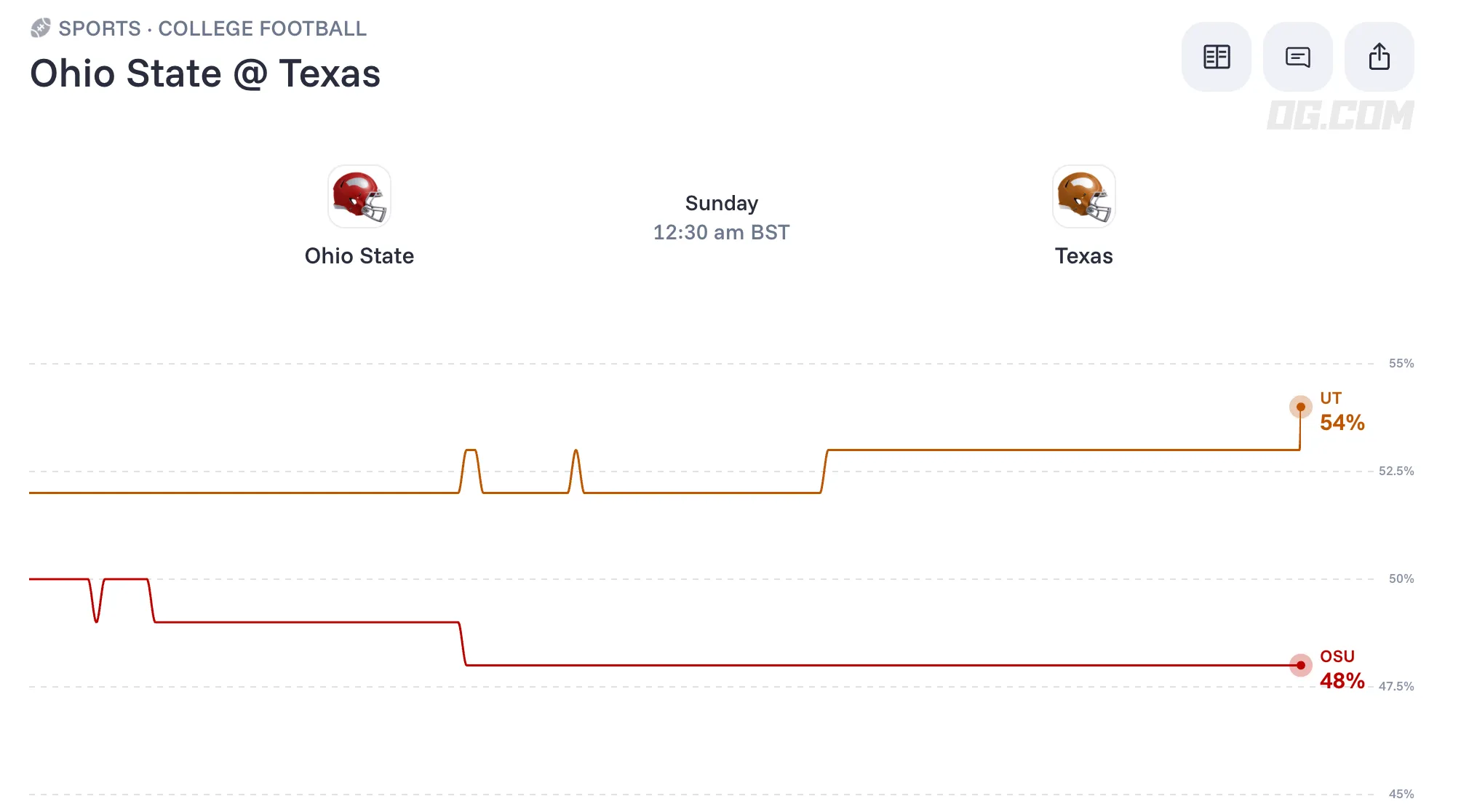
The Texas Longhorns are narrow 54% favorites at home, but the Ohio State Buckeyes arrive as the country's top-ranked team after winning the past two meetings.
Football
By Chris Old
The Ohio State Buckeyes and Texas Longhorns have spent the past two seasons meeting on stages that made September feel like January.
The Buckeyes knocked the Longhorns out of the College Football Playoff in early 2025, then beat them again in the following season opener.
The third game may be the most revealing. Arch Manning and Julian Sayin are no longer new starters feeling their way through a heavyweight matchup.
Both opened 2026 with more than 300 passing yards and enter this game among the leading Heisman Trophy contenders. They are also being discussed as potential top-10 picks in the 2027 NFL Draft.
Both now lead offenses built to stretch a defense from sideline to sideline.
The Longhorns have home field this time. The market thinks that is just enough to separate them.
This article is for informational purposes only and should not be construed as financial or investment advice. Past performance does not guarantee future results.
Ohio State vs Texas game snapshot
Date: Saturday, September 12, 2026
Kickoff: 7:30 p.m. ET
Competition: College Football
Week: 2
Texas Longhorns
Home team:
Ohio State Buckeyes win: 48%
Texas Longhorns win: 53%
Ohio State Buckeyes vs Texas Longhorns prediction
Prediction markets for Ohio State vs Texas currently make Texas a 53% favorite, with Ohio State at 48%.
Market data as of September 8, 2026. For the latest market-implied probability, check the OG app.
There is no clear gap here. The Longhorns have home field and an offense that looked immediately comfortable in their 59-7 opening win over Texas State. The Buckeyes are ranked No. 1, beat Ball State 56-3 and have defeated Texas twice since January 2025.
The Longhorns' case starts with a more mature Manning. He completed 20 of 27 passes for 305 yards and four touchdowns in Week 1, finding Ryan Wingo seven times for 121 yards and Cam Coleman three times for 70 yards and two scores.
Wingo can win vertically or turn an intermediate completion into a larger gain. Coleman gives Manning size and reach on the opposite side.
That pairing is a serious test for an Ohio State secondary replacing several important players from last season. Devin Sanchez has moved into a leading role, but the Buckeyes will need more than one corner to hold up when the Longhorns spread the formation and make the defense declare its coverage.
The Buckeyes can answer with the best individual matchup piece on the field. Jeremiah Smith caught eight passes for 151 yards and two touchdowns in the first half against Ball State. The Longhorns contained him in last season's meeting, holding Ohio State to 213 total yards, but Sayin needed only one major opening to connect with Carnell Tate for the decisive 40-yard touchdown.
Sayin is a different quarterback now. He went 21 of 25 for 320 yards and three passing touchdowns in the opener, taking the available completion without losing the willingness to attack downfield.
Devin McCuin added six catches for 97 yards and a score, giving the Buckeyes another receiver the Longhorns must account for when coverage rotates toward Smith.
The concern for the Buckeyes is balance. Their running game started slowly against Ball State, producing only 35 yards in the first half before improving after the break.
The Longhorns' speed makes it difficult to live in long-yardage situations, particularly if Will Muschamp can disguise pressure without leaving Smith isolated against favorable coverage.
The Longhorns have a similar question. Hollywood Smothers opened the season with a 45-yard run and finished with 70 yards on 10 carries, but Texas produced 156 rushing yards in total. Remove the explosive opener and much of the ground game was steady rather than dominant.
Ohio State has already shown it can make Manning play patiently. The Buckeyes held him to 170 passing yards last year, intercepted him once and stopped the Longhorns on two goal-line possessions. Manning's development, his new receiving options and home field justify Texas' narrow market lead. The Buckeyes' recent control of the series makes anything wider difficult to support.
The Longhorns deserve the slightest edge. Nothing about this matchup suggests comfort.
Ohio State vs Texas odds
Ohio State Buckeyes win: 48%
Texas Longhorns win: 53%
The pricing describes a near-even game rather than a strong favorite. The Longhorns have the small advantage that comes with playing at home and bring a deeper set of proven receiving options around Manning. The Buckeyes counter with the nation's No. 1 ranking, Sayin's efficiency and the recent head-to-head record.
For readers new to the format, our guide to how football prediction markets work explains how contract prices can be interpreted as market-implied probabilities. Here, the small separation between the teams reflects how little certainty there is around two elite programs after one game.
Ohio State Buckeyes vs Texas Longhorns game outlook
The Longhorns should ask the question Ohio State did not have to answer against Ball State: can the Buckeyes' new-look secondary cover two high-level outside receivers while still helping against Manning's legs?
Wingo and Coleman give Steve Sarkisian freedom to move the formation. The Longhorns can place them on opposite sides and force the Buckeyes to choose where the safety help goes, or bring them together in a stack that makes press coverage harder. Smothers can release from the backfield and occupy a linebacker underneath.
Manning is most dangerous when those options create a simple picture before the snap. If the Buckeyes stay in two-high coverage, Texas can run into lighter boxes or throw underneath. If a safety comes down, one of the outside receivers receives more space to attack vertically.
The Buckeyes cannot become passive. Their success in the 2025 meeting came from changing the picture after the snap, keeping Manning in the pocket and forcing him to complete several throws in succession. He went 5 of 10 for 26 yards in the first half and did not find the end zone until the final four minutes.
This version of the Buckeyes' defense is younger. Payton Pierce and Wisconsin transfer Christian Alliegro have larger responsibilities at linebacker following Sonny Styles' departure, while Sanchez leads a reworked secondary without Caleb Downs. Ball State gained only 165 total yards, although missed tackles offered the Longhorns something to investigate on film.
Texas can make those linebackers turn and run. Play-action from heavier personnel can bring them toward the line before Smothers or a tight end crosses behind them. Manning's ability to keep the ball on zone-read concepts adds another defender to the run fit.
The Buckeyes' offense presents a different problem. Smith demands extra attention, yet rolling coverage toward him creates room for Tate, McCuin and the tight ends. Sayin's accuracy lets Ohio State live on slants, option routes and intermediate in-breakers until a safety begins to step forward.
Then Smith can go over the top.
The Longhorns' new defense forced three turnovers and recorded two sacks in Muschamp's first game back as coordinator. Linebacker Rasheem Biles produced an interception and forced the fumble that Graceson Littleton returned for a touchdown. That aggression can change a game quickly, but the Buckeyes will use motion and formation width to identify where pressure is coming from.
The edge matchup matters. The Longhorns need to affect Sayin before Smith and Tate finish their routes. Ohio State protected with extra bodies repeatedly in last season's meeting, limiting Texas to a 25% pressure rate and no sacks. The approach reduced the number of receivers in the pattern, but it also gave a first-time starter a clean enough platform to avoid turnovers.
Muschamp must decide how many defenders to commit. Send pressure and Smith may see single coverage. Rush four and Sayin may have time to reach his second or third read.
The Buckeyes also need credible early-down runs. Without them, the Longhorns can widen their defensive front, keep a safety over Smith and attack the pocket without worrying about cutback lanes. Ohio State found explosive gains after halftime against Ball State, but consistent movement matters more here.
Texas has its own issue inside. Dylan Sikorski and Laurence Seymore shared work at left guard in the opener, and Sarkisian has indicated that the rotation will continue. The Buckeyes can test that communication with tackles and linebackers crossing gaps, especially on third down.
Neither team needs to chase the game from the opening series. Last year's meeting remained scoreless until late in the second quarter and was decided by seven points. Field position, fourth-down decisions and red-zone execution may matter as much as the spectacular receivers.
Team news and injuries
Ohio State Buckeyes
Sayin is the established starting quarterback and enters Week 2 after completing 84% of his passes against Ball State. Smith remains the focal point of the receiving group, with Tate and McCuin giving Ryan Day credible alternatives when defenses devote two players to the All-American.
The offensive line returns important experience through Luke Montgomery, but the running game still has something to prove after its slow first half in Week 1. The Buckeyes can use multiple tight ends to support the tackles and protect Sayin, as they did against Texas last season, without treating that as a fixed personnel package.
The defense has changed around Sanchez, Pierce and Alliegro following major offseason departures. That group passed its first test on the scoreboard, allowing only a field goal, but Texas' receiver depth and Manning's movement will place far more stress on its coverage rules.
The Buckeyes entered game week without a newly confirmed major absence in the program's initial Texas notes.
Texas Longhorns
Manning is the confirmed starter and comes into the game after throwing four touchdown passes in the opener. Wingo and Auburn transfer Coleman form the leading outside pair, while Smothers contributes both as a runner and receiver.
Freshman running back Derrek Cooper will be unavailable for the foreseeable future after sustaining an ankle injury against Texas State. He was listed behind Smothers and Raleek Brown, so the injury does not remove the lead back, but it reduces the depth of a rotation that Texas used freely in Week 1. Brown and James Simon are among the players who can absorb additional carries.
Trevor Goosby started at left tackle against Texas State after recovering from a knee issue in camp. His return stabilizes the most important protection spot for Manning. Left guard is less settled: Sikorski and Seymore rotated in the opener, while Cole Hutson is currently unavailable because of an eligibility matter.
On defense, Muschamp is expected to keep using varied personnel rather than one fixed starting group. Biles, Littleton, Jelani McDonald and Jonah Williams all made notable contributions in the opener. Their larger test is communicating through the Buckeyes' motion while preventing Smith from dictating every coverage call.
Key factors that could decide Ohio State vs Texas
Can the Longhorns create easier throws for Arch Manning?
The Buckeyes made Manning hold the ball and work through congested coverage last season. The Longhorns now have two outside receivers capable of winning quickly, plus a quarterback with another year of experience.
Screens, quick outs and designed movement can settle Manning before the Buckeyes' pass rush develops. If the Longhorns repeatedly face third-and-long, Ohio State can return to the disguised looks that frustrated him in 2025.
How do the Longhorns cover Jeremiah Smith?
One defender is unlikely to be enough. Smith can beat press coverage with strength, separate downfield and turn a short completion into an explosive play.
The Longhorns can shade a safety toward him, but that choice creates space elsewhere. Tate's route running and McCuin's Week 1 production make the decision more expensive than it was a year ago.
Which team can run efficiently without relying on one explosive play?
Both season openers contained a similar warning. The Buckeyes' ground game took time to develop, while a 45-yard opening carry accounted for a large part of Smothers' production.
Four- and five-yard gains would change the shape of this matchup. They keep the playbook open, slow the pass rush and create opportunities to attack linebackers with play-action.
Can the Buckeyes' secondary handle Ryan Wingo and Cam Coleman?
Wingo and Coleman combined for 191 receiving yards and three touchdowns against Texas State. The Longhorns can isolate one outside while using motion or a stack to release the other.
Sanchez cannot cover both. Ohio State's safeties and other corners must communicate cleanly, especially when Manning extends the play and receivers break away from their original routes.
Can the Longhorns pressure Julian Sayin with four rushers?
The Longhorns could not sack Sayin last season, partly because the Buckeyes kept extra blockers in protection. Muschamp now has to create pressure without surrendering favorable coverage to Smith.
If four rushers can hurry Sayin, Texas can keep seven defenders in coverage and close the intermediate windows. If the Longhorns must blitz, Ohio State has the receivers to make the risk visible.
Which offense finishes drives?
The Longhorns reached the Ohio State goal line twice without scoring in last year's 14-7 defeat. The Buckeyes produced only two touchdowns themselves.
Space disappears in the red zone. Quarterback movement, tight-end routes and the ability to run against a loaded box become more important when the vertical field is compressed.
Ohio State vs Texas head-to-head
The Ohio State Buckeyes lead the all-time series 3-2 and have won the past two meetings.
The Buckeyes beat the Texas Longhorns 28-14 in the College Football Playoff semifinal in January 2025. Jack Sawyer's strip-sack and 83-yard return turned away a late goal-line drive and sent Ohio State to the national championship game.
Eight months later, the Buckeyes won 14-7 in Columbus. The Longhorns held Ohio State to 213 yards, but Sayin protected the ball and found Tate for the decisive fourth-quarter touchdown. Manning finished 17 of 30 for 170 yards, one touchdown and one interception. Two failed goal-line possessions left Texas chasing the game.
That second meeting is directly relevant. Both quarterbacks and both head coaches return, and Texas must solve the defensive approach that disrupted Manning. The personnel around them has changed enough to prevent a simple replay. Coleman was not part of last year's Texas receiving group, and several central Ohio State defenders have moved on.
The Longhorns have won two of the three regular-season games in the series, including a 25-22 victory at Ohio State in 2005. The Buckeyes won the only previous meeting in Texas, 24-7 in 2006.
What could move Ohio State vs Texas odds?
Any late change involving Manning, Sayin, Smith, Wingo or Coleman would alter the offensive assumptions behind a market separated by only a few percentage points. Their practice participation and official availability carry more weight than broad comments about readiness.
The Longhorns' offensive line is the other immediate variable. Goosby's continued health and the left-guard rotation affect how comfortably Manning can operate against Ohio State's pressure. A clearer choice between Sikorski and Seymore may also improve communication inside.
For the Buckeyes, the secondary deserves similar attention. The Longhorns can stress every coverage player, so an absence or role change at cornerback or safety would have consequences beyond one direct replacement.
Weather can matter if it changes the passing conditions, although ordinary heat alone should not override the football matchup. The market may also respond to clearer indications of how each team plans to divide its backfield work.
Important information
Prediction is an event contract that is a derivatives product offered by North American Derivatives Exchange, Inc. (NADEX), a CFTC-regulated exchange, which does business under the brand OG.com Prediction Markets (OG). Crypto.com | Derivatives North America uses a CFTC-regulated exchange that uses OG.com technology.
Trading on OG.com involves risk and may not be appropriate for all. By trading you risk losing your cost to enter any transaction, including fees. You should carefully consider whether trading on OG.com is appropriate for you in light of your investment experience and financial resources. Any trading decisions you make are solely your responsibility and at your own risk.