August jobs report preview: US unemployment rate forecast
The US labor market has entered what economists call a “low hire, low fire economy”.
Economics
By Ekaterina Drozdovica
Hiring slowed in July, while layoffs remained low, according to BLS data. The August jobs report will show whether that pattern continued or July’s payroll decline marked a sharper slowdown.
Economists expect employment to return to modest growth while the US unemployment rate remains at 4.1%. However, weaker private-sector hiring and slower wage growth have added some uncertainty ahead of the report.
This article is for informational purposes only and should not be construed as financial or investment advice. Past performance does not guarantee future results.
TheBureau of Labor Statistics will publish the seasonally adjusted U-3 unemployment rate alongside nonfarm payrolls, wage growth and average weekly hours.
Although it is published in September, it is commonly called the August jobs report because the data covers labor-market conditions during August.
What is the August jobs report forecast?
Economists surveyed by expect the BLS jobs report to show that nonfarm payrolls increased by 53,000 in August. Their median unemployment rate forecast is 4.1%, unchanged from July.
The Wall Street Journal
The same survey expects average hourly earnings to rise 0.3% month over month and 3% year over year. These forecasts were based on responses from between 12 and 22 economists, depending on the indicator.
August forecast
July result
Nonfarm payrolls
+53,000
-23,000
Unemployment rate
4.1%
4.1%
Average hourly earnings, monthly
+0.3%
+0.1%
Average hourly earnings, annual
+3.0%
+3.2%
The forecast points to a modest recovery rather than a strong rebound. A gain of 53,000 jobs would reverse July’s decline, but it would still suggest that employers remain cautious.
Goldman Sachs takes a slightly softer longer-term view. Its economists expect the unemployment rate to reach 4.4% by the end of 2026. Chief US economist David Mericle said the projected rise would not be “enough to create a sense of urgency” for the Federal Reserve to cut interest rates.
The July Employment Situation report put the US unemployment rate at 4.1%, down from 4.2% in June. But the fall did not come with stronger hiring.
Non-farm payrolls declined by 23,000, following a gain of 20,000 in June. The three-month average stood at 20,000 jobs, compared with a 12-month average of 26,300.
The unemployment rate and payroll figure come from two different surveys. The household survey measures whether people are working or looking for work. The establishment survey asks employers about payrolls, wages and hours.
That distinction matters because the unemployment rate can fall even when payroll growth is weak. In July, the labor force participation rate slipped to 61.4%, down from 62.2% a year earlier. Fewer people participating in the labor market can limit upward pressure on the headline unemployment rate.
Average hourly earnings rose 0.1% in July and 3.2% from a year earlier, reaching $37.62. Average weekly hours remained at 34.3.
What are traders predicting for the August unemployment rate?
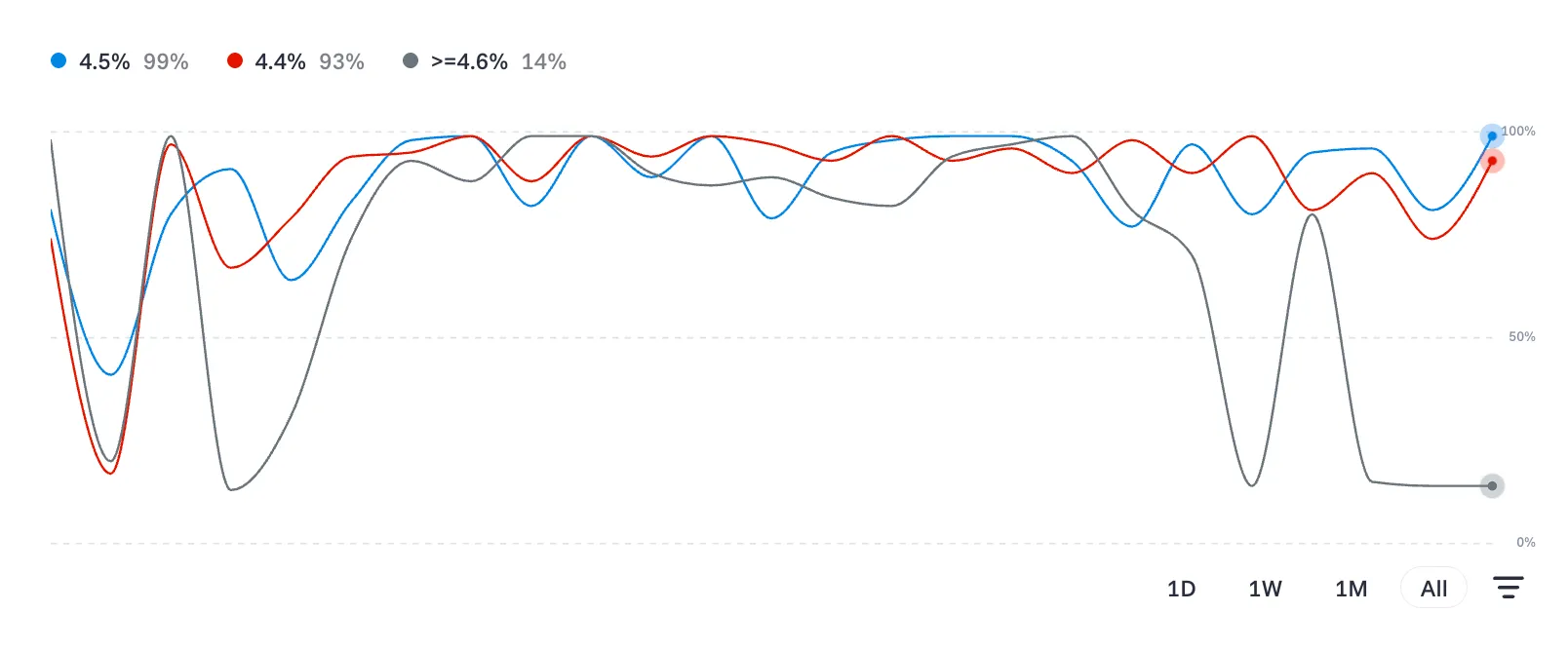
OG.com prediction markets traders currently appear confident that the unemployment rate will hit 4.5%, pricing 99% chance of that outcome.
Implied probabilities as of 2 September. For the up-to-date market data, please check the OG.com platform.
The market settles using the seasonally adjusted U-3 unemployment rate published in the August 2026 BLS Employment Situation report. Market prices reflect trader positioning, not an official forecast or guaranteed result.
How to trade US August jobs report on OG.com
Traders can use OG.com to take a position on how the August unemployment rate compares with the outcome ranges listed on the platform.
Create an account. Open an account and complete identity verification through the web or mobile platform.
What jobs report news is shaping the August outlook?
Recent data points to slower hiring, while layoffs remain low. Payroll provider ADP estimated that private employers added 38,000 jobs in August, below the 47,000 expected by economists surveyed by The Wall Street Journal. It was also the slowest pace of private-sector job creation since January.
The headline figure hides a sharp divide between industries. Education and health services added 45,000 jobs, while leisure and hospitality gained 16,000. Manufacturing lost 17,000 positions and professional and business services shed 16,000.
Most of the growth also came from large employers. Businesses with at least 500 employees added 34,000 jobs, while medium-sized companies recorded no net growth.
ADP chief economist Nela Richardson described the current environment as “choppy hiring.” She said analysts need to look beyond the headline and examine where pay growth is accelerating or slowing.
Wage data added to the cautious picture. Base pay increased 3.2% across all private-sector workers. Pay for people staying in their jobs rose 3%, while pay growth for job changers slowed to 4.7%.
ADP’s figures do not always predict the official BLS result because the two reports use different data and methods. Still, the slowdown gives markets another reason to watch Friday’s payroll number closely.
Why is the labor market being described as “low hire, low fire”?
The latest job-opening data suggest that companies have become more selective without moving into widespread layoffs.
US job openings increased to 7.27 million in July, according to the last report. However, the hiring rate fell from 3.4% to 3.2%. Layoffs remained low at 1.7 million, or 1% of employment.
James Knightley, chief international economist at ING, described this as a “low hire, low fire economy.” In other words, businesses are not recruiting aggressively, but they are not making broad job cuts either.
Knightley also noted that the quits rate fell to 1.9%. Fewer workers voluntarily leaving their jobs can suggest that people are less confident about finding a better position elsewhere.
Manufacturing provides a similar mixed signal. The ISM manufacturing employment index eased from 52.8 to 51.2 in August. A reading above 50 still points to expansion, but the de, which measures factory hiring, eased from 52.8 to 51.2 in August. A reading above 50 still points to expansion, but the decline suggests that hiring momentum softened during the month.
Together, these indicators explain why the consensus US unemployment rate forecast remains steady even as payroll growth slows. Hiring is weak, but layoffs have not risen enough to produce a clear jump in unemployment.
What could move the US unemployment rate away from the forecast?
The unemployment rate could come in above 4.1% if more people start looking for work without finding jobs, or if household employment declines. A weaker payroll figure would add to evidence that hiring slowed further in August.
The rate could also remain steady, or fall, if labor force participation declines again. That would not necessarily mean the labor market had strengthened, which is why payrolls, participation and wage growth all matter alongside the headline rate.
Revisions will be important too. The first payroll estimate is preliminary and can change as more employers respond to the BLS survey. June and July figures may therefore reshape the broader story even if the August headline lands close to expectations.
FAQs about August jobs report forecast
What is the unemployment rate forecast for August 2026?
Economists surveyed by The Wall Street Journal expect the unemployment rate to remain at 4.1%. The official figure will be published by BLS on September 4. OG.com traders currently appear confident that the unemployment rate will remain below 4.6%. The “No” position on 4.6% or higher was priced at 99¢ as of September 2, implying only around a 1% chance of that outcome.
How many jobs are expected to have been added in August?
The median forecast is for nonfarm payrolls to increase by 53,000 after falling by 23,000 in July.
What was the previous US unemployment rate?
The unemployment rate was 4.1% in July 2026, down from 4.2% in June, according to BLS data.
When is the next BLS jobs report?
The report covering August 2026 is scheduled for September 4 at 8:30 a.m. ET.
How do I trade the unemployment rate report on OG.com?
Traders can create an account, browse economics markets, review the contract’s settlement rules and listed outcomes, and then choose a position.
Important Information: Prediction is an event contract that is a derivatives product offered by North American Derivatives Exchange, Inc. (NADEX), a CFTC-regulated exchange, which does business under the brand OG.com Prediction Markets (OG) Crypto.com | Derivatives North America and uses a CFTC-regulated exchange that uses OG.com technology.
Trading on OG.com involves risk and may not be appropriate for all. By trading you risk losing your cost to enter any transaction, including fees. You should carefully consider whether trading on OG.com is appropriate for you in light of your investment experience and financial resources. Any trading decisions you make are solely your responsibility and at your own risk