F1 Italian Grand Prix 2026 prediction: race winner odds
George Russell looks to have the Friday edge at Monza, but Ferrari’s pace across the first two practice sessions suggests this could develop into a much tighter race-day fight than the outright market alone implies.
Motorsports
By Chris Old
Lando Norris arrived in Italy chasing a third consecutive Grand Prix victory and with the momentum of a genuine title push.
By the end of Friday, though, the shape of the weekend looked a little different.
Ferrari opened their home race weekend by going one-two in first practice, with Charles Leclerc fastest and Lewis Hamilton second.
Mercedes then hit back in second practice, where George Russell went quickest, Leclerc stayed right there in second, and Kimi Antonelli added another strong Mercedes datapoint in third despite the grid penalty that will compromise his Sunday route.
That is why Russell now leads the market.
The more interesting question is whether that makes him the best bet for both qualifying and the race.
At Monza, those are not quite the same thing. One lap is important, as it always is, but this is also a circuit where overtaking is realistic, slipstream effects are meaningful, and race management over a long stint can still decide everything on Sunday.
This article is for informational purposes only and should not be construed as financial or investment advice. Past performance does not guarantee future results.
F1 Italian Grand Prix 2026 weekend snapshot
Practice
Practice 3: Saturday, September 5 — 12:30 p.m. local / 6:30 a.m. ET
Race weekend
Qualifying: Saturday, September 5 — 4:00 p.m. local / 10:00 a.m. ET
Race: Sunday, September 6 — 3:00 p.m. local / 9:00 a.m. ET
Race distance: 53 laps / 306.72 km
Context
Drivers' Championship leader: Kimi Antonelli — 242 points
Teams' Championship leader: Mercedes
Last race winner: Lando Norris — Dutch Grand Prix
Monza remains one of the most distinctive tests on the F1 calendar. Straight-line speed, braking stability, traction out of the chicanes and energy deployment all matter heavily here, and the circuit often rewards teams that can combine low drag with a car that remains settled under heavy braking.
This article is for informational purposes only and should not be construed as financial or investment advice. Past performance does not guarantee future results.
Who will win the 2026 F1 Italian Grand Prix?
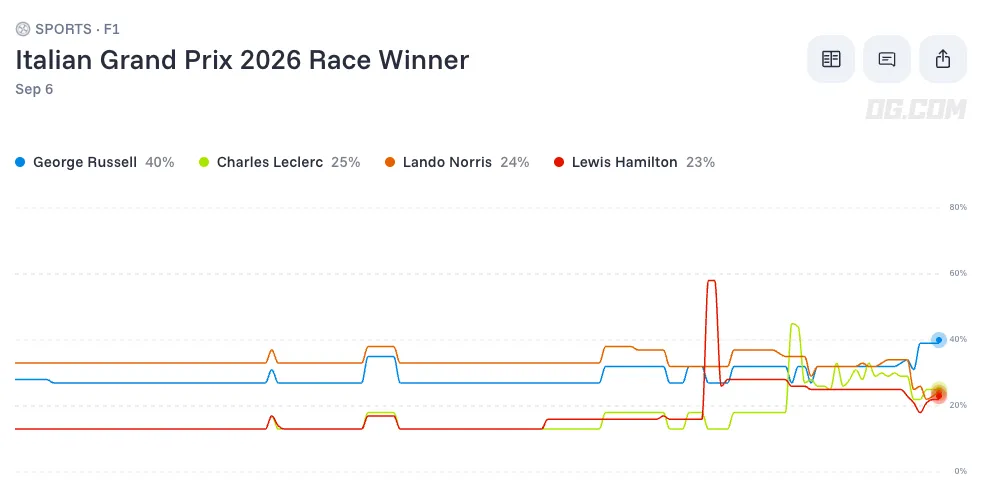
Prediction markets for Italian Grand Prix 2026 Race Winner currently make George Russell the favorite to win the 2026 Italian Grand Prix at 40%, ahead of Charles Leclerc at 25% and Lando Norris at 24%.
George Russell — 40%
Charles Leclerc — 25%
Lando Norris — 24%
Lewis Hamilton — 23%
Kimi Antonelli — 12%
Max Verstappen — 11%
Oscar Piastri — 8%
Market data as of September 4, 2026. For the latest market-implied probabilities, check the OG app.
Russell’s move to the top makes sense on the Friday evidence.
Mercedes looked quick enough in both sessions, Russell finished the day fastest, and Antonelli’s pace in third reinforces the idea that the car itself is genuinely competitive rather than Russell simply stringing together one clean lap.
But the market is also making a second judgment: that Russell is Mercedes’ cleanest path to victory because Antonelli’s grid penalty makes his race far more complicated, no matter how fast he looks.
That is reasonable.
What is less clear is whether Russell’s advantage is bigger on Saturday than on Sunday.
The obvious reason: he topped second practice. But the subtler reason matters too. Mercedes already knows Antonelli will start from the back, which means the team can lean fully into helping Russell maximize qualifying position if needed.
At Monza, where tow strategy and track positioning can make a meaningful difference, that is not a trivial advantage.
Leclerc looks like Russell’s most credible challenger over one lap.
Ferrari was immediately comfortable in Monza trim, Leclerc topped FP1, and he backed that up by going second in FP2 rather than fading away. That is the profile of a driver and car combination that can absolutely threaten pole if Saturday execution is clean.
Hamilton should not be far away either. He was second in FP1 and fifth in FP2, which is slightly less eye-catching than Leclerc’s Friday, but still consistent with Ferrari having two cars capable of qualifying near the front.
Norris remains a live threat, just not the obvious one. McLaren still looks competitive, but Friday did not suggest the same clear advantage it enjoyed at the last two tracks. On a low-drag circuit, “still in the fight” is different from “the team to beat.”
Who has the edge on long-run pace?
This is where the picture gets more interesting.
If qualifying pace alone decided Monza, Russell’s 40% would be easier to swallow without argument. But Sunday is a different question.
Ferrari may have the stronger race case than the outright prices suggest.
That is partly because its pace has looked stable rather than spiky. Leclerc and Hamilton were one-two in FP1, Ferrari ran longer stints in that session, and the car still looked competitive when the field reset in FP2.
It does not prove Ferrari is best over a race distance, but it does suggest the car is not reliant on a single qualifying-style burst.
That matters at Monza. This race has often leaned toward one-stop thinking, and tyre management plus energy usage can reshape the order once the laps start accumulating. If Ferrari can stay within touching distance on Saturday, it has every chance of turning this into a Sunday fight.
Mercedes still deserves huge respect. Antonelli being third-fastest even with his race compromised is a strong sign of underlying pace, and Russell’s car clearly has enough speed to control track position if he qualifies on the front row.
But there is a difference between having the cleanest route to victory and having the most comfortable race-day package.
On Friday, Ferrari looked like the team most likely to challenge Mercedes over a stint.
McLaren remains dangerous, mainly because Norris has been extracting so much more than almost anyone else recently.
The problem is that Monza did not immediately look like another weekend where McLaren unloads as the fastest car. Norris is good enough to win anyway, especially if he qualifies ahead of the Ferraris, but his current path looks more opportunistic than commanding.
What do we do with Antonelli?
Antonelli is a perfect example of why raw pace and win probability are different things.
He was strong again on Friday and, on pure speed, he belongs in the front-running conversation. If this were a normal weekend, his number would likely be much shorter than 12%.
But the power-unit penalty changes the structure of his race.
Monza is one of the better circuits on which to recover from the back, so he cannot be dismissed. Still, every overtake costs time, every dirty-air phase adds risk, and every position lost to strategy becomes harder to regain.
He might well be one of the fastest drivers on Sunday and still fail to win.
That makes him dangerous, but awkward.
Is Verstappen being overlooked?
Maybe slightly, but not by much.
At 11%, Verstappen is still being given a puncher’s chance, which feels about right after a subdued Friday. The key point is that Red Bull did not show enough yet to argue the market has badly missed something.
The case for him is basically Monza-specific upside and his track record here. The case against him is that the evidence so far is thinner than it is for Mercedes, Ferrari, or even Norris.
If Red Bull looks markedly stronger in FP3, he becomes interesting again very quickly. For now, he sits just outside the main group.
Russell now looks like the most likely pole contender
Russell came out of Friday with the strongest one-lap case. Mercedes was competitive from the opening session, then Russell went fastest in FP2 with Leclerc second and Antonelli third. That gives Mercedes two cars near the front on raw pace even before accounting for Antonelli’s penalty.
There is also a strategic advantage specific to qualifying. Antonelli already knows he will start from the back, so Mercedes has more freedom to use him to support Russell if a tow becomes useful. At Monza, where positioning on the out-lap and the slipstream can influence lap time, that could matter in a close Q3.
The harder question is whether pole would translate into control of the race. Russell looks like the cleanest Mercedes route because he does not have Antonelli’s recovery job, but Friday did not show a margin big enough to suggest he can simply disappear at the front.
Ferrari, in particular, looked menacing enough to make starting position only part of the equation.
Ferrari looks like the most credible Sunday threat
Ferrari’s Friday was encouraging because the pace appeared in both sessions rather than through one isolated lap. Leclerc led FP1 with Hamilton second, then Leclerc remained Russell’s closest challenger in FP2 while Hamilton stayed inside the leading group.
That matters more than simply saying Ferrari was “fast.” Monza asks a car to run efficiently on the straights without becoming nervous under heavy braking, while traction out of the chicanes is crucial to carrying speed onto those long full-throttle sections.
Ferrari, with their upgrades, looked comfortable enough across Friday to suggest its low-downforce package is genuinely competitive here.
The race case may be stronger still. Ferrari completed longer running on Friday and did not appear reliant on a single low-fuel lap to look quick.
If Leclerc or Hamilton can qualify within striking distance of Russell, the combination of race pace, overtaking opportunities and strategy gives Ferrari a realistic route to beating Mercedes on Sunday rather than merely following it home.
Norris is still in the fight, but Friday did not scream dominance
Norris arrived as the form driver after consecutive victories, but Monza has so far produced a different competitive picture. McLaren remains close enough to win — Norris was fourth in FP2 — yet Mercedes and Ferrari have shown more obvious Friday speed at a circuit that exposes straight-line efficiency and low-downforce balance.
That does not make Norris a weak contender. The important distinction is that he may no longer have the machinery advantage that helped shape the previous two weekends. If qualifying leaves him behind Russell and both Ferraris, he may have to race his way into contention rather than controlling the Grand Prix from the front.
Monza at least gives him that opportunity. Passing is more realistic here than at many circuits, and McLaren still has enough pace that a strong long-run package could matter more over 53 laps than a small qualifying deficit. FP3 should help show whether Friday understated McLaren or whether the competitive order really has shifted toward Mercedes and Ferrari.
Antonelli has pace but not the clean route
Antonelli’s Friday is one of the clearest examples of the difference between car pace and race-winning probability. He finished third in FP2 and looked every bit part of the leading Mercedes-Ferrari-McLaren group. On speed alone, there is little reason to treat him like a conventional outsider.
The penalty changes everything around that pace. Even at Monza, where overtaking is possible, starting from the back means spending time clearing slower cars, managing traffic and potentially using more tire and energy than the drivers racing in clean air at the front.
That is why his Sunday challenge is fundamentally different from Russell’s. Antonelli could have one of the quickest cars in the race and still lose too much time before reaching the leaders. His route depends not only on Mercedes pace, but on how efficiently he can move through the field and whether the race develops in a way that brings strategy, safety cars or tire offsets into play.
Recent Italian Grand Prix winners
2025 — Max Verstappen, Red Bull
2024 — Charles Leclerc, Ferrari
2023 — Max Verstappen, Red Bull
2022 — Max Verstappen, Red Bull
2021 — Daniel Ricciardo, McLaren
Verstappen has dominated the recent history with three wins in four years.
Ferrari broke that run through Leclerc in 2024.
Norris arrives trying to add McLaren's name for the first time since Ricciardo's 2021 victory.
Important information
Prediction is an event contract that is a derivatives product offered by North American Derivatives Exchange, Inc. (NADEX), a CFTC-regulated exchange, which does business under the brand OG.com Prediction Markets (OG). Crypto.com | Derivatives North America uses a CFTC-regulated exchange that uses OG.com technology.
Trading on OG.com involves risk and may not be appropriate for all. By trading you risk losing your cost to enter any transaction, including fees. You should carefully consider whether trading on OG.com is appropriate for you in light of your investment experience and financial resources. Any trading decisions you make are solely your responsibility and at your own risk.