How to trade weather and climate prediction markets
Weather and climate prediction markets let traders take a view on measurable outcomes, from tomorrow’s temperature at a specified station to where a year ranks in the historical heat record.
Climate
By Barbara Pazur

Reading the forecast only gets you halfway. Weather and climate event contracts also depend on the location, dataset, measurement window and settlement source written into the rules.
This article is for informational purposes only and should not be construed as financial or investment advice. Past performance does not guarantee future results.
What are weather and climate prediction markets?
Weather prediction markets are event markets tied to measurable weather or climate outcomes. A contract may focus on a daily high temperature, rainfall total, storm measurement or climate record.
Weather markets usually look at shorter windows. Think hours or days: whether a city hits a certain temperature, whether a measurable amount of rain falls, or whether a storm meets the definition written into the rules.
Instead of asking what happens today, climate markets usually cover longer periods, such as a season, a calendar year or a historical ranking. A climate prediction may depend on months of data rather than one forecast update. That longer timeline changes what traders watch because the result builds over time.
How do weather and climate prediction markets work?
A weather prediction market contract needs the exact measurement behind the headline. Say a market asks whether the recorded high temperature at Location A will exceed X°F on Date B. That sounds simple until you look at what ‘recorded’ means.
The contract should tell you:
- Variable: The weather measure that counts.
- Location: The city, station, region or measurement point used.
- Threshold or outcome: The level that has to be reached.
- Observation window: The time period that counts.
- Data source: The provider that supplies the value for settlement.
A daily temperature contract may resolve once that day’s official reading posts. Longer-term climate contracts need the same kind of precision, but the result may build across a season, a year or a published climate dataset.
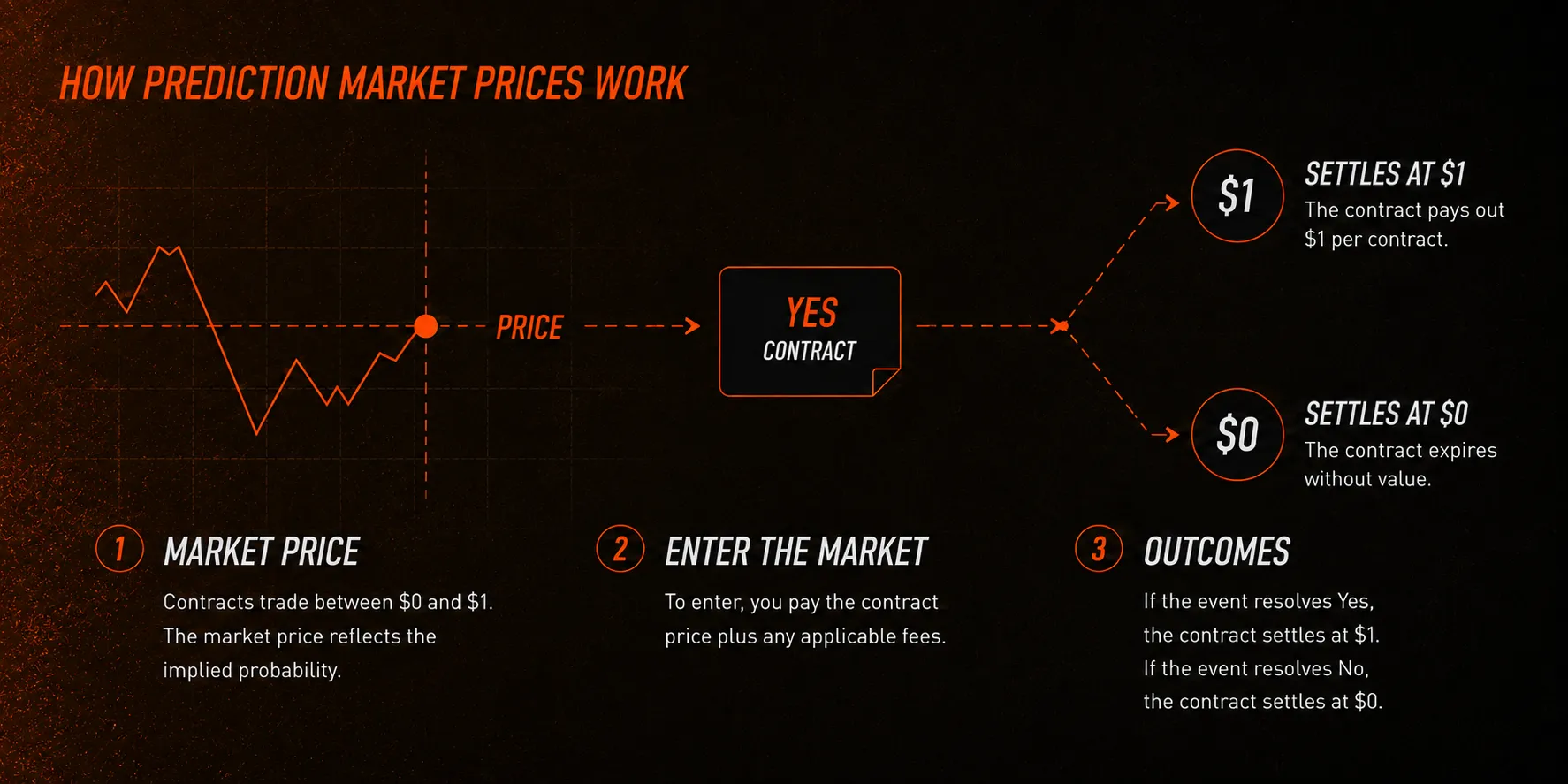
Contracts are structured around “Yes” or “No” outcomes. A contract trading at 56% costs $0.56, suggesting the market sees a 56% chance of that outcome occurring. When the market settles, the contract pays either $1 if correct or $0 if incorrect.
What types of weather and climate prediction markets are there?
Weather and climate markets can cover several kinds of measurable outcomes:
- Temperature markets: Daily highs or lows, temperature thresholds or defined temperature ranges.
- Precipitation markets: Rainfall or snowfall tied to a measurable amount.
- Storm markets: Storm events or storm-related measurements with a clear definition.
- Seasonal weather markets: Conditions measured across a season or fixed period.
- Climate record markets: Annual temperatures, historical rankings or related climate measurements.
- Multi-outcome climate markets: Several possible rankings or ranges inside one market.
Weather vs climate prediction markets: what changes?
A daily weather contract and a yearly climate contract can both depend on temperature data. However, the timeline is completely different.
For a short-term weather contract, traders may watch forecast-model updates and fresh observations. Radar, satellite information and local conditions near the measurement point can also change the picture quickly.
If a storm track shifts or a new station reading comes in differently than expected, the market can reprice before the observation window closes.
Longer-term climate contracts are built from accumulated data. One hot week, cold snap or storm season becomes part of the record. Year-to-date measurements, temperature anomalies, seasonal patterns, updated datasets and the time left in the period can keep shifting expectations.
Think of a hottest-year ranking market. The contract may ask whether a year finishes first, second, third or another stated position in the historical record.
Daily weather still feeds the result, but settlement comes from the final rank in the dataset named by the contract.
What affects weather and climate prediction market prices?
Prices move when new information changes the expected weather or climate outcome. Traders may follow:
- Forecast highs and lows
- Rainfall and snowfall estimates
- Hurricane tracks, wind speeds and landfall projections
- Live radar, satellite images and official weather-station readings
- Severe-weather, drought and wildfire alerts
- Monthly and annual temperature reports
- El Niño and La Niña updates
Updates matter most when they change the likelihood of settlement. For example, a revised temperature prediction may push the expected temperature above a contract’s threshold, while new climate data may change the expected annual ranking.
Why do the location, dataset and measurement period matter?
Two people in the same city can feel different weather. The contract doesn’t care which one feels right. It cares about the station, region or data source written into the rules.
That’s why a general city forecast may not be enough. The contract may use a specific station, unit and weather variable. A daily high in °F is different from an average temperature, just like inches of rain are different from millimeters of snowfall.
For climate markets, a record or ranking may depend on the dataset named in the rules and the method behind that dataset. Preliminary data may point one way, while finalized data or later corrections may change the number used for settlement.
Before treating the outcome as obvious, match your forecast or data view to the contract. Check the place, variable, unit, measurement period, official provider, data status, revision rules, fees and other contract terms.
Weather prediction markets vs weather forecasts
Prediction market | Weather forecast | |
Purpose | Trade a defined event outcome | Estimate future weather conditions |
Output | Market-implied probability | Forecast value or range |
Settlement | Defined event rules | No trade settlement |
Key question | Will this outcome occur? | What weather is expected? |
Why do traders use weather and climate prediction markets?
Weather and climate prediction markets let traders earn money if their own weather predictions turn out to be correct.
That can make weather trading interesting for people who already follow meteorology, seasonal outlooks or climate datasets. A strong forecast still has to line up with the contract’s location, measurement window, data source and settlement rule.
What are the risks of weather and climate prediction markets?
Weather and climate event contracts can settle against your position. If that happens, the loss may include what you paid to enter the trade, plus fees.
Forecasts help, but they don’t guarantee the contract result because models may disagree and storm tracks may shift close to the observation window. The official reading may also come in differently than nearby conditions suggest.
Some markets may also have lighter liquidity, which can affect the price available when you enter or exit. Misreading the station, dataset, measurement period or settlement source can turn a reasonable forecast into the wrong contract view.
How to trade weather and climate prediction markets on OG.com
With OG.com, you can trade event contracts on real-world outcomes across different market categories, including weather and climate.
- Create an account: Open an account and complete sign-up, including identity verification. You can use our web or mobile platforms.
- Browse markets: Explore markets across weather and climate.
- Review and trade: Compare the market price with your own view. Check the rules, fees and settlement details before opening a position.
- Monitor your position: After trading, your contract appears in your open positions, where you can track price movement as new information comes in.
FAQs about weather and climate prediction markets
What are weather derivatives?
Weather derivatives are financial contracts whose payoff links to a specified weather variable or index. They’re related to weather markets, but they use their own contract structure and payoff rules.
What is a weather prediction market?
A weather prediction market is an event market tied to a measurable weather outcome, such as a temperature threshold, rainfall amount, storm result or other defined condition.
How do weather prediction markets work?
Weather prediction markets turn a forecast question into a contract with rules. The contract defines the variable, location, threshold, observation period and data source used for settlement.
What is the difference between weather prediction markets and weather derivatives?
A weather prediction market prices a defined event outcome. A weather derivative links its payoff to a specified weather variable or index, often through a different financial structure.
How do temperature prediction markets settle?
Temperature prediction markets settle according to the measurement source named in the contract. That can include a specific station, date, time window, unit and threshold.
How do climate prediction markets work?
Climate prediction markets focus on longer-period outcomes, such as annual records or climate rankings. Settlement depends on the dataset, measurement period and source named in the rules.
What data determines the outcome of a weather prediction market?
The contract rules determine which data count. Check the official source, location, units, observation period and any treatment of corrections or revised data.
Important information: Prediction is an event contract that is a derivatives product offered by North American Derivatives Exchange, Inc. (NADEX), a CFTC-regulated exchange, which does business under the brand OG.com Prediction Markets (OG). Crypto.com | Derivatives North America uses a CFTC-regulated exchange that uses OG.com technology.
Trading on OG.com involves risk and may not be appropriate for all. By trading you risk losing your cost to enter any transaction, including fees. You should carefully consider whether trading on OG.com is appropriate for you in light of your investment experience and financial resources. Any trading decisions you make are solely your responsibility and at your own risk.