After a few record-breaking years, many traders are wondering: will 2026 become the hottest year ever recorded?
Climate
By Sean O'Meara
The answers, of course, depend on several moving pieces but these outcomes are also becoming tradable through regulated event contracts.
One such option is to trade a climate event contract on OG.com, which uses the same publicly available data used by researchers to determine annual temperature rankings. Here, we look at everything you need to know about it.
This article is for informational purposes only and should not be construed as financial or investment advice. Trading involves risk.
Where 2026 stands so far
The first half of 2026 has remained one of the warmest years ever observed. According to NOAA’s January to June global temperature analysis, 2026 ranks near the top of the historical record. But while mid-year rankings provide an important snapshot, they don’t determine the final outcome.
Rising greenhouse gas concentrations have slowly increased global average temperatures. This means that every year starts from a warmer baseline than previous generations expected. However, even the smallest difference in degree Celsius can separate the first and second warmest years on record.
What’s more, temporary climate patterns, including El Niño, can have a big effect on which year claims the top spot. In short, there are varying factors that contribute to overall global temperatures and whether these remain constant for the remainder of the year is yet to be determined.
When scientists talk about the hottest year on record, they’re talking about the global average surface temperature. This is calculated from thousands of land stations, ocean measurements and satellite-supported observations. It also looks at data from:
NASA's GISTEMP
NOAA's Global Temperature dataset
Berkeley Earth
The UK's HadCRUT dataset
While each uses slightly different methodologies, they typically agree on the order of the warmest years with only minor differences when it comes to exact temperature estimates.
OG.com and climate event contracts
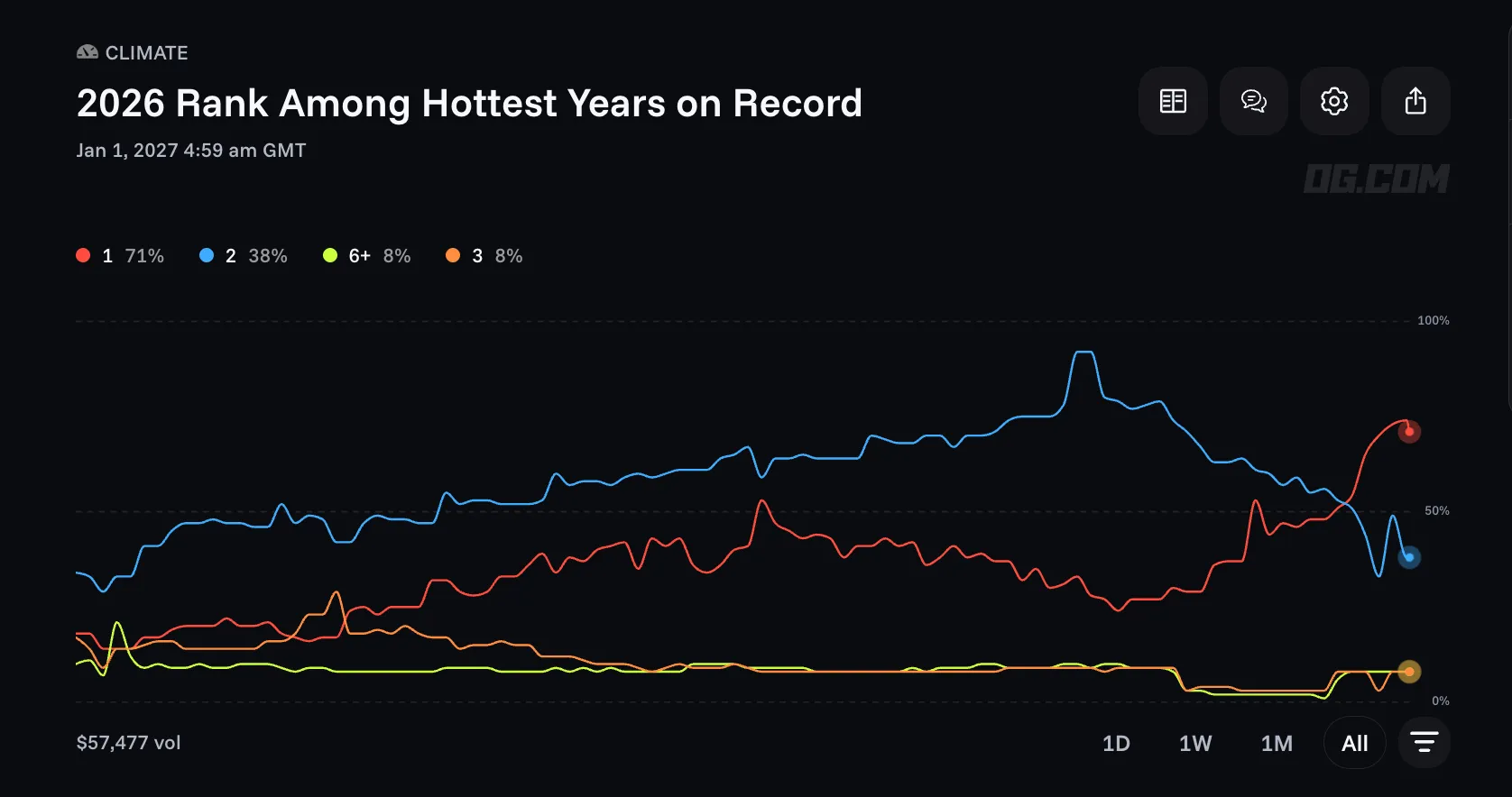
OG.com uses the final annual NASA GISTEMP global surface temperature ranking to determine the settlement of the event contract “2026 Rank Among Hottest Years on Record”. Once NASA publishes its annual dataset, the contract resolves.
Market data as of 11 August 2026. For up-to-date implied probability check OG.com platform.
At the time of writing, the OG.com prediction traders priced the implied probability of 2026 being the hottest year on record at 71%, while the second place is priced at 38%.
Climate event contracts use a straightforward event-based structure. Individuals buy or sell contracts tied to a clearly defined outcome such as whether 2026 will finish as the hottest year on record or rank second instead. If the specified event occurs according to the contract’s settlement rules, the contract resolves.
These markets are based on measurable real-world events. Individuals know the settlement source, the event definition and the resolution process. Market prices reflect current expectations rather than certainty and can change as new data, forecasts and observations become available.
El Niño 2026: the factor that may decide the ranking
Varying climate patterns can have a huge impact on the final ranking. One example of this is El Niño, a weather event that sees a naturally recurring climate cycle in the tropical Pacific Ocean.
Here, warmer-than-average ocean temperatures can alter atmospheric circulation and affect weather patterns around the world. And, more importantly, its influence on global temperatures isn’t immediate and can take several months. This means that the timing and strength of an El Niño event matter.
Research shows that strong El Niño events contributed to the record temperatures in 2023-2024. El Niño is just one part of the picture, however. Greenhouse gases, ocean temperatures elsewhere, volcanic activity, atmosphere feedback and other natural sources of variability can all influence the final outcome.
What climate scientists are forecasting for 2026
No organization can say for sure where 2026 will rank but several have published outlooks. The World Meteorological Organization (WMO) continues to project that the coming years are likely to remain exceptionally warm. What’s more, analysis by Carbon Brief also points to 2026 remaining firmly within the group of the warmest years on record.
While each organization uses different modeling approaches, they do seem to agree that 2026 could finish near the top of historical rankings. However, several climate variables could evolve during the remainder of the year.
Scenario breakdown: where could 2026 finish?
As the differences between the warmest years are so small, several outcomes remain possible.
Scenario 1: 2026 finishes as the hottest year ever recorded
For 2026 to claim the top spot, a developing El Niño event would probably have to happen quickly, so that it could influence global temperatures before the end of the year. Sea surface temperatures around the world would also need to remain high.
However, there are events that could reduce this outcome such as a major volcanic eruption and if Pacific warming develops more slowly than expected.
Scenario 2: 2026 finishes as the second warmest year
If this were to happen, it could be because El Niño develops during the latter part of the year, warming the local area but not enough to lift the annual average above 2024’s high benchmark. This is what’s currently priced on OG.com climate markets.
Scenario 3: 2026 finishes third or lower
This outcome would require one or more cooling influences such as an unexpected volcanic eruption, other atmosphere or oceanic feedbacks or El Niño developing more slowly than thought.
Ultimately, the final ranking will depend on observations rather than forecasts and until the complete year’s data is available and NASA finalizes its annual global temperature analysis, multiple scenarios remain possible.
What are climate event contracts?
Climate event contracts allow individuals to trade on whether a clearly defined real-world event will occur. Each contract specifies:
The event being measured.
The official settlement source.
The conditions required for the contract to resolve.
The contract's expiration date.
In OG’’s 2026 Rank Among Hottest Years on Record, the final outcome references NASA's final GISTEMP global annual temperature ranking, providing participants with a clearly defined and independently published outcome.
Remember, event contracts can gain or lose value as expectations change, and therefore you should understand both the contract specifications and the risks involved before trading.
FAQs about the hottest day on record
Will 2026 be the hottest year on record?
There’s no definitive answer for the hottest year on record until annual observations are complete and the official global temperature datasets are finalized. At the time of writing, the OG.com prediction traders priced the implied probability of 2026 being the hottest year on record at 71%, while the second place is priced at 38%. Check the latest market data for up-to-date implied probability.
What is the current global temperature ranking for 2026?
Based on NOAA's year-to-date global temperature analysis, 2026 ranks among the warmest years on record so far.
How does El Niño affect global temperatures?
El Niño typically raises global average temperatures by warming the tropical Pacific Ocean and altering atmospheric circulation.
What was the hottest year ever recorded?
According to major global temperature datasets, 2024 currently holds the highest annual temperature on record.
How is the hottest year on record determined?
Organizations such as NASA, NOAA and the Met Office calculate annual global temperature anomalies using worldwide land and ocean observations.
What is a climate event contract?
A climate event contract is a regulated derivatives product where the value depends on whether a predefined climate-related event occurs according to an official settlement source.
How do prediction markets price climate outcomes?
Prices reflect current prediction traders’ expectations based on available information. As new climate observations and forecasts emerge, prices may change as traders react to new information.
Where can I trade climate event contracts in the US?
One option is OG.com, which offers CFTC-regulated event contracts covering a range of real-world outcomes.
What data source does OG.com use to settle its hottest-year contract?
The 2026 Rank Among Hottest Years on Record contract settles using NASA's finalized annual GISTEMP global temperature ranking.
Important Information: Prediction is an event contract that is a derivatives product offered by North American Derivatives Exchange, Inc. (NADEX), a CFTC-regulated exchange, which does business under the brand OG.com Prediction Markets (OG) Crypto.com | Derivatives North America and uses a CFTC-regulated exchange that uses OG.com technology.
Trading on OG.com involves risk and may not be appropriate for all. By trading you risk losing your cost to enter any transaction, including fees. You should carefully consider whether trading on OG.com is appropriate for you in light of your investment experience and financial resources. Any trading decisions you make are solely your responsibility and at your own risk.