Democratic presidential nominee 2028 predictions: Who leads the field?
Kamala Harris leads early Democratic primary polls, but several other Democrats have attracted more support in OG’s nomination market.
Politics
By Barbara Pazur

Kamala Harris leads national Democratic primary polls, but prediction markets aren't following her lead. Jon Ossoff, Gavin Newsom, and Alexandria Ocasio-Cortez have higher prices in OG's 2028 Democratic presidential nominee market.
The gap raises an interesting question about the race. Are voters sticking with a familiar name while traders expect someone else to emerge? With the first Democratic primary scheduled for January 2028, the race is still wide open.
This article is for informational purposes only and should not be construed as financial or investment advice. Trading involves risk.
What are the 2028 Democratic nomination predictions?
Ossoff, Ocasio-Cortez, and Newsom are trading within a few percentage points of each other, while Harris is further back.
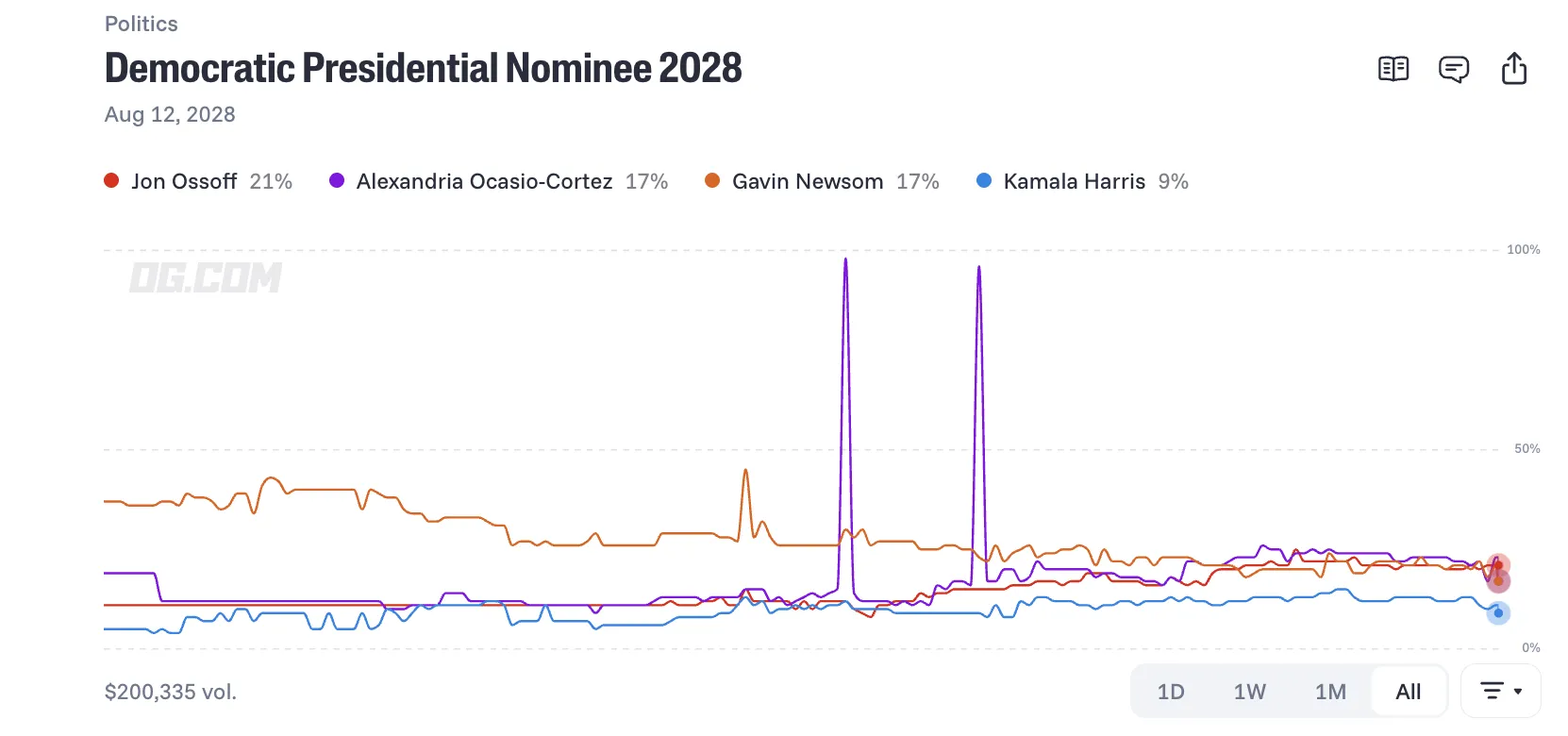
National polling looks quite different. Harris holds a double-digit lead over Newsom, while Pete Buttigieg polls ahead of both Ocasio-Cortez and Ossoff.
Potential Democratic nominee | OG market-implied probability | National polling average |
Jon Ossoff | 21% | 8.6% |
Gavin Newsom | 18% | 14.4% |
Alexandria Ocasio-Cortez | 17% | 11.1% |
Kamala Harris | 10% | 25.9% |
Pete Buttigieg | N/A | 12.9% |
Mark Kelly | N/A | 6.5% |
Josh Shapiro | N/A | 5.7% |
Andy Beshear | N/A | 4.0% |
Based on publicly available information as of October 26, 2026. Source: RealClearPolling.
For example, a Yes contract priced at 21¢ suggests roughly a 21% market-implied chance of Ossoff securing the nomination. If he wins, the contract settles at $1. If he doesn't, it settles at $0, subject to the market rules.
The prediction market prices reflect trading activity, not a poll of Democratic voters. They can move as the field develops, and trading involves risk.
Jon Ossoff
Jon Ossoff has another election to get through before 2028. The Georgia senator is seeking reelection this November, nearly six years after winning his seat in a January 2021 runoff.
His Senate campaign puts him back in the national spotlight. Georgia has been closely contested in recent federal elections, and the result could influence how Democrats view his political future.
For now, Ossoff leads our Democratic presidential nominee 2028 market at 21%, even though he draws just 8.6% in national primary polling. His immediate priority, however, is holding onto his Senate seat.
Gavin Newsom
California Governor Gavin Newsom has made himself one of the Trump administration's most prominent Democratic critics. He's also campaigning for Democrats outside California ahead of the midterms, putting him in front of voters who could matter in a future presidential primary.
Newsom polls at 14.4% nationally, second only to Harris, while our nomination prediction market puts him at 18%. His national political activity has attracted attention, although he hasn't announced a presidential campaign.
Alexandria Ocasio-Cortez
Alexandria Ocasio-Cortez has built a following far beyond her New York congressional district through her progressive positions and outspoken criticism of Republican policies.
The question for a potential presidential campaign is how that support translates across the Democratic electorate. Her nomination contract is priced at 17% on OG, while her national polling average stands at 11.1%, behind Harris and Newsom.
Kamala Harris
Harris is first in the polls, but not in the market. She has one advantage her potential rivals can't claim: she's already run for president as the Democratic nominee.
Her 2024 campaign gives her nationwide name recognition and an established network of supporters. But another run would also raise questions about what she could do differently after losing to Trump.
National polling still puts Harris ahead at 25.9%, although individual surveys vary. She received 38% in September's Harvard-Harris poll but just 19% in October's Echelon Insights survey.
Harris hasn't ruled out another run. She's campaigning for Democrats ahead of the midterms, including stops in Nevada and New Hampshire, both early states on the 2028 primary calendar.
For now, her 10% price in our Democratic presidential nominee 2028 predictions market is well below her standing in national polls.
Other 2028 Democratic primary candidates to watch
Pete Buttigieg polls at 12.9% nationally, but his support is considerably stronger in New Hampshire. An October survey put him at 28%, making him a potential contender worth watching when the early primaries begin.
Josh Shapiro governs Pennsylvania, a state both parties have fought hard to win in recent presidential elections. Andy Beshear has twice won the governorship in heavily Republican Kentucky. Their records offer different perspectives on how Democrats might appeal to voters outside the party's traditional strongholds.
Mark Kelly, a US senator for Arizona and former astronaut, also features in early nomination polls, averaging 6.5% nationally.
Polls vs. prediction markets 2028
Harris leads national polling by 11.5 percentage points. Yet, as we’ve seen, several other Democrats have higher prices in our Democratic presidential nominee 2028 market.
Polls ask people which candidate they currently prefer, usually from a list of potential contenders. Prediction markets ask a different question: who will win the 2028 Democratic nomination?
That leaves room for very different results. Someone might name Harris in a poll today while a trader expects Newsom or another Democrat to attract more support once campaigning begins.
The gap can also reflect uncertainty over who actually runs. Some candidates may enter the race, while others decide against it.
What early polls can and can't tell us
Early polls can show name recognition and existing voter support. They can also change considerably as voters hear more from candidates.
Recent polling illustrates this. Harris received 38% in the September Harvard-Harris survey but 19% in the October Echelon Insights poll. Different samples and survey methods can produce quite different results.
Prediction-market prices can also be misleading when trading activity is low. A few transactions may have an outsized effect on the displayed probability.
Historical research has found that election prediction markets can outperform polls in some forecasting periods, although much of that work concerns general-election vote shares rather than presidential nominations years in advance. It doesn't establish that today's prices accurately identify the eventual 2028 nominee.
How the 2028 Democratic primary calendar works
South Carolina kicks off the 2028 Democratic primaries on January 22. The Democratic National Committee (DNC) approved six early states in August 2026, adding New Mexico and Virginia to the lineup.
Date | State |
Jan. 22, 2028 | South Carolina |
Feb. 1, 2028 | Nevada |
Feb. 8, 2028 | New Hampshire |
Feb. 15, 2028 | New Mexico |
Feb. 22, 2028 | Michigan |
Feb. 29, 2028 | Virginia |
Based on publicly available information as of October 26, 2026. Source: DNC, August 15, 2026.
The early contests could give lesser-known candidates a chance to challenge the national frontrunners, particularly if they perform better than expected in South Carolina or New Hampshire.
How the Democratic nomination process works
Candidates compete for delegates through state primaries and caucuses. Democrats use proportional allocation, meaning qualifying candidates can share a state's delegates rather than the winner taking them all. A candidate needs a majority of delegates to secure the nomination.
The party also has automatic delegates, known as 'superdelegates.' Their voting rights depend on convention rules, which can limit their participation in the first ballot.
What could reshape the 2028 Democratic field?
The next major event on the political calendar is the November 3, 2026 midterm election. Its results could influence which Democrats receive greater national attention before the presidential primary campaign begins.
Several developments are worth following:
- The 2026 midterms: Candidates campaigning in competitive races could gain exposure before 2028.
- Campaign announcements: The field could change significantly once prominent Democrats confirm whether they're running.
- Fundraising: Candidates need financial support to build campaign organizations and compete across multiple states.
- Endorsements: Support from influential party figures could help contenders attract attention and organize voters.
- Early-state results: Strong performances in the first primaries could change polling and nomination-market prices.
Harris is already visiting early primary states, while Ossoff is focused on his Senate reelection campaign. Other potential contenders are also supporting Democrats in the midterms.
Once candidates begin formally entering the race, voters and traders can assess actual campaigns rather than hypothetical ones.
How to trade political event contracts on OG.com
With OG.com, you can trade event contracts on real-world outcomes across different market categories.
- Create an account: Open an account and complete sign-up, including identity verification. You can use our web or mobile platforms.
- Browse markets: Explore markets across politics, economics, culture, sports, and other real-world events.
- Review and trade: Compare the market price with your own view. Check the rules, fees, and settlement details before opening a position.
- Monitor your position: After trading, your contract appears in your open positions, where you can track price movement as new information comes in.
FAQs about Democratic presidential nominee 2028 predictions
Who is the current frontrunner for the 2028 Democratic presidential nomination?
Kamala Harris leads national Democratic primary polling at 25.9%, while Jon Ossoff, Gavin Newsom, and Alexandria Ocasio-Cortez have higher prices in our latest prediction market.
What do prediction markets say about the 2028 Democratic primary?
Across major prediction markets, Jon Ossoff, Gavin Newsom, and Alexandria Ocasio-Cortez are trading at roughly 14% to 21% to secure the Democratic nomination. Kamala Harris trails at around 6% to 10%, despite leading national primary polls.
How does the 2028 Democratic primary calendar differ from 2024?
The DNC has approved six early states for 2028, including New Mexico and Virginia, with South Carolina retaining the first contest.
What is the difference between polls and prediction markets for the 2028 race?
Polls measure respondents' current candidate preferences, while prediction-market prices reflect trading on who ultimately wins the nomination.
How does the Democratic delegate system work?
Candidates earn pledged delegates through state primaries and caucuses, generally using proportional allocation under party rules.
What role do superdelegates play in choosing the Democratic nominee?
Superdelegates are Democratic Party leaders and officials who can support any candidate but generally can't vote on the first ballot unless a nominee already has enough pledged delegates. They can vote in later rounds if no candidate secures the nomination.
Have any Democrats officially declared for 2028?
As of October 26, 2026, the major potential Democratic nominees discussed in this article haven't formally announced presidential campaigns.
How accurate are prediction markets for presidential nominations?
Historical studies show forecasting value in some election markets, but there isn't sufficient evidence to treat 2028 nomination prices as reliable forecasts this far ahead.
When is the first 2028 Democratic primary?
South Carolina is scheduled to hold the first Democratic presidential primary on January 22, 2028.
What factors could change the current frontrunner standings before 2028?
The 2026 midterm results and candidate announcements could significantly affect nomination polling and prediction-market prices.
Important Information: Prediction is an event contract that is a derivatives product offered by North American Derivatives Exchange, Inc. (NADEX), a CFTC-regulated exchange, which does business under the brand OG.com Prediction Markets (OG) Crypto.com | Derivatives North America and uses a CFTC-regulated exchange that uses OG.com technology.
Trading on OG.com involves risk and may not be appropriate for all. By trading you risk losing your cost to enter any transaction, including fees. You should carefully consider whether trading on OG.com is appropriate for you in light of your investment experience and financial resources. Any trading decisions you make are solely your responsibility and at your own risk.