Dead rubber matches can be interesting to watch because they often produce unexpected results that defy statistics and form.
Soccer
By Sean O'Meara
In this guide we’re exploring how dead rubber matches happen and why they matter in prediction markets.
This article is for informational purposes only and should not be construed as financial or investment advice. Past performance does not guarantee future results.
What does dead rubber mean in soccer?
In soccer, the term “dead rubber” describes a single match in a series or tournament in which the result has no bearing on the outcome of a team’s overall ranking in the series. Dead rubber matches necessarily occur toward the end of a series, once the competing teams have accumulated enough points for the final table, or league, to form.
In many cases, by the end of the series there will be teams who can’t move up or down in the league due to the points difference between them and the teams below.
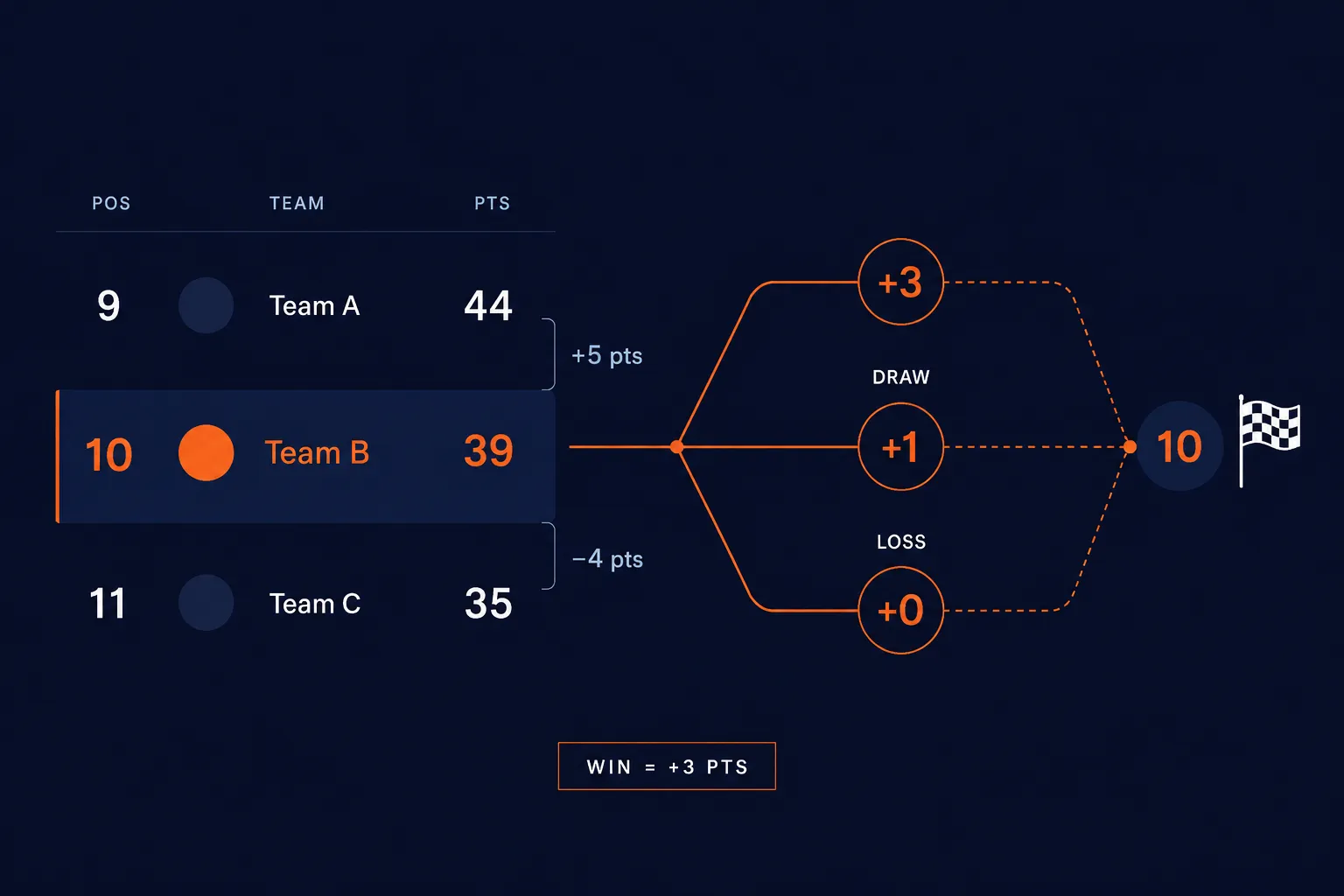
For example, a team in 10th place in a soccer league may be four points higher than the team below them and five points behind the team above. A win is worth three points, so winning, losing or drawing means they remain in tenth place, regardless of results.
When do dead rubber matches happen?
A dead rubber in a soccer match happens when both teams essentially have nothing to play for, because winning doesn’t advance their position in any material way.
Often, the outcome of dead rubber matches defy expectations as teams are relieved of the pressure of needing to win and coaches take the opportunity to experiment with team selection and tactics.
There are some nuances to the dead rubber concept, with interpretations of ‘nothing to play for’ varying, depending on who is involved.
For example, a team may have been relegated before their last game, but they can still finish one place higher in the table with a win. They are still relegated, but can avoid finishing bottom of the league.
To some, the game is still meaningless because relegation is guaranteed. To others, the chance to finish one place higher provides enough incentive.
Why dead rubber matches are different in 2026
The updated 2026 format lends itself to producing dead rubber matches in the group stage. The format, which starts with 12 groups of four-team mini leagues, with the top two teams from each group progressing to the knockout stage, along with eight of the 12 highest ranked third-placed teams also progressing.
Due to the league format of the group stage, some teams may get to the third game either having already qualified or already being eliminated. Some teams may have qualified, but have an incentive to win to play a lower ranked team in the knockout stage.
The following scenarios would constitute a dead rubber or ‘partial dead rubber’ match at the 2026 Soccer Championship.
Team A
Team B
Dead rubber
Guaranteed to finish top of their group.
Guaranteed to finish bottom of their group.
Dead rubber
Guaranteed to finish second in the group.
Guaranteed to finish bottom of their group.
Partial dead rubber
Guaranteed to progress, but can finish either top or in second place.
Guaranteed to finish bottom of their group.
Partial dead rubber
Guaranteed to finish third, but incapable of qualifying in the top eight of third-place finishers.
Guaranteed to finish bottom of their group.
Almost a dead rubber
Either guaranteed to finish top or guaranteed to finish bottom.
A slim outside chance, but reliant on other results to determine whether they progress.
What can still matter in a dead rubber match?
Dead rubber matches in soccer still matter. The extent to which they matter depends on a few things, including the depth of the respective squads, rivalries with opponents, fan expectations and the personality of the head coaches.
Depth of squad
When the result is immaterial, head coaches may elect to experiment with their lineups, either to allow fringe players to participate or, if the team has qualified already and has more games to come, to rest important or injury-prone players.
In most cases, teams will have enough talent on the fringes of their squad to remain competitive while selecting from the bench. In cases where the reserves and substitutes are inexperienced or insufficiently prepared, coaches may elect not to experiment.
Rivalries with opponents and fan expectations
Regardless of their ability to progress or need to win, if the teams competing in a dead rubber match have any sort of rivalry, fans and players should still be motivated to perform.
Playing for pride
If a team has performed badly, the dead rubber match might be their last chance to recoup some pride from the series. In such cases, they may throw caution to the wind and play in an unexpectedly aggressive or positive style.
Head coach
Some head coaches see dead rubber matches as an opportunity to give fringe players a chance, or to rest important players. Other head coaches prefer to stick with their regular playing squad, either for continuity if they are progressing, or out of perceived professionalism.
Dead rubber soccer match examples in 2026
On the final day of the 2017 / 2018 English football season, the team that had won the second tier played the team that finished bottom. Both teams were guaranteed to finish top and bottom respectively, regardless of the result of the game. Surprisingly, the bottom team beat the league champions 3-0.
In the 2026 Soccer Championship there have been two ‘classic’ dead rubber matches and a handful of matches that almost met the full dead rubber criteria.
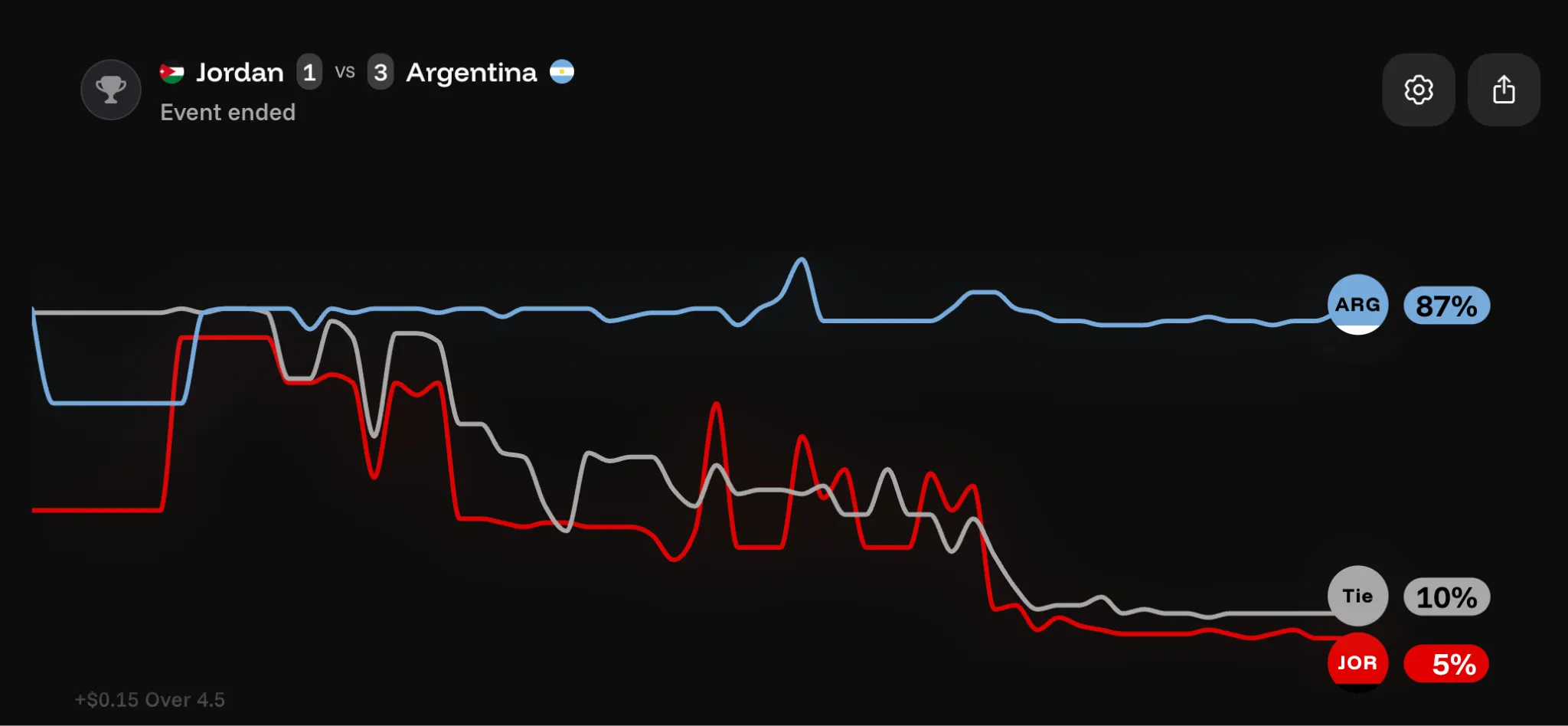
Jordan vs Argentina
Date: Sat 27 Jun 2026
Venue: Dallas Stadium, Arlington
Result: 1–3
Reason: Argentina had already won the group and Jordan were already eliminated, so the game had no impact on either side.
Context: Dead rubber
The market for an Argentina win increased significantly after their second goal, which made the score 2-0. Jordan halved the deficit early in the second half, resulting in some optimism for a surprise comeback.
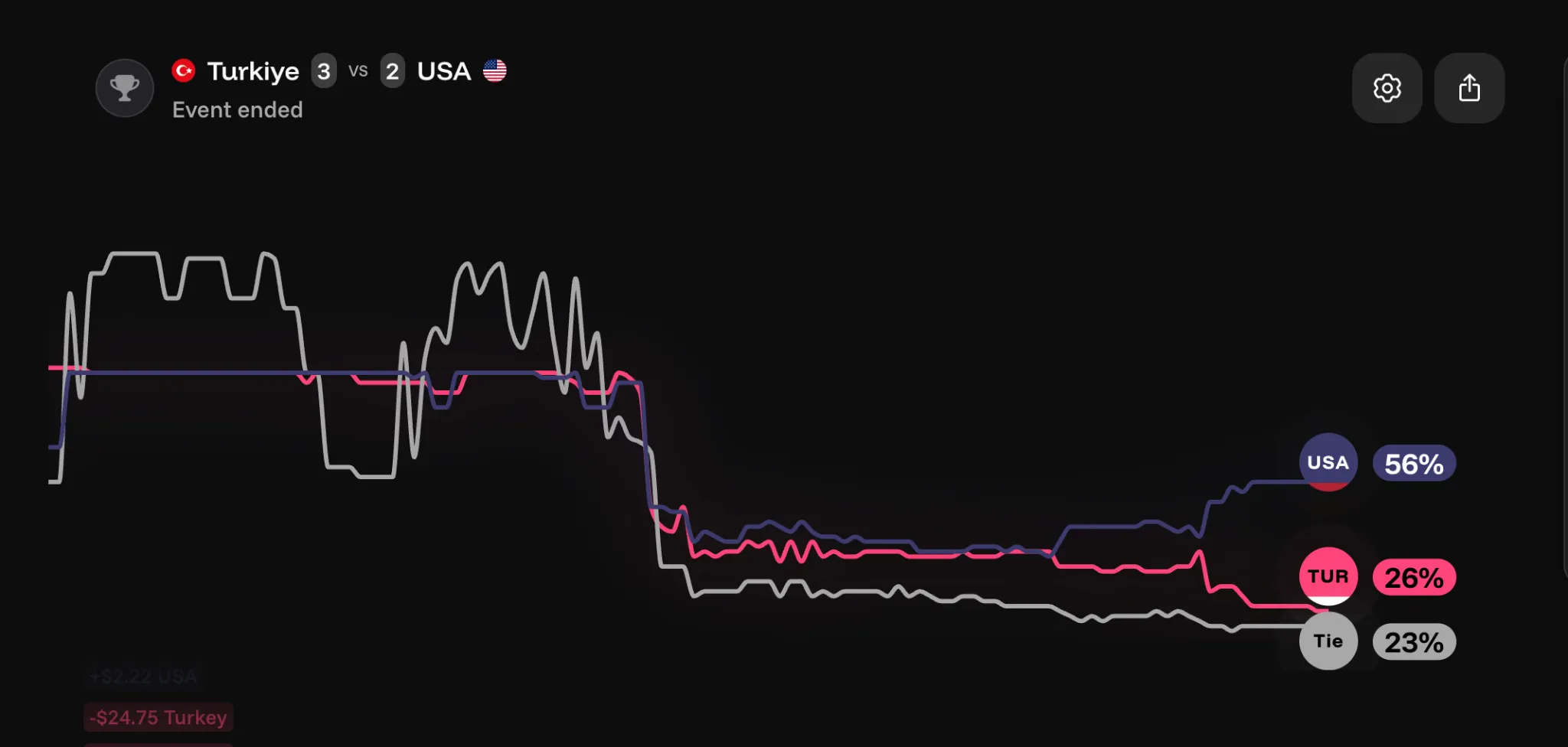
Türkiye vs United States
Date: Thu 25 Jun 2026
Venue: Los Angeles Stadium, Inglewood
Result: 3–2
Reason: USA had already won the group and Türkiye were already eliminated, so the game had no impact on either side.
Context: Dead rubber
This game confounded the form book, with USA fielding a second-string starting 11. Despite this they were market favorites and took the lead after three minutes, spiking their price until Turkey equalized in the tenth. Turkey grabbed a consolation win in virtually the last seconds of the game.
Since the group stages of the tournament have now ended, there is only one game remaining that could be perceived as a ‘dead rubber’: the third place play-off.
While this game does determine who finishes third in the tournament overall, since it features the two losing semifinalists, many teams approach it as a dead rubber.
How to read understand a rubber prediction market
Consider the relative quality of each team. In scenarios where a high ranking team has qualified and a low ranking team has been eliminated, the chances of a form-defying result may be slim.
But where teams are more evenly matched, an unexpected result may be on the cards. This may be especially true if one team decides to bring in fringe players and the other doesn’t.
Consider factors like injury-related absences, previous results, team morale and squad age and depth.
It’s a game in a series or tournament where the result has no impact on the final position or progression opportunities for either team.
Can a Soccer Championship match be a dead rubber?
Yes, there are a handful of scenarios where a Soccer Championship match becomes a dead rubber; both teams qualified, one team qualified and one team can’t qualify, or neither team can qualify.
Does a dead rubber match still count?
Yes, it can affect future rankings and seedings. These games can also have an outsized influence on secondary markets like top goalscorer or goals conceded.
Can a dead rubber match affect prediction markets?
Yes, dead rubber matches often produce unexpected results.This is because coaches may decide to rest important players for the next round, or give fringe players a shot if they’re already out of the contest. Fielding weakened teams in this manner can effectively give weaker teams an advantage, making an upset more likely.
Why can team rotation matter in a dead rubber match?
Coaches often use dead rubber matches to experiment with squad selection and tactics. If one team selects a significantly weaker squad than its opponent, extreme outcomes become more likely.
What should traders check before trading a dead rubber match market?
Injury news, coach’s comments ahead of the game, historic rivalries between the competing teams and fan expectations.
Important Information: Prediction is an event contract that is a derivatives product offered by North American Derivatives Exchange, Inc. (NADEX), a CFTC-regulated exchange, which does business under the brand OG.com Prediction Markets (OG) Crypto.com | Derivatives North America and uses a CFTC-regulated exchange that uses OG.com technology.
Trading on OG.com involves risk and may not be appropriate for all. By trading you risk losing your cost to enter any transaction, including fees. You should carefully consider whether trading on OG.com is appropriate for you in light of your investment experience and financial resources. Any trading decisions you make are solely your responsibility and at your own risk.