What is Pokémon* TCG?
A favorite Pokémon, striking artwork or the surprise inside a pack: every collection starts somewhere. Explore the cards, their history and how to reveal real Pokémon collectibles with OG.com Rips.
Learn
By Ekaterina Drozdovica
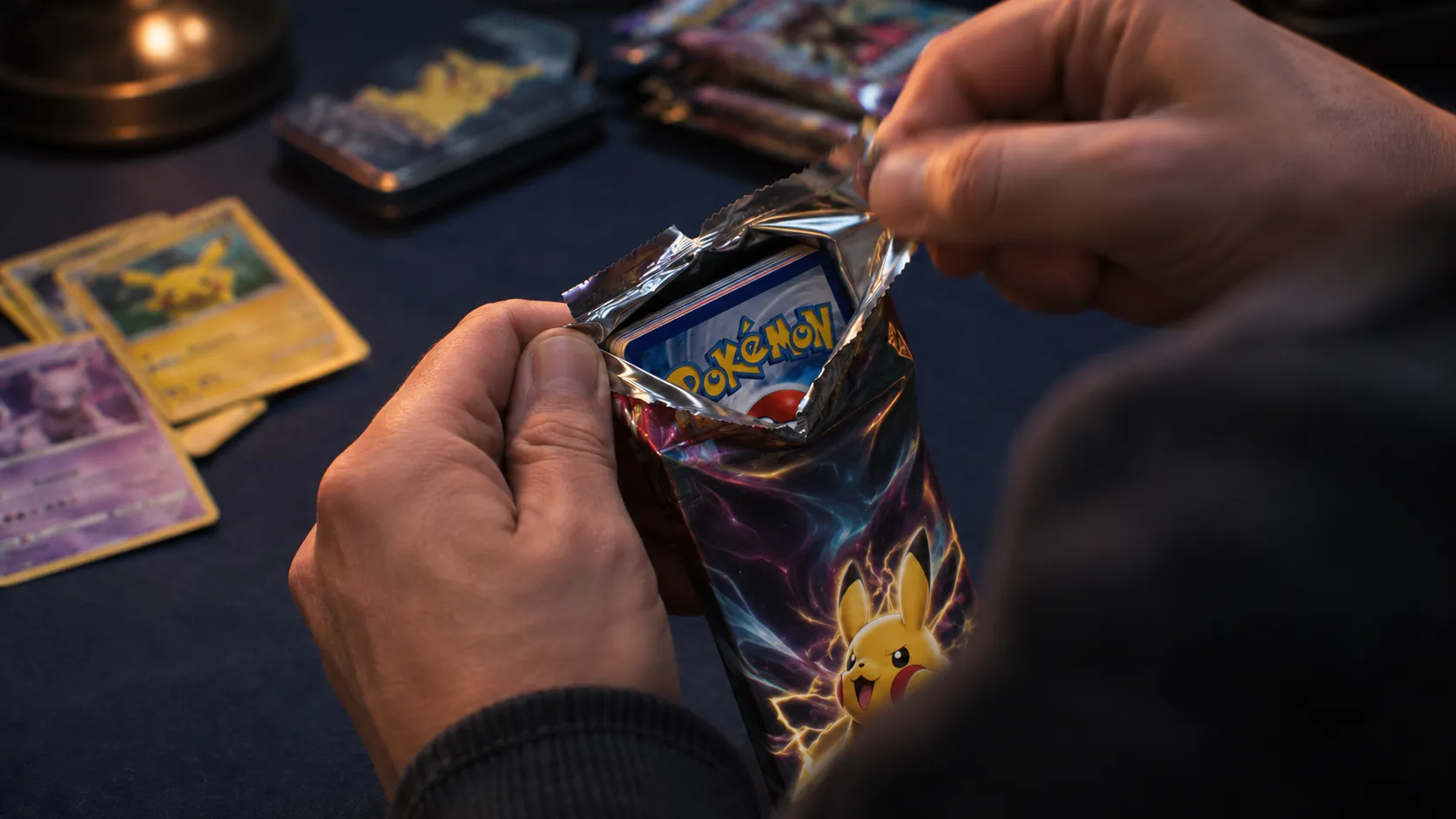
A Pikachu for your binder or a Charizard for your shelf: Pokémon collecting can begin with a character you already love. But unfamiliar symbols, different editions, and grading labels can make that first purchase confusing.
What is Pokémon* TCG?
Pokémon TCG stands for Pokémon Trading Card Game. It lets players build decks and battle using Pokémon characters. Collectors can focus on a favorite Pokémon, complete a set, or follow an illustrator’s work without playing.
Its history reaches back to October 1996, when the game launched in Japan, arriving before the animated series, which debuted in 1997. The U.S. base game set followed in January 1999.
That history may give older cards nostalgic appeal, but a collection does not need to begin with vintage rarities. For example, a spread of different Pikachu illustrations can be a satisfying project of its own.
How does the Pokémon* Trading Card Game work?
In the standard tabletop game, two players each use a 60-card deck containing three main Pokémon card types:
- Pokémon: The characters that battle, with attacks, hit points and sometimes special abilities.
- Energy: Cards that help power attacks.
- Trainer: Cards that provide effects such as finding cards or healing Pokémon.
Players take turns developing their board and attacking. Knocking out opposing Pokémon lets you take Prize cards. Taking all six of your Prize cards is one way to win; others include leaving your opponent with no Pokémon in play or unable to draw at the start of their turn.
If you want to play, a preconstructed deck provides a ready-made starting point. Random packs alone do not guarantee a playable deck.
What should beginners understand about Pokémon* cards?
Two cards featuring the same Pokémon can have very different artwork, rarity, and value. Understanding the set a card belongs to, how rare it is and its condition helps you know exactly what you’re adding to your collection.
Sets and card identity
A set is a named release of cards. To identify a card, check its name, collector number, set symbol or code, language and printing.
Two cards showing the same Pokémon can be different collectibles. Artwork, foil treatment and edition matter, so compare the exact version when checking prices.
Rarity and artwork
Pokémon card rarity describes a card’s classification within its release. Familiar symbols include a circle for common, a diamond for uncommon, and a star for rare, although systems vary across eras.
The Scarlet & Violet series introduced rare and special illustration cards, featuring expansive artwork that can show a Pokémon’s personality or surroundings. These designs give collectors another reason to look beyond battle strength.
Condition and grading
Scratches, worn edges, creases and uneven borders can affect condition. Graded Pokémon cards have been examined by a grading service and usually sealed in a labeled protective holder, often called a slab.
PSA’s grading standards consider features including corners, surface and centering.
How does ripping Pokémon* packs online work?
Online openings take different forms. A livestream seller may open a sealed booster for you and ship its contents. An instant rip reveals a card digitally from the product’s available inventory.
With OG.com Rips, each paid pack contains one real, physical card. This differs from a standard Pokémon booster containing multiple game cards.
When you rip a pack, an animation reveals your card, and you can share the moment with friends on social media. The physical card stays in a secure vault until you sell it back for cash or request delivery.
How do you rip Pokémon* cards on OG.com?
- Sign in or create an account. Open OG.com on the app or website and select Rips.
- Open the Pokémon category. Browse the available pack tiers and prices.
- Check before purchasing. Review the possible contents, probabilities and value ranges on the pack’s Odds page, plus applicable terms.
- Reveal and inspect. Complete payment, select a pack and swipe to rip. Check the revealed card’s identity and grade.
- Choose what happens next. Sell immediately at an offer, or select Keep. You have seven days from the reveal to request shipping or sell. After that, the card is automatically sold.
What should you check before opening a Pokémon* pack?
Start with your collecting goal and spending limit. If you want one exact card, buying it individually gives you certainty; opening a pack adds surprise.
Before paying, check:
- Contents: A sealed booster, a shared break spot, or one graded card?
- Probabilities: Chances for individual cards or broader rarity groups?
- Total cost: Pack price, shipping and applicable taxes.
- Buyback: The offer, withdrawal requirements and decision deadline.
A card’s buyback value can be lower than the pack price. For example, a $30 offer on a $50 purchase returns $20 less than you spent.
FAQs about Pokémon* TCG and online card ripping
Do you need to play Pokémon TCG to collect the cards?
No. You can collect favorite characters, artwork or sets without learning the battle rules.
How do you start collecting Pokémon cards?
Choose a manageable theme, set a budget and start collecting your cards. A favorite Pokémon or one set gives your collection a clear starting point.
How many cards are in a Pokémon booster pack?
Pokémon’s current guidance lists ten game cards, one Energy card and one code card. Contents vary by product and region. Each paid OG.com Rips pack contains one card.
What do the symbols on Pokémon cards mean?
They identify features such as Energy type, set and rarity. The regulation letter concerns eligibility for organized play, rather than condition.
What are holo and reverse holo Pokémon cards?
Traditionally, holo cards have foil within the illustration, while reverse holos have foil around it. Modern sets use additional foil patterns and full-card treatments.
How can you tell whether Pokémon cards are real?
Compare printing, text and packaging with official examples. Pokémon Support recommends consulting a specialist card shop if unsure. For graded cards, also check the certification record.
What does PSA 10 mean on a Pokémon card?
PSA 10 is its Gem Mint grade, describing a virtually perfect card under PSA’s standards. It does not guarantee rarity or value.
Why are some Pokémon cards more expensive than others?
Demand, availability, artwork, edition, condition and usefulness in play can influence prices. Compare recent sales of the exact version.
Can you choose which Pokémon card you get from an online pack?
On OG.com, you choose the category and pack tier. The individual card is revealed after purchase.
Can Pokémon cards opened online be shipped to your home?
On OG.com, eligible cards can be shipped to a U.S. address after identity verification. Request shipping within seven days; delivery charges apply.
Can you sell back a Pokémon card instead of having it shipped?
Yes. On OG.com, accept Phygitals’ displayed offer within seven days. Proceeds enter your USD Wallet and can be withdrawn after identity verification.
Important information: OG.com Rips is offered by OGMUS, subject to Terms and Conditions; 18+ only. OG.com Rips are not regulated by the CFTC. OGMUS also provides access to third-party services, including CFTC-regulated products.
*Pokémon is a third-party brand; its owner is not a party to the sale of cards via OG.com Rips.