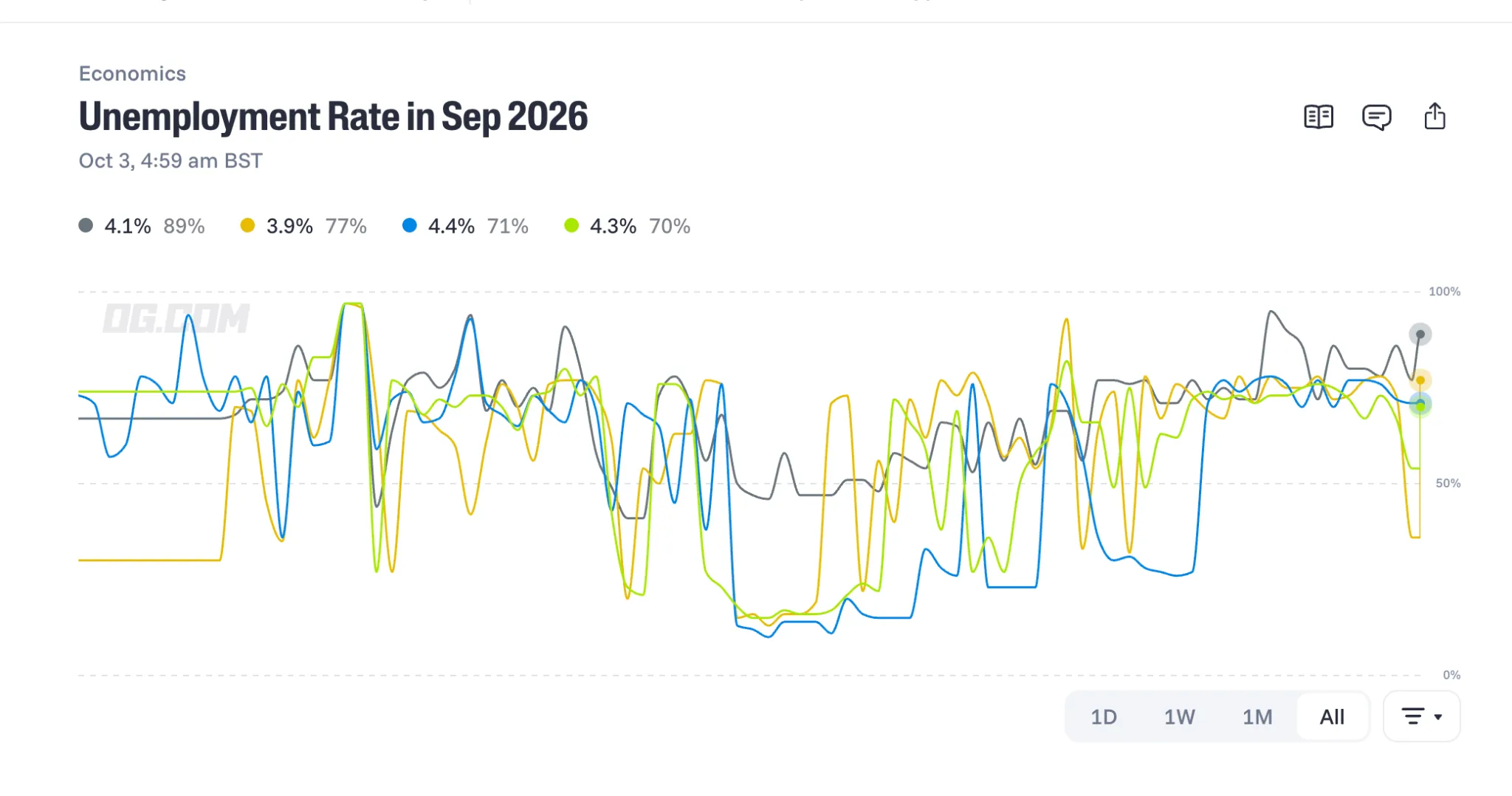
September’s jobs report will test whether US hiring can maintain its momentum, with 4.1% leading the prediction markets probabilities.
Economics
By Ekaterina Drozdovica
The US jobs market heads into September’s report with a stronger hiring figure behind it and plenty of questions ahead. Employers added 162,000 jobs in August, while unemployment held at 4.1%. September’s figures will help show whether that improvement has staying power.
The next release also arrives amid a wider debate about artificial intelligence and employment. Could businesses increasingly replace junior staff with software, or are other economic pressures doing more to explain a difficult job search?
This article is for informational purposes only and should not be construed as financial or investment advice. Past performance does not guarantee future results.
What is the unemployment rate prediction for September?
The 4.1% unemployment contract leads the four outcomes shown on unemployment rate prediction markets, with an implied probability 89%. Next comes 3.9% at 77%, followed by 4.4% at 71% and 4.3% at 70%.
Market data as of September 25, 2026, based on the supplied OG.com screenshot. For the latest prices, check the OG.com platform.
The likely marginal appeal of 4.1% is that it points to the jobs market holding its ground. August’s report showed employers adding 162,000 jobs while unemployment stayed at 4.1%.
That gives traders a concrete reason to expect another unchanged reading: hiring was strong enough to support employment, but it did not bring the unemployment rate down.
At the same time, the uneven recovery makes a sharper improvement harder to justify. More than half of August’s job gains came from restaurants and bars and local government education, while information-sector employment fell.
Taken together, those figures support a middle-ground outlook: enough hiring to make a rise in unemployment less compelling, but too little broad-based strength to confidently expect a fall to 3.9%.
When is the September unemployment rate released?
The US Bureau of Labor Statistics is scheduled to publish September 2026 unemployment data on Friday, October 2, at 8:30 a.m. ET, as part of its monthly Employment Situation report.
What could change September’s unemployment rate?
For traders assessing whether unemployment will stay at 4.1%, three indicators offer useful clues: unemployment claims, private-sector hiring and whether advertised vacancies are turning into actual jobs.
Jobless claims: are more people losing work?
Initial unemployment claims fell to 197,000 in the week ending September 19, down from 198,000 the previous week. The four-week average also declined, to 202,250. That gives the case for stable unemployment some support: new benefit applications are not showing a sustained increase in job losses.
Continuing claims deserve attention too. These edged up by 2,000 to 1.719 million for the week ending September 12, although their four-week average fell. A sustained rise would suggest that people losing jobs are taking longer to find another one, making a higher unemployment reading more plausible.
ADP hiring: is August’s improvement carrying into September?
ADP’s September 22 update showed private employers adding an average of 20,000 jobs a week over the four weeks ending September 5. Hiring accelerated for a third consecutive week, offering an early sign that employers entered September with some momentum.
That supports the argument against a sudden deterioration, but the figures are preliminary and cover only the beginning of September. Traders would need further evidence of sustained hiring before treating them as a reason to expect unemployment to fall.
Job openings: are employers actually filling vacancies?
The next checkpoint is the August JOLTS report, due September 29. July’s figures showed around 7.3 million openings but only 5.1 million hires, down from 5.3 million hires in June. Vacancies were available, but recruitment had slowed.
An increase in actual hires would strengthen the case that jobseekers are finding work, supporting a steady or lower unemployment rate. Another decline in hiring, particularly alongside rising layoffs, would weaken the case for 4.1%. Although JOLTS covers August, it will help traders assess the conditions employers carried into September.
What is Dario Amodei’s unemployment prediction?
Dario Amodei’s unemployment prediction has become a prominent warning about AI’s potential economic impact. In May 2025, the Anthropic CEO told Axios that AI could eliminate half of entry-level white-collar jobs and push unemployment to 10–20% within one to five years.
His warning concerned entry-level white-collar roles, rather than half of all office jobs. It was also a scenario spanning several years, rather than a forecast for September’s release.
In the evidence reviewed, unemployment had risen by 0.77 percentage points since 2022 among workers in the most AI-exposed occupations. The increase among the least exposed was slightly larger, at 0.85 points. That pattern is more consistent with broader labor-market softening than a downturn concentrated in AI-exposed work.
How to trade unemployment rate on OG.com
With OG.com, you can trade event contracts on real-world outcomes across different market categories.
Create an account: Open an account and complete sign-up, including identity verification. You can use our web or mobile platforms.
What is the predicted unemployment rate for September 2026?
The 4.1% contract leads the four displayed outcomes in the supplied OG.com snapshot. That is market pricing, rather than an official forecast, and interpreting its 89% displayed price requires checking the contract’s precise rules.
When will September’s unemployment rate be announced?
The scheduled release is October 2, 2026, at 8:30 a.m. ET, according to theBLS calendar.
Does a lower unemployment rate always mean a stronger jobs market?
No. The rate can fall when people stop looking for work and leave the labor force. Reading it alongside participation and employment provides a fuller picture.
Important Information: Prediction is an event contract that is a derivatives product offered by North American Derivatives Exchange, Inc. (NADEX), a CFTC-regulated exchange, which does business under the brand OG.com Prediction Markets (OG) Crypto.com | Derivatives North America and uses a CFTC-regulated exchange that uses OG.com technology.
Trading on OG.com involves risk and may not be appropriate for all. By trading you risk losing your cost to enter any transaction, including fees. You should carefully consider whether trading on OG.com is appropriate for you in light of your investment experience and financial resources. Any trading decisions you make are solely your responsibility and at your own risk