Will Big Tech layoffs continue in 2026? How prediction markets price job-cut risk
Tech layoff headlines don't always tell the full story. Different trackers measure different things, and what counts as "tech" can vary.
Financials
By Barbara Pazur

This guide explains how tech layoffs are reflected in prediction markets, what can move prices, and why understanding the data behind a contract matters.
This article is for informational purposes only and should not be construed as financial or investment advice. Past performance does not guarantee future results.
What prediction markets are actually pricing
A prediction market lets traders buy and sell event contracts based on whether a specific outcome happens. The market price can be read as an implied probability.
For example, a Yes contract for “More tech layoffs in 2026 than in 2025?” currently trades at 91¢ on the OG.com platform, pricing a 91% chance that this happens. However, that price can change quickly when filings, earnings calls, tracker updates, layoff announcements or broader economic data shift the story.
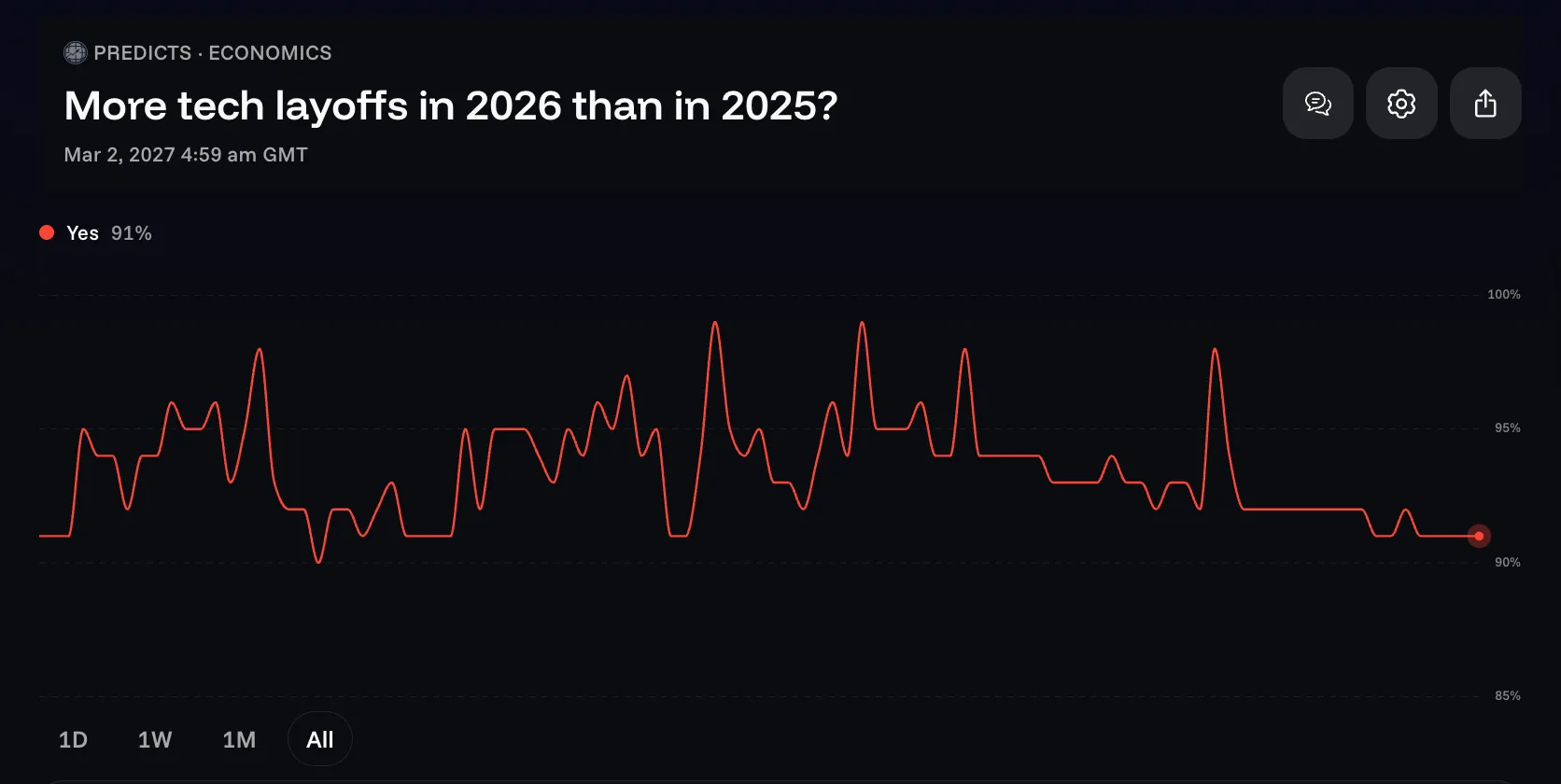
Market data as of 29 July 2026. For up-to-date data, visit OG.com platform.
What counts as ‘Big Tech’?
The phrase ‘Big Tech” is an ambiguous media shorthand, while an event contract always has a clear boundary, because the phrase itself doesn’t settle anything. Most event contracts predicting tech layoffs are tied to a specific data release.
For example, on OG.com, the above-mentioned contract is tied to the Layoffs and Discharges: Information – a data series published by the Federal Reserve Bank of St. Louis (FRED), sourced by the U.S. Bureau of Labor Statistics (BLS).
The data set covers the “Information sector” which BLS labels with NAICS 51 code. In practice, that covers a wide range of companies, including software publishers, streaming platforms, social media companies, film and video businesses, record labels, publishers, and many more.
Some companies have a bigger influence on this data series than others, particularly large telecommunications and software firms. Examples include AT&T, Microsoft, Meta, Comcast, T-Mobile, Charter Communications, Oracle, and Verizon.
What counts as a ‘layoff’?
Before reading a layoff market, check the settlement terms and the data series named in the rules. A headline may describe layoffs one way, while the contract follows the count used by its named source.
Because this contract uses the FRED Layoffs and Discharges: Information series, layoffs and discharges mean employer-initiated separations in the Information sector. That includes layoffs, discharges, and formal suspensions from pay status lasting, or expected to last, more than 7 days.
Companies can still reduce headcount in other ways, including buyouts, hiring freezes, contractor reductions, or team reorganizations. Those moves may shape how traders read the market, but they don’t automatically count toward settlement unless the named data source includes them.
What moves Big Tech layoffs predictions in 2026
If trading the "More tech layoffs in 2026 than in 2025" contract on OG.com, start by looking at what economists and analysts expect from the Layoffs and Discharges: Information data series that settles the contract.
Because this data is published by BLS monthly, traders can track the month-by-month trend in the Information sector. That can provide another way to assess whether layoffs are on pace to finish above or below the previous year's total.
More generally, Big Tech layoffs predictions can move when traders get new signals about costs, revenue, hiring plans or restructuring. One cautious earnings call may not change much. Several similar calls across large companies can make the market more sensitive to the next announcement.
Catalyst | What moves prediction markets | Typical timing |
|---|---|---|
Earnings season | Cost-cutting language, underperforming results | Quarterly |
Major layoff announcement | Especially relevant if data tracker is dominated by mega-companies | Any time |
Macro prints | Higher costs or tighter funding can pressure hiring plans | Monthly |
Tech spend cycle | Weaker budgets can raise concern about future cuts | Rolling |
AI spending can also shape pricing when companies tie job cuts to automation, efficiency, or shifting resources toward AI. News such as Meta’s planned layoffs and transfers in May 2026, including moving thousands of employees into AI initiatives, give traders a concrete example to watch.
The OG.com chart stayed mostly steady around that date, suggesting traders may have already priced in much of the risk.
Mergers and Acquisitions (M&A) can have a similar effect. Acquisitions, integrations and reorganizations can create overlap between teams, which may raise the chance of future job cuts.
Why trackers disagree and why that matters for market pricing
Tech layoff trackers can show different totals because they measure layoffs differently. Some count announced cuts, while others wait until they're confirmed, completed, or reported in official filings. The same layoff round may also appear in company statements, regulatory filings, and news reports, while contractors and regional offices can make the numbers harder to track.
How to get started with prediction markets on OG.com
OG.com gives you access to CFTC-regulated event contracts, so you can trade your view on real-world outcomes across different market categories.
- Create an account: Open an OG.com account and complete identity verification.
- Browse markets: Explore markets across economics, including the tech layoffs in 2026 event contract.
- Review and trade: Compare the market price with your own view. Check the rules, fees and settlement details before opening a position.
- Monitor your position: After trading, your contract appears in your open positions, where you can track price movement as new information comes in.
Trading tech layoffs event contracts: a checklist
- Check the data series: Understand which data series the contract uses, what sector it covers, and what counts as a layoff in that data.
- Read the settlement rules: Check the exact conditions for a Yes or No outcome. Review how revised data is treated, if applicable.
- Confirm the timeframe: Make sure you know the period the contract covers, such as a calendar year or a comparison between two years.
- Watch key catalysts: Follow earnings reports, major company layoff announcements, and scheduled economic data releases that could affect expectations.
FAQs about tech layoffs 2026
When will tech layoffs stop?
Tech layoffs may slow when companies feel less pressure from costs, weak demand, restructuring plans or budget uncertainty, but the timing depends on each company and market cycle.
Why are there so many tech layoffs?
Tech layoffs can pile up when several large companies cut roles in the same cycle, especially after periods of fast hiring or weaker revenue growth.
Are tech layoffs still happening?
Tech layoffs can still happen in 2026, but the better question for a prediction market is whether the specific contract’s layoff threshold and deadline will be met.
Why are tech layoffs happening?
Companies may reduce roles because of cost pressures, weaker demand, post-acquisition overlap, shifts in AI investment or efforts to improve margins.
Why are there so many tech layoffs?
Large tech companies have big workforces, so even targeted cuts can produce large headline numbers.
When did tech layoffs start?
Recent tech layoffs accelerated after the pandemic hiring boom, when many companies started cutting roles as growth slowed and costs rose.
Are more tech layoffs coming?
More tech layoffs are possible if companies keep cutting costs, shifting budgets toward AI, or seeing weaker ad, cloud, or enterprise demand. For this market, the key check is whether the FRED/BLS Information-sector layoff count stays on pace to finish above 2025.
When will tech layoffs end?
There’s no single end date for tech layoffs because each company follows its own hiring, cost-cutting and restructuring cycle.
Important Information: Prediction is an event contract that is a derivatives product offered by North American Derivatives Exchange, Inc. (NADEX), a CFTC-regulated exchange, which does business under the brand OG.com Prediction Markets (OG) Crypto.com | Derivatives North America and uses a CFTC-regulated exchange that uses OG.com technology.
Trading on OG.com involves risk and may not be appropriate for all. By trading you risk losing your cost to enter any transaction, including fees. You should carefully consider whether trading on OG.com is appropriate for you in light of your investment experience and financial resources. Any trading decisions you make are solely your responsibility and at your own risk