Party to win US Senate in 2026: predictions, forecasts, and battleground breakdown
Republicans hold a 53–47 Senate majority, but Democrats are gaining ground in several key races. With control of the chamber at stake, the 2026 midterms are shaping up to be a close contest.
Politics
By Barbara Pazur
Democrats need a net gain of four seats to take control of the Senate after the November 3 election. That means defending their existing seats while making gains in states like Maine, North Carolina, Ohio and Texas.
This article is for informational purposes only and should not be construed as financial or investment advice. Trading involves risk.
Which party will control the Senate in 2026? Predictions
The 2026 Senate election forecast has changed considerably since the beginning of the campaign. Cook Political Report now rates seven Senate races as toss-ups, including six Republican-held seats and one Democratic-held seat. Its October 6 assessment puts the potential Democratic gain at two to six seats.
Republicans have more seats to defend, but Democrats need to win several competitive races without losing vulnerable seats of their own.
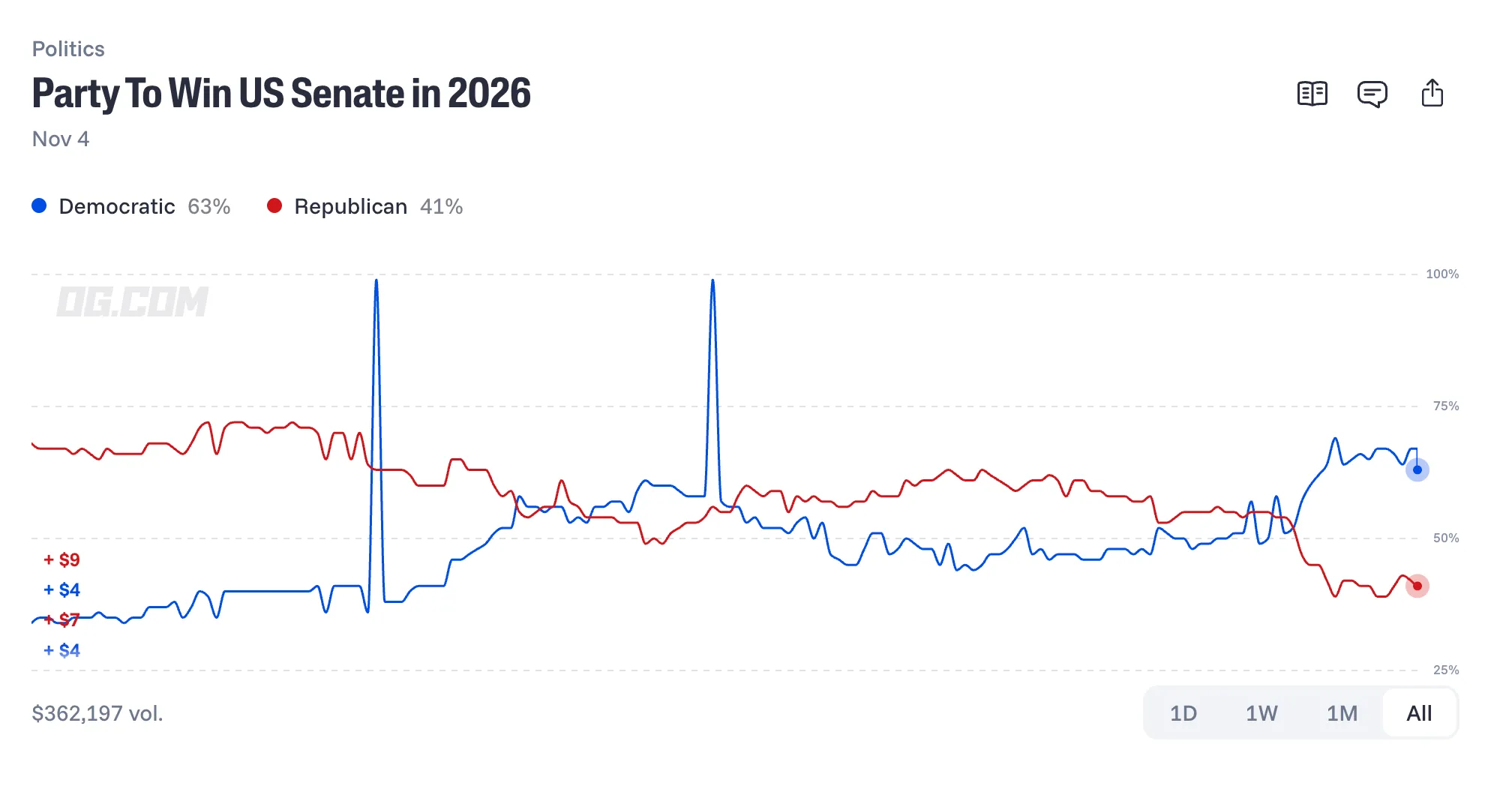
The OG.com Senate-control prediction market currently shows 63% for the Democratic outcome and 41% for the Republican outcome. Both figures reflect market pricing as the November 3 election approaches.
Market data as of 13 October. For the latest predictions, check OG.com.
How many seats each party needs
Republicans currently hold 53 Senate seats, while Democrats hold 45 and two independents caucus with them, bringing the Democratic caucus to 47.
Democrats need a net gain of four seats to take control. A three-seat gain would leave the chamber tied 50–50, with Republican Vice President JD Vance holding the tie-breaking vote.
There are 35 Senate seats on the ballot in 2026, including 33 regular elections and two special elections in Florida and Ohio. Republicans currently hold 22 of those seats, compared with 13 held by Democrats.
Florida's special election follows Marco Rubio's resignation to become secretary of state, while Ohio's follows JD Vance's departure to become vice president. Cook Political Report rates Ohio's race between Republican Jon Husted and Democrat Sherrod Brown a toss-up and Florida's race Solid Republican.
The 2026 midterm Senate map includes several competitive races. The table below covers the main 2026 Senate battleground states, showing key matchups, which party currently holds each seat and how Cook Political Report rates each contest.
State
Key matchup (D vs. R)
Current seat
Cook rating
Maine
Troy Jackson vs. Susan Collins
Republican
Toss Up
North Carolina
Roy Cooper vs. Michael Whatley
Republican
Likely D
Ohio
Sherrod Brown vs. Jon Husted
Republican
Toss Up
Alaska
Mary Peltola vs. Dan Sullivan
Republican
Toss Up
Iowa
Josh Turek vs. Ashley Hinson
Republican
Toss Up
Texas
James Talarico vs. Ken Paxton
Republican
Toss Up
Kansas
Adam Hamilton vs. Roger Marshall
Republican
Toss Up
Michigan
Abdul El-Sayed vs. Mike Rogers
Democratic
Toss Up
Georgia
Jon Ossoff vs. Mike Collins
Democratic
Likely D
New Hampshire
Chris Pappas vs. John E. Sununu
Democratic
Lean D
Based on publicly available information as of October 10, 2026. Source: Cook Political Report.
North Carolina, Iowa, Michigan and New Hampshire are all open-seat races after their incumbent senators decided not to seek reelection. Texas is also an open contest after Republican John Cornyn lost his primary runoff to Ken Paxton.
For Democrats, holding Michigan, Georgia and New Hampshire while flipping four Republican-held seats would secure a majority. Republicans could retain control despite losing three seats, or offset Democratic gains by flipping a Democratic-held seat. That's why results in states such as Michigan could be as important as Democratic pickup opportunities elsewhere.
How polling forecasts compare to prediction markets
Senate majority predictions for 2026 rely on different approaches.
Polling-based forecasts use voter surveys and historical election results to estimate which party could win enough seats to control the Senate. They also account for uncertainty, so a candidate polling at 51% doesn't necessarily have a 51% chance of winning.
Prediction markets reflect traders' expectations of the final outcome through market prices. Those prices can differ from statistical forecasts because traders and forecasting models may interpret the same information differently.
Historical midterm patterns and what they suggest for 2026
The president's party has historically struggled in midterm elections, particularly when presidential approval is low.
Gallup's historical research shows that parties of presidents with approval ratings below 50% have lost an average of 37 House seats in midterms, compared with 14 seats when approval was above 50%.
The figures cover House elections through 2014, but the relationship between presidential approval and congressional performance provides useful context for Senate races too.
President Trump's approval stood at 32% among U.S. adults in a Reuters/Ipsos survey reported on October 5. The same poll found Democrats leading Republicans 44% to 37% among registered voters asked which party they'd support in the congressional elections.
Still, Senate elections don't always follow the national trend. In 2018, Republicans gained two Senate seats despite losing 41 House seats during Trump's first midterm election. In 2022, Democrats gained one Senate seat even as Republicans took control of the House.
Only around one-third of Senate seats are contested in a typical election cycle, so the states holding elections matter as much as the national political mood.
Presidential approval and voter turnout could influence the national result, but the Senate majority depends on how those factors play out across individual battleground states.
How to trade political event contracts on OG.com
With OG.com, you can trade event contracts on real-world outcomes across different market categories.
Create an account: Open an account and complete sign-up, including identity verification. You can use our web or mobile platforms.
FAQs about party to win US Senate in 2026 predictions
How many seats do Democrats need to flip to win the Senate in 2026?
Democrats need a net gain of four seats to reach 51, assuming the two independents continue caucusing with them.
Which states are most likely to flip in the 2026 Senate elections?
Cook rates North Carolina Likely Democratic, while Maine, Ohio, Alaska, Iowa, Texas and Kansas are among the Republican-held toss-ups.
What do prediction markets currently say about 2026 Senate control?
As of October 10, major prediction markets show roughly 60% to 68% for Democratic Senate control. OG.com's Senate-control market displays 68% for Democrats and 43% for Republicans, with each outcome priced separately.
How do 2026 Senate prediction market odds compare to polling-based Senate forecasts?
Polling tracks voter preferences, forecasts estimate possible election results and prediction markets reflect the prices traders assign to those outcomes.
When is the 2026 Senate election?
Election Day is November 3, 2026, with 35 Senate seats being contested, including two special elections.
Why do midterm elections historically favor the party out of the White House?
Voters often use midterms to express dissatisfaction with the president, although Senate results depend heavily on which states have seats up for election.
What role does the vice president play if the Senate is tied 50–50?
The vice president can cast tie-breaking votes, meaning a 50–50 Senate would give Republicans the advantage while JD Vance holds that office.
Which Senate seats have open-seat races in 2026?
Open-seat contests include North Carolina, Iowa, Michigan, New Hampshire and Texas, along with several other states where incumbents are retiring or haven't secured renomination.
How does presidential approval rating affect midterm Senate outcomes?
Low presidential approval can hurt the president's party, although individual Senate contests can produce different results.
Could special elections in Florida and Ohio change the Senate map?
Both seats are currently Republican-held, with Ohio rated Toss Up and Florida Solid Republican by Cook Political Report. A Democratic win in either would shift the Senate balance, but whether it changes control depends on results in other states.
Important Information: Prediction is an event contract that is a derivatives product offered by North American Derivatives Exchange, Inc. (NADEX), a CFTC-regulated exchange, which does business under the brand OG.com Prediction Markets (OG) Crypto.com | Derivatives North America and uses a CFTC-regulated exchange that uses OG.com technology.
Trading on OG.com involves risk and may not be appropriate for all. By trading you risk losing your cost to enter any transaction, including fees. You should carefully consider whether trading on OG.com is appropriate for you in light of your investment experience and financial resources. Any trading decisions you make are solely your responsibility and at your own risk.