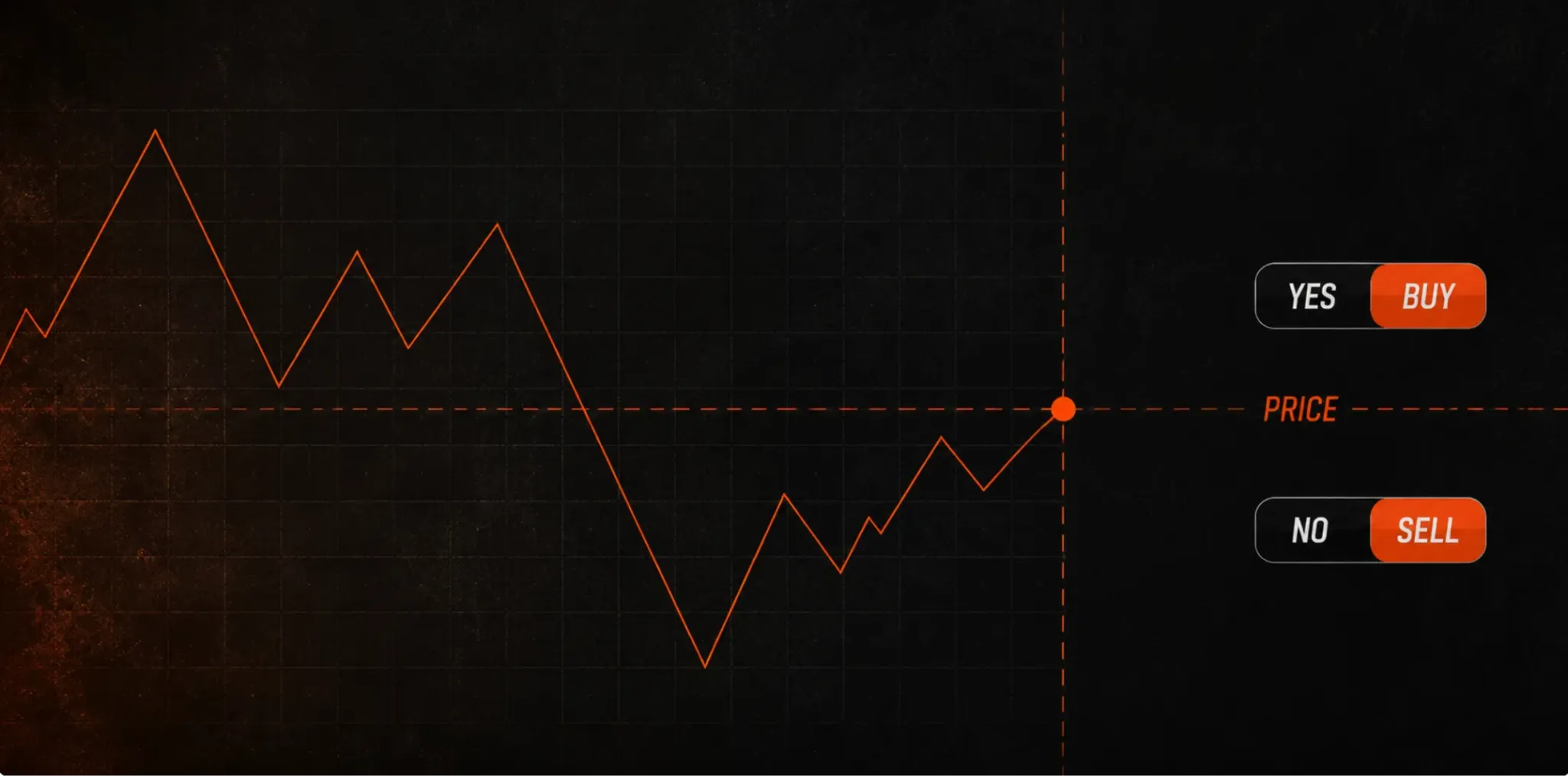
How to trade cryptocurrencies on prediction markets
Cryptocurrency markets react to protocol upgrades, regulatory announcements, macroeconomic data and social media sentiment round the clock.
Financials
By Nic Tse
If you want to take a position on where a crypto asset's price will land by a specific time, without buying or selling the asset itself, prediction markets let you do just that.
Instead of holding a token and watching its value drift, you trade an event contract that settles on one simple question: did the stated event happen, or didn't it?
This article is for informational purposes only and should not be construed as financial or investment advice. Past performance does not guarantee future results.
What are crypto prediction markets?
A crypto prediction market is a marketplace where traders buy and sell event contracts tied to certain outcomes. Every contract asks a specific, verifiable question; for example, whether a particular crypto asset will be above a certain price threshold by a given date.
These markets differ from spot or derivatives exchanges. Rather than buying a token and profiting from price movements, a trader purchases an event contract that settles as either ‘Yes’ or ‘No’. The outcome is binary: one side pays out and the other expires worthless.
That binary structure means the market is judging whether a defined event occurs, not tracking every tick of an asset's price.
The event contract has a fixed payout, a defined maximum loss and a clear resolution date, all known before you place the trade.
How crypto event contracts work
Every contract trades on a scale between $0 and $1 and that price reflects the market's current view of how likely the stated outcome is.
Take a contract asking ‘Will BTC be above $X by a certain date?’; if it'sit it’s trading at 30%, the market is pricing in roughly a 30% chance that the event will happen, meaning the contract is trading at $0.30.
Three quick examples:
20% = $0.20 per contract → roughly a 20% implied probability
65% = $0.65 per contract → roughly a 65% implied probability
90% = $0.90 per contract → roughly a 90% implied probability
Winning contracts pay $1 each; losing contracts expire worthless (payout structures can vary by platform, so it's worth checking the rules before you trade).
That $1 payout is what makes the math on entry price so direct: buy at $0.20 and a correct call nets $0.80 in profit; buy at $0.90 and a correct call nets just $0.10 – a smaller reward, because the market already sees that outcome as likely.
The flip side of that math is your risk. Since the most you can lose is the price you paid, your downside is fixed the moment you enter the trade.
A $0.30 contract caps your loss at $0.30 per contract, full stop.
One caveat: A contract's price reflects crowd positioning, not a guarantee. Prices can move fast on new information – an exchange listing, a protocol incident, a regulatory ruling, a surprise partnership – in either direction.
Crypto prediction markets vs. trading crypto on exchanges
The two come down to three real differences: what you're trading, how risk works and how the trade ends.
What you're trading
On a crypto exchange, you buy or sell the token itself. Its price can move in any direction, indefinitely. On a prediction market, you buy a contract tied to a specific outcome that resolves on a specific date.
How risk is structured
When you hold a crypto asset on an exchange, your potential loss is variable. The token could drop significantly; if you're using leveraged products such as futures, you may face margin calls or liquidation.
Binary event contracts work differently. Your maximum loss is capped at the price you paid for the contract. There are no margin calls and no liquidation risk on binary contracts. Your cost of entry is your total risk.
That's defined-risk trading in a nutshell: you know your worst-case loss before placing the trade.
How the trade ends
Crypto held on an exchange has no expiration. You can hold it as long as you want and its value moves continuously with the market.
An event contract, by contrast, has a defined resolution date. When that date arrives, the contract settles: either paying out or expiring worthless, depending on the outcome. Settlement structure is platform-dependent, so reviewing a platform's rules before trading is a good practice.
Crypto exchange
Crypto prediction market
Instrument
Token (the asset itself)
Event contract (yes or no)
Price movement
Continuous, no fixed endpoint
Binary outcome at resolution
Risk structure
Variable; potential margin or liquidation on leveraged products
Capped at contract price paid
Settlement
No automatic settlement
Resolves on a set date
Maximum loss
Potentially entire position (or more with leverage)
Contract purchase price
The binary ‘yes or no’ contract
Crypto event contracts are, for now, almost always binary yes/no contracts. Each is tied to a specific price threshold.
Example: ‘Will ETH be above $Y on a given date?’
A trader who believes the event will happen buys a ‘Yes’ contract. A trader who believes it won't, buys a ‘No’ contract.
Some prediction market platforms also offer multi-outcome or range-based contracts. For crypto price outcomes specifically, binary yes/no is what you'll find most often, including on OG.com.
Most platforms follow a similar path from sign-up to your first trade. You register and verify your identity, which regulated platforms require.
You then fund the account using whatever payment methods that platform accepts. You browse for event contracts tied to the crypto outcome you have a view on, then read the contract's exact question, resolution date, settlement rules and fees before committing.
From there, you choose a ‘Yes’ or ‘No’ position, set how many contracts you want and confirm the trade.
After that, you monitor the position as the price moves, holding until resolution or exiting early if the market has enough liquidity to support it.
Trade crypto prediction markets on OG.com
With OG.com, you can trade event contracts on real-world outcomes across many cryptocurrencies.
Create an account: Open an account and complete sign-up, including identity verification. You can use our web or mobile platforms.
Browse crypto markets: Explore crypto markets across Bitcoin, Ethereum, XRP, and many more coins.
Review and trade: Compare the market price with your own view. Check the rules, fees, and settlement details before opening a position.
Monitor your position: After trading, your contract appears in your open positions, where you can track price movement as new information comes in.
Every crypto event contract has two possible endpoints: hold it until resolution or exit the position early.
Settlement at resolution
When the contract reaches its resolution date, it settles based on whether the stated event occurred. If you hold a ‘Yes’ contract and the event has happened, the contract would paypays $1. If the event didn't happen, the contract expires without any payout.
The same logic applies in reverse for ‘No’ contracts. Payout structures can vary by platform, so reviewing the specific settlement rules before trading is important.
Early exit
You don't have to hold a contract until it resolves. If the market has enough liquidity, you can sell your position early, locking in a profit or limiting a loss based on how the price has moved since you bought it.
In markets with deep liquidity (many active buyers and sellers), exiting tends to be straightforward. In thin markets, you may need to accept a less favorable price or wait for more trading activity to show up.
Risk, reward and position sizing
A $0.80 contract carries a higher cost of entry (and therefore, a higher maximum loss) than a $0.20 contract, even though the $0.80 contract reflects a higher implied probability of the event occurring.
What to think about before sizing a position:
Maximum loss per contract: If you buy a contract at $0.40, your maximum loss is $0.40 per contract. Multiply that by the number of contracts to understand your total exposure.
Liquidity: If you plan to exit early rather than hold to resolution, consider whether the market has enough trading activity to support your exit. Thin liquidity can make it harder to sell at an attractive price.
Price movement: Contract prices fluctuate as new information and sentiment enter the market. A position that looks good at entry can move against you before resolution.
Consider how much of your trading account you're comfortable risking on a single contract or set of contracts. Trading involves risk and no outcome is guaranteed regardless of where a contract is priced.
Crypto prediction market: glossary of terms
Event contract
Pays out based on whether a specific, verifiable event occurs. In crypto prediction markets, that's usually a price threshold reached by a set date.
Binary contract (yes/no)
An event contract with two possible outcomes: it pays out if the event occurs, or expires worthless if it doesn't.
Contract price (market price)
The current trading price of a contract, between $0 and $1. It reflects the market's collective view of how likely the event is, not an objective probability, and shifts as traders buy and sell.
Implied probability
The likelihood suggested by a contract's price. A contract at $0.45 implies roughly a 45% chance the event happens.
Settlement
How a contract resolves at expiration. Winning contracts typically pay $1. Losing contracts expire worthless.
Rules can vary by platform.
Defined risk
A trade where the maximum possible loss is known upfront. For binary contracts, that's simply the price you paid.
Liquidity
How much trading activity a market has. Deep liquidity (many buyers and sellers) makes it easier to enter or exit and thin liquidity can make trading harder and affect your exit price.
Early exit
Selling a contract before its resolution date, provided there's enough liquidity, to lock in a profit or limit a loss without waiting for settlement.
Payout
What you receive when a contract settles in your favor. For binary contracts, that's usually $1 per contract, though this can vary by platform.
FAQs about crypto prediction markets
What is a crypto prediction market?
A crypto prediction market is a marketplace where traders buy and sell event contracts tied to cryptocurrency outcomes. Each contract settles based on whether a specific event – such as a crypto asset reaching a defined price threshold – occurs by a set date.
How is trading crypto on a prediction market different from buying crypto on an exchange?
On an exchange, you buy the asset itself and profit or lose from its continuous price movement. On a prediction market, you buy an event contract with a defined outcome, a set resolution date and a maximum loss capped at the price you paid. There are no margin calls or liquidation on binary contracts.
Do prediction markets run on crypto?
Some prediction markets operate on blockchain networks, while others are centralized, regulated platforms. The structure varies by platform. Not all prediction markets that offer crypto-related event contracts are themselves built on blockchain technology.
How does contract pricing reflect probability on crypto prediction markets?
Contracts trade between $0 and $1. A price of $0.30 can be read as roughly a 30% implied probability that the event occurs. Prices shift as traders buy and sell based on new information and sentiment. The market price reflects collective trading activity, not an objective probability.
What types of crypto event contracts can you trade?
The most common type is the binary yes/no contract, which is tied to whether a crypto asset will be above or below a specific price threshold by a set date. One side pays out, the other expires without any payout or value. Available contract types can vary by platform.
Can you exit a crypto prediction market trade early?
Yes, if there's enough liquidity in that market. You can sell your contract before the resolution date to lock in a profit or limit a loss. In markets with thin liquidity, exiting early may be harder and you might not get the price you want.
What happens when a crypto event contract settles?
At the resolution date, the contract settles based on whether the stated event occurred. Winning contracts typically pay $1 each; losing contracts expire worthless. Payout structures can vary, so reviewing settlement rules before trading is important.
Are crypto prediction markets regulated in the US?
Yes, at the federal level. Prediction markets operate as event contracts under Commodity Futures Trading Commission (CFTC) oversight, usually listed on CFTC-registered Designated Contract Markets (DCMs), the same regulatory structure used by traditional U.S. futures exchanges.
That framework is actively evolving: in June 2026, the CFTC proposed rule changes to how event contracts are reviewed and listed. Rules can still vary by state and platform, so it's worth confirming a platform's current regulatory status and your state's availability before trading.
What does defined-risk mean in crypto prediction market trading?
It means your maximum possible loss is known before you place the trade. With binary event contracts, the most you can lose is the contract price you paid. There are no margin calls and no liquidation risk, unlike leveraged crypto futures products.
How do you choose a timeframe for a crypto event contract?
Each event contract has a set resolution date. The timeframe is built into the contract itself. Consider how long you're comfortable holding a position and whether you may want the option to exit early.
Important Information: Prediction is an event contract that is a derivatives product offered by North American Derivatives Exchange, Inc. (NADEX), a CFTC-regulated exchange, which does business under the brand OG.com Prediction Markets (OG) Crypto.com | Derivatives North America and uses a CFTC-regulated exchange that uses OG.com technology.
Trading on OG.com involves risk and may not be appropriate for all. By trading you risk losing your cost to enter any transaction, including fees. You should carefully consider whether trading on OG.com is appropriate for you in light of your investment experience and financial resources. Any trading decisions you make are solely your responsibility and at your own risk.