ECB rate decision predictions: how to trade the ECB result
An ECB hold, cut, or hike can look obvious until one inflation report changes the market.
Financials
By Barbara Pazur
After the European Central Bank (ECB) held rates in July, attention shifted to the next ECB meeting date in September. Markets are weighing whether cooling inflation is enough to revive ECB rate cut expectations, or whether wage growth, services inflation, and eurozone growth data keep the central bank on hold.
Economist forecasts give one view of the ECB interest rate outlook. Prediction markets show another by turning those expectations into contracts tied to specific outcomes.
On OG, you can follow the ECB rate decision event contract for September, compare price movement with the latest ECB rate preview, and watch whether the market is bracing for a consensus result or a surprise.
This guide explains the current ECB interest rate forecast, the meeting schedule, the macro data shaping expectations, and how event-driven traders think about priced-in outcomes before the decision.
This article is for informational purposes only and should not be construed as financial or investment advice. Past performance does not guarantee future results.
What is the ECB rate decision, and how does this work?
The ECB sets interest rates for the 20 countries that use the euro. Markets tend to react most when the next ECB interest rate decision differs from what traders expected.
The rate markets tend to watch most closely is the deposit facility rate. It helps set the tone for short-term borrowing costs, bond yields, currency markets and the broader cost of money across the eurozone.
Each ECB rate decision usually falls into one of three buckets: a hold, a hike, or a cut.
ECB meeting schedule 2026
The ECB meeting schedule gives traders the event calendar. The repricing usually happens between those dates.
The ECB’s official calendar lists the remaining 2026 monetary policy meetings as September 9–10, October 28–29 and December 16–17. Each monetary policy meeting is followed by a press conference.
Meeting
Status
Why it matters
July 22–23, 2026
Completed
The ECB held rates, making July useful as a resolved market example.
September 9–10, 2026
Next scheduled decision
The next ECB meeting date for forward-looking rate pricing.
October 28–29, 2026
Scheduled
A later checkpoint if September doesn’t settle the policy debate.
December 16–17, 2026
Scheduled
The final 2026 meeting, often important for year-end policy expectations.
The next ECB meeting date is September 9–10, 2026, when the rate decision and press conference are scheduled. That makes September the main focus for the current ECB interest rate forecast.
The July meeting reset the baseline. The ECB chose to hold rates after its previous increase, leaving the deposit facility rate at 2.25%. That confirmed the current rate context traders are using when they price the September outcome.
Between July and September, the market will have several chances to revise its ECB rate decision prediction. Softer inflation can lift ECB rate cut expectations. Hotter services inflation, stronger wage data or another energy shock can support ECB rate hike expectations or keep the market anchored around a hold.
For event-driven markets, the schedule shows where uncertainty can narrow, widen or flip. The earlier a consensus forms, the more important surprise risk becomes.
ECB rate preview on prediction markets
On prediction markets, ECB rate decisions are reflected in contract prices. This means a contract is trading at 70¢, that can be read as roughly a 70% market-implied chance of that outcome – subject to the specific market rules.
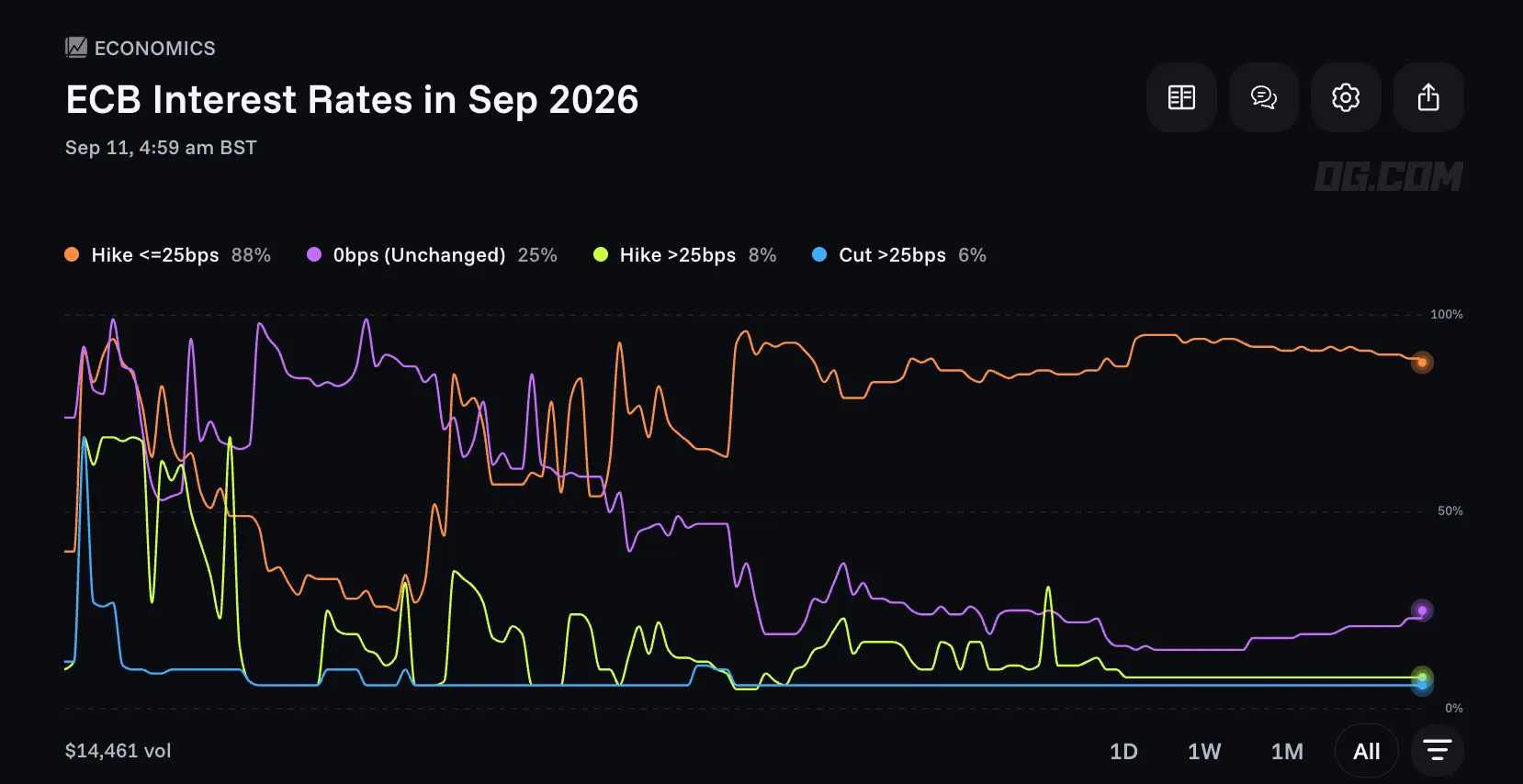
For example, on OG.com the event contract for September ECB interest rate decision reflect the following implied probabilities (as of the time of writing):
Hike <=25bps: 88%
0bps (Unchanged): 25%
Hike >=25bps: 8%
Cut >25bps: 6%
The market is scheduled to close on September 11, 2026, after the September 9–10 ECB meeting. The pricing shows where traders are leaning before the decision.
Market data as of 10 August. For the latest implied probabilities, check the OG.com platform.
Settlement comes down to the deposit facility rate. OG.com’s ECB markets resolve based on the change in basis points relative to that rate before the meeting, using the ECB’s published rate data as the official source.
That keeps the contract focused on the actual ECB interest rate decision. ECB officials may signal a later hike or cut, and those comments can still move the ECB interest rate outlook. But for this market, the result is the defined rate change at the meeting.
ECB interest rate forecast according to economists
The near-term ECB interest rate forecast now leans toward September. Economists and rates traders see a hike as more likely than a cut.
A Reuters poll taken before the July meeting found that 52 of 74 economists expected one more ECB rate hike in 2026, most likely in September. That was about 70% of respondents, up from roughly 60% in the previous poll.
After the July hold, Reuters reported that traders and economists were aligned around a possible September hike, while markets were pricing in two more hikes by early 2027.
The ECB hasn’t committed to a September hike. It held rates in July and said future interest rate decisions will depend on the inflation outlook, incoming economic and financial data, underlying inflation and how strongly earlier rate moves are feeding through to the economy.
Bank forecasts, rates markets and prediction markets all watch inflation, wages, growth, energy prices and ECB guidance. They can still disagree because they weigh those signals differently.
A bank forecast may focus on what the ECB is likely to do over the next few meetings. Rates markets can reflect the full expected policy path. An OG contract asks whether a specific rate outcome happens at a specific meeting, under the market rules.
A hawkish ECB interest rate outlook doesn’t guarantee a September hike. The broader policy path can lean tighter while one meeting stays uncertain. That’s why the price of each event contract can still move as inflation, wage, energy and growth data come in before the decision.
What macro factors are shaping the ECB interest rate outlook?
ECB rate decisions usually move around four macro factors. Traders watch each new data release for signs that inflation pressure is easing, holding steady or building again.
Energy prices
Energy can change the ECB interest rate outlook quickly because it feeds into fuel, transport, heating, production costs and household budgets.
If higher oil, gas or electricity costs stay contained, the ECB has more room to wait. If they spread into wages and business pricing, ECB rate hike expectations can strengthen before the next decision.
After the July meeting, the ECB said it was monitoring the size and persistence of the energy price increase, including how it could feed into prices, wages, inflation expectations and the broader economy.
The ECB also warned that a larger or more persistent energy price increase could push broader inflation higher through indirect and second-round effects. Chief economist Philip Lane later described the energy-driven inflation shock as “medium-sized,” not a 2022-style emergency, but still something the ECB would review meeting by meeting.
Inflation data
Inflation tells traders whether the ECB is moving closer to its target or still has more work to do. Softer inflation can weaken ECB rate hike expectations and make a hold look more likely. Inflation above target makes the cut case harder unless the broader economy also weakens.
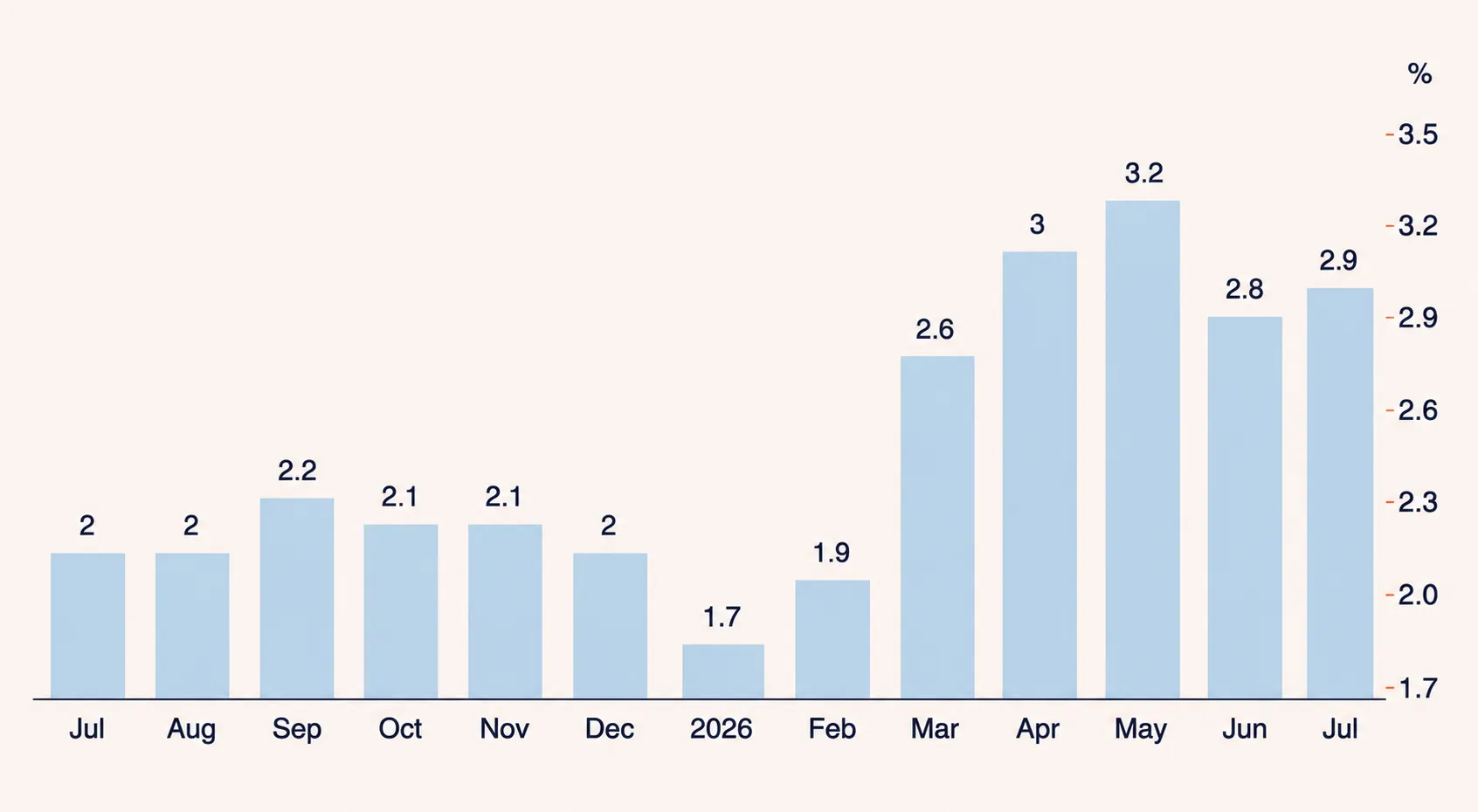
Euro area annual inflation was 2.8% in June 2026, down from 3.2% in May but still above the ECB’s 2% target. In July, the inflation rate increased slightly to 2.9%. Services, energy, food, alcohol and tobacco and non-energy industrial goods all contributed positively to inflation.
Wage growth can keep services inflation sticky. When pay rises, households may have more room to spend, while businesses with higher labor costs may raise prices. That can make inflation slower to cool, even when energy or goods prices improve.
After the July meeting, the ECB said wage growth was moving in the direction it had expected. Compensation per employee had slowed from 3.8% to 3.5%, and the ECB said its wage tracker and negotiated wage data were also useful signals for where wage pressure may go next.
If wage pressure cools, a hold can look easier to defend. If wages stay stronger than expected, ECB rate hike expectations can gain support.
Growth data
Growth data shows how much tightening the eurozone economy can absorb. Weak GDP, softer PMIs or tighter bank lending can make another hike harder to justify. Stronger growth gives the ECB more room to focus on inflation.
For traders, stronger growth can support a higher-for-longer or hike-leaning read if inflation stays above target. Weaker growth can push the market toward a hold or, if the slowdown is sharp enough, revive ECB rate cut expectations.
How to trade ECB interest rate decision on OG
Create an account:Sign up online or download the OG app, then complete the required account setup.
Browse markets: Explore markets across economics, including the ECB interest rate decisions.
Review the contract: Check the price, rules, fees, settlement source and potential payout before opening a position.
Monitor your position: Follow price movement and new information that may affect the market before settlement.
The ECB usually publishes its rate decision at 2:15 PM CET (that’s 8:15 AM EDT), followed by a press conference at 2:45 PM CET (8:15 AM EDT).
When is the next ECB meeting?
The next ECB meeting is scheduled for September 9–10, 2026. The ECB interest rate decision is expected on September 10, 2026.
Will the ECB cut interest rates?
A cut isn’t the main expectation right now. Inflation has cooled, but it remains above the ECB’s 2% target, which makes ECB rate cut expectations harder to support.
Will the ECB raise interest rates?
A hike is still possible. Economists and rates markets have been leaning toward a possible September hike, but the ECB has said its next move will depend on incoming inflation, wage, growth and energy data.
What are markets expecting from the ECB?
Markets are expecting the ECB to stay cautious. The current ECB interest rate outlook leans more toward a possible hike or hold than a cut.
What do prediction markets say about the ECB?
Prediction markets show how traders are pricing specific ECB rate outcomes. On OG.com, traders can follow contracts tied to whether the ECB holds, hikes or cuts at a scheduled meeting.
How are prediction markets pricing the next ECB meeting?
On.com OG.com the event contract for September ECB interest rate decision is pricing 88% for a rate hike up to 25bps. Traders are pricing a rate hold at 25%, a hike above 25bps at 8%, and a rate cut up to 25bps at 6%.
What was the most recent confirmed ECB rate decision?
The most recent confirmed ECB rate decision was a hold on July 23, 2026. The ECB left the deposit facility rate at 2.25%.
How often does the ECB meet to decide on interest rates?
The ECB usually holds monetary policy meetings every six weeks. These are the meetings where it reviews inflation, growth, financial conditions and interest rates.
Important information: Prediction is an event contract, a derivatives product offered by North American Derivatives Exchange, Inc. (NADEX), a CFTC-regulated exchange doing business under the brand OG.com Prediction Markets, which uses OG.com technology. Trading on OG.com involves risk and may not be appropriate for all; you risk losing your cost to enter any transaction, including fees. Any trading decisions are solely your responsibility and at your own risk.