Best baseball (MLB) cards and packs to rip in 2026
Following a player from the minor leagues to their first Major League appearance gives baseball collecting its own season-long storyline. You might start with a prospect card, add their official rookie card and eventually find a signature that earns a permanent place in your collection.
Rips
By Claire Williamson
The best baseball card packs to buy depend on which part of that story interests you. Bowman Baseball focuses on prospects, Topps Chrome offers reflective designs and rookie signatures, and Topps Series 1 and Series 2 give collectors a broad snapshot of the game.
The set name is only the starting point. Box formats can contain different cards, exclusive parallels and autograph counts, so it helps to know what you’re opening before the first reveal.
What are the best baseball cards to rip in 2026?
A favorite player can make an ordinary base card a keeper. For collectors interested in early career appearances, signatures or scarce versions, these four categories offer useful places to start.
Bowman 1st prospect cards
Prospect collecting lets you follow a player before they become an established Major Leaguer. Their development becomes part of the collecting experience, whether you’re watching minor league results or waiting for their first call-up.
A 1st Bowman marks a player’s first Bowman prospect appearance, usually before their official Major League Baseball (MLB) rookie card. Look for the ‘1st’ designation, then use Bowman’s official card list for that release to identify the version you have.
The 2026 release includes paper and Chrome prospect cards, with signed 1st Bowman cards among its autograph content. Those versions are separate collectibles: A paper card and a numbered Chrome autograph can feature the same player but have very different supplies and collector demand.
Rookie autograph cards
Baseball rookie cards capture a player’s arrival in MLB. A certified signature adds another connection to that moment, particularly when you’ve followed the player’s progress.
Topps Chrome Baseball’s 2026 autograph lineup includes on-card signatures from the rookie class. An on-card autograph is signed directly on the card, while a sticker autograph uses a signed label attached to it.
Check the signer list as well as the advertised autograph count. A box containing an autograph doesn’t necessarily promise a rookie signature, a numbered version or a particular player.
Topps Chrome refractors and numbered parallels
Refractors give Chrome cards their reflective appearance. Parallels offer alternative versions of a card through different colors, patterns or finishes.
Some carry a serial number identifying the stated print run. A card stamped 12/50, for example, is numbered 12 in a run of 50 for that specific version. The same player may also appear on a base card and several other parallels.
The box format can affect which versions are available. For 2026 Chrome Baseball, Mega boxes feature exclusive X-Fractors, while Jumbo boxes include a Wave Refractor family. That’s useful to know if you’re collecting a particular finish or building a player’s parallel collection.
Rare inserts and memorabilia cards
Inserts introduce designs and themes outside the main base set. Some appear regularly; others have a much more limited distribution.
The 2026 Chrome lineup includes Helix, Ultraviolet and World Series at Night, alongside additions such as Diamond Moments. Rare Gold Logoman content includes relic, autograph and autograph-relic cards connected to winners of MLB’s major 2025 awards.
Memorabilia cards contain material such as a jersey swatch. The authentication wording explains what that material represents, so read it before assuming a piece was game-used or connected to a specific occasion.
Which baseball card sets are worth opening in 2026?
The best baseball cards for your collection won’t necessarily come from the most expensive box. Compare the player checklist, the designs you enjoy and the advertised contents before deciding which type of pull suits you.
2026 Topps Chrome Baseball
2026 Topps Chrome Baseball combines a 300-card base set with refractors, inserts and signatures. It offers several ways to collect Major League players, from a straightforward rookie card to a numbered autograph parallel.
Its Hobby, Jumbo and Delight formats offer different opening experiences:
Chrome format | Packs per box | Cards per pack | Advertised autograph content |
Hobby | 20 | 4 | One autograph per box |
Jumbo | 12 | 11 | Two autographs per box |
Delight | 1 | 12 | Two autographs per pack |
Configurations apply to the 2026 release.
Hobby gives you more individual packs to open. Jumbo includes more cards overall and an additional autograph, while Delight puts its content into a single pack.
The purchase price and signer checklist belong in that comparison, too. More autographs don’t automatically mean more desirable cards or better value.
2026 Bowman Baseball
2026 Bowman Baseball puts prospect collecting at the center of the opening. It combines a 100-card base set of MLB players and rookies with a 150-card prospect set, giving collectors players at different stages of their careers.
Hobby and Jumbo differ in both card volume and autograph content:
Bowman format | Packs per box | Cards per pack | Advertised autograph content |
Hobby | 20 | 8 | One autograph per box |
Jumbo | 12 | 28 | Three autographs per box |
Configurations apply to the 2026 release.
Bowman can appeal to collectors who enjoy learning about emerging players and following their development. That story can take years to unfold, and a promising prospect’s early card doesn’t guarantee a successful MLB career.
Pay attention to the full product name when comparing boxes. Bowman Baseball includes Chrome prospect cards, but it’s a separate release from Bowman Chrome Baseball.
2026 Topps Series 1 and Series 2
If you enjoy sorting cards, filling binder pages and collecting players across the league, the flagship releases provide a different focus.
Series 1 and Series 2 each feature a 350-card base set, including stars and rookies alongside categories such as Future Stars and League Leaders. Check both lists to see where your favorite players appear.
Signatures and memorabilia add to the opening, but the Hobby boxes advertise one autograph or relic. That means you might pull a memorabilia card instead of a signature.
For anyone comparing the best baseball card packs to buy for autographs, be aware that a set can contain autograph cards without every box format promising one.
What makes a baseball card rare or valuable?
Scarcity describes how limited a card is. Value also depends on whether collectors want it and how well the individual copy has been preserved.
Two cards of the same player can have vastly different values. One might be a widely available base card, while another carries a certified autograph and a low serial number. Identifying the exact version comes before comparing prices.
Detail | What to check |
Card identity | Year, manufacturer, set, player and card number |
Version | Base card, parallel, image variation, autograph or memorabilia card |
Scarcity | Serial numbering and published distribution information |
Condition | Corners, edges, surface and centering |
Sales history | Completed transactions for the same version in similar condition |
Completed sales provide a more useful reference than asking prices. A listing shows what a seller hopes to receive; a completed transaction shows what a buyer paid.
The condition needs to match closely, too. A highly graded copy isn’t a direct comparison with an ungraded card that has visible surface damage.
If you want one specific collectible, compare buying that card directly with opening baseball card packs. Opening gives you the thrill of discovering the contents, without promising the card you’re looking for.
Bowman vs. Topps Chrome: What’s the difference?
Bowman Baseball emphasizes prospects, while Topps Chrome Baseball focuses on Major League players and rookie cards. Both include reflective cards and autographs, so the Topps checklist is the clearest place to understand their different collecting roles.
Question | Bowman Baseball | Topps Chrome Baseball |
What’s the main focus? | Prospects alongside MLB players and rookies | MLB players, rookies and legends |
What’s a key early-career collectible? | The 1st Bowman prospect card | The MLB rookie card and rookie autograph |
What’s the appeal? | Following players before they establish themselves in MLB | Collecting Major League players across Chrome designs and parallels |
What should you verify? | The 1st Bowman designation and exact version | The rookie designation, parallel and format availability |
You can collect both stages of a player’s career. An early prospect card and a later MLB rookie card represent different moments, which can make them complementary parts of the same collection.
What are the chances of pulling an autograph or rare parallel?
Box contents and pack-level pull rates tell you different things. A box description explains its advertised configuration, while a pull rate describes how frequently a particular category appears within a stated format.
A hypothetical rate of 1:100 packs means approximately one qualifying card per 100 packs across that distribution. It doesn’t mean every hundredth pack contains one or that opening 100 packs guarantees a hit.
When comparing published rates, check:
- The format. Hobby, Jumbo and retail packs can have different distributions.
- The category. An autograph group may contain many players, rather than one specific signer.
- The version. A base autograph and its numbered parallels can have separate entries.
Topps publishes format-specific information for products such as 2026 Bowman Baseball. Its production notes also explain that published configurations reflect the intended contents and that actual contents may vary.
Serial numbering answers a separate question. A /25 stamp identifies the stated print run of that card version; it doesn’t tell you the chance of finding it in a particular pack.
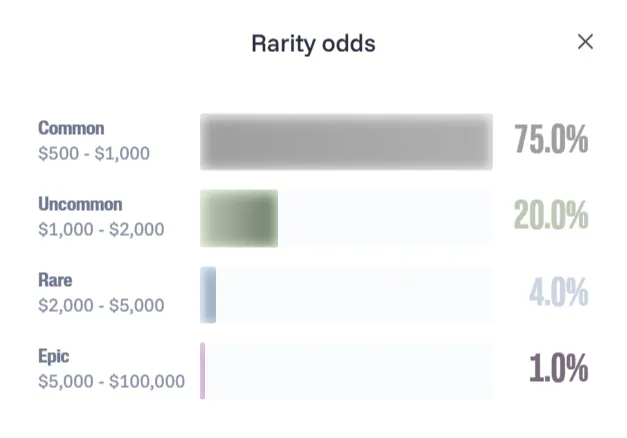
See how the rarity scale works with the example below on an OG.com MLB Eternal Rips card pack:
How to rip baseball cards on OG.com
With OG.com Rips, you can reveal a physical baseball collectible online, then choose delivery or the available cash buyback.
Here’s how it works:
- Explore the available baseball Rips. Check the price, possible cards and displayed chances.
- Choose your pack. Review the details for that specific product before completing your purchase.
- Reveal your card. Open it online and view your collectible in your Vault.
- Choose delivery or buyback. Review the offer and make your decision within the deadline shown for your purchase.
The manufacturer’s pull rates for sealed Topps or Bowman packs don’t apply to our Rips packs. The available cards can also change, so check the current selection rather than assuming every set discussed here is included.
A revealed card can be worth less than the pack’s purchase price.
You can explore baseball card packs on OG.com Rips or learn more about how online card ripping works.
FAQs about the best baseball (MLB) card packs to rip
What are the best baseball card packs to buy in 2026?
Bowman Baseball focuses on prospects and 1st Bowman cards. Topps Chrome offers MLB rookies, refractors and signatures, while Series 1 and Series 2 support broader set building. Compare the checklist, box configuration and price with what you enjoy collecting.
What baseball cards are worth money?
Sought-after rookie cards, 1st Bowman cards, certified autographs and scarce parallels can attract buyers. The exact version, condition and demand affect value. Recent completed sales for comparable cards provide a useful starting point.
What are the best baseball card packs for autographs?
Among the formats covered here, 2026 Bowman Jumbo advertises three autographs per box. Topps Chrome Jumbo and Delight each advertise two. Compare the signer lists and prices alongside those counts, since more signatures don’t necessarily mean greater value.
What is a Bowman 1st baseball card?
A 1st Bowman marks a player’s first Bowman prospect appearance, usually before their official MLB rookie card. Look for the designation and check whether you have a paper, Chrome, autograph or parallel version.
How can I tell if a baseball card is valuable?
Identify the year, set, card number and version, then inspect its condition. Compare completed sales for the same card in similar condition. Features such as an autograph or low serial number help identify the collectible but don’t establish its price alone.
Are rookie baseball cards worth collecting?
Rookie cards can be enjoyable records of a player’s early MLB career, especially when you follow that player or team. Many are widely available, so their appeal as collectibles doesn’t necessarily mean they’ll increase in value.
OG.com Rips is offered by OGMUS, subject to Terms and Conditions; 18+ only. OG.com Rips is not regulated by the CFTC. Images shown do not represent a typical result. OGMUS also provides access to third-party services.
Third-party brand owners are not parties to card sales through OG.com Rips.